
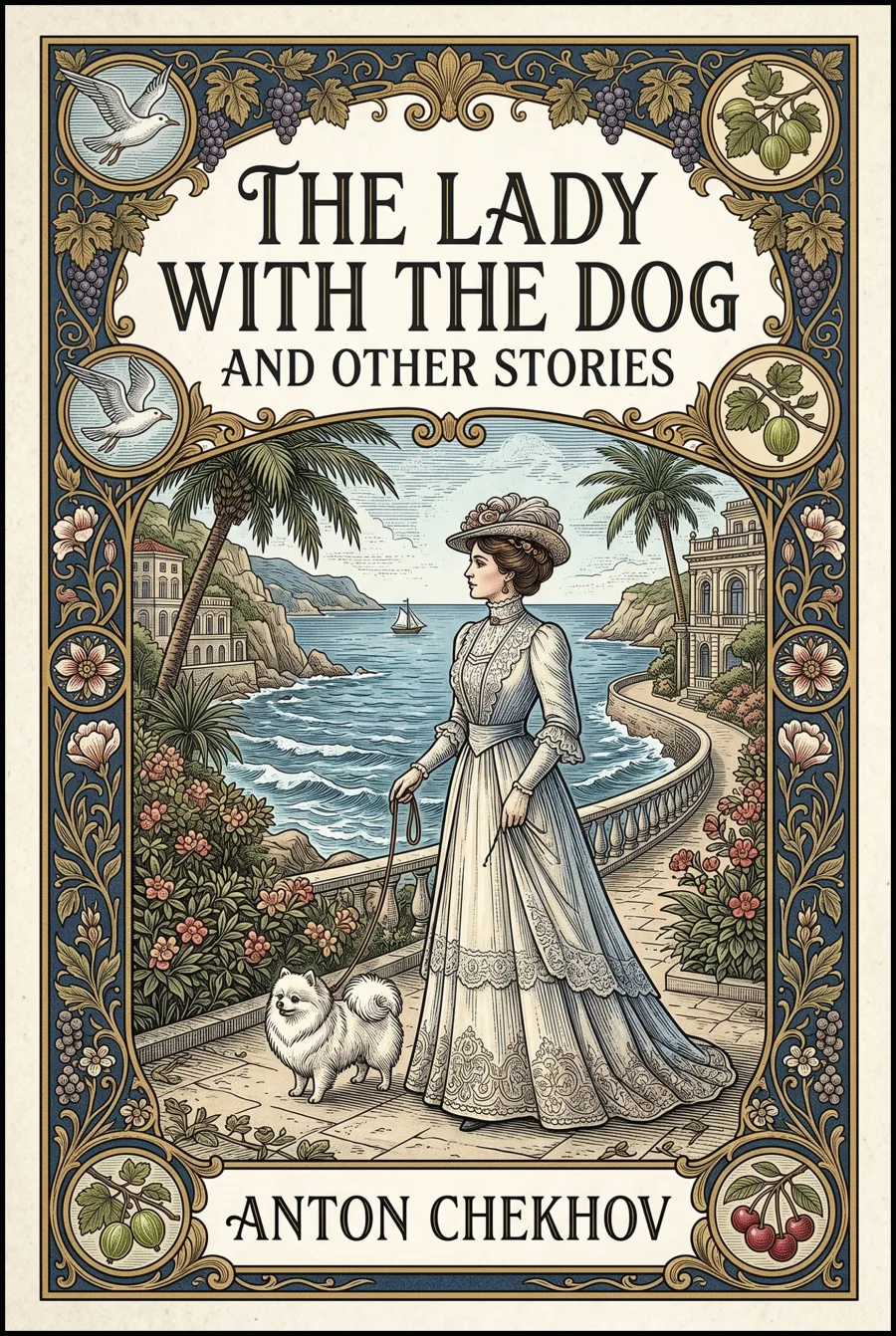
The Lady with the Dog and Other Stories
eBook
• INR 51.00
• English
• 9788169359221
No ratings yet
| Publisher | General Press |
|---|---|
| ISBN13 | 9788169359221 |
| ASIN/SKU | 8169359228 |
| Book Format | eBook |
| Language | English |
| List Price | INR 51.00 |
| Subject Code | FIC029000, FIC025000, FIC027050 |
| Publishing Date | 01/09/2026 |
| Book Code | BD00070232 |
Buy this Book
Amazon Stores
Ebook Stores
Other Stores
Discover The Lady with the Dog and Other Stories by Anton Chekhov. This book is published by General Press in eBook format, ISBN 9788169359221, ASIN 8169359228, under Literature and Fiction, Short Stories and Anthologies, Psychological Fiction.
Book Description
What happens when ordinary people suddenly find themselves caught between the lives they have built and the feelings they cannot ignore? 'The Lady with the Dog and Other Stories' by Anton Chekhov is a classic collection of literary fiction and short stories that explores love, loneliness, regret, social expectations, and the quiet struggles hidden beneath everyday life.
The collection brings together some of Chekhov's most memorable stories, including the famous “The Lady with the Dog,” in which Dmitri Gurov, a married man accustomed to casual romantic affairs, meets Anna Sergeyevna while vacationing in Yalta. What begins as a brief encounter unexpectedly develops into a relationship that affects both of them far more deeply than they anticipated. Their growing attachment forces them to confront the gap between outward appearances and their private emotional lives.
Across the other stories, Chekhov turns his attention to people from different walks of life, revealing their hopes, disappointments, weaknesses, and moments of unexpected courage. His characters often struggle with unhappy marriages, unfulfilled ambitions, social pressures, isolation, or the painful realization that life has not turned out as they once imagined. Rather than offering simple judgments, Chekhov presents these experiences with compassion, subtle humor, and psychological insight.
What makes the collection so powerful is its simplicity. Small conversations, brief encounters, and seemingly ordinary situations gradually reveal complicated emotional truths. Chekhov's writing captures the uncertainty of human relationships and the choices people make when happiness seems just beyond reach. For readers interested in timeless literary fiction and deeply human storytelling, 'The Lady with the Dog and Other Stories' offers a quietly moving collection whose characters may stay with you long after the final page.
The collection brings together some of Chekhov's most memorable stories, including the famous “The Lady with the Dog,” in which Dmitri Gurov, a married man accustomed to casual romantic affairs, meets Anna Sergeyevna while vacationing in Yalta. What begins as a brief encounter unexpectedly develops into a relationship that affects both of them far more deeply than they anticipated. Their growing attachment forces them to confront the gap between outward appearances and their private emotional lives.
Across the other stories, Chekhov turns his attention to people from different walks of life, revealing their hopes, disappointments, weaknesses, and moments of unexpected courage. His characters often struggle with unhappy marriages, unfulfilled ambitions, social pressures, isolation, or the painful realization that life has not turned out as they once imagined. Rather than offering simple judgments, Chekhov presents these experiences with compassion, subtle humor, and psychological insight.
What makes the collection so powerful is its simplicity. Small conversations, brief encounters, and seemingly ordinary situations gradually reveal complicated emotional truths. Chekhov's writing captures the uncertainty of human relationships and the choices people make when happiness seems just beyond reach. For readers interested in timeless literary fiction and deeply human storytelling, 'The Lady with the Dog and Other Stories' offers a quietly moving collection whose characters may stay with you long after the final page.
Author Biography
Some writers entertain us, while others quietly change the way we see ordinary life. Anton Pavlovich Chekhov was a Russian short story writer, playwright, and physician whose works helped shape modern literature and theatre. Best known for masterpieces such as 'The Seagull', 'Uncle Vanya', 'Three Sisters', 'The Cherry Orchard', and “The Lady with the Dog,” he became celebrated for his subtle understanding of human nature.
Born on January 29, 1860, in Taganrog, Russia, Chekhov grew up in a financially troubled family. He moved to Moscow in 1879 and studied medicine, qualifying as a physician in 1884. To support himself and his family while studying, he wrote humorous sketches for newspapers and magazines. Over time, his writing became more serious and thoughtful, and 'The Steppe', published in 1888, brought him major recognition and earned him the Pushkin Prize.
Chekhov’s literary style was remarkably simple on the surface but emotionally deep underneath. Instead of relying on dramatic plots or clear moral lessons, he focused on ordinary conversations, quiet disappointments, unspoken feelings, and the private struggles of his characters. His stories often blend humor with sadness, while his plays are known for their atmosphere, natural dialogue, and psychological depth. His collaboration with the Moscow Art Theatre and director Konstantin Stanislavski helped establish a new approach to realistic theatre.
Despite suffering from tuberculosis, Chekhov continued writing and practicing medicine for much of his life. He died in Badenweiler, Germany, on July 15, 1904, at the age of 44. His influence has reached generations of writers, actors, and directors, and his works continue to be translated, studied, and performed around the world. Anton Chekhov’s lasting legacy lies in his rare ability to find profound truth in the seemingly ordinary moments of human life.
Born on January 29, 1860, in Taganrog, Russia, Chekhov grew up in a financially troubled family. He moved to Moscow in 1879 and studied medicine, qualifying as a physician in 1884. To support himself and his family while studying, he wrote humorous sketches for newspapers and magazines. Over time, his writing became more serious and thoughtful, and 'The Steppe', published in 1888, brought him major recognition and earned him the Pushkin Prize.
Chekhov’s literary style was remarkably simple on the surface but emotionally deep underneath. Instead of relying on dramatic plots or clear moral lessons, he focused on ordinary conversations, quiet disappointments, unspoken feelings, and the private struggles of his characters. His stories often blend humor with sadness, while his plays are known for their atmosphere, natural dialogue, and psychological depth. His collaboration with the Moscow Art Theatre and director Konstantin Stanislavski helped establish a new approach to realistic theatre.
Despite suffering from tuberculosis, Chekhov continued writing and practicing medicine for much of his life. He died in Badenweiler, Germany, on July 15, 1904, at the age of 44. His influence has reached generations of writers, actors, and directors, and his works continue to be translated, studied, and performed around the world. Anton Chekhov’s lasting legacy lies in his rare ability to find profound truth in the seemingly ordinary moments of human life.
Editorial Reviews
Editorial Reviews will be added soon…
Book Summary
Anton Chekhov’s "The Lady with the Dog and Other Stories" is a collection that captures the quiet drama of ordinary human life with extraordinary psychological insight. Chekhov does not usually depend on spectacular events, heroic adventures, or neatly resolved conflicts. Instead, he focuses on moments when people suddenly recognize something important about themselves: a love they have denied, a marriage that has become empty, a dream that can no longer be recovered, or a life that has quietly passed them by. The title story, “The Lady with the Dog,” is perhaps his most famous exploration of unexpected love, but the other stories deepen the same concerns by examining loneliness, regret, social inequality, boredom, desire, compassion, and the difficulty of finding meaning. For readers searching for a 'The Lady with the Dog and Other Stories' summary, the collection is best understood as a compassionate portrait of people caught between the lives they have and the lives they secretly wish they could live.
“The Lady with the Dog” follows Dmitri Dmitrich Gurov, a married banker from Moscow who travels to Yalta, a fashionable resort town on the Black Sea. Gurov is already accustomed to affairs. He has been married for years, has children, and thinks of women as a source of temporary pleasure and escape from the boredom of domestic life. He does not initially expect his encounter with another married person to change him. At the resort, he notices a young woman walking with a small white dog. She is Anna Sergeyevna, a woman from the provinces who has come to Yalta alone while her husband remains elsewhere.
Gurov approaches Anna, and their relationship develops quickly. At first, he treats the affair much as he has treated previous romances. He is attracted to her beauty and enjoys the excitement of secrecy. Anna, however, is very different from the women he has casually pursued. She is inexperienced, emotionally vulnerable, and troubled by guilt. She repeatedly tells herself that she has behaved wrongly. Gurov initially views her distress with some detachment, but he gradually becomes emotionally involved.
After their brief relationship in Yalta, the two separate. Anna returns to her home, while Gurov goes back to Moscow. He expects life to return to normal, but something unexpected happens: he cannot forget her. At first, he attempts to continue his ordinary routine. He spends time with friends, attends social events, and returns to his family. Yet everything feels different. The life that once seemed normal now appears empty.
Gurov's transformation is one of the most important aspects of the story. He had always believed himself to be an experienced man who understood love and relationships. His affair with Anna initially seems like another temporary romance. Instead, he discovers that he has fallen genuinely in love. This realization frightens him because it forces him to acknowledge how superficial his previous life has been.
Eventually, Gurov travels to Anna's town and finds her at the theater. They meet secretly, and their relationship begins again. Anna still loves him, although she is tormented by the circumstances. They cannot openly live together because both are married. Their meetings therefore become hidden and fragmented. The story does not end with a conventional romantic resolution. Instead, Chekhov concludes with the realization that their situation is extraordinarily difficult and that the hardest part of their story is still ahead.
This unfinished ending is essential to the meaning of “The Lady with the Dog.” Chekhov does not turn love into a simple escape from reality. Love has awakened Gurov and Anna, but it has also made their existing lives impossible to accept. Before meeting each other, they were unhappy without fully understanding why. After falling in love, they understand their unhappiness but have no easy way to change their circumstances. Their love is therefore both a discovery and a problem.
The story's greatest strength is its subtle treatment of emotional transformation. Gurov does not suddenly become a different person. His change occurs gradually. He begins by thinking of Anna as another romantic encounter, but memories of her become increasingly persistent. He begins to see the shallowness of conversations and social rituals that once entertained him. Chekhov suggests that genuine feeling can expose the artificiality of an entire way of life.
Anna, meanwhile, represents a different kind of emotional conflict. She has internalized the moral expectations of her society and is deeply troubled by her own desires. She cannot simply enjoy the relationship because she experiences love and guilt simultaneously. Her struggle reflects the restrictive social environment in which women, especially married women, had limited freedom to pursue personal happiness.
Chekhov's treatment of marriage is equally subtle. Neither Gurov nor Anna is presented as completely innocent, but Chekhov does not reduce their affairs to simple moral lessons about adultery. Instead, he asks why people enter marriages and continue living inside relationships that have become emotionally empty. The problem is not merely that they break social rules. The deeper question is whether social respectability can conceal profound unhappiness.
The other stories in the collection broaden these themes. One recurring Chekhovian subject is the loneliness of people who are surrounded by others yet remain emotionally isolated. His characters may have families, colleagues, acquaintances, and social obligations, but they often lack someone with whom they can speak honestly. This emotional isolation creates much of the quiet sadness found throughout the collection.
In “The Darling,” Chekhov examines a woman whose identity is almost completely shaped by the people she loves. Olga Semyonovna, affectionately called “the darling,” repeatedly falls in love and adopts the interests, opinions, and worldview of the man in her life. When her husbands or companions disappear, she is left without a clear sense of herself. The story is both humorous and deeply sad because Olga's capacity for love is genuine, but she seems unable to exist independently.
Through Olga, Chekhov explores the question of personal identity. Is love supposed to complete a person, or can it erase individuality? Olga's willingness to devote herself completely to others appears admirable, yet it also leaves her vulnerable. She has little independent voice. Her opinions change according to the person she loves. Chekhov neither simply praises nor condemns her. Instead, he presents her with compassion and allows readers to see both the tenderness and tragedy of her personality.
“The Betrothed” explores another form of transformation. Nadya is a young woman living in a comfortable but emotionally restrictive environment. She is engaged to be married, but she gradually begins to question the life that has been planned for her. Her growing awareness leads her to leave home and pursue education and independence. The story is important because it presents awakening not through romantic love but through the recognition that a conventional future may not be enough.
Nadya's decision reflects a recurring Chekhov theme: the possibility of beginning again. His characters often reach moments when their existing lives become unbearable or meaningless. Yet Chekhov does not promise that change will be easy. Leaving an old life behind requires uncertainty and courage. The future may not be clearly defined, but the possibility of a more authentic life becomes more important than the comfort of remaining trapped.
Another recurring concern in Chekhov's stories is the gap between social appearance and inner reality. Characters often behave according to conventions because they fear what others will think. They may remain in unhappy marriages, tolerate humiliating jobs, pursue status, or suppress their feelings simply because those actions are considered respectable. Chekhov exposes this tension without turning his characters into caricatures.
His doctors, teachers, clerks, landowners, students, wives, husbands, and officials often want more from life but do not know how to achieve it. Some dream of happiness but remain passive. Others understand their problems but lack the courage to change. Still others make dramatic decisions only to discover that external change cannot immediately repair internal wounds.
A major reason these stories remain powerful is Chekhov's refusal to provide easy moral judgments. He does not divide people neatly into good and bad characters. His characters are contradictory. A selfish person may show tenderness. A respectable person may behave cruelly. Someone who breaks social rules may nevertheless experience sincere love. Someone who follows every convention may live a deeply empty life. This moral complexity makes Chekhov's fiction feel remarkably realistic.
Chekhov is equally interested in the passage of time. His characters often realize too late that life is moving forward without them. In “The Lady with the Dog,” Gurov's relationship with Anna awakens him partly because he suddenly sees how much of his life has been spent without genuine emotional engagement. The story therefore becomes not just a love story but a meditation on the fear of wasting one's life.
This concern with time also appears in Chekhov's treatment of ordinary routine. His characters go to work, attend dinners, visit theaters, travel, marry, argue, and perform social duties. Nothing appears extraordinary. Yet beneath these routines are enormous emotional questions. Chekhov's genius is to show that a person's most important turning point may happen during an apparently ordinary afternoon or conversation.
Nature and setting often reinforce these emotional states. In “The Lady with the Dog,” Yalta initially represents escape from routine. The sea, sunlight, promenades, and holiday atmosphere create the illusion that the characters can temporarily become different people. Yet they cannot escape their responsibilities forever. When they return home, the unresolved emotional reality follows them.
Chekhov's prose is generally simple and restrained, but this simplicity is deceptive. He does not explain everything the characters feel. Instead, he gives readers gestures, conversations, silences, and small details from which deeper emotions must be inferred. This technique makes his stories intimate. The reader becomes an observer of human behavior rather than a recipient of explicit moral commentary.
The title story also demonstrates Chekhov's distinctive approach to romance. There is no grand declaration that solves everything. There is no fairy-tale ending in which the lovers escape together. Instead, love complicates their lives. It gives them something authentic but also forces them to confront the falseness of their existing circumstances. The story ends at the beginning of their real struggle, making it feel unfinished in a deliberate and truthful way.
This open-ended quality is one reason “The Lady with the Dog” has remained so influential. The story does not tell readers exactly what will happen to Gurov and Anna. Instead, it captures a moment of emotional truth: two people have discovered that they genuinely love each other, but the social and personal circumstances surrounding them are extraordinarily difficult. The uncertainty makes the story more realistic than a conventional romantic conclusion would have been.
Across the collection, Chekhov repeatedly asks what it means to live authentically. His characters often perform roles assigned to them by society. They are husbands, wives, professionals, parents, officials, students, or respectable citizens. But their inner selves do not always fit these roles. Happiness becomes possible only when they begin to recognize the difference between social expectation and personal truth.
Compassion is another defining feature of Chekhov's writing. Even when his characters behave foolishly, selfishly, or dishonestly, he rarely treats them with contempt. He understands that human weakness often grows from loneliness, fear, habit, social pressure, or the inability to imagine a better life. His stories invite readers to observe people without immediately condemning them.
This humane perspective is perhaps the most enduring quality of 'The Lady with the Dog and Other Stories'. Chekhov does not promise that life will become fair or that every character will find happiness. Instead, he suggests that recognizing one's true feelings is itself important. Awareness may bring pain, but ignorance can produce an even deeper kind of emptiness.
For readers looking for the main themes and meaning of 'The Lady with the Dog and Other Stories', the collection can be understood as a study of emotional awakening. Love, loneliness, regret, social convention, and the desire for change repeatedly push characters toward a clearer understanding of themselves. Sometimes that understanding leads to action. Sometimes it comes too late. Sometimes the characters remain trapped. But in every case, Chekhov is interested in the moment when the ordinary surface of life breaks and something deeper becomes visible.
In conclusion, 'The Lady with the Dog and Other Stories' presents Anton Chekhov at his most psychologically subtle and humane. The title story follows Dmitri Gurov and Anna Sergeyevna as an apparently casual holiday romance becomes a profound and difficult love. Their relationship forces them to confront the emptiness of their existing lives and the challenge of living honestly in a society governed by convention. Other stories in the collection expand these concerns through characters who struggle with loneliness, dependence, marriage, identity, social expectations, and the desire for a different future.
Ultimately, Chekhov's great subject is not simply love or sadness but ''the complicated business of being human''. His characters make mistakes, hide their feelings, long for happiness, disappoint one another, and sometimes discover courage when they least expect it. They are neither heroes nor villains. They are ordinary people trying, often imperfectly, to understand what they want from life. That is why 'The Lady with the Dog' remains such a powerful story of love and why Chekhov's selected stories continue to feel remarkably modern. His fiction reminds us that the most important changes in a human life may begin quietly—with a meeting, a realization, a moment of loneliness, or the sudden recognition that the life we are living is not the life we truly want.
“The Lady with the Dog” follows Dmitri Dmitrich Gurov, a married banker from Moscow who travels to Yalta, a fashionable resort town on the Black Sea. Gurov is already accustomed to affairs. He has been married for years, has children, and thinks of women as a source of temporary pleasure and escape from the boredom of domestic life. He does not initially expect his encounter with another married person to change him. At the resort, he notices a young woman walking with a small white dog. She is Anna Sergeyevna, a woman from the provinces who has come to Yalta alone while her husband remains elsewhere.
Gurov approaches Anna, and their relationship develops quickly. At first, he treats the affair much as he has treated previous romances. He is attracted to her beauty and enjoys the excitement of secrecy. Anna, however, is very different from the women he has casually pursued. She is inexperienced, emotionally vulnerable, and troubled by guilt. She repeatedly tells herself that she has behaved wrongly. Gurov initially views her distress with some detachment, but he gradually becomes emotionally involved.
After their brief relationship in Yalta, the two separate. Anna returns to her home, while Gurov goes back to Moscow. He expects life to return to normal, but something unexpected happens: he cannot forget her. At first, he attempts to continue his ordinary routine. He spends time with friends, attends social events, and returns to his family. Yet everything feels different. The life that once seemed normal now appears empty.
Gurov's transformation is one of the most important aspects of the story. He had always believed himself to be an experienced man who understood love and relationships. His affair with Anna initially seems like another temporary romance. Instead, he discovers that he has fallen genuinely in love. This realization frightens him because it forces him to acknowledge how superficial his previous life has been.
Eventually, Gurov travels to Anna's town and finds her at the theater. They meet secretly, and their relationship begins again. Anna still loves him, although she is tormented by the circumstances. They cannot openly live together because both are married. Their meetings therefore become hidden and fragmented. The story does not end with a conventional romantic resolution. Instead, Chekhov concludes with the realization that their situation is extraordinarily difficult and that the hardest part of their story is still ahead.
This unfinished ending is essential to the meaning of “The Lady with the Dog.” Chekhov does not turn love into a simple escape from reality. Love has awakened Gurov and Anna, but it has also made their existing lives impossible to accept. Before meeting each other, they were unhappy without fully understanding why. After falling in love, they understand their unhappiness but have no easy way to change their circumstances. Their love is therefore both a discovery and a problem.
The story's greatest strength is its subtle treatment of emotional transformation. Gurov does not suddenly become a different person. His change occurs gradually. He begins by thinking of Anna as another romantic encounter, but memories of her become increasingly persistent. He begins to see the shallowness of conversations and social rituals that once entertained him. Chekhov suggests that genuine feeling can expose the artificiality of an entire way of life.
Anna, meanwhile, represents a different kind of emotional conflict. She has internalized the moral expectations of her society and is deeply troubled by her own desires. She cannot simply enjoy the relationship because she experiences love and guilt simultaneously. Her struggle reflects the restrictive social environment in which women, especially married women, had limited freedom to pursue personal happiness.
Chekhov's treatment of marriage is equally subtle. Neither Gurov nor Anna is presented as completely innocent, but Chekhov does not reduce their affairs to simple moral lessons about adultery. Instead, he asks why people enter marriages and continue living inside relationships that have become emotionally empty. The problem is not merely that they break social rules. The deeper question is whether social respectability can conceal profound unhappiness.
The other stories in the collection broaden these themes. One recurring Chekhovian subject is the loneliness of people who are surrounded by others yet remain emotionally isolated. His characters may have families, colleagues, acquaintances, and social obligations, but they often lack someone with whom they can speak honestly. This emotional isolation creates much of the quiet sadness found throughout the collection.
In “The Darling,” Chekhov examines a woman whose identity is almost completely shaped by the people she loves. Olga Semyonovna, affectionately called “the darling,” repeatedly falls in love and adopts the interests, opinions, and worldview of the man in her life. When her husbands or companions disappear, she is left without a clear sense of herself. The story is both humorous and deeply sad because Olga's capacity for love is genuine, but she seems unable to exist independently.
Through Olga, Chekhov explores the question of personal identity. Is love supposed to complete a person, or can it erase individuality? Olga's willingness to devote herself completely to others appears admirable, yet it also leaves her vulnerable. She has little independent voice. Her opinions change according to the person she loves. Chekhov neither simply praises nor condemns her. Instead, he presents her with compassion and allows readers to see both the tenderness and tragedy of her personality.
“The Betrothed” explores another form of transformation. Nadya is a young woman living in a comfortable but emotionally restrictive environment. She is engaged to be married, but she gradually begins to question the life that has been planned for her. Her growing awareness leads her to leave home and pursue education and independence. The story is important because it presents awakening not through romantic love but through the recognition that a conventional future may not be enough.
Nadya's decision reflects a recurring Chekhov theme: the possibility of beginning again. His characters often reach moments when their existing lives become unbearable or meaningless. Yet Chekhov does not promise that change will be easy. Leaving an old life behind requires uncertainty and courage. The future may not be clearly defined, but the possibility of a more authentic life becomes more important than the comfort of remaining trapped.
Another recurring concern in Chekhov's stories is the gap between social appearance and inner reality. Characters often behave according to conventions because they fear what others will think. They may remain in unhappy marriages, tolerate humiliating jobs, pursue status, or suppress their feelings simply because those actions are considered respectable. Chekhov exposes this tension without turning his characters into caricatures.
His doctors, teachers, clerks, landowners, students, wives, husbands, and officials often want more from life but do not know how to achieve it. Some dream of happiness but remain passive. Others understand their problems but lack the courage to change. Still others make dramatic decisions only to discover that external change cannot immediately repair internal wounds.
A major reason these stories remain powerful is Chekhov's refusal to provide easy moral judgments. He does not divide people neatly into good and bad characters. His characters are contradictory. A selfish person may show tenderness. A respectable person may behave cruelly. Someone who breaks social rules may nevertheless experience sincere love. Someone who follows every convention may live a deeply empty life. This moral complexity makes Chekhov's fiction feel remarkably realistic.
Chekhov is equally interested in the passage of time. His characters often realize too late that life is moving forward without them. In “The Lady with the Dog,” Gurov's relationship with Anna awakens him partly because he suddenly sees how much of his life has been spent without genuine emotional engagement. The story therefore becomes not just a love story but a meditation on the fear of wasting one's life.
This concern with time also appears in Chekhov's treatment of ordinary routine. His characters go to work, attend dinners, visit theaters, travel, marry, argue, and perform social duties. Nothing appears extraordinary. Yet beneath these routines are enormous emotional questions. Chekhov's genius is to show that a person's most important turning point may happen during an apparently ordinary afternoon or conversation.
Nature and setting often reinforce these emotional states. In “The Lady with the Dog,” Yalta initially represents escape from routine. The sea, sunlight, promenades, and holiday atmosphere create the illusion that the characters can temporarily become different people. Yet they cannot escape their responsibilities forever. When they return home, the unresolved emotional reality follows them.
Chekhov's prose is generally simple and restrained, but this simplicity is deceptive. He does not explain everything the characters feel. Instead, he gives readers gestures, conversations, silences, and small details from which deeper emotions must be inferred. This technique makes his stories intimate. The reader becomes an observer of human behavior rather than a recipient of explicit moral commentary.
The title story also demonstrates Chekhov's distinctive approach to romance. There is no grand declaration that solves everything. There is no fairy-tale ending in which the lovers escape together. Instead, love complicates their lives. It gives them something authentic but also forces them to confront the falseness of their existing circumstances. The story ends at the beginning of their real struggle, making it feel unfinished in a deliberate and truthful way.
This open-ended quality is one reason “The Lady with the Dog” has remained so influential. The story does not tell readers exactly what will happen to Gurov and Anna. Instead, it captures a moment of emotional truth: two people have discovered that they genuinely love each other, but the social and personal circumstances surrounding them are extraordinarily difficult. The uncertainty makes the story more realistic than a conventional romantic conclusion would have been.
Across the collection, Chekhov repeatedly asks what it means to live authentically. His characters often perform roles assigned to them by society. They are husbands, wives, professionals, parents, officials, students, or respectable citizens. But their inner selves do not always fit these roles. Happiness becomes possible only when they begin to recognize the difference between social expectation and personal truth.
Compassion is another defining feature of Chekhov's writing. Even when his characters behave foolishly, selfishly, or dishonestly, he rarely treats them with contempt. He understands that human weakness often grows from loneliness, fear, habit, social pressure, or the inability to imagine a better life. His stories invite readers to observe people without immediately condemning them.
This humane perspective is perhaps the most enduring quality of 'The Lady with the Dog and Other Stories'. Chekhov does not promise that life will become fair or that every character will find happiness. Instead, he suggests that recognizing one's true feelings is itself important. Awareness may bring pain, but ignorance can produce an even deeper kind of emptiness.
For readers looking for the main themes and meaning of 'The Lady with the Dog and Other Stories', the collection can be understood as a study of emotional awakening. Love, loneliness, regret, social convention, and the desire for change repeatedly push characters toward a clearer understanding of themselves. Sometimes that understanding leads to action. Sometimes it comes too late. Sometimes the characters remain trapped. But in every case, Chekhov is interested in the moment when the ordinary surface of life breaks and something deeper becomes visible.
In conclusion, 'The Lady with the Dog and Other Stories' presents Anton Chekhov at his most psychologically subtle and humane. The title story follows Dmitri Gurov and Anna Sergeyevna as an apparently casual holiday romance becomes a profound and difficult love. Their relationship forces them to confront the emptiness of their existing lives and the challenge of living honestly in a society governed by convention. Other stories in the collection expand these concerns through characters who struggle with loneliness, dependence, marriage, identity, social expectations, and the desire for a different future.
Ultimately, Chekhov's great subject is not simply love or sadness but ''the complicated business of being human''. His characters make mistakes, hide their feelings, long for happiness, disappoint one another, and sometimes discover courage when they least expect it. They are neither heroes nor villains. They are ordinary people trying, often imperfectly, to understand what they want from life. That is why 'The Lady with the Dog' remains such a powerful story of love and why Chekhov's selected stories continue to feel remarkably modern. His fiction reminds us that the most important changes in a human life may begin quietly—with a meeting, a realization, a moment of loneliness, or the sudden recognition that the life we are living is not the life we truly want.
Sample Chapters
Sample Chapters will be added soon…
Reader Reviews
No reviews yet.
The Lady with the Dog and Other Stories
Download Cover Image
Do you want to download the full cover image for The Lady with the Dog and Other Stories?