
The Lives and Opinions of Eminent Philosophers
eBook
• INR 51.00
• English
• 9788169359429
No ratings yet
| Publisher | General Press |
|---|---|
| ISBN13 | 9788169359429 |
| ASIN/SKU | 8169359422 |
| Book Format | eBook |
| Language | English |
| List Price | INR 51.00 |
| Subject Code | PHI002000, PHI021000, BIO009000 |
| Publishing Date | 01/09/2026 |
| Book Code | BD00070233 |
Buy this Book
Amazon Stores
Ebook Stores
Other Stores
Discover The Lives and Opinions of Eminent Philosophers by Diogenes Laertius. This book is published by General Press in eBook format, ISBN 9788169359429, ASIN 8169359422, under Non Fiction, Philosophy, Philosophy Reference.
Book Description
What if you could meet the greatest philosophers of the ancient Greek world not only through their ideas, but also through their personalities, rivalries, habits, friendships, and strange stories? 'The Lives and Opinions of Eminent Philosophers' by Diogenes Laertius is a classic work of ancient biography and philosophy that preserves a remarkable collection of stories, teachings, doctrines, and anecdotes about the thinkers who shaped Western philosophy.
Rather than presenting philosophy as a dry history of abstract ideas, Diogenes Laertius brings its major figures to life. The work is organized into ten books and covers philosophers and philosophical schools ranging from the early Greek thinkers to later figures such as Socrates, Plato, Aristotle, the Cynics, Stoics, Epicureans, and Skeptics. Along the way, readers encounter famous names alongside lesser-known personalities whose ideas might otherwise have disappeared from history.
The author records each philosopher's background, education, teachers, students, major beliefs, writings, and memorable sayings. He also includes colorful accounts of their behavior, friendships, rivalries, deaths, and personal eccentricities. These details make the book feel surprisingly human, showing that philosophers were not simply distant intellectual figures but complicated people with ambitions, weaknesses, humor, and strong opinions.
One of the book's greatest strengths is its preservation of information from earlier sources that have since been lost. Although Diogenes Laertius sometimes repeats conflicting traditions without resolving them, this very mixture gives the work its character and offers a fascinating glimpse into how ancient people remembered their intellectual heritage. For anyone interested in philosophy, history, or the lives behind great ideas, this enduring work opens a window onto the ancient world—and invites readers to discover which philosopher's life and thinking might speak most strongly to them.
Rather than presenting philosophy as a dry history of abstract ideas, Diogenes Laertius brings its major figures to life. The work is organized into ten books and covers philosophers and philosophical schools ranging from the early Greek thinkers to later figures such as Socrates, Plato, Aristotle, the Cynics, Stoics, Epicureans, and Skeptics. Along the way, readers encounter famous names alongside lesser-known personalities whose ideas might otherwise have disappeared from history.
The author records each philosopher's background, education, teachers, students, major beliefs, writings, and memorable sayings. He also includes colorful accounts of their behavior, friendships, rivalries, deaths, and personal eccentricities. These details make the book feel surprisingly human, showing that philosophers were not simply distant intellectual figures but complicated people with ambitions, weaknesses, humor, and strong opinions.
One of the book's greatest strengths is its preservation of information from earlier sources that have since been lost. Although Diogenes Laertius sometimes repeats conflicting traditions without resolving them, this very mixture gives the work its character and offers a fascinating glimpse into how ancient people remembered their intellectual heritage. For anyone interested in philosophy, history, or the lives behind great ideas, this enduring work opens a window onto the ancient world—and invites readers to discover which philosopher's life and thinking might speak most strongly to them.
Author Biography
Few ancient writers have done more to preserve the voices, ideas, and personalities of Greek philosophers than Diogenes Laertius. Diogenes Laertius was an ancient Greek biographer and doxographer best known for 'Lives and Opinions of Eminent Philosophers', a remarkable work that combines biography, anecdotes, philosophical teachings, quotations, and historical details.
Little is known with certainty about Diogenes Laertius himself. Scholars generally place him in the 3rd century CE, during the Roman imperial period, although the exact dates and details of his life remain uncertain. His name is traditionally associated with Laërte in Cilicia, though his precise birthplace and background are still debated. Unlike many philosophers he wrote about, Diogenes does not appear to have belonged firmly to one philosophical school. Instead, he approached his subject as an enthusiastic collector of knowledge, gathering material from earlier books and traditions.
His greatest achievement, 'Lives and Opinions of Eminent Philosophers', is arranged into ten books and covers major Greek philosophical schools and figures, from the Seven Sages and early thinkers to Socrates, Plato, Aristotle, Epicurus, the Stoics, Skeptics, and Cynics. His account of Epicurus is especially valuable because it preserves three important letters attributed to the philosopher, along with the famous Principal Doctrines. Diogenes also included memorable anecdotes, lists of works, sayings, and accounts of philosophical disagreements, giving readers a vivid sense of how ancient philosophers were remembered.
Diogenes Laertius wrote in a straightforward, sometimes anecdotal style rather than presenting a systematic history of philosophy. Although modern scholars sometimes question the accuracy of his sources and stories, his work remains an indispensable window into ancient Greek thought. Without him, much of the biographical and philosophical material he preserved might have disappeared. His enduring legacy lies in his role as a bridge between the ancient world and later generations of readers fascinated by philosophy, ideas, and the lives of those who shaped them.
Little is known with certainty about Diogenes Laertius himself. Scholars generally place him in the 3rd century CE, during the Roman imperial period, although the exact dates and details of his life remain uncertain. His name is traditionally associated with Laërte in Cilicia, though his precise birthplace and background are still debated. Unlike many philosophers he wrote about, Diogenes does not appear to have belonged firmly to one philosophical school. Instead, he approached his subject as an enthusiastic collector of knowledge, gathering material from earlier books and traditions.
His greatest achievement, 'Lives and Opinions of Eminent Philosophers', is arranged into ten books and covers major Greek philosophical schools and figures, from the Seven Sages and early thinkers to Socrates, Plato, Aristotle, Epicurus, the Stoics, Skeptics, and Cynics. His account of Epicurus is especially valuable because it preserves three important letters attributed to the philosopher, along with the famous Principal Doctrines. Diogenes also included memorable anecdotes, lists of works, sayings, and accounts of philosophical disagreements, giving readers a vivid sense of how ancient philosophers were remembered.
Diogenes Laertius wrote in a straightforward, sometimes anecdotal style rather than presenting a systematic history of philosophy. Although modern scholars sometimes question the accuracy of his sources and stories, his work remains an indispensable window into ancient Greek thought. Without him, much of the biographical and philosophical material he preserved might have disappeared. His enduring legacy lies in his role as a bridge between the ancient world and later generations of readers fascinated by philosophy, ideas, and the lives of those who shaped them.
Editorial Reviews
Editorial Reviews will be added soon…
Book Summary
"The Lives and Opinions of Eminent Philosophers" by Diogenes Laertius is one of the most important surviving works for anyone interested in ancient Greek philosophy, classical philosophy, Socrates, Plato, Aristotle, the Stoics, the Cynics, Epicurus, and the development of Western philosophical thought. Written in ten books, the work combines biography, philosophical doctrine, anecdotes, letters, sayings, quotations, school histories, and accounts of philosophers' deaths. It is not a conventional history of philosophy in the modern academic sense. Instead, Diogenes Laertius brings philosophers to life as people, showing how their ideas were connected with their personalities, habits, friendships, rivalries, teaching methods, and ways of living. The work is especially valuable because many of the original writings used by Diogenes have disappeared, making his compilation an indispensable source for reconstructing ancient philosophy. Scholars, however, also caution that he often repeats conflicting traditions without fully resolving them, so his accounts must be read critically.
Very little is known with certainty about Diogenes Laertius himself. He probably lived in the third century CE, centuries after many of the philosophers he describes. His lack of a substantial surviving biography is almost ironic: the man who preserved the lives of so many famous thinkers left his own life largely unknown. His great work survives under several related titles, including 'Lives of the Philosophers' and 'Lives and Opinions of Eminent Philosophers'. Its central purpose is to record the succession of philosophical schools and the lives and teachings of their principal representatives. The surviving work moves from the early sages and natural philosophers through Socrates and the Socratic schools, Plato and Aristotle, the Cynics and Stoics, the Pythagoreans and other Italian philosophers, and finally Epicurus.
The book begins with a broad question: where did philosophy come from? Diogenes reports competing claims that philosophy originated among peoples such as the Persians, Egyptians, Babylonians, Indians, and Celts. He ultimately presents the Greek tradition as the principal lineage that his history will follow. His opening discussion is important because it establishes philosophy not simply as a collection of abstract arguments but as an inherited tradition passed from teacher to student. He describes two major lines of philosophical succession, the Ionian and the Italian. The Ionian line begins with Thales and proceeds through Anaximander and other thinkers before reaching Socrates and the philosophical schools that developed from him; the Italian line begins with Pythagoras and eventually leads toward Epicurus.
Book One introduces the famous Seven Sages of Greece and other early wise men, including Thales, Solon, Pittacus, Bias, Chilon, Cleobulus, and Periander. Diogenes is interested not only in what these figures believed but also in the memorable sayings attributed to them. This pattern continues throughout the work. A philosopher is presented through his doctrines, but also through anecdotes that make him recognizable as a human personality. A short remark, an amusing incident, an act of courage, an insult, an unusual habit, or a memorable response can reveal a philosopher's character as effectively as a philosophical treatise. This approach is one reason the book remains so readable despite its antiquity.
Book Two moves into the Ionian philosophers and then the Socratic tradition. Figures such as Anaximander, Anaximenes, Anaxagoras, and other early thinkers are discussed in connection with their attempts to explain the nature of reality. These early philosophers are significant because they sought natural or rational explanations of the cosmos rather than relying entirely on traditional mythology. Their questions concern the origin of the universe, matter, change, perception, and the fundamental principles underlying existence. Diogenes does not provide a modern systematic analysis of these theories; instead, he gathers reports about their lives and summarizes their opinions.
The arrival of Socrates marks one of the most important transitions in the entire work. According to Diogenes' account of the philosophical succession, Socrates redirected philosophical attention toward ethics and human conduct. Rather than concentrating primarily on the structure of the physical universe, Socrates became associated with questions about virtue, justice, knowledge, self-control, and the proper way to live. His influence was enormous, and the philosophers who followed him developed sharply different interpretations of his legacy. Diogenes' treatment of Socrates therefore becomes the gateway to a whole family of philosophical schools.
Book Three is devoted to Plato, one of the central figures in the history of Western philosophy. Diogenes describes Plato's life, education, travels, relationships, philosophical reputation, writings, and death, while also discussing his doctrines. Plato appears not simply as an abstract thinker but as a person whose intellectual development was shaped by Socrates and whose influence established the Academy. Diogenes is particularly interested in Plato's writings and in the organization of his philosophy. The biography also reflects the extraordinary variety of traditions surrounding Plato's life, demonstrating one of the recurring characteristics of the entire work: history, philosophical interpretation, anecdote, and legend are often intertwined.
Book Four follows Plato's successors in the Academy. Here Diogenes demonstrates that philosophical schools were not static institutions. They developed through generations of teachers and students, and doctrines changed as later thinkers challenged or revised earlier positions. Figures such as Speusippus, Xenocrates, Polemo, Crates, Arcesilaus, Lacydes, Carneades, and Clitomachus illustrate the changing character of Academic philosophy. The Academy eventually became associated with increasingly skeptical approaches to knowledge, showing how a school could evolve substantially while retaining an institutional connection to its founder.
Book Five turns to Aristotle and the Peripatetic tradition. Aristotle receives a substantial biography, followed by accounts of Theophrastus and later members of the school. Diogenes discusses Aristotle's writings, his relationship with Plato, his philosophical interests, and aspects of his personal life. The Peripatetic tradition is important because it represents one of the most comprehensive attempts in antiquity to investigate nature, logic, ethics, politics, rhetoric, and many other fields. Through Aristotle and his successors, Diogenes presents philosophy as a broad intellectual discipline rather than a single narrow subject.
Book Six changes tone dramatically with its treatment of the Cynics. Antisthenes, Diogenes of Sinope, Crates, and other Cynic figures are famous for rejecting conventional social values and emphasizing independence, self-sufficiency, and freedom from unnecessary desires. The Cynics often expressed philosophy through behavior rather than elaborate theoretical systems. Diogenes of Sinope, in particular, becomes one of the most memorable characters in the entire book. His famous anecdotes portray him as deliberately provocative, fearless, sarcastic, and unwilling to flatter social authority. He lives simply and openly challenges conventional ideas about wealth, status, respectability, and happiness. These stories demonstrate one of Diogenes Laertius' most distinctive themes: philosophy is something that can be practiced with one's entire life.
Book Seven turns to Zeno of Citium and the Stoics. Stoicism emphasizes living according to reason and nature, developing virtue, and maintaining inner stability regardless of external circumstances. Diogenes discusses Zeno and then the Stoic succession, including major figures such as Cleanthes and Chrysippus. The Stoics developed sophisticated ideas about logic, physics, ethics, fate, and human responsibility. Their philosophy presents the wise person as someone who does not become enslaved to external events. Although Book Seven is one of the longest sections, it is unfortunately incomplete in the surviving manuscripts. The loss is especially significant because evidence indicates that additional Stoic biographies once formed part of the book.
Book Eight returns to the Italian philosophical tradition, beginning with Pythagoras. Pythagoras appears as a philosopher surrounded by mathematics, religious discipline, communal rules, and legendary traditions. Diogenes also discusses Empedocles and other thinkers associated with this broad intellectual lineage. The Pythagorean tradition is especially interesting because it blurs the boundary between philosophy, mathematics, religion, and a disciplined way of life. The philosopher is again presented as someone whose beliefs are reflected in daily practices.
Book Nine gathers a diverse group of philosophers sometimes described as "sporadic" thinkers. Among them are Heraclitus, Xenophanes, Parmenides, Democritus, Protagoras, Pyrrho, and Timon. These thinkers represent radically different approaches to reality and knowledge. Heraclitus is associated with the idea of continual change and the mysterious ordering principle of the cosmos. Parmenides argues for a radically different conception of being and reality. Democritus is connected with atomism, while Protagoras is associated with sophistic thought and skepticism about objective knowledge. Pyrrho becomes particularly important for the history of skepticism, emphasizing suspension of judgment as a response to uncertainty.
The tenth and final book is devoted entirely to Epicurus. This extended treatment is one of the most valuable sections of the work because Diogenes preserves substantial material that would otherwise be difficult to recover. Epicurean philosophy teaches that the good life depends upon freedom from unnecessary fear and disturbance. Epicurus emphasizes pleasure, but his conception of pleasure is often misunderstood. The ideal is not uncontrolled indulgence. Instead, it involves tranquility, freedom from bodily pain, moderation, friendship, and the removal of irrational fears, particularly fear of the gods and fear of death. Diogenes concludes his work with Epicurus and includes important Epicurean texts, including letters and the 'Principal Doctrines'.
One of the most important themes of 'The Lives and Opinions of Eminent Philosophers' is the relationship between philosophy and the way a person lives. Diogenes repeatedly connects philosophical teaching with character. The Cynic demonstrates his philosophy through radical simplicity; the Stoic seeks self-command; the Epicurean pursues tranquility; the philosopher concerned with knowledge pursues understanding even when the conclusions are uncomfortable. Philosophy therefore becomes more than an academic discipline. It becomes a model for shaping one's habits, choices, relationships, and responses to fortune.
Another major theme is the diversity of philosophical thought. Diogenes does not present ancient philosophy as a single unified system. Instead, he shows an extraordinary range of competing answers to the same fundamental questions. What is reality? What can human beings know? What makes a person good? What is happiness? Is pleasure desirable? Should one participate in politics? Are the gods concerned with humanity? What happens after death? The philosophers frequently disagree, and their disagreements are part of the story.
The book is also a meditation on mortality. Almost every biography eventually reaches the philosopher's death, and Diogenes often records the circumstances in considerable detail. Some philosophers die peacefully, others dramatically, and some deaths become legendary. These endings reinforce a central philosophical question: if death is unavoidable, how should a wise person respond to it? The different answers given by Socratics, Stoics, Cynics, and Epicureans reveal how deeply the problem of mortality shaped ancient philosophy.
Diogenes' method, however, should not be mistaken for modern historical scholarship. He draws from a large number of earlier sources, many of which are now lost, and he frequently preserves contradictory versions of events without deciding between them. He also includes legends and entertaining anecdotes alongside serious philosophical information. Modern scholars therefore treat the work cautiously. Yet this very imperfection has made it invaluable. Because so many ancient philosophical writings disappeared, Diogenes sometimes preserves the only surviving evidence for particular philosophers, schools, doctrines, quotations, or biographical traditions.
The enduring importance of 'The Lives and Opinions of Eminent Philosophers' lies precisely in this mixture of philosophy and human personality. Diogenes does not reduce philosophers to names attached to theories. He gives readers people: brilliant thinkers, eccentric teachers, proud intellectuals, ascetics, skeptics, controversialists, seekers of truth, and individuals struggling with the same human problems that still concern us. His stories suggest that philosophical ideas matter most when they change the way people actually live.
For readers searching for an ''in-depth summary of 'The Lives and Opinions of Eminent Philosophers''', the work can therefore be understood as a sweeping portrait of ancient Greek philosophy told through the lives of its major representatives. The ten books begin with the early sages and philosophical origins, move through the Ionian and Socratic traditions, examine Plato and Aristotle and their successors, explore the Cynics and Stoics, return to Pythagorean and other Italian traditions, examine Heraclitus, Parmenides, Democritus, Protagoras, Pyrrho, and other major figures, and finally culminate in Epicurus.
Ultimately, Diogenes Laertius' great achievement is preservation. His book is not the most rigorous ancient history of philosophy, nor is it a systematic philosophical argument of its own. It is something more unusual: a vast memory of the philosophical world. Through biographies, sayings, doctrines, anecdotes, quotations, letters, school successions, and stories of death, Diogenes keeps alive a tradition that might otherwise have disappeared. His work allows modern readers to encounter ancient philosophy not only as a collection of difficult theories but as a living human activity. That is why 'The Lives and Opinions of Eminent Philosophers' remains an essential classic for readers interested in ''ancient Greek philosophy, Stoicism, Epicureanism, Cynicism, Plato, Aristotle, Socrates, Pythagoras, philosophical biography, classical literature, and the history of Western philosophy''. Its greatest lesson is perhaps the simplest: philosophy has always been about more than knowing what is true. It has also been about discovering how a human being ought to live.
Very little is known with certainty about Diogenes Laertius himself. He probably lived in the third century CE, centuries after many of the philosophers he describes. His lack of a substantial surviving biography is almost ironic: the man who preserved the lives of so many famous thinkers left his own life largely unknown. His great work survives under several related titles, including 'Lives of the Philosophers' and 'Lives and Opinions of Eminent Philosophers'. Its central purpose is to record the succession of philosophical schools and the lives and teachings of their principal representatives. The surviving work moves from the early sages and natural philosophers through Socrates and the Socratic schools, Plato and Aristotle, the Cynics and Stoics, the Pythagoreans and other Italian philosophers, and finally Epicurus.
The book begins with a broad question: where did philosophy come from? Diogenes reports competing claims that philosophy originated among peoples such as the Persians, Egyptians, Babylonians, Indians, and Celts. He ultimately presents the Greek tradition as the principal lineage that his history will follow. His opening discussion is important because it establishes philosophy not simply as a collection of abstract arguments but as an inherited tradition passed from teacher to student. He describes two major lines of philosophical succession, the Ionian and the Italian. The Ionian line begins with Thales and proceeds through Anaximander and other thinkers before reaching Socrates and the philosophical schools that developed from him; the Italian line begins with Pythagoras and eventually leads toward Epicurus.
Book One introduces the famous Seven Sages of Greece and other early wise men, including Thales, Solon, Pittacus, Bias, Chilon, Cleobulus, and Periander. Diogenes is interested not only in what these figures believed but also in the memorable sayings attributed to them. This pattern continues throughout the work. A philosopher is presented through his doctrines, but also through anecdotes that make him recognizable as a human personality. A short remark, an amusing incident, an act of courage, an insult, an unusual habit, or a memorable response can reveal a philosopher's character as effectively as a philosophical treatise. This approach is one reason the book remains so readable despite its antiquity.
Book Two moves into the Ionian philosophers and then the Socratic tradition. Figures such as Anaximander, Anaximenes, Anaxagoras, and other early thinkers are discussed in connection with their attempts to explain the nature of reality. These early philosophers are significant because they sought natural or rational explanations of the cosmos rather than relying entirely on traditional mythology. Their questions concern the origin of the universe, matter, change, perception, and the fundamental principles underlying existence. Diogenes does not provide a modern systematic analysis of these theories; instead, he gathers reports about their lives and summarizes their opinions.
The arrival of Socrates marks one of the most important transitions in the entire work. According to Diogenes' account of the philosophical succession, Socrates redirected philosophical attention toward ethics and human conduct. Rather than concentrating primarily on the structure of the physical universe, Socrates became associated with questions about virtue, justice, knowledge, self-control, and the proper way to live. His influence was enormous, and the philosophers who followed him developed sharply different interpretations of his legacy. Diogenes' treatment of Socrates therefore becomes the gateway to a whole family of philosophical schools.
Book Three is devoted to Plato, one of the central figures in the history of Western philosophy. Diogenes describes Plato's life, education, travels, relationships, philosophical reputation, writings, and death, while also discussing his doctrines. Plato appears not simply as an abstract thinker but as a person whose intellectual development was shaped by Socrates and whose influence established the Academy. Diogenes is particularly interested in Plato's writings and in the organization of his philosophy. The biography also reflects the extraordinary variety of traditions surrounding Plato's life, demonstrating one of the recurring characteristics of the entire work: history, philosophical interpretation, anecdote, and legend are often intertwined.
Book Four follows Plato's successors in the Academy. Here Diogenes demonstrates that philosophical schools were not static institutions. They developed through generations of teachers and students, and doctrines changed as later thinkers challenged or revised earlier positions. Figures such as Speusippus, Xenocrates, Polemo, Crates, Arcesilaus, Lacydes, Carneades, and Clitomachus illustrate the changing character of Academic philosophy. The Academy eventually became associated with increasingly skeptical approaches to knowledge, showing how a school could evolve substantially while retaining an institutional connection to its founder.
Book Five turns to Aristotle and the Peripatetic tradition. Aristotle receives a substantial biography, followed by accounts of Theophrastus and later members of the school. Diogenes discusses Aristotle's writings, his relationship with Plato, his philosophical interests, and aspects of his personal life. The Peripatetic tradition is important because it represents one of the most comprehensive attempts in antiquity to investigate nature, logic, ethics, politics, rhetoric, and many other fields. Through Aristotle and his successors, Diogenes presents philosophy as a broad intellectual discipline rather than a single narrow subject.
Book Six changes tone dramatically with its treatment of the Cynics. Antisthenes, Diogenes of Sinope, Crates, and other Cynic figures are famous for rejecting conventional social values and emphasizing independence, self-sufficiency, and freedom from unnecessary desires. The Cynics often expressed philosophy through behavior rather than elaborate theoretical systems. Diogenes of Sinope, in particular, becomes one of the most memorable characters in the entire book. His famous anecdotes portray him as deliberately provocative, fearless, sarcastic, and unwilling to flatter social authority. He lives simply and openly challenges conventional ideas about wealth, status, respectability, and happiness. These stories demonstrate one of Diogenes Laertius' most distinctive themes: philosophy is something that can be practiced with one's entire life.
Book Seven turns to Zeno of Citium and the Stoics. Stoicism emphasizes living according to reason and nature, developing virtue, and maintaining inner stability regardless of external circumstances. Diogenes discusses Zeno and then the Stoic succession, including major figures such as Cleanthes and Chrysippus. The Stoics developed sophisticated ideas about logic, physics, ethics, fate, and human responsibility. Their philosophy presents the wise person as someone who does not become enslaved to external events. Although Book Seven is one of the longest sections, it is unfortunately incomplete in the surviving manuscripts. The loss is especially significant because evidence indicates that additional Stoic biographies once formed part of the book.
Book Eight returns to the Italian philosophical tradition, beginning with Pythagoras. Pythagoras appears as a philosopher surrounded by mathematics, religious discipline, communal rules, and legendary traditions. Diogenes also discusses Empedocles and other thinkers associated with this broad intellectual lineage. The Pythagorean tradition is especially interesting because it blurs the boundary between philosophy, mathematics, religion, and a disciplined way of life. The philosopher is again presented as someone whose beliefs are reflected in daily practices.
Book Nine gathers a diverse group of philosophers sometimes described as "sporadic" thinkers. Among them are Heraclitus, Xenophanes, Parmenides, Democritus, Protagoras, Pyrrho, and Timon. These thinkers represent radically different approaches to reality and knowledge. Heraclitus is associated with the idea of continual change and the mysterious ordering principle of the cosmos. Parmenides argues for a radically different conception of being and reality. Democritus is connected with atomism, while Protagoras is associated with sophistic thought and skepticism about objective knowledge. Pyrrho becomes particularly important for the history of skepticism, emphasizing suspension of judgment as a response to uncertainty.
The tenth and final book is devoted entirely to Epicurus. This extended treatment is one of the most valuable sections of the work because Diogenes preserves substantial material that would otherwise be difficult to recover. Epicurean philosophy teaches that the good life depends upon freedom from unnecessary fear and disturbance. Epicurus emphasizes pleasure, but his conception of pleasure is often misunderstood. The ideal is not uncontrolled indulgence. Instead, it involves tranquility, freedom from bodily pain, moderation, friendship, and the removal of irrational fears, particularly fear of the gods and fear of death. Diogenes concludes his work with Epicurus and includes important Epicurean texts, including letters and the 'Principal Doctrines'.
One of the most important themes of 'The Lives and Opinions of Eminent Philosophers' is the relationship between philosophy and the way a person lives. Diogenes repeatedly connects philosophical teaching with character. The Cynic demonstrates his philosophy through radical simplicity; the Stoic seeks self-command; the Epicurean pursues tranquility; the philosopher concerned with knowledge pursues understanding even when the conclusions are uncomfortable. Philosophy therefore becomes more than an academic discipline. It becomes a model for shaping one's habits, choices, relationships, and responses to fortune.
Another major theme is the diversity of philosophical thought. Diogenes does not present ancient philosophy as a single unified system. Instead, he shows an extraordinary range of competing answers to the same fundamental questions. What is reality? What can human beings know? What makes a person good? What is happiness? Is pleasure desirable? Should one participate in politics? Are the gods concerned with humanity? What happens after death? The philosophers frequently disagree, and their disagreements are part of the story.
The book is also a meditation on mortality. Almost every biography eventually reaches the philosopher's death, and Diogenes often records the circumstances in considerable detail. Some philosophers die peacefully, others dramatically, and some deaths become legendary. These endings reinforce a central philosophical question: if death is unavoidable, how should a wise person respond to it? The different answers given by Socratics, Stoics, Cynics, and Epicureans reveal how deeply the problem of mortality shaped ancient philosophy.
Diogenes' method, however, should not be mistaken for modern historical scholarship. He draws from a large number of earlier sources, many of which are now lost, and he frequently preserves contradictory versions of events without deciding between them. He also includes legends and entertaining anecdotes alongside serious philosophical information. Modern scholars therefore treat the work cautiously. Yet this very imperfection has made it invaluable. Because so many ancient philosophical writings disappeared, Diogenes sometimes preserves the only surviving evidence for particular philosophers, schools, doctrines, quotations, or biographical traditions.
The enduring importance of 'The Lives and Opinions of Eminent Philosophers' lies precisely in this mixture of philosophy and human personality. Diogenes does not reduce philosophers to names attached to theories. He gives readers people: brilliant thinkers, eccentric teachers, proud intellectuals, ascetics, skeptics, controversialists, seekers of truth, and individuals struggling with the same human problems that still concern us. His stories suggest that philosophical ideas matter most when they change the way people actually live.
For readers searching for an ''in-depth summary of 'The Lives and Opinions of Eminent Philosophers''', the work can therefore be understood as a sweeping portrait of ancient Greek philosophy told through the lives of its major representatives. The ten books begin with the early sages and philosophical origins, move through the Ionian and Socratic traditions, examine Plato and Aristotle and their successors, explore the Cynics and Stoics, return to Pythagorean and other Italian traditions, examine Heraclitus, Parmenides, Democritus, Protagoras, Pyrrho, and other major figures, and finally culminate in Epicurus.
Ultimately, Diogenes Laertius' great achievement is preservation. His book is not the most rigorous ancient history of philosophy, nor is it a systematic philosophical argument of its own. It is something more unusual: a vast memory of the philosophical world. Through biographies, sayings, doctrines, anecdotes, quotations, letters, school successions, and stories of death, Diogenes keeps alive a tradition that might otherwise have disappeared. His work allows modern readers to encounter ancient philosophy not only as a collection of difficult theories but as a living human activity. That is why 'The Lives and Opinions of Eminent Philosophers' remains an essential classic for readers interested in ''ancient Greek philosophy, Stoicism, Epicureanism, Cynicism, Plato, Aristotle, Socrates, Pythagoras, philosophical biography, classical literature, and the history of Western philosophy''. Its greatest lesson is perhaps the simplest: philosophy has always been about more than knowing what is true. It has also been about discovering how a human being ought to live.
Sample Chapters
Sample Chapters will be added soon…
Reader Reviews
No reviews yet.
The Lives and Opinions of Eminent Philosophers
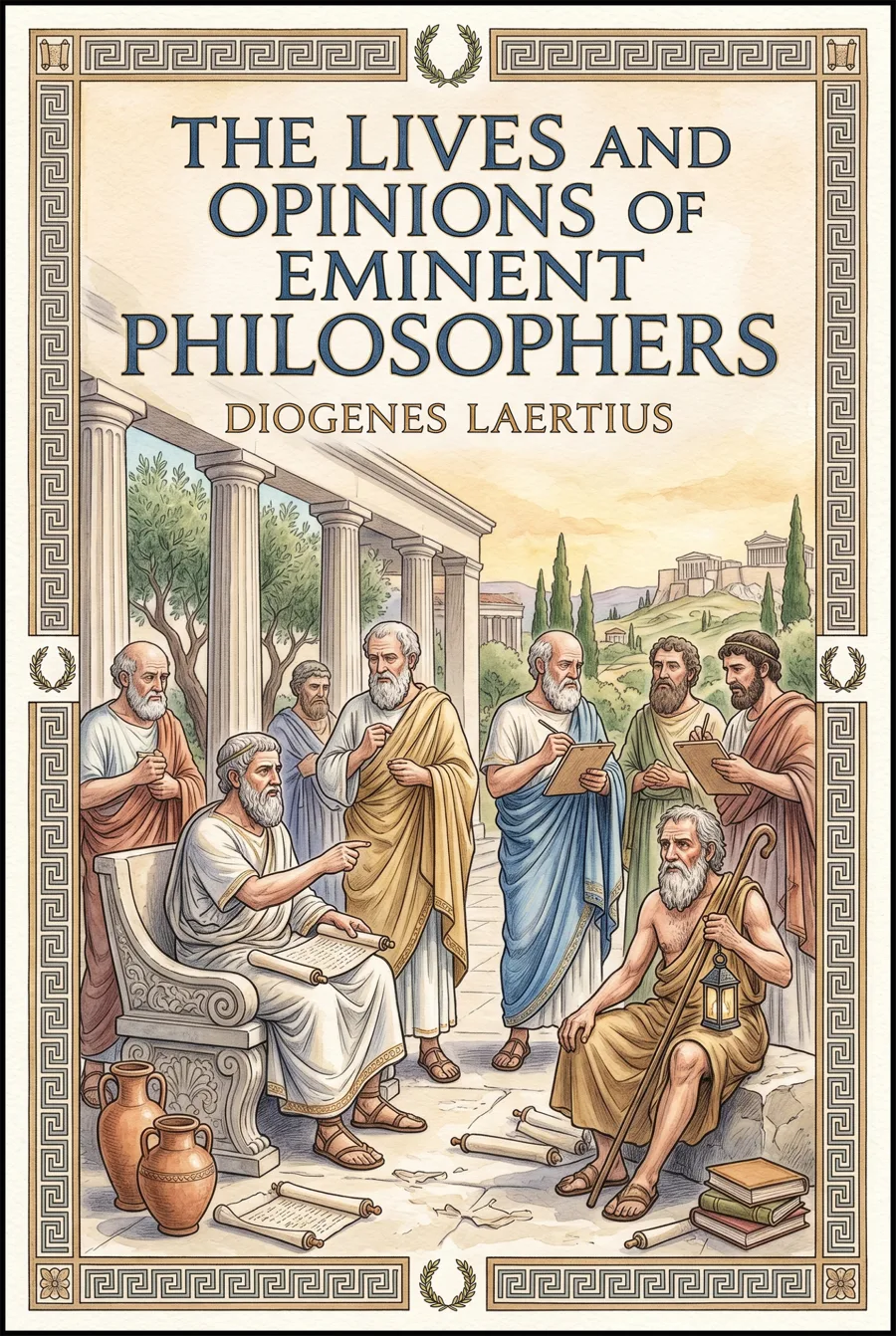
Download Cover Image
Do you want to download the full cover image for The Lives and Opinions of Eminent Philosophers?