
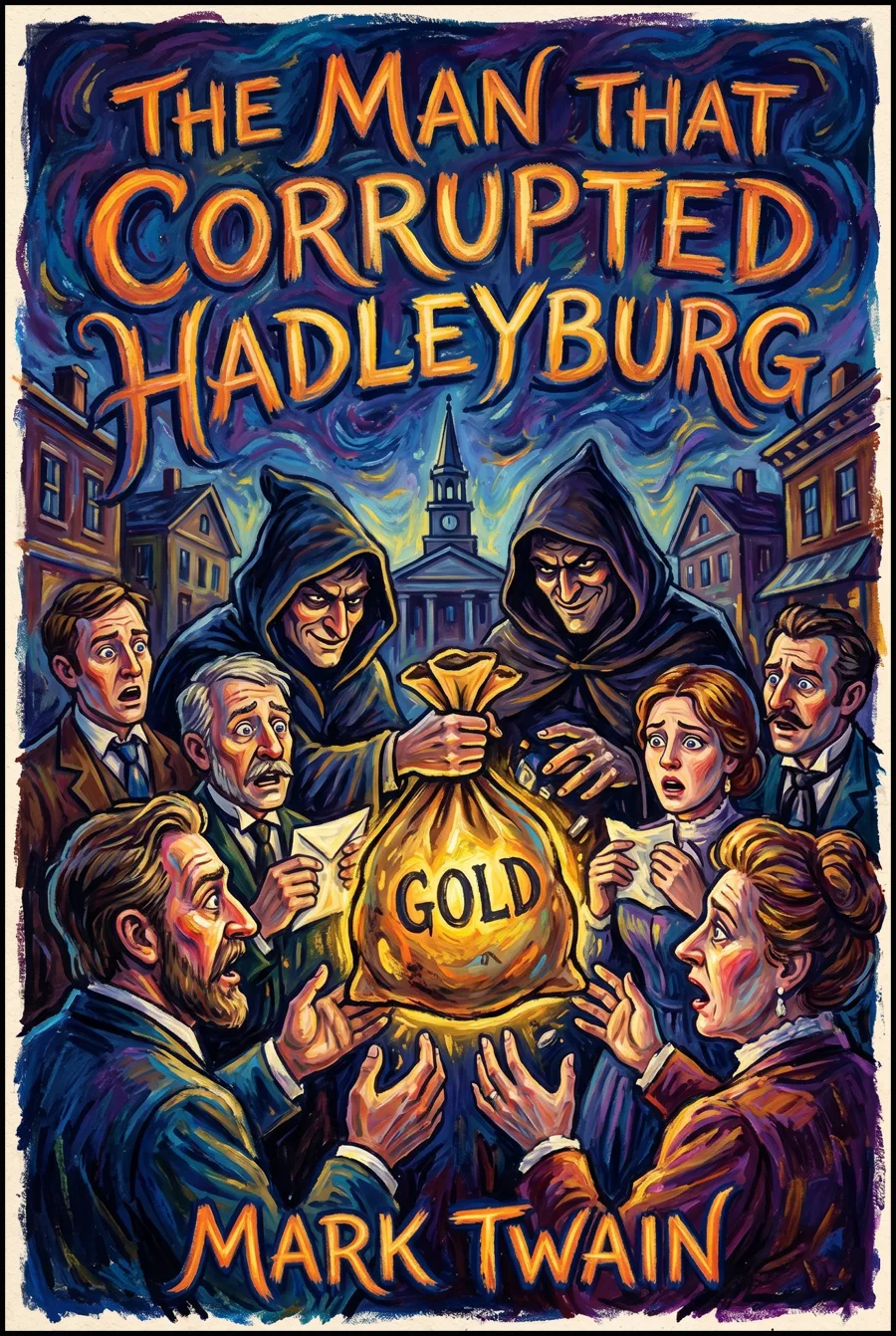
The Man That Corrupted Hadleyburg
eBook
• INR 51.00
• English
• 9788169359238
No ratings yet
| Publisher | General Press |
|---|---|
| ISBN13 | 9788169359238 |
| ASIN/SKU | 8169359236 |
| Book Format | eBook |
| Language | English |
| List Price | INR 51.00 |
| Subject Code | FIC052000, FIC025000, FIC066000 |
| Publishing Date | 01/09/2026 |
| Book Code | BD00070234 |
Buy this Book
Amazon Stores
Ebook Stores
Other Stores
Discover The Man That Corrupted Hadleyburg by Mark Twain. This book is published by General Press in eBook format, ISBN 9788169359238, ASIN 8169359236, under Literature and Fiction, Fiction Satire, Psychological Fiction.
Book Description
What happens when a town that prides itself on being completely honest is given a chance to prove it? 'The Man That Corrupted Hadleyburg' by Mark Twain is a classic satirical short story that explores human nature, temptation, hypocrisy, greed, and the fragile difference between a good reputation and genuine integrity.
Hadleyburg is a small American town famous for its honesty. Its residents have carefully built a reputation for being so morally upright that they believe they are practically immune to temptation. However, one offended stranger decides to challenge this confidence by setting a clever trap. After leaving town, he sends a mysterious sack containing a large sum of money to a prominent citizen, along with instructions claiming that the money belongs to the person who once helped him during a difficult moment. The stranger also suggests that the town's most respected citizens know the identity of this supposed benefactor.
The news quickly spreads, and the people of Hadleyburg become fascinated by the mystery. Although the town publicly insists that the money should go to its rightful owner, curiosity and greed begin working beneath the surface. Several respected citizens privately wonder whether they might be the person the stranger is seeking. As rumors grow, the town's carefully maintained image of virtue begins to crack.
Twain uses the unfolding scandal to expose the difference between appearing moral and actually resisting temptation. With sharp humor and irony, he shows how easily pride, suspicion, greed, and fear can transform a respectable community. The story is both entertaining and unsettling, asking whether anyone can honestly claim to be incorruptible when the right temptation appears. 'The Man That Corrupted Hadleyburg' remains a memorable satire of human weakness—and its surprising turns make it a story worth discovering for yourself.
Hadleyburg is a small American town famous for its honesty. Its residents have carefully built a reputation for being so morally upright that they believe they are practically immune to temptation. However, one offended stranger decides to challenge this confidence by setting a clever trap. After leaving town, he sends a mysterious sack containing a large sum of money to a prominent citizen, along with instructions claiming that the money belongs to the person who once helped him during a difficult moment. The stranger also suggests that the town's most respected citizens know the identity of this supposed benefactor.
The news quickly spreads, and the people of Hadleyburg become fascinated by the mystery. Although the town publicly insists that the money should go to its rightful owner, curiosity and greed begin working beneath the surface. Several respected citizens privately wonder whether they might be the person the stranger is seeking. As rumors grow, the town's carefully maintained image of virtue begins to crack.
Twain uses the unfolding scandal to expose the difference between appearing moral and actually resisting temptation. With sharp humor and irony, he shows how easily pride, suspicion, greed, and fear can transform a respectable community. The story is both entertaining and unsettling, asking whether anyone can honestly claim to be incorruptible when the right temptation appears. 'The Man That Corrupted Hadleyburg' remains a memorable satire of human weakness—and its surprising turns make it a story worth discovering for yourself.
Author Biography
Mark Twain turned everyday American life into unforgettable stories filled with humor, adventure, and sharp social observation. Born Samuel Langhorne Clemens, Mark Twain was an American novelist, essayist, humorist, and journalist best known for classic works such as 'The Adventures of Tom Sawyer' and 'Adventures of Huckleberry Finn', which helped shape American literature.
He was born on November 30, 1835, in Florida, Missouri, and grew up in Hannibal, a Mississippi River town that later inspired many settings in his fiction. After leaving school as a teenager, Clemens worked as a printer and typesetter before becoming a riverboat pilot on the Mississippi. His experience on the river led him to adopt the pen name “Mark Twain,” a term used by riverboat workers to indicate safe navigable water.
Twain began gaining national attention as a writer with humorous newspaper and magazine pieces. His 1865 story “The Celebrated Jumping Frog of Calaveras County” brought him widespread recognition. He went on to publish 'The Innocents Abroad', 'The Prince and the Pauper', 'A Connecticut Yankee in King Arthur's Court', and other influential works. His writing combined wit, vivid characters, regional speech, and adventurous storytelling with serious criticism of racism, inequality, hypocrisy, and social injustice.
'Adventures of Huckleberry Finn', published in 1884, is widely regarded as one of the great American novels. Twain’s ability to capture the voices and attitudes of his time gave his work unusual realism, while his humor made difficult subjects accessible to broad audiences. His lectures and public appearances also made him one of the best-known literary figures of his era.
Mark Twain died on April 21, 1910, but his distinctive voice and fearless humor continue to influence writers and entertain readers. His books remain enduring works of American literature, keeping his legacy alive across generations.
He was born on November 30, 1835, in Florida, Missouri, and grew up in Hannibal, a Mississippi River town that later inspired many settings in his fiction. After leaving school as a teenager, Clemens worked as a printer and typesetter before becoming a riverboat pilot on the Mississippi. His experience on the river led him to adopt the pen name “Mark Twain,” a term used by riverboat workers to indicate safe navigable water.
Twain began gaining national attention as a writer with humorous newspaper and magazine pieces. His 1865 story “The Celebrated Jumping Frog of Calaveras County” brought him widespread recognition. He went on to publish 'The Innocents Abroad', 'The Prince and the Pauper', 'A Connecticut Yankee in King Arthur's Court', and other influential works. His writing combined wit, vivid characters, regional speech, and adventurous storytelling with serious criticism of racism, inequality, hypocrisy, and social injustice.
'Adventures of Huckleberry Finn', published in 1884, is widely regarded as one of the great American novels. Twain’s ability to capture the voices and attitudes of his time gave his work unusual realism, while his humor made difficult subjects accessible to broad audiences. His lectures and public appearances also made him one of the best-known literary figures of his era.
Mark Twain died on April 21, 1910, but his distinctive voice and fearless humor continue to influence writers and entertain readers. His books remain enduring works of American literature, keeping his legacy alive across generations.
Editorial Reviews
Editorial Reviews will be added soon…
Book Summary
Mark Twain’s "The Man That Corrupted Hadleyburg" is a darkly humorous and deeply human satire about honesty, temptation, pride, hypocrisy, greed, guilt, and the dangerous difference between appearing virtuous and actually being virtuous. First published in 1899, the story centers on the fictional American town of Hadleyburg, a community famous for its supposedly perfect moral character. For generations, its citizens have taken enormous pride in being known as the most honest and upright people in the surrounding region. Twain gradually turns this admirable reputation into the central object of his satire. What happens when a community that has never been seriously tested by temptation suddenly faces an irresistible opportunity for wealth? The answer forms the heart of this memorable story.
Hadleyburg’s greatest possession is not its money, buildings, or social institutions, but its reputation. The citizens believe that they are different from ordinary people because they have trained themselves to resist dishonesty. From childhood, their children are taught the principles of honest dealing, while temptation is deliberately kept away from them. The community congratulates itself on having created generations of morally dependable citizens. Yet Twain immediately places a question mark over this supposed virtue. If people are protected from temptation, how can they know that they are genuinely virtuous? Avoiding temptation is not necessarily the same thing as resisting it. Hadleyburg has built its identity around an ideal that has never been properly tested.
The town’s weakness becomes even clearer in its attitude toward outsiders. Hadleyburg is proud, self-contained, and largely indifferent to strangers. At some point, the townspeople offend a passing stranger, although Twain deliberately leaves the exact incident unclear. The important point is not what they did but the attitude behind it. Hadleyburg considers itself morally superior and therefore has little interest in the feelings or opinions of outsiders. The offended man, however, is bitter and determined to take revenge. He does not merely want to hurt one person. He wants to destroy the entire town’s confidence in itself. His plan is therefore psychological rather than physical: he will tempt Hadleyburg with money and allow its supposedly honest citizens to expose themselves.
The stranger chooses Edward and Mary Richards as the unsuspecting starting point for his scheme. A mysterious sack containing gold coins, supposedly worth around $40,000, is left at their home. Along with it comes a letter explaining that many years earlier a poor stranger had passed through Hadleyburg. At a moment when he was desperate and tempted to continue his dishonest way of life, one citizen had given him twenty dollars and offered him advice that changed his life. The stranger now wants to repay that kindness. The problem is that he does not identify the benefactor. Instead, he provides a way for the true recipient to prove his identity. The mysterious reward quickly becomes the talk of the entire town.
This simple device creates the story’s central moral experiment. Each of the town’s nineteen most respected men, known collectively as the “Nineteeners,” has reason to believe that he might be the mysterious benefactor. The test is carefully designed because the citizens do not have to steal the money outright. They merely have to convince themselves that they deserve it. This is precisely where Twain’s understanding of human psychology becomes so sharp. Greed rarely presents itself honestly as greed. Instead, people create explanations that make their selfish desires appear reasonable, deserved, or even morally justified.
The citizens begin privately imagining what they could do with the money. Their thoughts reveal a side of themselves that their public reputation has hidden for years. Men who have spent their lives presenting themselves as pillars of honesty begin constructing stories that might allow them to claim the reward. Their wives become involved as well. The promise of wealth awakens jealousy, suspicion, ambition, and self-interest throughout the community. Instead of proving that Hadleyburg is morally superior, the mysterious sack exposes how fragile that superiority has always been.
Edward and Mary Richards occupy a particularly important position in this moral drama. Edward is the town’s cashier and one of its respected citizens. At first, the couple appears to be caught in the same trap as everyone else. They know something about the stranger’s past, and Edward has information that could help identify the supposed benefactor. Yet the story gradually reveals that their own history is not as innocent as their reputation suggests. Edward has previously behaved out of self-interest and fear, particularly in his failure to defend another citizen, Reverend Burgess, when doing so might have exposed his own secrets.
This part of the story is crucial because Twain shows that Hadleyburg’s corruption did not begin with the sack of gold. The gold merely reveals corruption that was already present. The town’s citizens have learned how to maintain an appearance of goodness while protecting their own interests. Their morality is therefore largely social and external. They want to be regarded as honest, rather than necessarily having the courage to behave honestly when honesty carries a personal cost. Twain’s satire is especially powerful because the people of Hadleyburg are not presented as extraordinary villains. They are ordinary human beings whose weaknesses become visible under pressure.
The public meeting becomes the dramatic center of the story. The townspeople gather to discover who deserves the mysterious reward. The atmosphere is filled with anticipation, pride, suspicion, and greed. One after another, the supposed claimants are exposed as frauds. The mysterious stranger has deliberately arranged the situation so that the citizens will publicly reveal their dishonesty. Their confident reputation collapses in front of the entire community. The people who had spent generations boasting about their incorruptibility are suddenly shown to be capable of lying when enough money is placed before them.
The irony is devastating. Hadleyburg has spent generations protecting its citizens from temptation because it believes this will make them morally strong. Twain suggests that the opposite may have happened. Their virtue has become delicate because it has never been exercised. Like a muscle that has never been used, their moral strength has not developed through struggle. The townspeople mistake the absence of temptation for evidence of moral superiority. The stranger’s experiment demonstrates how little that reputation is worth once circumstances change.
The Richardses suffer a different kind of punishment. Unlike the other prominent citizens, they are not immediately exposed before the whole town. Their dishonesty remains private, but this does not save them. Instead, guilt gradually destroys them from within. Edward and Mary cannot enjoy the consequences of their actions because they know that the praise they receive is undeserved. Their conscience becomes more painful precisely because their public reputation remains intact. Twain thereby creates an important contrast between public shame and private guilt. The other citizens lose their reputation, while the Richardses retain theirs but lose their peace of mind.
This distinction gives the story much of its emotional force. Twain does not suggest that public humiliation is the only punishment for dishonesty. A person can deceive an entire community and still be unable to escape himself or herself. The Richardses discover that a guilty conscience can be more destructive than public disgrace. Their suffering also reveals the emptiness of reputation when it is separated from reality. What good is it to be called honest if you know that you are not?
Another important element of the story is the stranger himself. He is not simply a villain who introduces corruption into an innocent community. His actions are cruel, manipulative, and motivated by revenge, but his experiment also exposes a truth that Hadleyburg desperately needs to confront. His purpose is to prove that the town’s celebrated honesty is largely untested. In this sense, he functions almost like a moral examiner. He creates the conditions under which the town must finally confront itself. Twain leaves readers with an uncomfortable question: is the person who exposes hypocrisy more morally dangerous than the hypocrites themselves?
The story’s humor makes this moral criticism easier to absorb. Twain does not preach in a solemn voice. Instead, he exaggerates the town’s pride, makes its citizens ridiculous, and allows their own words and actions to expose their contradictions. The result is comedy with a bitter edge. We laugh at Hadleyburg, but the joke gradually turns toward us because the weaknesses Twain identifies—greed, vanity, rationalization, fear, and the desire for social approval—are not limited to fictional towns. They are ordinary human weaknesses.
One of the most important themes in *The Man That Corrupted Hadleyburg* is therefore the difference between **appearance and reality**. Hadleyburg looks honest because everyone agrees that it is honest. Its reputation becomes a kind of collective belief. But reputation is not proof of character. Twain suggests that true virtue must exist independently of applause. A person who behaves well only because everyone is watching has not necessarily developed genuine moral strength.
The story also explores **hypocrisy and vanity**. The citizens love their reputation because it gives them a sense of superiority. Their pride in being “incorruptible” becomes so great that the reputation itself matters more than the virtue it supposedly represents. This is why the stranger’s revenge is so effective. He does not merely steal money from Hadleyburg; he attacks the town’s self-image. The community can survive financial loss, but it struggles to survive the discovery that its moral identity was partly an illusion.
Another major theme is **temptation**. Twain does not simply argue that money makes people dishonest. His deeper point is that temptation reveals what is already inside people. Hadleyburg’s citizens are not suddenly transformed into different human beings. Rather, the opportunity to obtain wealth without consequences gives their hidden desires permission to surface. The story therefore asks readers to think honestly about their own moral confidence. We may believe we know what we would do in a difficult situation, but until the situation actually arrives, our certainty may be meaningless.
The story also contains an important idea about **moral education**. Hadleyburg believes that children can be made virtuous by shielding them from temptation. Twain questions this method. Real character, the story suggests, cannot be manufactured simply by avoiding every opportunity to do wrong. Moral strength must be tested, practiced, and chosen. A person who has never faced temptation may not be more virtuous than someone who has faced temptation and resisted it. This is why the town’s eventual transformation carries a strange kind of hope.
By the end, Hadleyburg has lost its old reputation. The town is so deeply humiliated that it decides to change its identity, even altering its famous motto. Its earlier motto had asked to be protected from temptation; the new attitude embraces the possibility of being tested. This is one of Twain’s most significant ironies. The town must first fall before it can begin developing genuine wisdom. Its corruption becomes, paradoxically, the beginning of a more honest understanding of morality.
The ending is therefore more complicated than a simple story of punishment. Hadleyburg is disgraced, but the destruction of its false confidence may create the possibility of real improvement. The citizens now know something they did not know before: they are human. They can be greedy, frightened, selfish, and dishonest. Recognizing that weakness may actually make them more cautious and more humble. Twain does not promise that the town will become perfectly virtuous. Instead, he suggests that honest self-knowledge is a better foundation for morality than self-congratulation.
Ultimately, *The Man That Corrupted Hadleyburg* is a powerful study of human nature disguised as a comic tale about a small American town. Mark Twain attacks the belief that morality can be established through reputation, social approval, and avoidance of temptation. Hadleyburg’s tragedy is not that its citizens possess human weaknesses; it is that they have convinced themselves that they do not. The mysterious sack of gold simply tears away the protective covering.
The story remains relevant because its central question is timeless: **How do we know whether we are truly good?** Twain’s answer is uncomfortable but convincing. We do not discover our character through what we say about ourselves or what other people say about us. Character emerges when our values cost us something. *The Man That Corrupted Hadleyburg* ultimately teaches that genuine honesty requires more than a clean reputation. It requires the courage to face temptation, resist self-deception, accept uncomfortable truths, and live according to one's principles even when nobody is watching. In that sense, Twain’s story is not merely about the corruption of one fictional town. It is about the fragile distance between who we believe ourselves to be and who we reveal ourselves to be when life finally puts us to the test.
Hadleyburg’s greatest possession is not its money, buildings, or social institutions, but its reputation. The citizens believe that they are different from ordinary people because they have trained themselves to resist dishonesty. From childhood, their children are taught the principles of honest dealing, while temptation is deliberately kept away from them. The community congratulates itself on having created generations of morally dependable citizens. Yet Twain immediately places a question mark over this supposed virtue. If people are protected from temptation, how can they know that they are genuinely virtuous? Avoiding temptation is not necessarily the same thing as resisting it. Hadleyburg has built its identity around an ideal that has never been properly tested.
The town’s weakness becomes even clearer in its attitude toward outsiders. Hadleyburg is proud, self-contained, and largely indifferent to strangers. At some point, the townspeople offend a passing stranger, although Twain deliberately leaves the exact incident unclear. The important point is not what they did but the attitude behind it. Hadleyburg considers itself morally superior and therefore has little interest in the feelings or opinions of outsiders. The offended man, however, is bitter and determined to take revenge. He does not merely want to hurt one person. He wants to destroy the entire town’s confidence in itself. His plan is therefore psychological rather than physical: he will tempt Hadleyburg with money and allow its supposedly honest citizens to expose themselves.
The stranger chooses Edward and Mary Richards as the unsuspecting starting point for his scheme. A mysterious sack containing gold coins, supposedly worth around $40,000, is left at their home. Along with it comes a letter explaining that many years earlier a poor stranger had passed through Hadleyburg. At a moment when he was desperate and tempted to continue his dishonest way of life, one citizen had given him twenty dollars and offered him advice that changed his life. The stranger now wants to repay that kindness. The problem is that he does not identify the benefactor. Instead, he provides a way for the true recipient to prove his identity. The mysterious reward quickly becomes the talk of the entire town.
This simple device creates the story’s central moral experiment. Each of the town’s nineteen most respected men, known collectively as the “Nineteeners,” has reason to believe that he might be the mysterious benefactor. The test is carefully designed because the citizens do not have to steal the money outright. They merely have to convince themselves that they deserve it. This is precisely where Twain’s understanding of human psychology becomes so sharp. Greed rarely presents itself honestly as greed. Instead, people create explanations that make their selfish desires appear reasonable, deserved, or even morally justified.
The citizens begin privately imagining what they could do with the money. Their thoughts reveal a side of themselves that their public reputation has hidden for years. Men who have spent their lives presenting themselves as pillars of honesty begin constructing stories that might allow them to claim the reward. Their wives become involved as well. The promise of wealth awakens jealousy, suspicion, ambition, and self-interest throughout the community. Instead of proving that Hadleyburg is morally superior, the mysterious sack exposes how fragile that superiority has always been.
Edward and Mary Richards occupy a particularly important position in this moral drama. Edward is the town’s cashier and one of its respected citizens. At first, the couple appears to be caught in the same trap as everyone else. They know something about the stranger’s past, and Edward has information that could help identify the supposed benefactor. Yet the story gradually reveals that their own history is not as innocent as their reputation suggests. Edward has previously behaved out of self-interest and fear, particularly in his failure to defend another citizen, Reverend Burgess, when doing so might have exposed his own secrets.
This part of the story is crucial because Twain shows that Hadleyburg’s corruption did not begin with the sack of gold. The gold merely reveals corruption that was already present. The town’s citizens have learned how to maintain an appearance of goodness while protecting their own interests. Their morality is therefore largely social and external. They want to be regarded as honest, rather than necessarily having the courage to behave honestly when honesty carries a personal cost. Twain’s satire is especially powerful because the people of Hadleyburg are not presented as extraordinary villains. They are ordinary human beings whose weaknesses become visible under pressure.
The public meeting becomes the dramatic center of the story. The townspeople gather to discover who deserves the mysterious reward. The atmosphere is filled with anticipation, pride, suspicion, and greed. One after another, the supposed claimants are exposed as frauds. The mysterious stranger has deliberately arranged the situation so that the citizens will publicly reveal their dishonesty. Their confident reputation collapses in front of the entire community. The people who had spent generations boasting about their incorruptibility are suddenly shown to be capable of lying when enough money is placed before them.
The irony is devastating. Hadleyburg has spent generations protecting its citizens from temptation because it believes this will make them morally strong. Twain suggests that the opposite may have happened. Their virtue has become delicate because it has never been exercised. Like a muscle that has never been used, their moral strength has not developed through struggle. The townspeople mistake the absence of temptation for evidence of moral superiority. The stranger’s experiment demonstrates how little that reputation is worth once circumstances change.
The Richardses suffer a different kind of punishment. Unlike the other prominent citizens, they are not immediately exposed before the whole town. Their dishonesty remains private, but this does not save them. Instead, guilt gradually destroys them from within. Edward and Mary cannot enjoy the consequences of their actions because they know that the praise they receive is undeserved. Their conscience becomes more painful precisely because their public reputation remains intact. Twain thereby creates an important contrast between public shame and private guilt. The other citizens lose their reputation, while the Richardses retain theirs but lose their peace of mind.
This distinction gives the story much of its emotional force. Twain does not suggest that public humiliation is the only punishment for dishonesty. A person can deceive an entire community and still be unable to escape himself or herself. The Richardses discover that a guilty conscience can be more destructive than public disgrace. Their suffering also reveals the emptiness of reputation when it is separated from reality. What good is it to be called honest if you know that you are not?
Another important element of the story is the stranger himself. He is not simply a villain who introduces corruption into an innocent community. His actions are cruel, manipulative, and motivated by revenge, but his experiment also exposes a truth that Hadleyburg desperately needs to confront. His purpose is to prove that the town’s celebrated honesty is largely untested. In this sense, he functions almost like a moral examiner. He creates the conditions under which the town must finally confront itself. Twain leaves readers with an uncomfortable question: is the person who exposes hypocrisy more morally dangerous than the hypocrites themselves?
The story’s humor makes this moral criticism easier to absorb. Twain does not preach in a solemn voice. Instead, he exaggerates the town’s pride, makes its citizens ridiculous, and allows their own words and actions to expose their contradictions. The result is comedy with a bitter edge. We laugh at Hadleyburg, but the joke gradually turns toward us because the weaknesses Twain identifies—greed, vanity, rationalization, fear, and the desire for social approval—are not limited to fictional towns. They are ordinary human weaknesses.
One of the most important themes in *The Man That Corrupted Hadleyburg* is therefore the difference between **appearance and reality**. Hadleyburg looks honest because everyone agrees that it is honest. Its reputation becomes a kind of collective belief. But reputation is not proof of character. Twain suggests that true virtue must exist independently of applause. A person who behaves well only because everyone is watching has not necessarily developed genuine moral strength.
The story also explores **hypocrisy and vanity**. The citizens love their reputation because it gives them a sense of superiority. Their pride in being “incorruptible” becomes so great that the reputation itself matters more than the virtue it supposedly represents. This is why the stranger’s revenge is so effective. He does not merely steal money from Hadleyburg; he attacks the town’s self-image. The community can survive financial loss, but it struggles to survive the discovery that its moral identity was partly an illusion.
Another major theme is **temptation**. Twain does not simply argue that money makes people dishonest. His deeper point is that temptation reveals what is already inside people. Hadleyburg’s citizens are not suddenly transformed into different human beings. Rather, the opportunity to obtain wealth without consequences gives their hidden desires permission to surface. The story therefore asks readers to think honestly about their own moral confidence. We may believe we know what we would do in a difficult situation, but until the situation actually arrives, our certainty may be meaningless.
The story also contains an important idea about **moral education**. Hadleyburg believes that children can be made virtuous by shielding them from temptation. Twain questions this method. Real character, the story suggests, cannot be manufactured simply by avoiding every opportunity to do wrong. Moral strength must be tested, practiced, and chosen. A person who has never faced temptation may not be more virtuous than someone who has faced temptation and resisted it. This is why the town’s eventual transformation carries a strange kind of hope.
By the end, Hadleyburg has lost its old reputation. The town is so deeply humiliated that it decides to change its identity, even altering its famous motto. Its earlier motto had asked to be protected from temptation; the new attitude embraces the possibility of being tested. This is one of Twain’s most significant ironies. The town must first fall before it can begin developing genuine wisdom. Its corruption becomes, paradoxically, the beginning of a more honest understanding of morality.
The ending is therefore more complicated than a simple story of punishment. Hadleyburg is disgraced, but the destruction of its false confidence may create the possibility of real improvement. The citizens now know something they did not know before: they are human. They can be greedy, frightened, selfish, and dishonest. Recognizing that weakness may actually make them more cautious and more humble. Twain does not promise that the town will become perfectly virtuous. Instead, he suggests that honest self-knowledge is a better foundation for morality than self-congratulation.
Ultimately, *The Man That Corrupted Hadleyburg* is a powerful study of human nature disguised as a comic tale about a small American town. Mark Twain attacks the belief that morality can be established through reputation, social approval, and avoidance of temptation. Hadleyburg’s tragedy is not that its citizens possess human weaknesses; it is that they have convinced themselves that they do not. The mysterious sack of gold simply tears away the protective covering.
The story remains relevant because its central question is timeless: **How do we know whether we are truly good?** Twain’s answer is uncomfortable but convincing. We do not discover our character through what we say about ourselves or what other people say about us. Character emerges when our values cost us something. *The Man That Corrupted Hadleyburg* ultimately teaches that genuine honesty requires more than a clean reputation. It requires the courage to face temptation, resist self-deception, accept uncomfortable truths, and live according to one's principles even when nobody is watching. In that sense, Twain’s story is not merely about the corruption of one fictional town. It is about the fragile distance between who we believe ourselves to be and who we reveal ourselves to be when life finally puts us to the test.
Sample Chapters
Sample Chapters will be added soon…
Reader Reviews
No reviews yet.
The Man That Corrupted Hadleyburg
Download Cover Image
Do you want to download the full cover image for The Man That Corrupted Hadleyburg?