
The Mysteries of Udolpho
eBook
• INR 51.00
• English
• 9788169359894
No ratings yet
| Publisher | General Press |
|---|---|
| ISBN13 | 9788169359894 |
| ASIN/SKU | 8169359899 |
| Book Format | eBook |
| Language | English |
| List Price | INR 51.00 |
| Subject Code | FIC027040, FIC030000, FIC022060 |
| Publishing Date | 01/09/2026 |
| Book Code | BD00070235 |
Buy this Book
Amazon Stores
Ebook Stores
Other Stores
Discover The Mysteries of Udolpho by Ann Radcliffe. This book is published by General Press in eBook format, ISBN 9788169359894, ASIN 8169359899, under Literature and Fiction, Gothic Fiction, Suspense Thrillers.
Book Description
Imagine being taken from the peaceful life you know and carried into a remote castle filled with secrets, strange sounds, and unexplained dangers. 'The Mysteries of Udolpho' by Ann Radcliffe is a classic Gothic novel that combines suspense, romance, mystery, and psychological terror while following a young woman's struggle to protect herself in a world ruled by fear and uncertainty.
The story follows Emily St. Aubert, a sensitive and thoughtful young woman whose happy life is shattered by the death of her beloved father. Left vulnerable, Emily is placed under the care of her aunt, Madame Cheron, whose marriage to the powerful and mysterious Montoni soon changes everything. When Montoni takes control of the family, Emily is carried away to the imposing Castle Udolpho in the Italian mountains. Surrounded by dark corridors, ruined rooms, strange legends, and unexplained occurrences, she begins to fear that the castle may hide secrets far more disturbing than she could have imagined.
Emily's situation becomes even more difficult as Montoni attempts to control her future and separate her from the people she trusts. Throughout her ordeal, memories of her father, her love for Valancourt, and her own moral strength help her endure the uncertainty surrounding her. Radcliffe creates suspense by constantly placing Emily between what she sees and what she thinks she sees, allowing ordinary events and supernatural possibilities to blur together.
With its atmospheric landscapes, mysterious castle, hidden identities, family conflicts, and emotional tension, the novel became one of the defining works of Gothic fiction. 'The Mysteries of Udolpho' is a gripping journey through fear, imagination, and resilience, inviting readers to enter its shadowy corridors and discover which mysteries are truly supernatural—and which have a more human explanation.
The story follows Emily St. Aubert, a sensitive and thoughtful young woman whose happy life is shattered by the death of her beloved father. Left vulnerable, Emily is placed under the care of her aunt, Madame Cheron, whose marriage to the powerful and mysterious Montoni soon changes everything. When Montoni takes control of the family, Emily is carried away to the imposing Castle Udolpho in the Italian mountains. Surrounded by dark corridors, ruined rooms, strange legends, and unexplained occurrences, she begins to fear that the castle may hide secrets far more disturbing than she could have imagined.
Emily's situation becomes even more difficult as Montoni attempts to control her future and separate her from the people she trusts. Throughout her ordeal, memories of her father, her love for Valancourt, and her own moral strength help her endure the uncertainty surrounding her. Radcliffe creates suspense by constantly placing Emily between what she sees and what she thinks she sees, allowing ordinary events and supernatural possibilities to blur together.
With its atmospheric landscapes, mysterious castle, hidden identities, family conflicts, and emotional tension, the novel became one of the defining works of Gothic fiction. 'The Mysteries of Udolpho' is a gripping journey through fear, imagination, and resilience, inviting readers to enter its shadowy corridors and discover which mysteries are truly supernatural—and which have a more human explanation.
Author Biography
Few writers have shaped the atmosphere of Gothic fiction as powerfully as Ann Radcliffe. Ann Radcliffe was an influential English novelist best known for her Gothic novels, including 'The Mysteries of Udolpho' and 'The Italian', which helped define the genre in the late eighteenth century.
Born Ann Ward in 1764 in Holborn, London, she grew up in a respectable family and later married journalist and Oxford graduate William Radcliffe in 1787. Although she lived a relatively private life, her imagination carried her far beyond the quiet world around her. Her early novels attracted attention for their mysterious settings, suspenseful plots, dramatic landscapes, and strong female characters.
Radcliffe became one of the most successful novelists of her time. Her breakthrough came with 'A Sicilian Romance' (1790), followed by 'The Romance of the Forest' (1791), which established her reputation as a leading Gothic writer. Her most famous work, 'The Mysteries of Udolpho' (1794), follows Emily St. Aubert through haunted castles, family secrets, danger, and psychological uncertainty. 'The Italian' (1797) continued her exploration of fear, romance, religion, and hidden motives.
A distinctive feature of her writing was her use of the “explained supernatural.” Radcliffe often created frightening situations that seemed supernatural but were eventually given rational explanations. This approach allowed her to build suspense while appealing to readers who enjoyed both mystery and reason. Her vivid descriptions of nature also became a hallmark of her style.
Radcliffe's influence reached far beyond her lifetime, inspiring later Gothic writers and helping shape the development of the modern horror and mystery novel. Her ability to combine romance, suspense, psychological tension, and atmospheric storytelling continues to make her work relevant to readers today. Ann Radcliffe remains a defining figure in Gothic literature and a lasting influence on the way writers create fear through imagination.
Born Ann Ward in 1764 in Holborn, London, she grew up in a respectable family and later married journalist and Oxford graduate William Radcliffe in 1787. Although she lived a relatively private life, her imagination carried her far beyond the quiet world around her. Her early novels attracted attention for their mysterious settings, suspenseful plots, dramatic landscapes, and strong female characters.
Radcliffe became one of the most successful novelists of her time. Her breakthrough came with 'A Sicilian Romance' (1790), followed by 'The Romance of the Forest' (1791), which established her reputation as a leading Gothic writer. Her most famous work, 'The Mysteries of Udolpho' (1794), follows Emily St. Aubert through haunted castles, family secrets, danger, and psychological uncertainty. 'The Italian' (1797) continued her exploration of fear, romance, religion, and hidden motives.
A distinctive feature of her writing was her use of the “explained supernatural.” Radcliffe often created frightening situations that seemed supernatural but were eventually given rational explanations. This approach allowed her to build suspense while appealing to readers who enjoyed both mystery and reason. Her vivid descriptions of nature also became a hallmark of her style.
Radcliffe's influence reached far beyond her lifetime, inspiring later Gothic writers and helping shape the development of the modern horror and mystery novel. Her ability to combine romance, suspense, psychological tension, and atmospheric storytelling continues to make her work relevant to readers today. Ann Radcliffe remains a defining figure in Gothic literature and a lasting influence on the way writers create fear through imagination.
Editorial Reviews
Editorial Reviews will be added soon…
Book Summary
Ann Radcliffe’s "The Mysteries of Udolpho" is one of the most influential Gothic novels of the eighteenth century and a landmark work in the history of suspense, romance, and Gothic literature. First published in 1794, the novel follows Emily St. Aubert, a sensitive and intelligent young woman whose peaceful life is shattered by the death of her father. She is subsequently placed under the authority of her aunt’s new husband, the sinister Montoni, and taken to the remote castle of Udolpho in the Italian mountains. There, Emily encounters mysterious sounds, frightening apparitions, secret passages, family secrets, imprisonment, and apparent supernatural events. Yet Radcliffe’s novel is more than a collection of Gothic thrills. At its heart, 'The Mysteries of Udolpho' is a story about fear, reason, imagination, female vulnerability, family, love, and the difficult journey from innocence to emotional maturity. Its famous atmosphere of terror and uncertainty helped establish many conventions that later became central to Gothic fiction.
The novel begins in the peaceful surroundings of La Vallée in Gascony, France. Emily St. Aubert lives with her beloved father, Monsieur St. Aubert, and enjoys a sheltered existence surrounded by nature. Her mother has died, and Emily's relationship with her father is exceptionally close. St. Aubert is a thoughtful and gentle man who teaches Emily to appreciate nature, moral virtue, and emotional restraint. He is particularly concerned that she should learn to control excessive sensitivity and imagination. This early emphasis becomes important because Emily will later find herself in situations where fear and imagination constantly compete with reason.
Emily's peaceful life changes when her father becomes seriously ill. Before his death, he reveals important information about the family and warns Emily about the dangers of unrestrained emotion. He also entrusts her to the care of her aunt, Madame Cheron. The loss is devastating for Emily because her father has been her closest companion and moral guide. After his death, she is forced to leave the familiar security of La Vallée and enter a much more uncertain world.
Madame Cheron is very different from St. Aubert. Self-centered, vain, and concerned with social status, she has little understanding of Emily's emotional needs. Her marriage to the Italian nobleman Montoni changes Emily's life even more dramatically. Montoni is powerful, proud, secretive, and intimidating. Although he initially appears merely severe, it soon becomes clear that he is capable of manipulation and violence. His character embodies the threatening masculine authority that dominates much of the novel.
Before Emily leaves France, she develops a romantic attachment to Valancourt, a young Frenchman she meets during her travels. Their relationship is based on affection and shared appreciation of nature rather than wealth or social ambition. Valancourt is sincere, generous, and emotionally expressive, and Emily genuinely loves him. However, Madame Cheron disapproves of the match because she considers him socially unsuitable. Montoni later becomes even more determined to prevent the relationship, particularly because he wants Emily to marry someone whose position or wealth will benefit him.
The journey into Italy marks a major change in the novel's atmosphere. Radcliffe moves Emily from the open landscapes of France into increasingly isolated and mysterious surroundings. Eventually she is taken to the Castle of Udolpho, an enormous fortress surrounded by mountains and forests. Udolpho becomes one of the most famous settings in Gothic literature. Its dark corridors, ruined towers, locked rooms, hidden passages, and ancient walls create an atmosphere of constant uncertainty. Emily feels physically and emotionally imprisoned there, and the castle seems to reflect the fears developing within her.
At Udolpho, Montoni's authority becomes increasingly oppressive. He attempts to use Emily's inheritance as a means of controlling her and pressures her into a marriage that would strengthen his own position. Emily resists him, but her ability to act independently is severely limited. She has little legal or social power, and her aunt repeatedly fails to protect her. Radcliffe therefore makes the Gothic castle more than a frightening building: it becomes a symbol of patriarchal power and female confinement.
The supernatural atmosphere intensifies when Emily begins to experience strange events. She hears unexplained noises, discovers mysterious objects, and encounters things that seem to belong to the world of ghosts. One of the novel's most famous episodes involves a black veil concealing something terrifying in a remote room of the castle. Emily's curiosity and imagination lead her toward the mysterious object, but Radcliffe deliberately delays the explanation. The reader, like Emily, is encouraged to imagine the worst.
This technique is central to Radcliffe's style. Unlike later Gothic writers who often present supernatural events as genuinely supernatural, Radcliffe frequently provides rational explanations for apparently impossible occurrences. Her fiction is therefore built around the difference between ''terror and horror''. Terror arises from uncertainty, anticipation, darkness, and the imagination of what might happen. Horror comes from directly confronting something frightening. Radcliffe prefers terror. She often allows the reader's imagination to become more frightening than the reality eventually revealed.
Emily's experiences at Udolpho are also complicated by the stories of the castle's previous inhabitants. The fortress contains a history of violence, betrayal, and hidden crimes. Old legends circulate about its rooms and inhabitants, making Emily uncertain about what is real. Radcliffe uses these stories within the story to deepen the sense that the past is never completely dead. The Gothic castle becomes a physical record of generations of secrets.
Meanwhile, Montoni's behavior becomes more ruthless. His financial problems and political ambitions increase the pressure on Emily. He attempts to force her into marriage and treats her inheritance as something he has a right to control. Madame Cheron, who becomes Madame Montoni, is increasingly frightened by her husband's behavior. Eventually she is imprisoned and threatened when she refuses to surrender her property. Her suffering reveals how vulnerable women can be when they depend upon male authority.
Emily remains frightened but gradually becomes stronger. Her courage does not mean that she stops feeling fear. Instead, she learns to act despite fear. This is one of the most important elements of her character development. At the beginning of the novel, Emily is sensitive and easily overwhelmed by frightening impressions. As her experiences accumulate, she learns to distinguish between imagination and evidence. She still possesses a powerful emotional nature, but she becomes more capable of controlling it.
The story eventually moves away from Udolpho, but its mysteries do not immediately disappear. Emily is confronted with new uncertainties concerning her family history, Valancourt's reputation, and the identities of various characters. Radcliffe deliberately complicates the plot through apparently contradictory evidence. Valancourt, whom Emily loves, is reported to have behaved dishonorably in Paris. Emily struggles between her affection for him and her fear that the accusations may be true. The episode reinforces one of the novel's recurring themes: appearances can be misleading.
Emily's separation from Valancourt is therefore not merely a romantic obstacle. It becomes another test of judgment. She must learn that love cannot depend entirely upon emotion, but neither should emotion be destroyed by every rumor. Radcliffe presents mature judgment as the ability to balance feeling with evidence.
Another important character is the mysterious Signora Laurentini, whose tragic history becomes connected with Emily's family. Her story adds another layer to the novel's exploration of guilt, lost identity, forbidden love, and the consequences of past actions. As the narrative unfolds, old relationships and hidden identities begin to emerge. The mysteries that seemed supernatural increasingly become connected with ordinary human passions such as jealousy, desire, revenge, fear, and regret.
Radcliffe also gives considerable attention to landscapes. Mountains, forests, ruins, moonlit valleys, lakes, and storms are described in rich detail. Nature often mirrors Emily's emotional state. Peaceful landscapes offer comfort and moral clarity, while dark forests and mountain passes intensify uncertainty. The natural world is therefore not merely decorative. It is an essential part of the novel's emotional architecture.
The novel's treatment of art and imagination is equally important. Emily is deeply affected by music, poetry, paintings, landscapes, and stories. Her sensitivity gives her a capacity for beauty, but it also makes her vulnerable to fear. Radcliffe does not suggest that imagination is inherently bad. Instead, she argues for balance. Imagination can enrich life when guided by reason, but it can also transform uncertainty into terror when allowed to operate without restraint.
As the various mysteries are gradually explained, the novel shifts from Gothic terror toward resolution. Many apparently supernatural events receive rational explanations. Sounds have physical causes, strange appearances are connected with hidden people or objects, and mysterious circumstances eventually prove to have ordinary origins. This rational resolution is one of Radcliffe's defining characteristics and an important feature of the early Gothic novel.
The revelations also clarify Emily's family history and restore her sense of identity. The various threads involving her parents, relatives, Valancourt, the mysterious women connected with Udolpho, and the political and financial conflicts surrounding Montoni eventually come together. The truth is more complicated than Emily initially believed, but it is no longer unknowable.
Montoni's fate also contributes to the novel's moral structure. His ambition, cruelty, and disregard for others eventually bring about his downfall. He represents the destructive side of unchecked power, particularly when wealth and social authority are used without moral restraint. His eventual disappearance from Emily's life allows her to recover some of the independence that his control had denied her.
Emily's final development is perhaps the novel's greatest achievement. She does not emerge from her ordeal as an entirely different person. Her sensitivity, compassion, love of nature, and appreciation of beauty remain. What changes is her ability to govern those qualities. She has learned that fear does not always tell the truth, that appearances can deceive, that human beings can be both weak and cruel, and that patience and reason can reveal what panic hides.
The eventual restoration of Emily's relationship with Valancourt provides the emotional resolution readers have been waiting for. Their reunion is not simply the reward for surviving a Gothic adventure. It symbolizes the return of trust, stability, and emotional balance. Emily can finally move toward a future in which love is no longer threatened by the secrets and forces that dominated her youth.
For readers searching for an ''in-depth summary of 'The Mysteries of Udolpho''', the central story can therefore be understood as Emily St. Aubert's journey from sheltered innocence to mature self-command. After her father's death, Emily is placed under the authority of her aunt and her intimidating new husband, Montoni. She falls in love with Valancourt but is separated from him when Montoni takes her and her aunt to the remote Castle of Udolpho. There Emily encounters imprisonment, family secrets, mysterious rooms, frightening apparitions, political intrigue, and apparent supernatural phenomena. She must endure Montoni's attempts to control her inheritance while attempting to preserve her moral independence. Eventually, many of the castle's mysteries and the secrets surrounding Emily's family receive explanations, while false accusations against Valancourt are resolved. Emily finally regains her freedom and is reunited with the man she loves.
The enduring appeal of 'The Mysteries of Udolpho' lies in the way Ann Radcliffe makes fear psychological. The darkest places in the novel are frightening not simply because something terrible is present, but because Emily does not know what is present. A closed door, a strange sound, a curtain, a distant light, or an unexplained movement becomes terrifying because the imagination fills the gap left by uncertainty. This technique had an enormous influence on Gothic literature and helped establish the conventions later developed by writers such as Matthew Lewis, Mary Shelley, Charlotte Brontë, and Edgar Allan Poe.
Ultimately, 'The Mysteries of Udolpho' is both a Gothic romance and a coming-of-age story. Its castles, secrets, villains, mysterious documents, hidden identities, and supernatural-looking events provide the suspense, but Emily's emotional development provides the heart of the novel. Radcliffe asks what happens when a sensitive person is forced into circumstances she cannot control and must learn to distinguish genuine danger from imagined danger. Her answer is ultimately hopeful. Fear can be overcome by courage, confusion can be replaced by understanding, and suffering can produce wisdom. For readers interested in ''classic Gothic fiction, Gothic romance, eighteenth-century literature, haunted castles, mystery novels, psychological suspense, female protagonists, and the origins of Gothic literature'', 'The Mysteries of Udolpho' remains a foundational and rewarding novel—one in which the greatest mystery is not merely what lies behind the castle's locked doors, but how the human mind responds when it cannot yet see the truth.
The novel begins in the peaceful surroundings of La Vallée in Gascony, France. Emily St. Aubert lives with her beloved father, Monsieur St. Aubert, and enjoys a sheltered existence surrounded by nature. Her mother has died, and Emily's relationship with her father is exceptionally close. St. Aubert is a thoughtful and gentle man who teaches Emily to appreciate nature, moral virtue, and emotional restraint. He is particularly concerned that she should learn to control excessive sensitivity and imagination. This early emphasis becomes important because Emily will later find herself in situations where fear and imagination constantly compete with reason.
Emily's peaceful life changes when her father becomes seriously ill. Before his death, he reveals important information about the family and warns Emily about the dangers of unrestrained emotion. He also entrusts her to the care of her aunt, Madame Cheron. The loss is devastating for Emily because her father has been her closest companion and moral guide. After his death, she is forced to leave the familiar security of La Vallée and enter a much more uncertain world.
Madame Cheron is very different from St. Aubert. Self-centered, vain, and concerned with social status, she has little understanding of Emily's emotional needs. Her marriage to the Italian nobleman Montoni changes Emily's life even more dramatically. Montoni is powerful, proud, secretive, and intimidating. Although he initially appears merely severe, it soon becomes clear that he is capable of manipulation and violence. His character embodies the threatening masculine authority that dominates much of the novel.
Before Emily leaves France, she develops a romantic attachment to Valancourt, a young Frenchman she meets during her travels. Their relationship is based on affection and shared appreciation of nature rather than wealth or social ambition. Valancourt is sincere, generous, and emotionally expressive, and Emily genuinely loves him. However, Madame Cheron disapproves of the match because she considers him socially unsuitable. Montoni later becomes even more determined to prevent the relationship, particularly because he wants Emily to marry someone whose position or wealth will benefit him.
The journey into Italy marks a major change in the novel's atmosphere. Radcliffe moves Emily from the open landscapes of France into increasingly isolated and mysterious surroundings. Eventually she is taken to the Castle of Udolpho, an enormous fortress surrounded by mountains and forests. Udolpho becomes one of the most famous settings in Gothic literature. Its dark corridors, ruined towers, locked rooms, hidden passages, and ancient walls create an atmosphere of constant uncertainty. Emily feels physically and emotionally imprisoned there, and the castle seems to reflect the fears developing within her.
At Udolpho, Montoni's authority becomes increasingly oppressive. He attempts to use Emily's inheritance as a means of controlling her and pressures her into a marriage that would strengthen his own position. Emily resists him, but her ability to act independently is severely limited. She has little legal or social power, and her aunt repeatedly fails to protect her. Radcliffe therefore makes the Gothic castle more than a frightening building: it becomes a symbol of patriarchal power and female confinement.
The supernatural atmosphere intensifies when Emily begins to experience strange events. She hears unexplained noises, discovers mysterious objects, and encounters things that seem to belong to the world of ghosts. One of the novel's most famous episodes involves a black veil concealing something terrifying in a remote room of the castle. Emily's curiosity and imagination lead her toward the mysterious object, but Radcliffe deliberately delays the explanation. The reader, like Emily, is encouraged to imagine the worst.
This technique is central to Radcliffe's style. Unlike later Gothic writers who often present supernatural events as genuinely supernatural, Radcliffe frequently provides rational explanations for apparently impossible occurrences. Her fiction is therefore built around the difference between ''terror and horror''. Terror arises from uncertainty, anticipation, darkness, and the imagination of what might happen. Horror comes from directly confronting something frightening. Radcliffe prefers terror. She often allows the reader's imagination to become more frightening than the reality eventually revealed.
Emily's experiences at Udolpho are also complicated by the stories of the castle's previous inhabitants. The fortress contains a history of violence, betrayal, and hidden crimes. Old legends circulate about its rooms and inhabitants, making Emily uncertain about what is real. Radcliffe uses these stories within the story to deepen the sense that the past is never completely dead. The Gothic castle becomes a physical record of generations of secrets.
Meanwhile, Montoni's behavior becomes more ruthless. His financial problems and political ambitions increase the pressure on Emily. He attempts to force her into marriage and treats her inheritance as something he has a right to control. Madame Cheron, who becomes Madame Montoni, is increasingly frightened by her husband's behavior. Eventually she is imprisoned and threatened when she refuses to surrender her property. Her suffering reveals how vulnerable women can be when they depend upon male authority.
Emily remains frightened but gradually becomes stronger. Her courage does not mean that she stops feeling fear. Instead, she learns to act despite fear. This is one of the most important elements of her character development. At the beginning of the novel, Emily is sensitive and easily overwhelmed by frightening impressions. As her experiences accumulate, she learns to distinguish between imagination and evidence. She still possesses a powerful emotional nature, but she becomes more capable of controlling it.
The story eventually moves away from Udolpho, but its mysteries do not immediately disappear. Emily is confronted with new uncertainties concerning her family history, Valancourt's reputation, and the identities of various characters. Radcliffe deliberately complicates the plot through apparently contradictory evidence. Valancourt, whom Emily loves, is reported to have behaved dishonorably in Paris. Emily struggles between her affection for him and her fear that the accusations may be true. The episode reinforces one of the novel's recurring themes: appearances can be misleading.
Emily's separation from Valancourt is therefore not merely a romantic obstacle. It becomes another test of judgment. She must learn that love cannot depend entirely upon emotion, but neither should emotion be destroyed by every rumor. Radcliffe presents mature judgment as the ability to balance feeling with evidence.
Another important character is the mysterious Signora Laurentini, whose tragic history becomes connected with Emily's family. Her story adds another layer to the novel's exploration of guilt, lost identity, forbidden love, and the consequences of past actions. As the narrative unfolds, old relationships and hidden identities begin to emerge. The mysteries that seemed supernatural increasingly become connected with ordinary human passions such as jealousy, desire, revenge, fear, and regret.
Radcliffe also gives considerable attention to landscapes. Mountains, forests, ruins, moonlit valleys, lakes, and storms are described in rich detail. Nature often mirrors Emily's emotional state. Peaceful landscapes offer comfort and moral clarity, while dark forests and mountain passes intensify uncertainty. The natural world is therefore not merely decorative. It is an essential part of the novel's emotional architecture.
The novel's treatment of art and imagination is equally important. Emily is deeply affected by music, poetry, paintings, landscapes, and stories. Her sensitivity gives her a capacity for beauty, but it also makes her vulnerable to fear. Radcliffe does not suggest that imagination is inherently bad. Instead, she argues for balance. Imagination can enrich life when guided by reason, but it can also transform uncertainty into terror when allowed to operate without restraint.
As the various mysteries are gradually explained, the novel shifts from Gothic terror toward resolution. Many apparently supernatural events receive rational explanations. Sounds have physical causes, strange appearances are connected with hidden people or objects, and mysterious circumstances eventually prove to have ordinary origins. This rational resolution is one of Radcliffe's defining characteristics and an important feature of the early Gothic novel.
The revelations also clarify Emily's family history and restore her sense of identity. The various threads involving her parents, relatives, Valancourt, the mysterious women connected with Udolpho, and the political and financial conflicts surrounding Montoni eventually come together. The truth is more complicated than Emily initially believed, but it is no longer unknowable.
Montoni's fate also contributes to the novel's moral structure. His ambition, cruelty, and disregard for others eventually bring about his downfall. He represents the destructive side of unchecked power, particularly when wealth and social authority are used without moral restraint. His eventual disappearance from Emily's life allows her to recover some of the independence that his control had denied her.
Emily's final development is perhaps the novel's greatest achievement. She does not emerge from her ordeal as an entirely different person. Her sensitivity, compassion, love of nature, and appreciation of beauty remain. What changes is her ability to govern those qualities. She has learned that fear does not always tell the truth, that appearances can deceive, that human beings can be both weak and cruel, and that patience and reason can reveal what panic hides.
The eventual restoration of Emily's relationship with Valancourt provides the emotional resolution readers have been waiting for. Their reunion is not simply the reward for surviving a Gothic adventure. It symbolizes the return of trust, stability, and emotional balance. Emily can finally move toward a future in which love is no longer threatened by the secrets and forces that dominated her youth.
For readers searching for an ''in-depth summary of 'The Mysteries of Udolpho''', the central story can therefore be understood as Emily St. Aubert's journey from sheltered innocence to mature self-command. After her father's death, Emily is placed under the authority of her aunt and her intimidating new husband, Montoni. She falls in love with Valancourt but is separated from him when Montoni takes her and her aunt to the remote Castle of Udolpho. There Emily encounters imprisonment, family secrets, mysterious rooms, frightening apparitions, political intrigue, and apparent supernatural phenomena. She must endure Montoni's attempts to control her inheritance while attempting to preserve her moral independence. Eventually, many of the castle's mysteries and the secrets surrounding Emily's family receive explanations, while false accusations against Valancourt are resolved. Emily finally regains her freedom and is reunited with the man she loves.
The enduring appeal of 'The Mysteries of Udolpho' lies in the way Ann Radcliffe makes fear psychological. The darkest places in the novel are frightening not simply because something terrible is present, but because Emily does not know what is present. A closed door, a strange sound, a curtain, a distant light, or an unexplained movement becomes terrifying because the imagination fills the gap left by uncertainty. This technique had an enormous influence on Gothic literature and helped establish the conventions later developed by writers such as Matthew Lewis, Mary Shelley, Charlotte Brontë, and Edgar Allan Poe.
Ultimately, 'The Mysteries of Udolpho' is both a Gothic romance and a coming-of-age story. Its castles, secrets, villains, mysterious documents, hidden identities, and supernatural-looking events provide the suspense, but Emily's emotional development provides the heart of the novel. Radcliffe asks what happens when a sensitive person is forced into circumstances she cannot control and must learn to distinguish genuine danger from imagined danger. Her answer is ultimately hopeful. Fear can be overcome by courage, confusion can be replaced by understanding, and suffering can produce wisdom. For readers interested in ''classic Gothic fiction, Gothic romance, eighteenth-century literature, haunted castles, mystery novels, psychological suspense, female protagonists, and the origins of Gothic literature'', 'The Mysteries of Udolpho' remains a foundational and rewarding novel—one in which the greatest mystery is not merely what lies behind the castle's locked doors, but how the human mind responds when it cannot yet see the truth.
Sample Chapters
Sample Chapters will be added soon…
Reader Reviews
No reviews yet.
The Mysteries of Udolpho
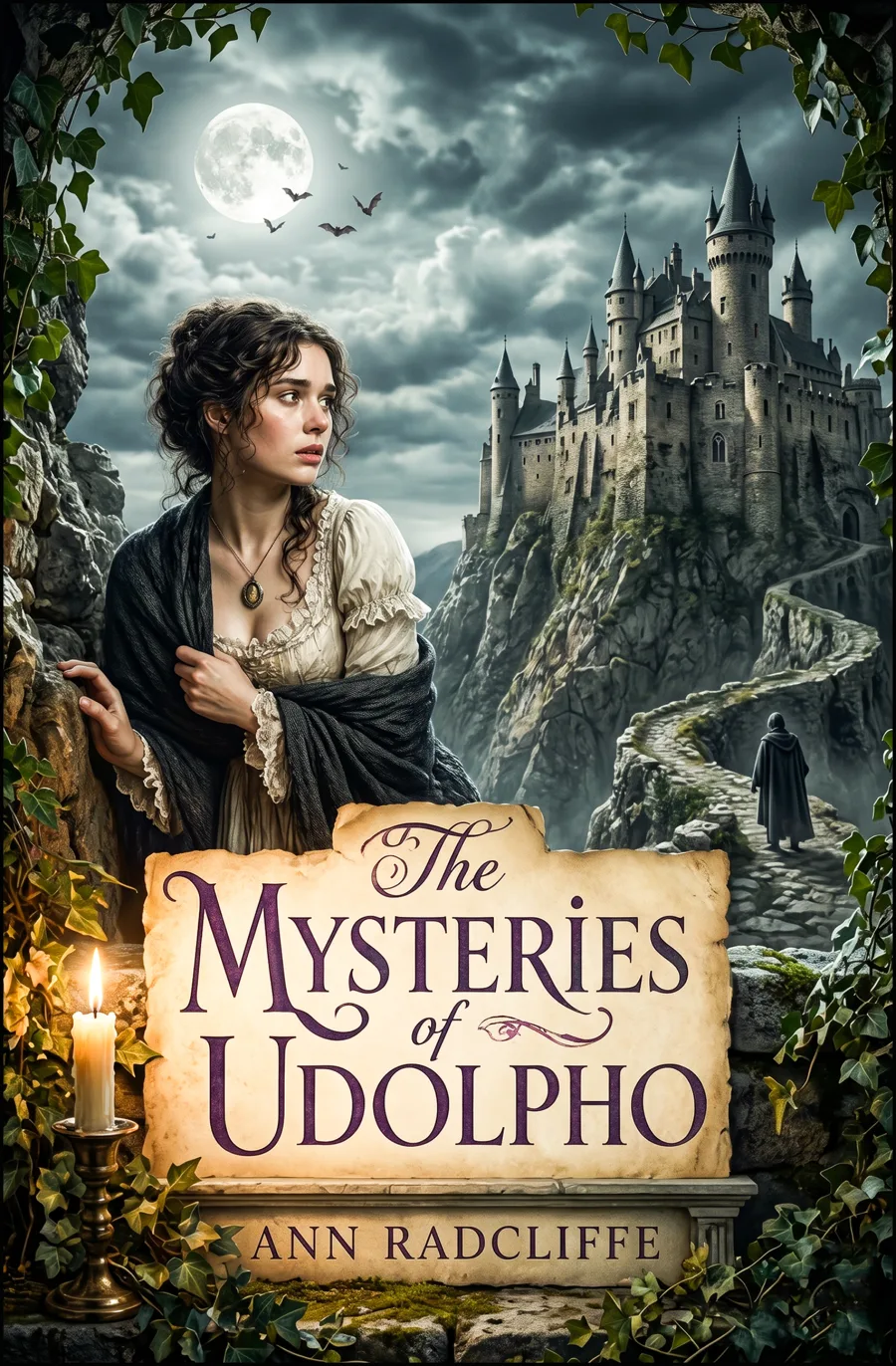
Download Cover Image
Do you want to download the full cover image for The Mysteries of Udolpho?