
The Old Curiosity Shop
eBook
• INR 51.00
• English
• 9788169359245
No ratings yet
| Publisher | General Press |
|---|---|
| ISBN13 | 9788169359245 |
| ASIN/SKU | 8169359244 |
| Book Format | eBook |
| Language | English |
| List Price | INR 51.00 |
| Subject Code | FIC043000, FIC045000, FIC052000 |
| Publishing Date | 01/09/2026 |
| Book Code | BD00070236 |
Buy this Book
Amazon Stores
Ebook Stores
Other Stores
Discover The Old Curiosity Shop by Charles Dickens. This book is published by General Press in eBook format, ISBN 9788169359245, ASIN 8169359244, under Literature and Fiction, Coming of Age Fiction, Family Life Fiction.
Book Description
A young girl's desperate journey becomes a moving struggle against poverty, greed, and the hardships of an unforgiving world. 'The Old Curiosity Shop' by Charles Dickens is a classic Victorian novel that blends literary fiction, drama, sentiment, and social commentary, following the fortunes of innocent Nell Trent and her troubled grandfather.
Nell lives with her grandfather in the mysterious old curiosity shop, where their quiet existence is overshadowed by financial difficulties. Her grandfather loves her deeply but has secretly become obsessed with gambling, hoping that luck will provide enough money to secure Nell's future. When his debts grow beyond control, the two are forced to leave the shop and begin a difficult journey across England. Along the way, they encounter a wide range of characters, from generous and compassionate people to selfish figures who take advantage of their vulnerability.
Their greatest threat is Daniel Quilp, a cruel, cunning, and physically grotesque moneylender who becomes determined to control their lives. As Nell and her grandfather struggle to escape his influence, they travel through unfamiliar towns and countryside, finding moments of kindness as well as hardship. Nell's courage and innocence stand in sharp contrast to the greed and cruelty surrounding her, while her grandfather's weaknesses repeatedly place them in danger.
Dickens uses their journey to explore poverty, exploitation, family devotion, and the fragile hopes of people living on society's margins. The novel's emotional storytelling, memorable characters, and richly detailed settings give it both warmth and darkness. At its heart, 'The Old Curiosity Shop' is a story about a child's determination to protect someone she loves, no matter how difficult the road becomes. To discover where Nell's journey leads, readers must follow her into Dickens's unforgettable world.
Nell lives with her grandfather in the mysterious old curiosity shop, where their quiet existence is overshadowed by financial difficulties. Her grandfather loves her deeply but has secretly become obsessed with gambling, hoping that luck will provide enough money to secure Nell's future. When his debts grow beyond control, the two are forced to leave the shop and begin a difficult journey across England. Along the way, they encounter a wide range of characters, from generous and compassionate people to selfish figures who take advantage of their vulnerability.
Their greatest threat is Daniel Quilp, a cruel, cunning, and physically grotesque moneylender who becomes determined to control their lives. As Nell and her grandfather struggle to escape his influence, they travel through unfamiliar towns and countryside, finding moments of kindness as well as hardship. Nell's courage and innocence stand in sharp contrast to the greed and cruelty surrounding her, while her grandfather's weaknesses repeatedly place them in danger.
Dickens uses their journey to explore poverty, exploitation, family devotion, and the fragile hopes of people living on society's margins. The novel's emotional storytelling, memorable characters, and richly detailed settings give it both warmth and darkness. At its heart, 'The Old Curiosity Shop' is a story about a child's determination to protect someone she loves, no matter how difficult the road becomes. To discover where Nell's journey leads, readers must follow her into Dickens's unforgettable world.
Author Biography
Few writers have captured the struggles, hopes, humor, and contradictions of everyday life as vividly as Charles Dickens. Charles Dickens was a celebrated English novelist and social commentator whose literary work includes classics such as 'Oliver Twist', 'David Copperfield', 'Great Expectations', 'A Christmas Carol', and 'A Tale of Two Cities'. His stories brought memorable characters and powerful social themes to readers around the world, making him one of the most influential writers of the Victorian era.
Born on February 7, 1812, in Portsmouth, England, Dickens experienced financial hardship during his childhood. When his father was sent to a debtors’ prison, young Dickens was forced to work in a London factory, an experience that deeply influenced his later writing. He eventually became a journalist and began publishing stories that quickly attracted public attention. His early success with 'The Pickwick Papers' established him as a popular writer, while novels such as 'Oliver Twist' and 'Nicholas Nickleby' strengthened his reputation.
Dickens was known for his vivid descriptions, sharp humor, emotional storytelling, and unforgettable characters. Beneath the entertainment, however, his novels often exposed poverty, child labor, poor working conditions, harsh schools, and social inequality. 'A Christmas Carol', in particular, became a lasting symbol of generosity and compassion. His writing connected deeply with ordinary readers and helped encourage greater awareness of social problems.
Throughout his career, Dickens also worked as an editor, public speaker, and performer, gaining remarkable fame during his lifetime. He died on June 9, 1870, but his books have never faded from public life. Charles Dickens remains a defining voice of English literature, and his stories continue to entertain, challenge, and move readers more than a century after his death.
Born on February 7, 1812, in Portsmouth, England, Dickens experienced financial hardship during his childhood. When his father was sent to a debtors’ prison, young Dickens was forced to work in a London factory, an experience that deeply influenced his later writing. He eventually became a journalist and began publishing stories that quickly attracted public attention. His early success with 'The Pickwick Papers' established him as a popular writer, while novels such as 'Oliver Twist' and 'Nicholas Nickleby' strengthened his reputation.
Dickens was known for his vivid descriptions, sharp humor, emotional storytelling, and unforgettable characters. Beneath the entertainment, however, his novels often exposed poverty, child labor, poor working conditions, harsh schools, and social inequality. 'A Christmas Carol', in particular, became a lasting symbol of generosity and compassion. His writing connected deeply with ordinary readers and helped encourage greater awareness of social problems.
Throughout his career, Dickens also worked as an editor, public speaker, and performer, gaining remarkable fame during his lifetime. He died on June 9, 1870, but his books have never faded from public life. Charles Dickens remains a defining voice of English literature, and his stories continue to entertain, challenge, and move readers more than a century after his death.
Editorial Reviews
Editorial Reviews will be added soon…
Book Summary
Charles Dickens’s "The Old Curiosity Shop" is one of his most emotionally powerful novels, combining childhood innocence, poverty, exploitation, family loyalty, greed, loneliness, and the search for safety in an often cruel world. First published in serial form in 1840–1841, the novel tells the story of Nell Trent, a young orphan whose life is destroyed by circumstances largely beyond her control. At the center of the story is the mysterious old curiosity shop where Nell lives with her grandfather, an elderly man whose obsession with gambling gradually pushes them into poverty and danger. As they flee London and encounter a wide range of memorable characters, Dickens creates a moving journey through Victorian society. Although 'The Old Curiosity Shop' is often remembered for its tragic ending, its deeper appeal lies in its compassionate portrait of vulnerable people and its criticism of greed, cruelty, and social indifference.
The story begins in London, where Nell Trent lives with her grandfather in an old shop filled with strange and miscellaneous objects. Nell is an orphan, and her grandfather is her only close family. Dickens deliberately keeps the old man’s name and background somewhat mysterious, emphasizing the unusual atmosphere of the shop and the isolation of the household. Nell is gentle, thoughtful, and remarkably mature for her age. She has very little money, but she possesses a strong moral sense and a deep affection for her grandfather. Her greatest wish is simply to keep their small family together and protect the old man from the troubles created by his own weaknesses.
Unfortunately, Nell’s grandfather has developed a dangerous obsession with gambling. He wants to make money quickly so that Nell will never have to experience poverty. His intentions are not entirely selfish; he genuinely loves her. Yet his attempts to secure her future only make their situation worse. He secretly borrows money and becomes increasingly dependent on Daniel Quilp, a wealthy moneylender whose physical ugliness is matched by his cruelty and manipulative nature. Quilp becomes one of Dickens’s most memorable villains because he enjoys controlling and humiliating people. He sees the vulnerability of Nell and her grandfather as an opportunity to increase his own power.
The grandfather’s gambling eventually destroys the security of the curiosity shop. He loses money that he cannot afford to lose and becomes indebted to Quilp. As the pressure grows, Nell realizes that remaining in London may put both of them in greater danger. She therefore makes the courageous decision to leave the shop with her grandfather. Their departure marks the beginning of the novel’s central journey. Nell is still a child, but she becomes the person responsible for protecting an adult who should have been protecting her.
Nell and her grandfather travel through the English countryside, moving from one place to another and surviving through kindness, chance, and Nell’s determination. Their journey gives Dickens the opportunity to contrast the dark, crowded world of London with the more open landscapes of rural England. Yet the countryside is not presented as a perfect refuge. Poverty and hardship exist there too, and the pair remains vulnerable to exploitation. Their journey becomes both physical and emotional: they are searching for safety, but they are also gradually moving toward a fate that Nell cannot escape.
One of the novel’s most important qualities is the contrast between Nell’s innocence and the corrupt adults around her. Nell does not understand the complicated financial and social forces that have trapped her. She simply knows that her grandfather is frightened and that she must help him. Dickens uses her innocence to make the surrounding cruelty more painful. The reader sees dangers that Nell herself cannot always recognize. Her goodness does not protect her from suffering, and this is one of the novel’s most heartbreaking ideas.
The story also introduces Nell’s older brother, Frederick Trent, who becomes involved in the family’s troubles. Frederick is ambitious and self-interested, and he believes that Nell may eventually inherit money. He therefore tries to manipulate others for his own benefit. His schemes connect him with Richard Swiveller, one of the novel’s most entertaining characters. Swiveller is a talkative, extravagant, and often irresponsible young man whose comic behavior provides relief from the darker elements of the narrative. Although he initially appears selfish and foolish, he gradually reveals a more generous side.
Richard Swiveller’s relationship with the orphaned girl known as the Marchioness is especially significant. The Marchioness is a neglected child who works for Quilp and his household. She is treated with extraordinary cruelty and given almost no dignity or affection. Swiveller eventually begins to feel genuine concern for her. His growing kindness demonstrates one of Dickens’s recurring ideas: people are not always what they initially appear to be. Someone who seems foolish can possess a good heart, while respectable-looking people can be deeply cruel.
Another major figure is Sampson Brass, Quilp’s lawyer and associate. Brass is dishonest, slippery, and opportunistic. His sister Sally Brass is equally manipulative, and together they help create an atmosphere of intimidation and deceit. Through these characters, Dickens exposes the darker side of Victorian professional life. Respectability, education, and social position do not necessarily correspond to morality. People who appear civilized can exploit the vulnerable just as effectively as obvious criminals.
Quilp remains the central force of danger throughout much of the novel. He is physically small but psychologically domineering. His cruelty toward others is not merely motivated by financial gain; he seems to enjoy the power he exercises over people. He manipulates Nell’s grandfather, pursues Nell and her family, and uses fear to control those around him. Dickens makes Quilp grotesque, almost theatrical, but his behavior represents something very real: the ability of powerful individuals to take advantage of people who have little protection.
The novel’s title is itself important because the old curiosity shop represents both memory and confinement. It is filled with objects from different times and places, suggesting a world disconnected from ordinary life. For Nell, however, the shop is also home. It is where she has lived with her grandfather and where her childhood has been shaped. When she leaves it, she loses more than a building. She loses the only stable environment she has ever known. Her journey therefore becomes a search for a new home that she never truly finds.
As Nell and her grandfather continue traveling, their condition becomes increasingly difficult. They have little money, and the grandfather’s mental and physical state deteriorates. Nell repeatedly sacrifices her own comfort to care for him. She works when she can, accepts help from strangers, and tries to remain hopeful even when circumstances seem hopeless. Dickens uses these experiences to emphasize the dignity of the poor. Nell may have little material wealth, but she possesses qualities that many richer characters lack: patience, compassion, loyalty, and self-sacrifice.
The journey also allows Dickens to introduce a series of memorable episodes and characters, creating the episodic structure for which the novel is known. Nell and her grandfather encounter schoolmasters, performers, workers, travelers, and other people living at the margins of society. Some are kind, while others are indifferent or exploitative. These encounters broaden the novel beyond the immediate family drama and turn it into a portrait of nineteenth-century England. Dickens repeatedly asks what happens to people who lack money, social status, or a protective family.
One of the most striking aspects of the novel is the way Dickens treats childhood. Nell is young, yet she is forced to confront adult responsibilities. She has to worry about money, shelter, illness, and her grandfather’s safety. In contrast, many adults around her behave irresponsibly. This reversal is central to Dickens’s emotional strategy. The child becomes the moral center of the story while adults repeatedly fail in their duties.
Dickens also explores the destructive effects of gambling. Nell’s grandfather does not gamble because he is naturally wicked. His original motivation is the desire to provide security for Nell. Yet gambling gradually becomes an obsession that overwhelms his judgment. His tragedy demonstrates how good intentions can become destructive when combined with addiction and desperation. The grandfather loves Nell, but his inability to control himself places her directly in danger.
The novel’s emotional intensity increases as Nell’s health begins to fail. She has endured physical exhaustion, emotional strain, uncertainty, and poverty for a long time. Her body cannot sustain the burden indefinitely. She and her grandfather eventually find relative safety in a small rural community, where Nell’s character earns the affection of people who recognize her goodness. Yet this peaceful environment comes too late. The possibility of a happy future remains painfully close but ultimately unreachable.
Nell’s death is the defining tragedy of 'The Old Curiosity Shop'. Dickens presents it as the end of a long process of exhaustion rather than as a sudden dramatic event. Nell becomes increasingly weak, and those around her gradually understand that she is dying. Her grandfather, who has depended upon her throughout their journey, is devastated. His love for her is genuine, but it cannot undo the consequences of his earlier actions. The novel’s ending is therefore not simply the death of an innocent child; it is also the emotional destruction of the adult whose choices helped bring about her suffering.
After Nell’s death, the grandfather is left in a state of profound grief. His attachment to her becomes almost obsessive, and he struggles to accept that she is gone. The final sections of the novel reveal the lasting consequences of loss. Other characters also experience reversals, punishments, or changes, but Nell’s death remains the emotional center of the conclusion. Dickens does not offer the reader a conventional happy ending. Instead, he insists that some forms of suffering cannot be neatly repaired.
The character of Nell has sometimes been criticized as overly idealized, but this idealization serves a clear purpose. Dickens wanted her to represent innocence, compassion, and moral endurance in a society where vulnerable people could easily be exploited. She is not powerful because she controls events; she is powerful because she retains her humanity despite what happens to her. Her kindness becomes a form of resistance against the cruelty surrounding her.
At the same time, the novel is not entirely bleak. Characters such as Richard Swiveller demonstrate that people can change. Swiveller’s growing affection for the Marchioness reveals his capacity for responsibility and compassion. Their relationship provides one of the novel’s warmer emotional threads and suggests that genuine kindness can emerge in unexpected places. Dickens therefore balances tragedy with humor and redemption, preventing the novel from becoming completely despairing.
The major themes of 'The Old Curiosity Shop' include ''innocence and vulnerability, poverty and social inequality, gambling and addiction, greed, family loyalty, exploitation, compassion, and the loss of childhood''. Dickens repeatedly contrasts wealth with moral poverty. Some characters have money but little humanity, while others possess almost nothing yet show extraordinary generosity. The novel asks readers to judge people not by their possessions or social standing but by the way they treat those who are weaker than themselves.
The book is also a powerful exploration of ''the relationship between love and responsibility''. Nell loves her grandfather deeply, but love cannot erase the damage caused by his choices. Dickens avoids making him a simple villain. He is a flawed, frightened, loving man whose weakness has terrible consequences. This complexity makes the tragedy more believable. People can love one another sincerely and still hurt one another through poor decisions.
Ultimately, 'The Old Curiosity Shop' is much more than a sentimental Victorian novel about a tragic little girl. It is a compassionate examination of what happens when vulnerable people are left without adequate protection. Through Nell’s journey, Dickens exposes a society in which poverty can make ordinary people helpless before moneylenders, employers, criminals, and other forms of authority. Yet he also celebrates the small acts of kindness that allow people to survive. The novel’s lasting emotional power comes from its combination of social criticism and human tenderness.
The story begins in London, where Nell Trent lives with her grandfather in an old shop filled with strange and miscellaneous objects. Nell is an orphan, and her grandfather is her only close family. Dickens deliberately keeps the old man’s name and background somewhat mysterious, emphasizing the unusual atmosphere of the shop and the isolation of the household. Nell is gentle, thoughtful, and remarkably mature for her age. She has very little money, but she possesses a strong moral sense and a deep affection for her grandfather. Her greatest wish is simply to keep their small family together and protect the old man from the troubles created by his own weaknesses.
Unfortunately, Nell’s grandfather has developed a dangerous obsession with gambling. He wants to make money quickly so that Nell will never have to experience poverty. His intentions are not entirely selfish; he genuinely loves her. Yet his attempts to secure her future only make their situation worse. He secretly borrows money and becomes increasingly dependent on Daniel Quilp, a wealthy moneylender whose physical ugliness is matched by his cruelty and manipulative nature. Quilp becomes one of Dickens’s most memorable villains because he enjoys controlling and humiliating people. He sees the vulnerability of Nell and her grandfather as an opportunity to increase his own power.
The grandfather’s gambling eventually destroys the security of the curiosity shop. He loses money that he cannot afford to lose and becomes indebted to Quilp. As the pressure grows, Nell realizes that remaining in London may put both of them in greater danger. She therefore makes the courageous decision to leave the shop with her grandfather. Their departure marks the beginning of the novel’s central journey. Nell is still a child, but she becomes the person responsible for protecting an adult who should have been protecting her.
Nell and her grandfather travel through the English countryside, moving from one place to another and surviving through kindness, chance, and Nell’s determination. Their journey gives Dickens the opportunity to contrast the dark, crowded world of London with the more open landscapes of rural England. Yet the countryside is not presented as a perfect refuge. Poverty and hardship exist there too, and the pair remains vulnerable to exploitation. Their journey becomes both physical and emotional: they are searching for safety, but they are also gradually moving toward a fate that Nell cannot escape.
One of the novel’s most important qualities is the contrast between Nell’s innocence and the corrupt adults around her. Nell does not understand the complicated financial and social forces that have trapped her. She simply knows that her grandfather is frightened and that she must help him. Dickens uses her innocence to make the surrounding cruelty more painful. The reader sees dangers that Nell herself cannot always recognize. Her goodness does not protect her from suffering, and this is one of the novel’s most heartbreaking ideas.
The story also introduces Nell’s older brother, Frederick Trent, who becomes involved in the family’s troubles. Frederick is ambitious and self-interested, and he believes that Nell may eventually inherit money. He therefore tries to manipulate others for his own benefit. His schemes connect him with Richard Swiveller, one of the novel’s most entertaining characters. Swiveller is a talkative, extravagant, and often irresponsible young man whose comic behavior provides relief from the darker elements of the narrative. Although he initially appears selfish and foolish, he gradually reveals a more generous side.
Richard Swiveller’s relationship with the orphaned girl known as the Marchioness is especially significant. The Marchioness is a neglected child who works for Quilp and his household. She is treated with extraordinary cruelty and given almost no dignity or affection. Swiveller eventually begins to feel genuine concern for her. His growing kindness demonstrates one of Dickens’s recurring ideas: people are not always what they initially appear to be. Someone who seems foolish can possess a good heart, while respectable-looking people can be deeply cruel.
Another major figure is Sampson Brass, Quilp’s lawyer and associate. Brass is dishonest, slippery, and opportunistic. His sister Sally Brass is equally manipulative, and together they help create an atmosphere of intimidation and deceit. Through these characters, Dickens exposes the darker side of Victorian professional life. Respectability, education, and social position do not necessarily correspond to morality. People who appear civilized can exploit the vulnerable just as effectively as obvious criminals.
Quilp remains the central force of danger throughout much of the novel. He is physically small but psychologically domineering. His cruelty toward others is not merely motivated by financial gain; he seems to enjoy the power he exercises over people. He manipulates Nell’s grandfather, pursues Nell and her family, and uses fear to control those around him. Dickens makes Quilp grotesque, almost theatrical, but his behavior represents something very real: the ability of powerful individuals to take advantage of people who have little protection.
The novel’s title is itself important because the old curiosity shop represents both memory and confinement. It is filled with objects from different times and places, suggesting a world disconnected from ordinary life. For Nell, however, the shop is also home. It is where she has lived with her grandfather and where her childhood has been shaped. When she leaves it, she loses more than a building. She loses the only stable environment she has ever known. Her journey therefore becomes a search for a new home that she never truly finds.
As Nell and her grandfather continue traveling, their condition becomes increasingly difficult. They have little money, and the grandfather’s mental and physical state deteriorates. Nell repeatedly sacrifices her own comfort to care for him. She works when she can, accepts help from strangers, and tries to remain hopeful even when circumstances seem hopeless. Dickens uses these experiences to emphasize the dignity of the poor. Nell may have little material wealth, but she possesses qualities that many richer characters lack: patience, compassion, loyalty, and self-sacrifice.
The journey also allows Dickens to introduce a series of memorable episodes and characters, creating the episodic structure for which the novel is known. Nell and her grandfather encounter schoolmasters, performers, workers, travelers, and other people living at the margins of society. Some are kind, while others are indifferent or exploitative. These encounters broaden the novel beyond the immediate family drama and turn it into a portrait of nineteenth-century England. Dickens repeatedly asks what happens to people who lack money, social status, or a protective family.
One of the most striking aspects of the novel is the way Dickens treats childhood. Nell is young, yet she is forced to confront adult responsibilities. She has to worry about money, shelter, illness, and her grandfather’s safety. In contrast, many adults around her behave irresponsibly. This reversal is central to Dickens’s emotional strategy. The child becomes the moral center of the story while adults repeatedly fail in their duties.
Dickens also explores the destructive effects of gambling. Nell’s grandfather does not gamble because he is naturally wicked. His original motivation is the desire to provide security for Nell. Yet gambling gradually becomes an obsession that overwhelms his judgment. His tragedy demonstrates how good intentions can become destructive when combined with addiction and desperation. The grandfather loves Nell, but his inability to control himself places her directly in danger.
The novel’s emotional intensity increases as Nell’s health begins to fail. She has endured physical exhaustion, emotional strain, uncertainty, and poverty for a long time. Her body cannot sustain the burden indefinitely. She and her grandfather eventually find relative safety in a small rural community, where Nell’s character earns the affection of people who recognize her goodness. Yet this peaceful environment comes too late. The possibility of a happy future remains painfully close but ultimately unreachable.
Nell’s death is the defining tragedy of 'The Old Curiosity Shop'. Dickens presents it as the end of a long process of exhaustion rather than as a sudden dramatic event. Nell becomes increasingly weak, and those around her gradually understand that she is dying. Her grandfather, who has depended upon her throughout their journey, is devastated. His love for her is genuine, but it cannot undo the consequences of his earlier actions. The novel’s ending is therefore not simply the death of an innocent child; it is also the emotional destruction of the adult whose choices helped bring about her suffering.
After Nell’s death, the grandfather is left in a state of profound grief. His attachment to her becomes almost obsessive, and he struggles to accept that she is gone. The final sections of the novel reveal the lasting consequences of loss. Other characters also experience reversals, punishments, or changes, but Nell’s death remains the emotional center of the conclusion. Dickens does not offer the reader a conventional happy ending. Instead, he insists that some forms of suffering cannot be neatly repaired.
The character of Nell has sometimes been criticized as overly idealized, but this idealization serves a clear purpose. Dickens wanted her to represent innocence, compassion, and moral endurance in a society where vulnerable people could easily be exploited. She is not powerful because she controls events; she is powerful because she retains her humanity despite what happens to her. Her kindness becomes a form of resistance against the cruelty surrounding her.
At the same time, the novel is not entirely bleak. Characters such as Richard Swiveller demonstrate that people can change. Swiveller’s growing affection for the Marchioness reveals his capacity for responsibility and compassion. Their relationship provides one of the novel’s warmer emotional threads and suggests that genuine kindness can emerge in unexpected places. Dickens therefore balances tragedy with humor and redemption, preventing the novel from becoming completely despairing.
The major themes of 'The Old Curiosity Shop' include ''innocence and vulnerability, poverty and social inequality, gambling and addiction, greed, family loyalty, exploitation, compassion, and the loss of childhood''. Dickens repeatedly contrasts wealth with moral poverty. Some characters have money but little humanity, while others possess almost nothing yet show extraordinary generosity. The novel asks readers to judge people not by their possessions or social standing but by the way they treat those who are weaker than themselves.
The book is also a powerful exploration of ''the relationship between love and responsibility''. Nell loves her grandfather deeply, but love cannot erase the damage caused by his choices. Dickens avoids making him a simple villain. He is a flawed, frightened, loving man whose weakness has terrible consequences. This complexity makes the tragedy more believable. People can love one another sincerely and still hurt one another through poor decisions.
Ultimately, 'The Old Curiosity Shop' is much more than a sentimental Victorian novel about a tragic little girl. It is a compassionate examination of what happens when vulnerable people are left without adequate protection. Through Nell’s journey, Dickens exposes a society in which poverty can make ordinary people helpless before moneylenders, employers, criminals, and other forms of authority. Yet he also celebrates the small acts of kindness that allow people to survive. The novel’s lasting emotional power comes from its combination of social criticism and human tenderness.
Sample Chapters
Sample Chapters will be added soon…
Reader Reviews
No reviews yet.
The Old Curiosity Shop
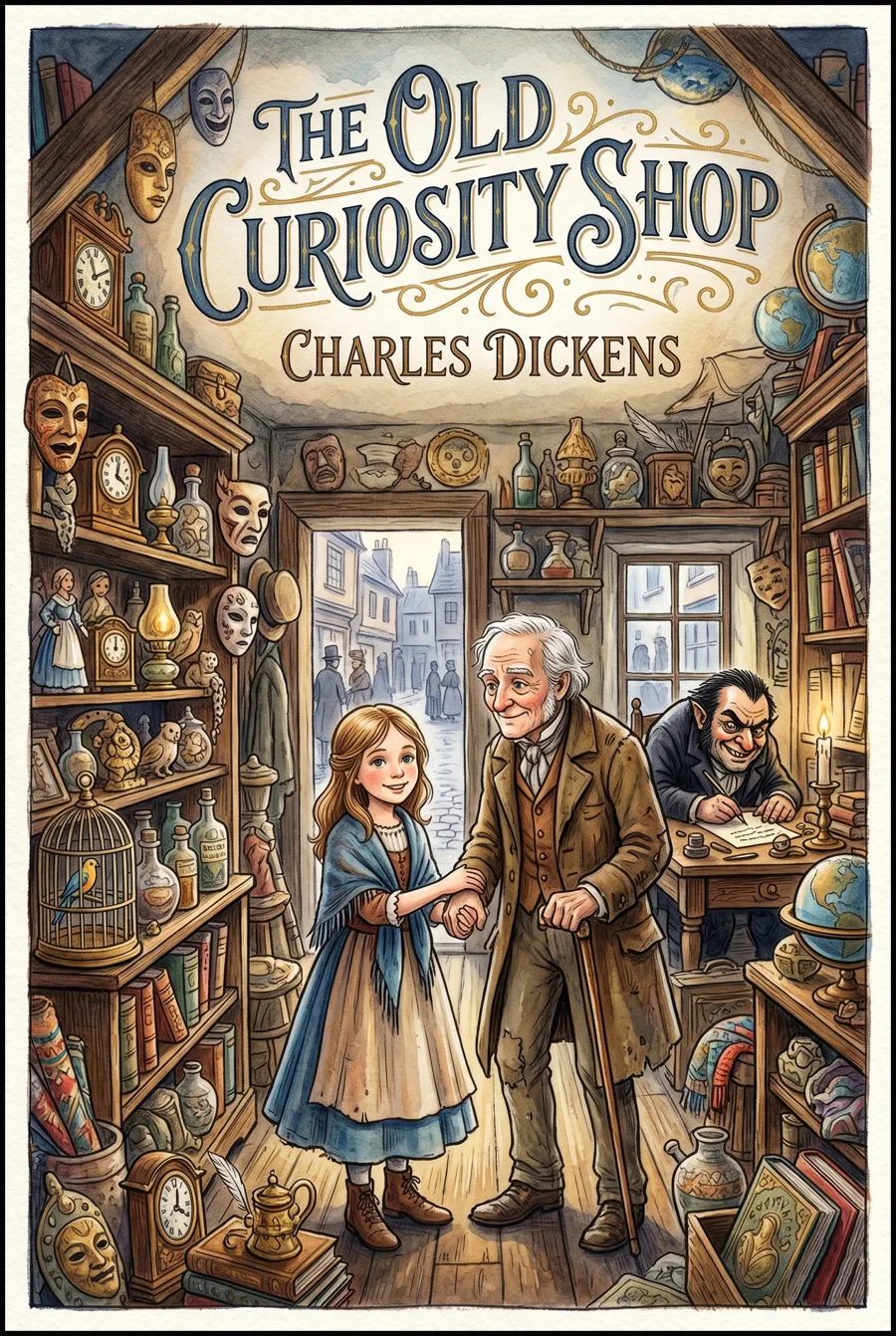
Download Cover Image
Do you want to download the full cover image for The Old Curiosity Shop?