
The Sorrows of Young Werther
eBook
• INR 51.00
• English
• 9788169359283
No ratings yet
| Publisher | General Press |
|---|---|
| ISBN13 | 9788169359283 |
| ASIN/SKU | 8169359287 |
| Book Format | eBook |
| Language | English |
| List Price | INR 51.00 |
| Subject Code | FIC025000, FIC027050, FIC043000 |
| Publishing Date | 01/09/2026 |
| Book Code | BD00070237 |
Buy this Book
Amazon Stores
Ebook Stores
Other Stores
Discover The Sorrows of Young Werther by Johann Wolfgang von Goethe. This book is published by General Press in eBook format, ISBN 9788169359283, ASIN 8169359287, under Literature and Fiction, Psychological Fiction, Historical Romances.
Book Description
When love becomes the center of a person's world, even the smallest distance can feel unbearable. 'The Sorrows of Young Werther' by Johann Wolfgang von Goethe is a landmark German epistolary novel and Romantic tragedy that explores unrequited love, emotional sensitivity, loneliness, and the painful struggle between personal desire and social reality.
The story is told largely through letters written by Werther, a young and deeply sensitive man who leaves his familiar surroundings and settles in the countryside. There, he finds comfort in nature, simple village life, and the freedom to follow his emotions and imagination. His peaceful existence changes when he meets Charlotte, a warm and intelligent young woman who immediately captivates him. Werther soon discovers that Charlotte is already promised to Albert, a respectable and thoughtful man who is away when Werther first encounters her.
Although Werther knows that Charlotte cannot be his, his feelings continue to grow. His admiration gradually becomes an all-consuming love, and he struggles to control emotions that seem stronger than reason. His relationship with Charlotte remains emotionally intimate, yet the limits imposed by her engagement create increasing frustration and despair. Werther's intense personality also makes it difficult for him to find satisfaction in ordinary social expectations, work, or conventional ideas of happiness.
Goethe's novel is much more than a tragic love story. Through Werther's letters, readers experience his shifting moods, passionate observations, and increasingly troubled understanding of himself and the world around him. Nature becomes a reflection of his emotional state, while his conflict with society highlights the tension between individual feeling and restraint.
Beautiful, intimate, and deeply moving, 'The Sorrows of Young Werther' remains a powerful portrait of a heart struggling to live with a love it cannot possess. Its emotional intensity makes every page feel like a step closer to an ending readers will want to discover for themselves.
The story is told largely through letters written by Werther, a young and deeply sensitive man who leaves his familiar surroundings and settles in the countryside. There, he finds comfort in nature, simple village life, and the freedom to follow his emotions and imagination. His peaceful existence changes when he meets Charlotte, a warm and intelligent young woman who immediately captivates him. Werther soon discovers that Charlotte is already promised to Albert, a respectable and thoughtful man who is away when Werther first encounters her.
Although Werther knows that Charlotte cannot be his, his feelings continue to grow. His admiration gradually becomes an all-consuming love, and he struggles to control emotions that seem stronger than reason. His relationship with Charlotte remains emotionally intimate, yet the limits imposed by her engagement create increasing frustration and despair. Werther's intense personality also makes it difficult for him to find satisfaction in ordinary social expectations, work, or conventional ideas of happiness.
Goethe's novel is much more than a tragic love story. Through Werther's letters, readers experience his shifting moods, passionate observations, and increasingly troubled understanding of himself and the world around him. Nature becomes a reflection of his emotional state, while his conflict with society highlights the tension between individual feeling and restraint.
Beautiful, intimate, and deeply moving, 'The Sorrows of Young Werther' remains a powerful portrait of a heart struggling to live with a love it cannot possess. Its emotional intensity makes every page feel like a step closer to an ending readers will want to discover for themselves.
Author Biography
Johann Wolfgang von Goethe was a German writer, poet, playwright, and thinker whose remarkable body of work helped shape European literature. Best known for works such as 'Faust', 'The Sorrows of Young Werther', and 'Wilhelm Meister’s Apprenticeship', Goethe remains one of the most influential figures in world literature.
Born on August 28, 1749, in Frankfurt, Germany, Goethe grew up in a well-educated family and received a broad education in languages, literature, philosophy, art, and science. He studied law at the University of Leipzig and later worked as a lawyer, but his passion for writing soon became the defining force of his life. His early novel 'The Sorrows of Young Werther', published in 1774, brought him international fame. Its emotional intensity and exploration of love, loneliness, and despair made a powerful impression on young readers across Europe.
Goethe eventually settled in Weimar, where he became closely involved in the intellectual and cultural life of the city. His friendship and creative partnership with Friedrich Schiller played an important role in the development of Weimar Classicism. Goethe’s writing ranged widely, from poetry and drama to novels, autobiography, scientific studies, and philosophical reflections. His masterpiece, 'Faust', explores ambition, knowledge, temptation, morality, and the search for meaning through the story of a scholar who makes a pact with the devil.
Known for his elegant language, emotional depth, intellectual curiosity, and interest in human nature, Goethe constantly crossed the boundaries between literature, philosophy, art, and science. He died in Weimar on March 22, 1832, leaving behind a vast and influential body of work. His ideas and writings continue to inspire readers, writers, artists, and thinkers around the world, securing Goethe’s lasting place as a giant of German and global literature.
Born on August 28, 1749, in Frankfurt, Germany, Goethe grew up in a well-educated family and received a broad education in languages, literature, philosophy, art, and science. He studied law at the University of Leipzig and later worked as a lawyer, but his passion for writing soon became the defining force of his life. His early novel 'The Sorrows of Young Werther', published in 1774, brought him international fame. Its emotional intensity and exploration of love, loneliness, and despair made a powerful impression on young readers across Europe.
Goethe eventually settled in Weimar, where he became closely involved in the intellectual and cultural life of the city. His friendship and creative partnership with Friedrich Schiller played an important role in the development of Weimar Classicism. Goethe’s writing ranged widely, from poetry and drama to novels, autobiography, scientific studies, and philosophical reflections. His masterpiece, 'Faust', explores ambition, knowledge, temptation, morality, and the search for meaning through the story of a scholar who makes a pact with the devil.
Known for his elegant language, emotional depth, intellectual curiosity, and interest in human nature, Goethe constantly crossed the boundaries between literature, philosophy, art, and science. He died in Weimar on March 22, 1832, leaving behind a vast and influential body of work. His ideas and writings continue to inspire readers, writers, artists, and thinkers around the world, securing Goethe’s lasting place as a giant of German and global literature.
Editorial Reviews
Editorial Reviews will be added soon…
Book Summary
Johann Wolfgang von Goethe’s "The Sorrows of Young Werther" is one of the most influential novels of European Romanticism and one of the defining works of the German Sturm und Drang movement. First published anonymously in 1774, the novel takes the form of a collection of letters written primarily by the young Werther to his friend Wilhelm. Through these intensely personal letters, Goethe tells the story of a sensitive young man whose overwhelming love for Charlotte, a woman already engaged to another man, gradually develops into emotional despair. The novel explores unrequited love, loneliness, artistic sensitivity, nature, social conventions, class divisions, emotional excess, and the conflict between individual desire and social reality. The story is short, but its emotional intensity is extraordinary. Werther does not simply fall in love; he gradually allows his entire understanding of life to become dependent upon that love. His inability to reconcile his feelings with reality ultimately leads to tragedy.
At the beginning of the novel, Werther has withdrawn from ordinary social life and moved to the countryside, where he hopes to escape the pressures and disappointments of his previous existence. He writes enthusiastically to Wilhelm about the beauty of nature and the freedom he feels away from the city. The landscape gives him a sense of peace and renewal. He spends his days walking through fields, observing trees, talking with ordinary people, and enjoying the simplicity of rural life. His descriptions are emotional rather than scientific. Nature is not merely scenery to Werther; it is something alive and deeply connected to his inner state. When he feels happy, the natural world seems radiant, and when he becomes miserable, the same world appears darker and more oppressive.
These early letters establish Werther as an exceptionally sensitive and imaginative young man. He responds passionately to art, poetry, music, nature, and human suffering. He admires simplicity and dislikes rigid social conventions. He is especially attracted to people who live naturally rather than according to artificial rules. This emotional intensity is both his greatest strength and his greatest weakness. Werther experiences life deeply, but he has difficulty controlling the emotions that overwhelm him.
Everything changes when he meets Charlotte, usually called Lotte. Werther first sees her at a country gathering after being warned that she is already promised to another man. Charlotte is caring for her younger brothers and sisters after the death of her mother, and Werther is immediately captivated by her kindness, responsibility, and natural grace. The scene in which he first meets her is central to the novel. Rather than presenting Charlotte as a distant aristocratic beauty, Goethe introduces her as an ordinary but deeply compassionate young woman who is devoted to her family. Werther sees in her everything he admires: warmth, simplicity, intelligence, generosity, and emotional authenticity.
Werther's attraction to Charlotte quickly becomes an intense love. He spends increasing amounts of time with her, despite knowing that she is engaged to Albert. At first, Albert is away, allowing Werther and Charlotte to become close. Werther idealizes their relationship and begins to interpret their conversations, walks, and shared experiences as evidence of an extraordinary emotional connection. Charlotte cares deeply for Werther, but she never promises him a romantic future. She remains committed to Albert, and Werther knows this from the beginning. The tragedy of the novel therefore does not arise from deception. It arises from Werther's inability to accept a reality that conflicts with his desires.
When Albert returns, Werther meets him and initially finds him reasonable, respectable, and decent. Albert is not portrayed as a conventional villain. He loves Charlotte sincerely and intends to marry her. He is more controlled and practical than Werther, and this difference creates a powerful contrast between the two men. Werther is ruled by emotion, imagination, and spontaneity, while Albert represents reason, stability, social responsibility, and self-control. Neither man is presented as entirely wrong, but Werther gradually becomes unable to tolerate the existence of a rival who possesses the legitimate place in Charlotte's life that he desires.
Werther continues visiting Charlotte even after Albert's return. His emotional dependence on her becomes increasingly obvious. He knows that his presence complicates her life, yet he cannot bring himself to leave. He tries to persuade himself that their friendship is enough, but his letters reveal that he is constantly suffering because he wants more. The ordinary events of their lives become emotionally charged for him. A glance, a conversation, a song, or a shared walk can produce intense happiness followed by equally intense despair.
Goethe uses Werther's letters to show the gradual narrowing of his emotional world. At first, Werther is interested in many things: art, literature, nature, philosophy, friendship, and social life. As his love for Charlotte intensifies, however, these interests increasingly revolve around her. She becomes the center of his existence. His emotional identity becomes dependent upon whether he can be close to her. This transformation is crucial to understanding the novel's tragedy. Werther does not merely suffer because Charlotte does not love him in the same way. He suffers because he has allowed one impossible desire to become the measure of his entire life.
The novel also contains an important criticism of eighteenth-century social hierarchy. Werther becomes frustrated by the rigid distinctions between social classes. He dislikes the idea that a person's worth should depend upon birth, wealth, or rank. At one point, he is humiliated when his presence among aristocratic society is considered inappropriate. The incident deeply affects him because he believes that human beings should be valued according to their character rather than social position. His reaction reveals the broader revolutionary energy of the Sturm und Drang period, which emphasized individual feeling and authenticity over rigid social conventions.
Werther's artistic temperament also contributes to his isolation. He admires Ossian and the emotional intensity of poetry, and he increasingly identifies himself with tragic literary heroes. He finds in literature a reflection of his own suffering. Instead of helping him achieve emotional distance, however, art sometimes intensifies his feelings. He begins to see his own life through the language of tragedy, and the boundary between experience and imagination becomes increasingly blurred.
Eventually, Werther decides that he must leave Charlotte and the countryside. He accepts a position at a court, hoping that work and distance will help him overcome his obsession. This attempt initially appears practical, but the court environment quickly disappoints him. He finds the aristocratic world artificial, hierarchical, and restrictive. His social frustrations become so intense that he resigns and returns to the countryside.
When Werther returns, Charlotte is now married to Albert. This makes his emotional situation even more painful. The possibility he once imagined, however unrealistic, is now definitively closed. Yet instead of accepting the finality of Charlotte's marriage, Werther becomes increasingly obsessed with her. His visits continue, but they become painful for both of them. Charlotte recognizes that his feelings are dangerous and begins to distance herself. She understands that their relationship cannot continue without causing suffering.
The novel's second half becomes progressively darker. Werther's letters lose much of the joyful energy of the opening chapters. Nature, once a source of happiness, begins to reflect his despair. He sees storms, decay, winter, and barren landscapes as expressions of his own emotional condition. The world has not necessarily changed, but his perception of it has. Goethe uses this transformation to show how profoundly psychological states can alter a person's experience of reality.
One of the most significant elements in Werther's decline is his inability to establish emotional boundaries. He understands intellectually that Charlotte is married and that his relationship with her cannot become what he wants. Yet emotional understanding does not translate into acceptance. He repeatedly returns to the same thoughts, memories, and hopes. His suffering becomes self-reinforcing. The more he thinks about Charlotte, the more important she becomes; the more important she becomes, the more impossible it is for him to imagine life without her.
Charlotte is not simply the object of Werther's love; she is also one of the novel's most sympathetic figures. She cares about him and understands his pain, but she cannot give him what he wants without betraying her own commitments. Her eventual decision to distance herself is therefore an act of painful responsibility rather than cruelty. She sees that continued intimacy would only deepen his attachment.
Albert, too, becomes more complicated than the simple "rival" figure Werther might wish him to be. He is not responsible for Werther's suffering. He has a legitimate marriage and a sincere relationship with Charlotte. His rational approach to life stands in direct contrast to Werther's emotional absolutism. Their conflict therefore represents a deeper philosophical tension between feeling and reason.
Werther eventually asks Albert to lend him his pistols. Albert agrees, unaware—or perhaps unwilling to fully acknowledge—what Werther intends to do. Werther then writes his final letters and spends his last evening with Charlotte. Their final meeting is emotionally overwhelming. Werther reads from Ossian, and the atmosphere becomes charged with grief, love, and despair. Charlotte recognizes the danger but cannot prevent what follows.
Werther returns home and shoots himself with the pistols he borrowed from Albert. He does not die immediately. His death is slow and painful, and Goethe describes the aftermath with considerable emotional force. Charlotte is devastated. Werther dies alone, and his burial takes place without the conventional religious and social honors associated with a respectable funeral. The novel ends in an atmosphere of profound sadness and unresolved moral complexity.
For readers searching for an ''in-depth summary of 'The Sorrows of Young Werther''', the central story can be understood as the psychological descent of a sensitive young man who becomes hopelessly attached to a woman he cannot have. Werther begins his life in the countryside with enthusiasm, finding happiness in nature, art, and simple human relationships. His meeting with Charlotte transforms his emotional world. Although he knows she is engaged to Albert, he falls deeply in love with her and gradually becomes unable to imagine happiness without her. He leaves in an attempt to escape his feelings, but returns after becoming dissatisfied with the world of aristocratic society. By then Charlotte is married, and his attachment becomes increasingly destructive. Charlotte finally asks him to stay away, and Werther decides that he cannot continue living with his emotional pain. He takes Albert's pistols and ends his life.
The novel's most important theme is the conflict between ''emotion and reason''. Werther believes that intense feeling is a sign of authentic life, while social conventions often appear to him artificial and oppressive. Yet Goethe does not simply celebrate Werther's emotional freedom. The novel shows the danger of allowing emotion to become absolute. Feeling can provide beauty, empathy, and inspiration, but when a single passion dominates every aspect of existence, it can become destructive. Werther's tragedy lies partly in his inability to accept limits.
Another major theme is ''unrequited love''. Werther's feelings are genuine, but genuine feelings do not create an obligation for another person to return them. Charlotte cares for him, but she loves Albert and remains faithful to her marriage. The novel's emotional power comes from the fact that there is no simple villain. Werther's love is sincere, Charlotte's loyalty is sincere, and Albert's marriage is legitimate. Their tragedy emerges from incompatible desires rather than deliberate cruelty.
Nature is also central to the novel. Goethe uses landscapes as a reflection of Werther's emotional life. The beautiful countryside at the beginning represents freedom and possibility, while the increasingly bleak landscapes of the later sections mirror his despair. This intimate relationship between nature and emotion became one of the defining characteristics of Romantic literature.
The novel is also a study of ''youthful idealism''. Werther wants life to possess an intensity and purity that ordinary society cannot provide. He wants love without compromise, art without limitation, friendship without restraint, and freedom without social restrictions. The adult world, with its duties and compromises, seems disappointing to him. Yet Goethe suggests that maturity requires learning how to live with limits rather than simply rejecting them.
The influence of 'The Sorrows of Young Werther' was enormous. It became a major European literary sensation and helped establish Goethe as an international literary figure. Its emotional directness, epistolary structure, focus on subjective experience, and celebration of individual feeling made it a foundational text of Romanticism. The novel also became associated with the so-called "Werther effect," referring to reported imitation of the character's suicide, although modern readers should approach that historical association carefully and distinguish literary influence from the much more complex realities of suicide and mental distress.
Ultimately, 'The Sorrows of Young Werther' is not simply a tragic love story. It is a deeply personal exploration of what happens when sensitivity becomes inseparable from suffering. Werther sees beauty more intensely than many people around him, but he also experiences disappointment with unusual force. His tragedy is that he cannot find a way to preserve his sensitivity while accepting reality. Goethe gives readers neither a simple condemnation nor a simple celebration of Werther. Instead, he creates a deeply human portrait of a young man caught between what he feels and what life will allow.
That is why 'The Sorrows of Young Werther' remains an enduring classic of ''German literature, Romantic literature, epistolary fiction, tragic romance, unrequited love, and psychological fiction''. Its language of longing and emotional isolation continues to resonate because the central experience is timeless: loving someone who cannot belong to you, believing that one feeling can determine the meaning of an entire life, and struggling to reconcile the heart's desires with the world's limits. Goethe's achievement is to turn that private emotional conflict into a universal literary experience, making Werther's sorrow not merely the tragedy of one young man, but a powerful examination of love, identity, imagination, and the painful process of growing up.
At the beginning of the novel, Werther has withdrawn from ordinary social life and moved to the countryside, where he hopes to escape the pressures and disappointments of his previous existence. He writes enthusiastically to Wilhelm about the beauty of nature and the freedom he feels away from the city. The landscape gives him a sense of peace and renewal. He spends his days walking through fields, observing trees, talking with ordinary people, and enjoying the simplicity of rural life. His descriptions are emotional rather than scientific. Nature is not merely scenery to Werther; it is something alive and deeply connected to his inner state. When he feels happy, the natural world seems radiant, and when he becomes miserable, the same world appears darker and more oppressive.
These early letters establish Werther as an exceptionally sensitive and imaginative young man. He responds passionately to art, poetry, music, nature, and human suffering. He admires simplicity and dislikes rigid social conventions. He is especially attracted to people who live naturally rather than according to artificial rules. This emotional intensity is both his greatest strength and his greatest weakness. Werther experiences life deeply, but he has difficulty controlling the emotions that overwhelm him.
Everything changes when he meets Charlotte, usually called Lotte. Werther first sees her at a country gathering after being warned that she is already promised to another man. Charlotte is caring for her younger brothers and sisters after the death of her mother, and Werther is immediately captivated by her kindness, responsibility, and natural grace. The scene in which he first meets her is central to the novel. Rather than presenting Charlotte as a distant aristocratic beauty, Goethe introduces her as an ordinary but deeply compassionate young woman who is devoted to her family. Werther sees in her everything he admires: warmth, simplicity, intelligence, generosity, and emotional authenticity.
Werther's attraction to Charlotte quickly becomes an intense love. He spends increasing amounts of time with her, despite knowing that she is engaged to Albert. At first, Albert is away, allowing Werther and Charlotte to become close. Werther idealizes their relationship and begins to interpret their conversations, walks, and shared experiences as evidence of an extraordinary emotional connection. Charlotte cares deeply for Werther, but she never promises him a romantic future. She remains committed to Albert, and Werther knows this from the beginning. The tragedy of the novel therefore does not arise from deception. It arises from Werther's inability to accept a reality that conflicts with his desires.
When Albert returns, Werther meets him and initially finds him reasonable, respectable, and decent. Albert is not portrayed as a conventional villain. He loves Charlotte sincerely and intends to marry her. He is more controlled and practical than Werther, and this difference creates a powerful contrast between the two men. Werther is ruled by emotion, imagination, and spontaneity, while Albert represents reason, stability, social responsibility, and self-control. Neither man is presented as entirely wrong, but Werther gradually becomes unable to tolerate the existence of a rival who possesses the legitimate place in Charlotte's life that he desires.
Werther continues visiting Charlotte even after Albert's return. His emotional dependence on her becomes increasingly obvious. He knows that his presence complicates her life, yet he cannot bring himself to leave. He tries to persuade himself that their friendship is enough, but his letters reveal that he is constantly suffering because he wants more. The ordinary events of their lives become emotionally charged for him. A glance, a conversation, a song, or a shared walk can produce intense happiness followed by equally intense despair.
Goethe uses Werther's letters to show the gradual narrowing of his emotional world. At first, Werther is interested in many things: art, literature, nature, philosophy, friendship, and social life. As his love for Charlotte intensifies, however, these interests increasingly revolve around her. She becomes the center of his existence. His emotional identity becomes dependent upon whether he can be close to her. This transformation is crucial to understanding the novel's tragedy. Werther does not merely suffer because Charlotte does not love him in the same way. He suffers because he has allowed one impossible desire to become the measure of his entire life.
The novel also contains an important criticism of eighteenth-century social hierarchy. Werther becomes frustrated by the rigid distinctions between social classes. He dislikes the idea that a person's worth should depend upon birth, wealth, or rank. At one point, he is humiliated when his presence among aristocratic society is considered inappropriate. The incident deeply affects him because he believes that human beings should be valued according to their character rather than social position. His reaction reveals the broader revolutionary energy of the Sturm und Drang period, which emphasized individual feeling and authenticity over rigid social conventions.
Werther's artistic temperament also contributes to his isolation. He admires Ossian and the emotional intensity of poetry, and he increasingly identifies himself with tragic literary heroes. He finds in literature a reflection of his own suffering. Instead of helping him achieve emotional distance, however, art sometimes intensifies his feelings. He begins to see his own life through the language of tragedy, and the boundary between experience and imagination becomes increasingly blurred.
Eventually, Werther decides that he must leave Charlotte and the countryside. He accepts a position at a court, hoping that work and distance will help him overcome his obsession. This attempt initially appears practical, but the court environment quickly disappoints him. He finds the aristocratic world artificial, hierarchical, and restrictive. His social frustrations become so intense that he resigns and returns to the countryside.
When Werther returns, Charlotte is now married to Albert. This makes his emotional situation even more painful. The possibility he once imagined, however unrealistic, is now definitively closed. Yet instead of accepting the finality of Charlotte's marriage, Werther becomes increasingly obsessed with her. His visits continue, but they become painful for both of them. Charlotte recognizes that his feelings are dangerous and begins to distance herself. She understands that their relationship cannot continue without causing suffering.
The novel's second half becomes progressively darker. Werther's letters lose much of the joyful energy of the opening chapters. Nature, once a source of happiness, begins to reflect his despair. He sees storms, decay, winter, and barren landscapes as expressions of his own emotional condition. The world has not necessarily changed, but his perception of it has. Goethe uses this transformation to show how profoundly psychological states can alter a person's experience of reality.
One of the most significant elements in Werther's decline is his inability to establish emotional boundaries. He understands intellectually that Charlotte is married and that his relationship with her cannot become what he wants. Yet emotional understanding does not translate into acceptance. He repeatedly returns to the same thoughts, memories, and hopes. His suffering becomes self-reinforcing. The more he thinks about Charlotte, the more important she becomes; the more important she becomes, the more impossible it is for him to imagine life without her.
Charlotte is not simply the object of Werther's love; she is also one of the novel's most sympathetic figures. She cares about him and understands his pain, but she cannot give him what he wants without betraying her own commitments. Her eventual decision to distance herself is therefore an act of painful responsibility rather than cruelty. She sees that continued intimacy would only deepen his attachment.
Albert, too, becomes more complicated than the simple "rival" figure Werther might wish him to be. He is not responsible for Werther's suffering. He has a legitimate marriage and a sincere relationship with Charlotte. His rational approach to life stands in direct contrast to Werther's emotional absolutism. Their conflict therefore represents a deeper philosophical tension between feeling and reason.
Werther eventually asks Albert to lend him his pistols. Albert agrees, unaware—or perhaps unwilling to fully acknowledge—what Werther intends to do. Werther then writes his final letters and spends his last evening with Charlotte. Their final meeting is emotionally overwhelming. Werther reads from Ossian, and the atmosphere becomes charged with grief, love, and despair. Charlotte recognizes the danger but cannot prevent what follows.
Werther returns home and shoots himself with the pistols he borrowed from Albert. He does not die immediately. His death is slow and painful, and Goethe describes the aftermath with considerable emotional force. Charlotte is devastated. Werther dies alone, and his burial takes place without the conventional religious and social honors associated with a respectable funeral. The novel ends in an atmosphere of profound sadness and unresolved moral complexity.
For readers searching for an ''in-depth summary of 'The Sorrows of Young Werther''', the central story can be understood as the psychological descent of a sensitive young man who becomes hopelessly attached to a woman he cannot have. Werther begins his life in the countryside with enthusiasm, finding happiness in nature, art, and simple human relationships. His meeting with Charlotte transforms his emotional world. Although he knows she is engaged to Albert, he falls deeply in love with her and gradually becomes unable to imagine happiness without her. He leaves in an attempt to escape his feelings, but returns after becoming dissatisfied with the world of aristocratic society. By then Charlotte is married, and his attachment becomes increasingly destructive. Charlotte finally asks him to stay away, and Werther decides that he cannot continue living with his emotional pain. He takes Albert's pistols and ends his life.
The novel's most important theme is the conflict between ''emotion and reason''. Werther believes that intense feeling is a sign of authentic life, while social conventions often appear to him artificial and oppressive. Yet Goethe does not simply celebrate Werther's emotional freedom. The novel shows the danger of allowing emotion to become absolute. Feeling can provide beauty, empathy, and inspiration, but when a single passion dominates every aspect of existence, it can become destructive. Werther's tragedy lies partly in his inability to accept limits.
Another major theme is ''unrequited love''. Werther's feelings are genuine, but genuine feelings do not create an obligation for another person to return them. Charlotte cares for him, but she loves Albert and remains faithful to her marriage. The novel's emotional power comes from the fact that there is no simple villain. Werther's love is sincere, Charlotte's loyalty is sincere, and Albert's marriage is legitimate. Their tragedy emerges from incompatible desires rather than deliberate cruelty.
Nature is also central to the novel. Goethe uses landscapes as a reflection of Werther's emotional life. The beautiful countryside at the beginning represents freedom and possibility, while the increasingly bleak landscapes of the later sections mirror his despair. This intimate relationship between nature and emotion became one of the defining characteristics of Romantic literature.
The novel is also a study of ''youthful idealism''. Werther wants life to possess an intensity and purity that ordinary society cannot provide. He wants love without compromise, art without limitation, friendship without restraint, and freedom without social restrictions. The adult world, with its duties and compromises, seems disappointing to him. Yet Goethe suggests that maturity requires learning how to live with limits rather than simply rejecting them.
The influence of 'The Sorrows of Young Werther' was enormous. It became a major European literary sensation and helped establish Goethe as an international literary figure. Its emotional directness, epistolary structure, focus on subjective experience, and celebration of individual feeling made it a foundational text of Romanticism. The novel also became associated with the so-called "Werther effect," referring to reported imitation of the character's suicide, although modern readers should approach that historical association carefully and distinguish literary influence from the much more complex realities of suicide and mental distress.
Ultimately, 'The Sorrows of Young Werther' is not simply a tragic love story. It is a deeply personal exploration of what happens when sensitivity becomes inseparable from suffering. Werther sees beauty more intensely than many people around him, but he also experiences disappointment with unusual force. His tragedy is that he cannot find a way to preserve his sensitivity while accepting reality. Goethe gives readers neither a simple condemnation nor a simple celebration of Werther. Instead, he creates a deeply human portrait of a young man caught between what he feels and what life will allow.
That is why 'The Sorrows of Young Werther' remains an enduring classic of ''German literature, Romantic literature, epistolary fiction, tragic romance, unrequited love, and psychological fiction''. Its language of longing and emotional isolation continues to resonate because the central experience is timeless: loving someone who cannot belong to you, believing that one feeling can determine the meaning of an entire life, and struggling to reconcile the heart's desires with the world's limits. Goethe's achievement is to turn that private emotional conflict into a universal literary experience, making Werther's sorrow not merely the tragedy of one young man, but a powerful examination of love, identity, imagination, and the painful process of growing up.
Sample Chapters
Sample Chapters will be added soon…
Reader Reviews
No reviews yet.
The Sorrows of Young Werther
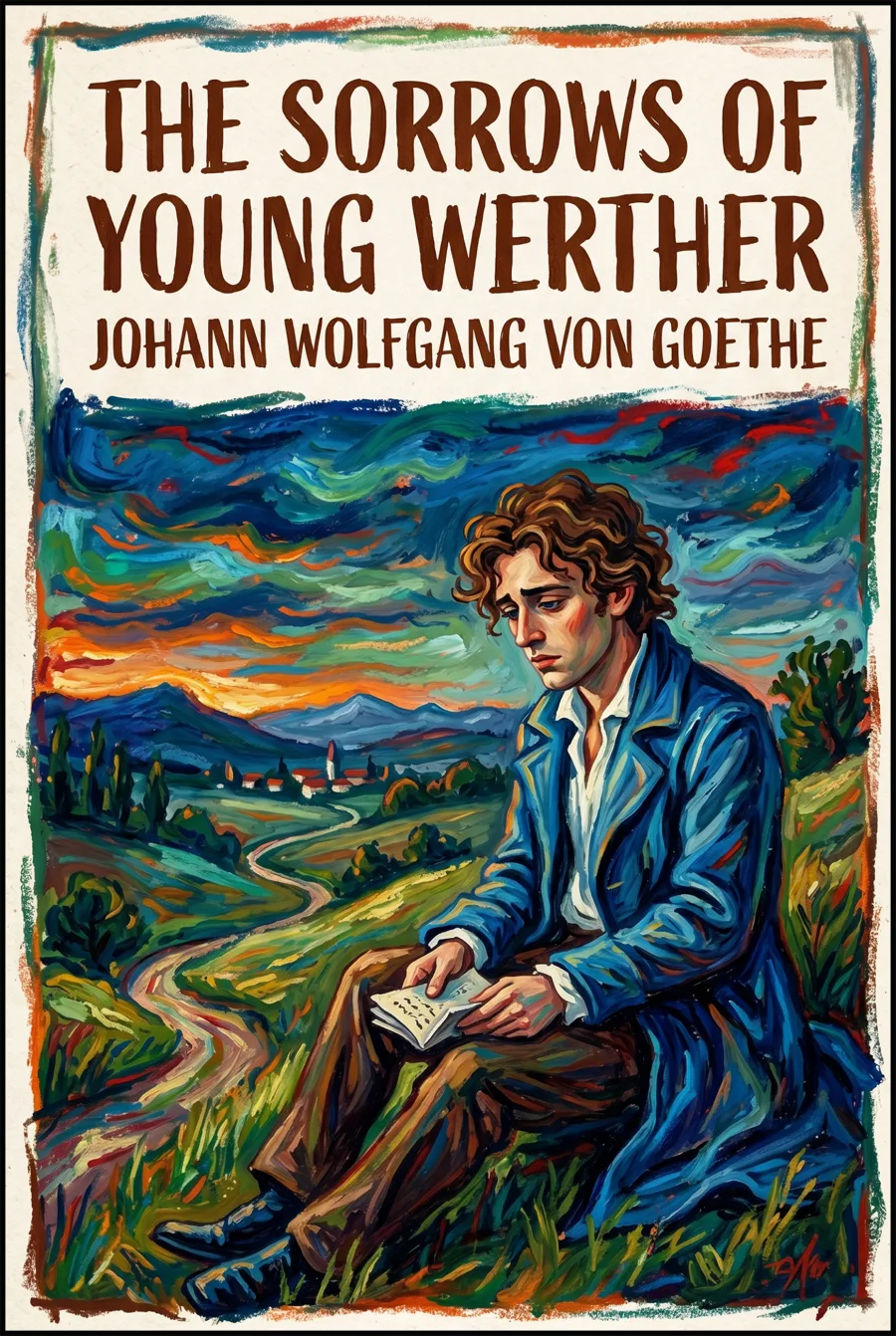
Download Cover Image
Do you want to download the full cover image for The Sorrows of Young Werther?