
Thuvia, maid of Mars
eBook
• INR 51.00
• English
• 9788169359665
No ratings yet
| Publisher | General Press |
|---|---|
| ISBN13 | 9788169359665 |
| ASIN/SKU | 816935966X |
| Book Format | eBook |
| Language | English |
| List Price | INR 51.00 |
| Subject Code | FIC028010, FIC028030, FIC027130 |
| Publishing Date | 01/09/2026 |
| Book Code | BD00070238 |
Buy this Book
Amazon Stores
Ebook Stores
Other Stores
Discover Thuvia, maid of Mars by Edgar Rice Burroughs. This book is published by General Press in eBook format, ISBN 9788169359665, ASIN 816935966X, under Literature and Fiction, Science Fiction Adventures, Space Operas.
Book Description
When love, honor, and adventure collide on a distant world, one young warrior must cross dangerous lands to rescue the woman he loves. 'Thuvia, Maid of Mars' by Edgar Rice Burroughs is a classic science fiction and planetary romance novel filled with action, political intrigue, ancient civilizations, daring escapes, and the sweeping adventure of Barsoom.
The story follows Carthoris, the son of John Carter and Dejah Thoris, as he struggles to establish his own identity and prove himself as a warrior. His life changes dramatically when he falls in love with Thuvia, the beautiful princess of Ptarth. Their romance quickly becomes complicated by political tensions and a sinister plot involving the kingdoms of Barsoom. When Thuvia is abducted, Carthoris is blamed for her disappearance, forcing him to leave behind his home and reputation in order to find her.
His search takes him across the dangerous Martian landscape, where he encounters hostile creatures, strange cultures, rival warriors, and enemies determined to use Thuvia as part of a larger political scheme. Burroughs keeps the story moving at a brisk pace, combining sword fights, aerial battles, captivity, escapes, and unexpected alliances. Carthoris must rely not only on his strength and courage but also on his judgment as he attempts to survive a world where loyalty can change quickly and appearances are often deceptive.
Alongside its romance and action, the novel explores themes of courage, family legacy, loyalty, and the struggle to earn one's place in a heroic tradition. The vivid Barsoom setting adds an imaginative sense of wonder, making every journey feel like a step into another civilization.
For readers who enjoy classic space adventure and romantic fantasy, 'Thuvia, Maid of Mars' offers a thrilling ride through Burroughs's unforgettable Martian world—where the fate of love may depend on surviving the next impossible challenge.
The story follows Carthoris, the son of John Carter and Dejah Thoris, as he struggles to establish his own identity and prove himself as a warrior. His life changes dramatically when he falls in love with Thuvia, the beautiful princess of Ptarth. Their romance quickly becomes complicated by political tensions and a sinister plot involving the kingdoms of Barsoom. When Thuvia is abducted, Carthoris is blamed for her disappearance, forcing him to leave behind his home and reputation in order to find her.
His search takes him across the dangerous Martian landscape, where he encounters hostile creatures, strange cultures, rival warriors, and enemies determined to use Thuvia as part of a larger political scheme. Burroughs keeps the story moving at a brisk pace, combining sword fights, aerial battles, captivity, escapes, and unexpected alliances. Carthoris must rely not only on his strength and courage but also on his judgment as he attempts to survive a world where loyalty can change quickly and appearances are often deceptive.
Alongside its romance and action, the novel explores themes of courage, family legacy, loyalty, and the struggle to earn one's place in a heroic tradition. The vivid Barsoom setting adds an imaginative sense of wonder, making every journey feel like a step into another civilization.
For readers who enjoy classic space adventure and romantic fantasy, 'Thuvia, Maid of Mars' offers a thrilling ride through Burroughs's unforgettable Martian world—where the fate of love may depend on surviving the next impossible challenge.
Author Biography
Few writers have imagined worlds as vividly as Edgar Rice Burroughs, the American author best known for adventure, science fiction, and fantasy novels, especially the iconic 'Tarzan' series and the 'Barsoom' books. His stories of jungle heroes, lost civilizations, and distant planets captivated generations of readers and helped shape modern popular fiction.
Born on September 1, 1875, in Chicago, Illinois, Burroughs came from a comfortable family but experienced an unsettled early adulthood. He attended several schools, served briefly in the military, and tried his hand at a variety of jobs before finding his calling as a writer. His breakthrough came in 1912 with 'Under the Moons of Mars', a science-fiction adventure later published in book form as 'A Princess of Mars'. The novel introduced readers to John Carter and the imaginative world of Barsoom, establishing Burroughs as a distinctive voice in adventure fiction.
That same year, he published 'Tarzan of the Apes', the novel that would make him famous worldwide. Tarzan, a man raised by apes in the African jungle, became one of the most enduring characters in popular culture. Burroughs continued the character's adventures across numerous novels while also writing stories set on Venus, in Earth's prehistoric past, and in other fantastical settings.
His writing was fast-paced, imaginative, and driven by action, romance, exploration, and survival. Although some elements of his work reflect the attitudes of his era, his ability to create compelling heroes and richly imagined worlds gave his books remarkable staying power. His stories influenced films, comics, television, and generations of science-fiction and adventure writers.
Burroughs died in 1950, but his imaginative worlds continue to attract readers. His lasting legacy lies in the sheer scope of his imagination and the unforgettable characters that continue to bring adventure to life.
Born on September 1, 1875, in Chicago, Illinois, Burroughs came from a comfortable family but experienced an unsettled early adulthood. He attended several schools, served briefly in the military, and tried his hand at a variety of jobs before finding his calling as a writer. His breakthrough came in 1912 with 'Under the Moons of Mars', a science-fiction adventure later published in book form as 'A Princess of Mars'. The novel introduced readers to John Carter and the imaginative world of Barsoom, establishing Burroughs as a distinctive voice in adventure fiction.
That same year, he published 'Tarzan of the Apes', the novel that would make him famous worldwide. Tarzan, a man raised by apes in the African jungle, became one of the most enduring characters in popular culture. Burroughs continued the character's adventures across numerous novels while also writing stories set on Venus, in Earth's prehistoric past, and in other fantastical settings.
His writing was fast-paced, imaginative, and driven by action, romance, exploration, and survival. Although some elements of his work reflect the attitudes of his era, his ability to create compelling heroes and richly imagined worlds gave his books remarkable staying power. His stories influenced films, comics, television, and generations of science-fiction and adventure writers.
Burroughs died in 1950, but his imaginative worlds continue to attract readers. His lasting legacy lies in the sheer scope of his imagination and the unforgettable characters that continue to bring adventure to life.
Editorial Reviews
Editorial Reviews will be added soon…
Book Summary
Edgar Rice Burroughs’s "Thuvia, Maid of Mars" is the fourth novel in the famous Barsoom series and one of the classic works of early planetary romance and science fiction. First published in 1916, the novel continues the adventures of John Carter’s family on Mars but shifts its central focus to his son, Carthoris. The story combines romance, interplanetary adventure, political rivalry, ancient civilizations, dangerous creatures, lost cities, and spectacular battles. At the heart of the novel is Carthoris’s love for Thuvia, a beautiful Martian princess whose mysterious ability to command the planet’s banths makes her both politically valuable and personally fascinating. Their relationship becomes entangled in a dangerous conspiracy involving rival nations, assassination, kidnapping, and a race across the hostile landscape of Barsoom. For readers searching for an ''in-depth summary of 'Thuvia, Maid of Mars''', the novel is best understood as a fast-moving adventure about love and loyalty in a dying world, where personal courage must survive alongside political ambition and ancient Martian mysteries.
The story takes place on Barsoom, Burroughs’s fictional Mars, a planet whose civilization is both technologically advanced and socially rooted in ancient traditions. Mars is a dying world with diminishing water supplies, vast deserts, ruined cities, and isolated communities separated by enormous distances. Its inhabitants include several races and cultures, each with their own political structures and customs. Despite the dangerous environment, Barsoomian society is filled with elaborate traditions surrounding honor, warfare, royalty, marriage, and personal loyalty. These traditions provide the background for Carthoris’s adventure.
Carthoris is the son of John Carter and Dejah Thoris, the heroic couple from the earlier Barsoom novels. He has inherited many of his father's qualities, including courage, physical strength, determination, and a willingness to challenge danger. Yet Carthoris is not simply a copy of John Carter. He is younger, more impulsive, and must establish his own identity as a warrior and leader. His position is complicated because he is connected to the royal house of Helium and is therefore surrounded by political expectations. His romantic interest in Thuvia becomes especially difficult because she is also a princess and because their relationship has implications far beyond their private feelings.
Thuvia is the daughter of the Jeddak of Ptarth, and her beauty and royal status make her one of the most desirable women on Barsoom. More importantly, she possesses a rare ability to control and communicate with the planet's great predatory creatures known as banths. These creatures, sometimes described as Martian lions, are enormously dangerous to ordinary people, but Thuvia can summon and command them. Her unusual power gives her a distinctive place in Barsoomian society and contributes to the mystery surrounding her character.
Carthoris becomes deeply attracted to Thuvia, but their relationship is complicated by the fact that another powerful prince, Astok, also desires her. Astok is a member of the ruling family of Kaol and represents a very different kind of character from Carthoris. Whereas Carthoris is courageous and comparatively straightforward, Astok is ambitious and willing to manipulate circumstances to achieve his objectives. The rivalry between the two men becomes one of the driving forces of the plot.
Thuvia herself is not merely a prize to be won between competing men. She possesses courage and independence, and she becomes an active participant in the story's dangers. Her ability to command banths gives her an unusual form of power, while her royal position makes her central to the political relationships among the Martian kingdoms. Burroughs uses her character to combine romance with adventure: she is both the beloved woman Carthoris seeks to rescue and a significant figure in her own right.
The central conflict begins when political and romantic tensions are manipulated by those who want to weaken Helium and its allies. Carthoris is accused of wrongdoing connected with Thuvia, and circumstances are arranged to make it appear that he has acted dishonorably. The accusation is particularly serious in Barsoomian society because honor is closely tied to personal reputation and political legitimacy. Carthoris finds himself caught in a situation where proving his innocence becomes as important as surviving the physical dangers around him.
The disappearance of Thuvia further complicates the situation. Carthoris is determined to find her, but the circumstances surrounding her kidnapping suggest that the conspiracy is much larger than a simple romantic rivalry. The search takes him away from the familiar political centers of Helium and into the remote regions of Barsoom. As he travels across the planet, the novel becomes a classic lost-world adventure filled with strange cities, dangerous landscapes, hostile warriors, and forgotten civilizations.
One of the most appealing features of 'Thuvia, Maid of Mars' is the way Burroughs transforms Mars into an enormous adventure landscape. Barsoom is not simply a backdrop for the characters. Its deserts, ruined cities, ancient structures, and isolated kingdoms constantly create new dangers. Carthoris must survive encounters with enemies and creatures while also trying to determine who can be trusted. The planet's enormous distances reinforce the sense that he is far from safety.
The novel also introduces the concept of artificial or manufactured creatures and mysterious ancient technology, adding a stronger science-fiction element to the adventure. Burroughs repeatedly imagines a Mars in which advanced technology exists alongside ancient customs. This mixture is characteristic of the Barsoom series. Characters may use sophisticated weapons and aircraft while still following traditions that resemble those of ancient warrior societies.
Carthoris's journey eventually brings him into contact with the mysterious race known as the Lotharians. Their society is one of the novel's most unusual and imaginative elements. The Lotharians have developed extraordinary powers involving the creation of physical manifestations through mental concentration and belief. Their civilization has become so dominated by these powers that the boundary between imagination and physical reality is unstable. Burroughs uses the Lotharians to explore an idea that goes beyond ordinary sword-and-planet adventure: the possibility that thought itself can influence material reality.
The Lotharians also provide some of the novel's strangest episodes because Carthoris encounters apparently impossible enemies and figures whose existence is difficult to understand. What initially seems supernatural gradually receives an explanation through the peculiar psychological and technological practices of the Lotharians. Burroughs maintains his characteristic balance between fantasy and science fiction, allowing extraordinary events to exist while still suggesting rational mechanisms behind them.
Meanwhile, Thuvia remains at the center of the larger political struggle. Her disappearance has consequences for Ptarth, Helium, and other Martian powers. Carthoris's efforts to locate her therefore become a race against time. He must not only save the woman he loves but also expose the conspiracy that has placed them both in danger.
The novel repeatedly emphasizes the importance of honor. Carthoris is willing to risk his life to clear his name and protect Thuvia. On Barsoom, personal reputation is not a minor social concern. It determines political relationships and can mean the difference between alliance and war. Burroughs's heroes tend to operate according to a clear moral code: courage, loyalty, honesty, and devotion are virtues worth risking everything to preserve.
The romance between Carthoris and Thuvia is therefore closely connected to the novel's broader ideas about loyalty. Carthoris's feelings for Thuvia are not merely romantic attraction. His love becomes a source of determination that allows him to endure imprisonment, physical danger, uncertainty, and political hostility. Thuvia, in turn, demonstrates that courage is not limited to warriors. She remains resilient despite the forces attempting to use her as a political object.
Astok's role highlights the darker side of Barsoomian politics. He represents the willingness to manipulate love and honor for personal ambition. His rivalry with Carthoris is not simply a competition for Thuvia's affection; it is a struggle between different ideas of power. Carthoris believes that love and honor must be earned, while Astok is prepared to exploit political circumstances to obtain what he wants.
As the story develops, the various mysteries surrounding Thuvia's disappearance and the accusations against Carthoris begin to converge. The apparent chaos is revealed to be the product of deliberate manipulation. Burroughs builds the narrative around a series of revelations, escapes, confrontations, and reversals. The reader is repeatedly moved from one dangerous situation to another, creating the breathless pacing characteristic of the Barsoom novels.
The Lotharian episodes provide an important contrast to the more familiar political and military conflicts. Their society is strange even by Barsoomian standards, and their unusual powers force Carthoris to question what is real. This section also demonstrates Burroughs's willingness to experiment with different forms of science-fiction imagination. Rather than limiting Mars to battles and exotic landscapes, he introduces a society organized around psychological phenomena and constructed realities.
Despite the novel's fantastical elements, Carthoris's emotional journey remains straightforward. He wants to protect Thuvia, restore his honor, and survive the dangers into which he has been thrown. His determination provides the narrative with a clear emotional center. He does not become heroic because he possesses royal blood; he becomes heroic because he repeatedly chooses courage when fear would be easier.
The final stages of the story bring the various conflicts toward resolution. Carthoris's innocence is established, the conspiracies surrounding Thuvia are exposed, and the threats created by his political enemies begin to collapse. The adventure ultimately allows Carthoris and Thuvia's relationship to move toward a future that had seemed impossible at the beginning. Their union also carries political significance, helping connect the royal interests of different Martian states.
For readers searching for a ''detailed plot summary of 'Thuvia, Maid of Mars''', the story follows Carthoris, the son of John Carter and Dejah Thoris, as he becomes involved with Thuvia, the princess of Ptarth. Thuvia's ability to command the deadly banths makes her unusual even among the extraordinary people of Barsoom. When political rivals manipulate events and Thuvia disappears, Carthoris becomes entangled in a conspiracy that threatens both his reputation and his life. Determined to find Thuvia and prove his innocence, he travels through dangerous regions of Mars, encountering hostile warriors, strange civilizations, ancient ruins, and the mysterious Lotharians. His journey eventually reveals the forces behind the deception and brings the central characters toward a resolution in which love, honor, and political loyalty triumph over manipulation.
One of the novel's most important themes is ''love as a test of courage''. Carthoris's love for Thuvia is repeatedly placed under pressure. He cannot simply declare his affection and expect happiness. He must prove his loyalty through action. This is typical of Burroughs's romantic adventure fiction, in which love is demonstrated through sacrifice, endurance, and bravery.
Another important theme is ''honor versus ambition''. The conflict between Carthoris and Astok represents two competing approaches to power. Carthoris accepts danger in order to protect another person and defend the truth. Astok seeks advantage through manipulation. Burroughs clearly favors the first model, presenting honor as more valuable than political success achieved through deception.
The novel also explores ''imagination and reality'', particularly through the Lotharians. Their unusual society suggests that human beings are capable of creating realities through belief, mental discipline, and imagination. This gives the story a surprisingly modern science-fiction dimension and distinguishes it from a simple planetary adventure.
As a Barsoom novel, 'Thuvia, Maid of Mars' is also notable because it shifts the series' perspective from John Carter to the next generation. Carthoris must step out from his father's shadow and demonstrate that he deserves to be considered a hero in his own right. His adventures suggest that courage and character are not inherited automatically. A famous parent may provide a legacy, but each individual must ultimately prove himself through his own choices.
Ultimately, 'Thuvia, Maid of Mars' is a fast-paced ''science fiction adventure, planetary romance, lost-world fantasy, and heroic romance''. Edgar Rice Burroughs combines sword fights, airships, alien creatures, ancient cities, royal intrigue, mysterious civilizations, and passionate romance into a story designed to keep the reader moving from one discovery to the next. The novel is especially appealing to readers interested in classic science fiction, the Barsoom series, Edgar Rice Burroughs, Mars adventures, sword-and-planet fiction, and early planetary romance.
The enduring appeal of 'Thuvia, Maid of Mars' comes from its sense of limitless adventure. Barsoom is a dying planet, but Burroughs fills it with life, danger, mystery, and imagination. Carthoris's journey across that world is both a physical adventure and a personal test. He must discover whom he can trust, defend the woman he loves, protect his honor, and establish his own identity. Thuvia adds emotional depth to the adventure, while the Lotharians broaden the novel's imaginative scope. By the conclusion, the immediate conspiracies have been resolved, but the larger world of Barsoom remains filled with unexplored possibilities. That combination of romance, action, mystery, and imaginative science fiction explains why 'Thuvia, Maid of Mars' remains an enduring classic of early science fiction and an important chapter in Edgar Rice Burroughs's legendary Barsoom saga.
The story takes place on Barsoom, Burroughs’s fictional Mars, a planet whose civilization is both technologically advanced and socially rooted in ancient traditions. Mars is a dying world with diminishing water supplies, vast deserts, ruined cities, and isolated communities separated by enormous distances. Its inhabitants include several races and cultures, each with their own political structures and customs. Despite the dangerous environment, Barsoomian society is filled with elaborate traditions surrounding honor, warfare, royalty, marriage, and personal loyalty. These traditions provide the background for Carthoris’s adventure.
Carthoris is the son of John Carter and Dejah Thoris, the heroic couple from the earlier Barsoom novels. He has inherited many of his father's qualities, including courage, physical strength, determination, and a willingness to challenge danger. Yet Carthoris is not simply a copy of John Carter. He is younger, more impulsive, and must establish his own identity as a warrior and leader. His position is complicated because he is connected to the royal house of Helium and is therefore surrounded by political expectations. His romantic interest in Thuvia becomes especially difficult because she is also a princess and because their relationship has implications far beyond their private feelings.
Thuvia is the daughter of the Jeddak of Ptarth, and her beauty and royal status make her one of the most desirable women on Barsoom. More importantly, she possesses a rare ability to control and communicate with the planet's great predatory creatures known as banths. These creatures, sometimes described as Martian lions, are enormously dangerous to ordinary people, but Thuvia can summon and command them. Her unusual power gives her a distinctive place in Barsoomian society and contributes to the mystery surrounding her character.
Carthoris becomes deeply attracted to Thuvia, but their relationship is complicated by the fact that another powerful prince, Astok, also desires her. Astok is a member of the ruling family of Kaol and represents a very different kind of character from Carthoris. Whereas Carthoris is courageous and comparatively straightforward, Astok is ambitious and willing to manipulate circumstances to achieve his objectives. The rivalry between the two men becomes one of the driving forces of the plot.
Thuvia herself is not merely a prize to be won between competing men. She possesses courage and independence, and she becomes an active participant in the story's dangers. Her ability to command banths gives her an unusual form of power, while her royal position makes her central to the political relationships among the Martian kingdoms. Burroughs uses her character to combine romance with adventure: she is both the beloved woman Carthoris seeks to rescue and a significant figure in her own right.
The central conflict begins when political and romantic tensions are manipulated by those who want to weaken Helium and its allies. Carthoris is accused of wrongdoing connected with Thuvia, and circumstances are arranged to make it appear that he has acted dishonorably. The accusation is particularly serious in Barsoomian society because honor is closely tied to personal reputation and political legitimacy. Carthoris finds himself caught in a situation where proving his innocence becomes as important as surviving the physical dangers around him.
The disappearance of Thuvia further complicates the situation. Carthoris is determined to find her, but the circumstances surrounding her kidnapping suggest that the conspiracy is much larger than a simple romantic rivalry. The search takes him away from the familiar political centers of Helium and into the remote regions of Barsoom. As he travels across the planet, the novel becomes a classic lost-world adventure filled with strange cities, dangerous landscapes, hostile warriors, and forgotten civilizations.
One of the most appealing features of 'Thuvia, Maid of Mars' is the way Burroughs transforms Mars into an enormous adventure landscape. Barsoom is not simply a backdrop for the characters. Its deserts, ruined cities, ancient structures, and isolated kingdoms constantly create new dangers. Carthoris must survive encounters with enemies and creatures while also trying to determine who can be trusted. The planet's enormous distances reinforce the sense that he is far from safety.
The novel also introduces the concept of artificial or manufactured creatures and mysterious ancient technology, adding a stronger science-fiction element to the adventure. Burroughs repeatedly imagines a Mars in which advanced technology exists alongside ancient customs. This mixture is characteristic of the Barsoom series. Characters may use sophisticated weapons and aircraft while still following traditions that resemble those of ancient warrior societies.
Carthoris's journey eventually brings him into contact with the mysterious race known as the Lotharians. Their society is one of the novel's most unusual and imaginative elements. The Lotharians have developed extraordinary powers involving the creation of physical manifestations through mental concentration and belief. Their civilization has become so dominated by these powers that the boundary between imagination and physical reality is unstable. Burroughs uses the Lotharians to explore an idea that goes beyond ordinary sword-and-planet adventure: the possibility that thought itself can influence material reality.
The Lotharians also provide some of the novel's strangest episodes because Carthoris encounters apparently impossible enemies and figures whose existence is difficult to understand. What initially seems supernatural gradually receives an explanation through the peculiar psychological and technological practices of the Lotharians. Burroughs maintains his characteristic balance between fantasy and science fiction, allowing extraordinary events to exist while still suggesting rational mechanisms behind them.
Meanwhile, Thuvia remains at the center of the larger political struggle. Her disappearance has consequences for Ptarth, Helium, and other Martian powers. Carthoris's efforts to locate her therefore become a race against time. He must not only save the woman he loves but also expose the conspiracy that has placed them both in danger.
The novel repeatedly emphasizes the importance of honor. Carthoris is willing to risk his life to clear his name and protect Thuvia. On Barsoom, personal reputation is not a minor social concern. It determines political relationships and can mean the difference between alliance and war. Burroughs's heroes tend to operate according to a clear moral code: courage, loyalty, honesty, and devotion are virtues worth risking everything to preserve.
The romance between Carthoris and Thuvia is therefore closely connected to the novel's broader ideas about loyalty. Carthoris's feelings for Thuvia are not merely romantic attraction. His love becomes a source of determination that allows him to endure imprisonment, physical danger, uncertainty, and political hostility. Thuvia, in turn, demonstrates that courage is not limited to warriors. She remains resilient despite the forces attempting to use her as a political object.
Astok's role highlights the darker side of Barsoomian politics. He represents the willingness to manipulate love and honor for personal ambition. His rivalry with Carthoris is not simply a competition for Thuvia's affection; it is a struggle between different ideas of power. Carthoris believes that love and honor must be earned, while Astok is prepared to exploit political circumstances to obtain what he wants.
As the story develops, the various mysteries surrounding Thuvia's disappearance and the accusations against Carthoris begin to converge. The apparent chaos is revealed to be the product of deliberate manipulation. Burroughs builds the narrative around a series of revelations, escapes, confrontations, and reversals. The reader is repeatedly moved from one dangerous situation to another, creating the breathless pacing characteristic of the Barsoom novels.
The Lotharian episodes provide an important contrast to the more familiar political and military conflicts. Their society is strange even by Barsoomian standards, and their unusual powers force Carthoris to question what is real. This section also demonstrates Burroughs's willingness to experiment with different forms of science-fiction imagination. Rather than limiting Mars to battles and exotic landscapes, he introduces a society organized around psychological phenomena and constructed realities.
Despite the novel's fantastical elements, Carthoris's emotional journey remains straightforward. He wants to protect Thuvia, restore his honor, and survive the dangers into which he has been thrown. His determination provides the narrative with a clear emotional center. He does not become heroic because he possesses royal blood; he becomes heroic because he repeatedly chooses courage when fear would be easier.
The final stages of the story bring the various conflicts toward resolution. Carthoris's innocence is established, the conspiracies surrounding Thuvia are exposed, and the threats created by his political enemies begin to collapse. The adventure ultimately allows Carthoris and Thuvia's relationship to move toward a future that had seemed impossible at the beginning. Their union also carries political significance, helping connect the royal interests of different Martian states.
For readers searching for a ''detailed plot summary of 'Thuvia, Maid of Mars''', the story follows Carthoris, the son of John Carter and Dejah Thoris, as he becomes involved with Thuvia, the princess of Ptarth. Thuvia's ability to command the deadly banths makes her unusual even among the extraordinary people of Barsoom. When political rivals manipulate events and Thuvia disappears, Carthoris becomes entangled in a conspiracy that threatens both his reputation and his life. Determined to find Thuvia and prove his innocence, he travels through dangerous regions of Mars, encountering hostile warriors, strange civilizations, ancient ruins, and the mysterious Lotharians. His journey eventually reveals the forces behind the deception and brings the central characters toward a resolution in which love, honor, and political loyalty triumph over manipulation.
One of the novel's most important themes is ''love as a test of courage''. Carthoris's love for Thuvia is repeatedly placed under pressure. He cannot simply declare his affection and expect happiness. He must prove his loyalty through action. This is typical of Burroughs's romantic adventure fiction, in which love is demonstrated through sacrifice, endurance, and bravery.
Another important theme is ''honor versus ambition''. The conflict between Carthoris and Astok represents two competing approaches to power. Carthoris accepts danger in order to protect another person and defend the truth. Astok seeks advantage through manipulation. Burroughs clearly favors the first model, presenting honor as more valuable than political success achieved through deception.
The novel also explores ''imagination and reality'', particularly through the Lotharians. Their unusual society suggests that human beings are capable of creating realities through belief, mental discipline, and imagination. This gives the story a surprisingly modern science-fiction dimension and distinguishes it from a simple planetary adventure.
As a Barsoom novel, 'Thuvia, Maid of Mars' is also notable because it shifts the series' perspective from John Carter to the next generation. Carthoris must step out from his father's shadow and demonstrate that he deserves to be considered a hero in his own right. His adventures suggest that courage and character are not inherited automatically. A famous parent may provide a legacy, but each individual must ultimately prove himself through his own choices.
Ultimately, 'Thuvia, Maid of Mars' is a fast-paced ''science fiction adventure, planetary romance, lost-world fantasy, and heroic romance''. Edgar Rice Burroughs combines sword fights, airships, alien creatures, ancient cities, royal intrigue, mysterious civilizations, and passionate romance into a story designed to keep the reader moving from one discovery to the next. The novel is especially appealing to readers interested in classic science fiction, the Barsoom series, Edgar Rice Burroughs, Mars adventures, sword-and-planet fiction, and early planetary romance.
The enduring appeal of 'Thuvia, Maid of Mars' comes from its sense of limitless adventure. Barsoom is a dying planet, but Burroughs fills it with life, danger, mystery, and imagination. Carthoris's journey across that world is both a physical adventure and a personal test. He must discover whom he can trust, defend the woman he loves, protect his honor, and establish his own identity. Thuvia adds emotional depth to the adventure, while the Lotharians broaden the novel's imaginative scope. By the conclusion, the immediate conspiracies have been resolved, but the larger world of Barsoom remains filled with unexplored possibilities. That combination of romance, action, mystery, and imaginative science fiction explains why 'Thuvia, Maid of Mars' remains an enduring classic of early science fiction and an important chapter in Edgar Rice Burroughs's legendary Barsoom saga.
Sample Chapters
Sample Chapters will be added soon…
Reader Reviews
No reviews yet.
Thuvia, maid of Mars
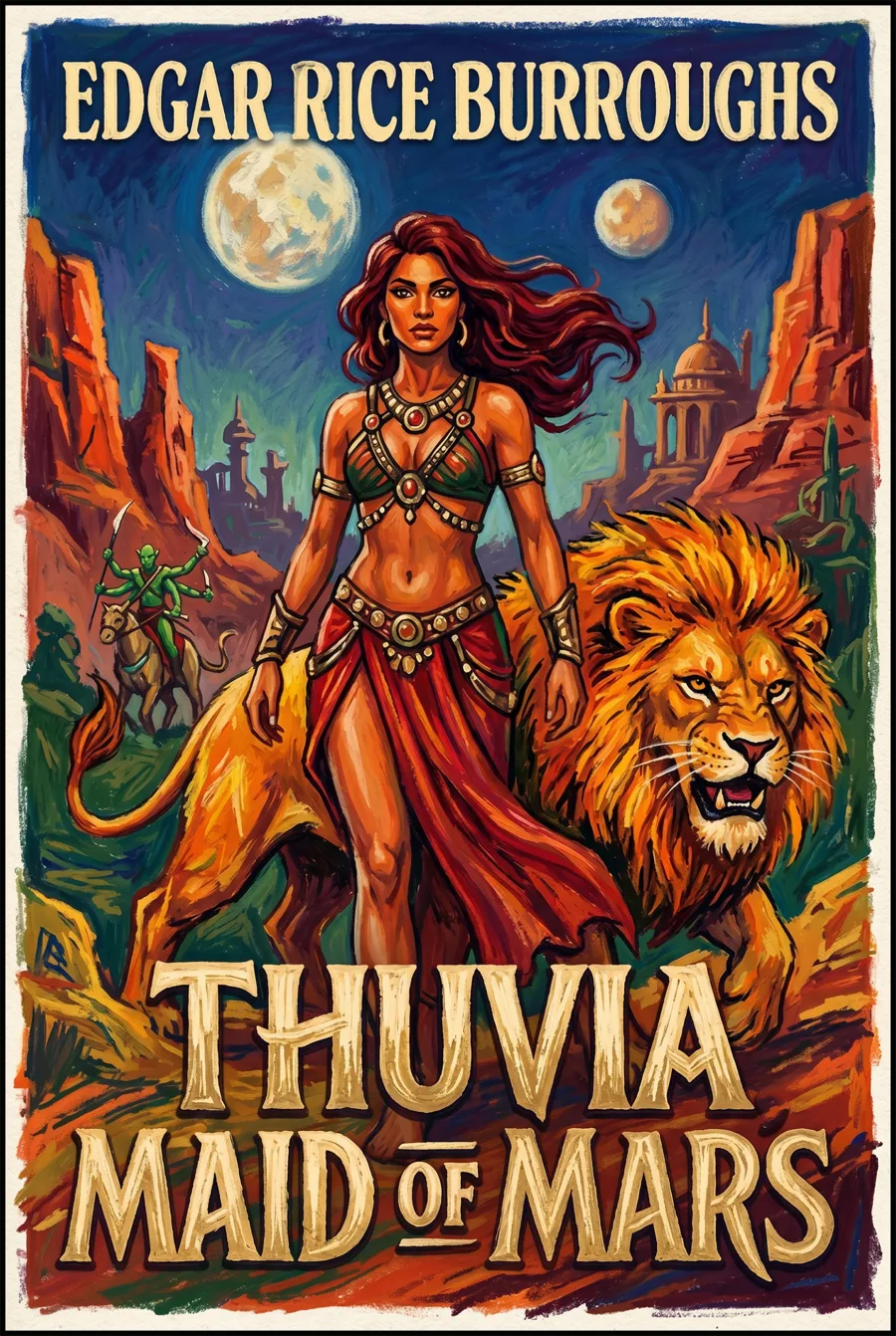
Download Cover Image
Do you want to download the full cover image for Thuvia, maid of Mars?