
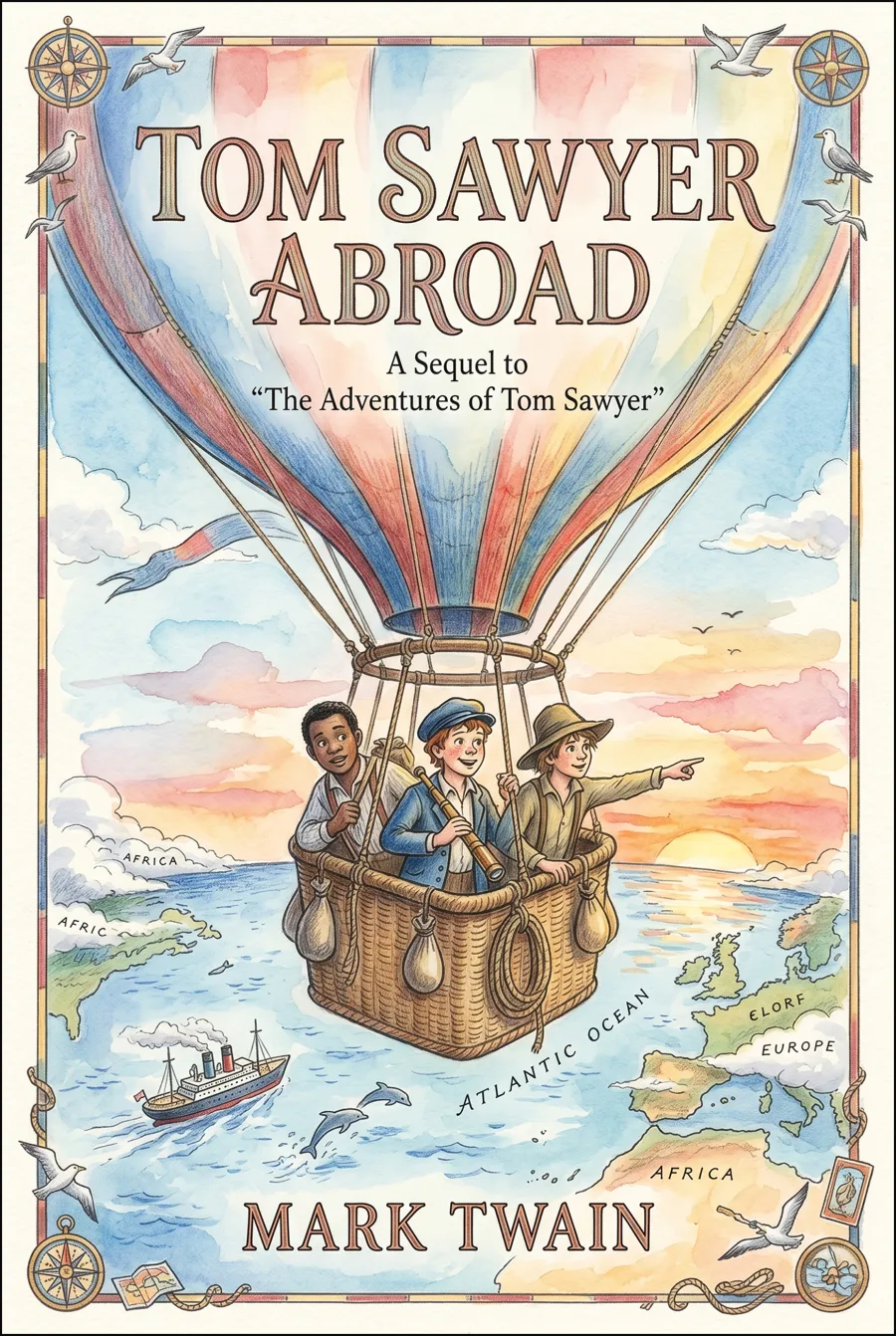
Tom Sawyer Abroad
eBook
• INR 51.00
• English
• 9788169359290
No ratings yet
| Publisher | General Press |
|---|---|
| ISBN13 | 9788169359290 |
| ASIN/SKU | 8169359295 |
| Book Format | eBook |
| Language | English |
| List Price | INR 51.00 |
| Subject Code | FIC002000, FIC016000, FIC052000 |
| Publishing Date | 01/09/2026 |
| Book Code | BD00070239 |
Buy this Book
Amazon Stores
Ebook Stores
Other Stores
Discover Tom Sawyer Abroad by Mark Twain. This book is published by General Press in eBook format, ISBN 9788169359290, ASIN 8169359295, under Literature and Fiction, Action and Adventure Fiction, Humorous Fiction.
Book Description
What happens when Tom Sawyer trades the familiar streets of St. Petersburg for a dangerous adventure across the desert? 'Tom Sawyer Abroad' by Mark Twain is a classic children’s adventure novel filled with humor, mischief, friendship, and unexpected danger. Published in 1894, the story brings Tom, Huck Finn, and Jim together for another unforgettable journey, this time far beyond the Mississippi River.
The adventure begins when Tom and Huck find themselves involved with a mysterious flying machine operated by an eccentric inventor. Before long, the boys and Jim are swept into an extraordinary journey through the skies and across unfamiliar lands. What starts as an exciting opportunity quickly becomes a serious struggle for survival when their aircraft carries them far from home and leaves them stranded in the vast deserts of North Africa.
Separated from the comforts of civilization, Tom, Huck, and Jim must depend on one another as they face scorching heat, limited supplies, unfamiliar surroundings, and the constant uncertainty of finding their way back. Tom's imagination and confidence repeatedly turn ordinary situations into grand adventures, while Huck's practical nature provides a humorous contrast to Tom's elaborate ideas. Jim, meanwhile, brings his own common sense and experience to the group's increasingly difficult circumstances.
Through their journey, Twain combines comedy with a playful look at adventure stories, travel fantasies, and the popular fascination with new technology. Tom's tendency to dramatize events makes even frightening situations entertaining, while Huck's straightforward storytelling keeps the story grounded.
Full of lively dialogue, comic misunderstandings, and unexpected challenges, 'Tom Sawyer Abroad' offers a fresh adventure for two of Twain's most beloved characters. For readers who enjoy classic children's literature, humor, and old-fashioned adventure, this entertaining journey promises plenty of surprises along the way.
The adventure begins when Tom and Huck find themselves involved with a mysterious flying machine operated by an eccentric inventor. Before long, the boys and Jim are swept into an extraordinary journey through the skies and across unfamiliar lands. What starts as an exciting opportunity quickly becomes a serious struggle for survival when their aircraft carries them far from home and leaves them stranded in the vast deserts of North Africa.
Separated from the comforts of civilization, Tom, Huck, and Jim must depend on one another as they face scorching heat, limited supplies, unfamiliar surroundings, and the constant uncertainty of finding their way back. Tom's imagination and confidence repeatedly turn ordinary situations into grand adventures, while Huck's practical nature provides a humorous contrast to Tom's elaborate ideas. Jim, meanwhile, brings his own common sense and experience to the group's increasingly difficult circumstances.
Through their journey, Twain combines comedy with a playful look at adventure stories, travel fantasies, and the popular fascination with new technology. Tom's tendency to dramatize events makes even frightening situations entertaining, while Huck's straightforward storytelling keeps the story grounded.
Full of lively dialogue, comic misunderstandings, and unexpected challenges, 'Tom Sawyer Abroad' offers a fresh adventure for two of Twain's most beloved characters. For readers who enjoy classic children's literature, humor, and old-fashioned adventure, this entertaining journey promises plenty of surprises along the way.
Author Biography
Mark Twain turned everyday American life into unforgettable stories filled with humor, adventure, and sharp social observation. Born Samuel Langhorne Clemens, Mark Twain was an American novelist, essayist, humorist, and journalist best known for classic works such as 'The Adventures of Tom Sawyer' and 'Adventures of Huckleberry Finn', which helped shape American literature.
He was born on November 30, 1835, in Florida, Missouri, and grew up in Hannibal, a Mississippi River town that later inspired many settings in his fiction. After leaving school as a teenager, Clemens worked as a printer and typesetter before becoming a riverboat pilot on the Mississippi. His experience on the river led him to adopt the pen name “Mark Twain,” a term used by riverboat workers to indicate safe navigable water.
Twain began gaining national attention as a writer with humorous newspaper and magazine pieces. His 1865 story “The Celebrated Jumping Frog of Calaveras County” brought him widespread recognition. He went on to publish 'The Innocents Abroad', 'The Prince and the Pauper', 'A Connecticut Yankee in King Arthur's Court', and other influential works. His writing combined wit, vivid characters, regional speech, and adventurous storytelling with serious criticism of racism, inequality, hypocrisy, and social injustice.
'Adventures of Huckleberry Finn', published in 1884, is widely regarded as one of the great American novels. Twain’s ability to capture the voices and attitudes of his time gave his work unusual realism, while his humor made difficult subjects accessible to broad audiences. His lectures and public appearances also made him one of the best-known literary figures of his era.
Mark Twain died on April 21, 1910, but his distinctive voice and fearless humor continue to influence writers and entertain readers. His books remain enduring works of American literature, keeping his legacy alive across generations.
He was born on November 30, 1835, in Florida, Missouri, and grew up in Hannibal, a Mississippi River town that later inspired many settings in his fiction. After leaving school as a teenager, Clemens worked as a printer and typesetter before becoming a riverboat pilot on the Mississippi. His experience on the river led him to adopt the pen name “Mark Twain,” a term used by riverboat workers to indicate safe navigable water.
Twain began gaining national attention as a writer with humorous newspaper and magazine pieces. His 1865 story “The Celebrated Jumping Frog of Calaveras County” brought him widespread recognition. He went on to publish 'The Innocents Abroad', 'The Prince and the Pauper', 'A Connecticut Yankee in King Arthur's Court', and other influential works. His writing combined wit, vivid characters, regional speech, and adventurous storytelling with serious criticism of racism, inequality, hypocrisy, and social injustice.
'Adventures of Huckleberry Finn', published in 1884, is widely regarded as one of the great American novels. Twain’s ability to capture the voices and attitudes of his time gave his work unusual realism, while his humor made difficult subjects accessible to broad audiences. His lectures and public appearances also made him one of the best-known literary figures of his era.
Mark Twain died on April 21, 1910, but his distinctive voice and fearless humor continue to influence writers and entertain readers. His books remain enduring works of American literature, keeping his legacy alive across generations.
Editorial Reviews
Editorial Reviews will be added soon…
Book Summary
Mark Twain’s "Tom Sawyer Abroad" is a lively adventure novel that takes Tom Sawyer, Huckleberry Finn, and Jim far beyond the familiar world of the Mississippi River. First published in 1894, the novel combines humor, suspense, travel, fantasy, and satire as the three friends become involved in an extraordinary journey through the American South, across the Atlantic region, and eventually over the deserts of North Africa. While the book is often described as a sequel to 'The Adventures of Tom Sawyer' and 'Adventures of Huckleberry Finn', it has a distinctive personality of its own. Twain uses the boys’ adventure to poke fun at popular travel stories, scientific speculation, exaggerated ideas about technology, and the human tendency to believe exciting stories simply because they sound marvelous. At the same time, the novel continues Twain’s affectionate portrayal of friendship, courage, curiosity, and the imaginative spirit of childhood.
The story is narrated by Huckleberry Finn, whose plainspoken voice immediately gives the novel its familiar Twainian character. Huck is once again the practical observer who tries to understand the strange events around him without becoming too impressed by Tom’s imagination. Tom, however, remains fascinated by adventure stories. He has read about explorers, inventors, pirates, heroes, and mysterious lands, and he constantly wants to experience the kind of adventures he has encountered in books. Huck is much more skeptical. He has already learned through experience that the world is complicated and that things are rarely as simple as adventure stories make them appear. Their different personalities create much of the novel’s humor.
Jim, meanwhile, is an important member of the trio. He is older, more cautious, and more easily frightened by unfamiliar situations than Tom. Yet his presence also provides emotional warmth. Tom sees the world as a stage for adventure, Huck tries to understand it logically, and Jim reacts according to practical concerns and common sense. Their contrasting perspectives allow Twain to tell the same events from several angles. The friendship among the three is one of the novel’s strongest features, especially because the dangers they encounter repeatedly force them to depend upon one another.
The adventure begins when Tom and Huck become involved with an eccentric inventor named Professor Artemus Robinson. Robinson has constructed a remarkable flying machine—a hot-air balloon—and the boys become fascinated by the possibility of traveling through the air. Tom is thrilled by the idea because it seems like exactly the sort of adventure he has always imagined. Huck, as usual, is less enthusiastic. Jim is even more alarmed by the prospect. Nevertheless, the three eventually find themselves aboard the balloon, and the journey quickly becomes far more serious than any of them expected.
The balloon rises into the sky, carrying Tom, Huck, and Jim away from their familiar surroundings. Their excitement soon gives way to uncertainty when they discover that controlling the balloon is not as easy as they imagined. Instead of being able to return safely, they are carried along by the wind. The situation turns from a thrilling experiment into a genuine survival adventure. They are isolated in the air, uncertain about where they are going, and increasingly dependent upon whatever knowledge they can gather.
This part of 'Tom Sawyer Abroad' shows Twain’s talent for turning technological excitement into comedy. The late nineteenth century was fascinated by scientific progress, inventions, transportation, and the possibility of conquering nature through technology. Twain plays with this enthusiasm by presenting a machine that is astonishing but not entirely dependable. The balloon represents both human ingenuity and human foolishness. The boys have entered the sky because they are fascinated by the possibilities of modern invention, but once they are airborne, they discover that nature remains much more powerful than they are.
Tom, naturally, treats the situation as an adventure. He continually interprets their circumstances through the language of heroic exploration. He is eager to believe that every strange sight has some dramatic explanation. Huck is more cautious, often questioning Tom’s assumptions. This difference between them allows Twain to parody the exaggerated confidence found in adventure literature. Tom wants life to resemble the stories he has read, while Huck repeatedly notices that real life is messier and more frightening.
The balloon eventually carries them across the Atlantic and toward Africa. Their arrival over the Sahara Desert transforms the adventure yet again. The vast desert becomes one of the novel’s most memorable settings. To the boys, it is a mysterious landscape filled with danger, unfamiliar people, strange animals, and ancient ruins. Twain uses their reactions to explore the difference between imagined geography and actual experience. Tom has read descriptions of foreign countries, but reading about a place is very different from surviving there.
The desert creates a new set of problems. The travelers have to think about food, water, shelter, navigation, and the possibility of being stranded far from civilization. The balloon gives them an extraordinary view of the landscape, but it also separates them from the ordinary world. Their elevated perspective allows them to see things that people on the ground cannot see, yet it makes them vulnerable in other ways. The contrast between freedom and helplessness is central to the adventure.
As they travel through Africa, Tom becomes increasingly convinced that they are witnessing extraordinary phenomena. He interprets unfamiliar sights according to the stories and theories he has absorbed. Huck often provides a skeptical counterweight. Their conversations are humorous because Tom’s imagination is so powerful that he can turn almost anything into evidence of a fantastic explanation. Huck, however, understands that people often believe things simply because they want them to be true.
One of the novel’s central comic targets is therefore ''credulity''. Twain repeatedly asks why people accept extraordinary claims without sufficient evidence. Tom is especially vulnerable to spectacular explanations because he enjoys the feeling of being part of a grand adventure. Huck, though hardly a scientific expert, understands the importance of doubt. Through their disagreements, Twain suggests that imagination is valuable but becomes dangerous when it replaces observation and judgment.
The novel also makes fun of ''popular adventure fiction''. Tom has been shaped by books that present heroes as fearless, clever, and constantly surrounded by dramatic events. He tries to imitate these literary heroes in real life. Twain enjoys showing what happens when a boy attempts to apply adventure-story logic to genuine danger. Tom’s courage is real, but his understanding of danger is often distorted by his romantic imagination. This gives the novel both its humor and its affectionate criticism of storytelling itself.
The presence of Jim adds another layer to these adventures. Jim frequently reacts to danger with fear and suspicion, but his fears are not always irrational. In many situations, his practical concerns are more sensible than Tom’s heroic fantasies. Twain uses the contrast to remind readers that courage does not necessarily mean being fearless. Sometimes courage means being afraid and continuing to act sensibly anyway.
Huck’s narration is particularly important because it keeps the story grounded. His language is direct and informal, and he does not pretend to understand everything. This honesty makes him an effective narrator. He reports what he sees, describes Tom’s theories, and lets readers decide what to believe. His uncertainty also contributes to the book’s playful relationship with truth. Like many Twain narrators, Huck is not a perfect authority, but his willingness to admit uncertainty makes him more trustworthy than characters who confidently claim to know everything.
As the journey continues, the boys encounter various dangers and mysteries that test their resourcefulness. Their balloon adventure becomes increasingly unpredictable, and survival depends upon cooperation. Tom’s imagination can sometimes produce useful ideas, while Huck’s caution helps prevent reckless decisions. Jim contributes practical knowledge and emotional steadiness. The three therefore complement one another despite their differences.
The novel’s humor often comes from this dependence. Tom may imagine himself as the heroic leader, but the reality is that none of them can manage the adventure alone. The story quietly undermines the idea of the solitary hero. Real survival is collaborative. The characters must communicate, compromise, and depend on one another, even when their personalities clash.
Another important theme is ''the conflict between civilization and nature''. The balloon seems to represent modern civilization’s attempt to master the natural world. It allows humans to rise above the earth and travel extraordinary distances. Yet the balloon is ultimately controlled by wind and weather. The desert is similarly indifferent to human ambition. No matter how clever Tom thinks he is, the natural world does not care about his plans. Twain’s comedy therefore contains a serious observation about human limitations.
The journey also explores ''the power and limitations of knowledge''. Tom knows many things because he has read many books, but book knowledge does not always prepare him for reality. Huck’s experience often proves more useful because it is based on observation and practical survival. Twain is not simply attacking education or books. Instead, he is showing that knowledge becomes meaningful when people learn how to distinguish information from understanding.
Tom Sawyer himself remains the imaginative center of the novel. He is brave, energetic, curious, and endlessly inventive, but he is also vain and prone to dramatizing everything. His greatest strength and greatest weakness are the same: he wants life to be exciting. This makes him an appealing character because his imagination is closely connected to the imaginative power of childhood itself. Tom reminds readers of the desire to turn ordinary existence into something extraordinary.
Huck, by contrast, represents a more grounded way of seeing the world. He has experienced enough hardship to know that danger is real. He does not need to make life into an adventure because life has already given him plenty of difficult experiences. His friendship with Tom works because the two boys balance one another. Tom provides imagination; Huck provides realism.
Jim’s role also continues Twain’s broader interest in friendship across social boundaries. Although the novel is lighter and more fantastical than 'Adventures of Huckleberry Finn', Jim remains a human presence rather than merely a comic side character. His relationship with Tom and Huck is built around familiarity, affection, disagreement, and mutual dependence. The adventure gives all three characters opportunities to demonstrate loyalty.
The title 'Tom Sawyer Abroad' is itself playful. “Abroad” traditionally suggests travel to distant foreign countries, and Twain uses that idea to take a familiar American character into an unfamiliar world. The result is partly a travel adventure and partly a parody of travel writing. Twain exaggerates the strange and sensational aspects of foreign travel while allowing Huck’s voice to expose the absurdity of some of the boys’ interpretations.
Ultimately, 'Tom Sawyer Abroad' is about more than a balloon trip. It is a humorous exploration of ''adventure, imagination, friendship, technology, fear, storytelling, and the difference between fantasy and reality''. Twain celebrates the curiosity that drives people to explore, but he also warns against believing every exciting story simply because it is exciting. Tom wants the world to be a grand adventure, and in many ways he succeeds in making it one. Huck, however, reminds us that adventure is not the same thing as understanding.
The lasting appeal of 'Tom Sawyer Abroad' comes from this combination of humor and humanity. Readers who enjoy 'The Adventures of Tom Sawyer' and 'Adventures of Huckleberry Finn' will recognize the familiar personalities of Tom, Huck, and Jim, but the setting and subject matter give the story a fresh character. The balloon, the desert, and the distant landscapes create a sense of wonder, while Twain’s satire keeps the adventure from becoming a simple heroic fantasy. Beneath the comedy lies a gentle lesson about humility: human beings can invent remarkable machines, travel astonishing distances, and imagine incredible possibilities, but they remain vulnerable to nature, uncertainty, and their own tendency to misunderstand the world.
In the end, 'Tom Sawyer Abroad' is best understood as a playful adventure story with a skeptical heart. Tom’s imagination makes the journey exciting; Huck’s practical voice makes it believable; and Jim’s presence gives it warmth. Twain invites readers to enjoy the thrill of the unknown while remaining alert to exaggeration and false certainty. The book celebrates the restless human desire to explore, but it also reminds us that the world is often stranger, more difficult, and more interesting than any adventure story can predict.
The story is narrated by Huckleberry Finn, whose plainspoken voice immediately gives the novel its familiar Twainian character. Huck is once again the practical observer who tries to understand the strange events around him without becoming too impressed by Tom’s imagination. Tom, however, remains fascinated by adventure stories. He has read about explorers, inventors, pirates, heroes, and mysterious lands, and he constantly wants to experience the kind of adventures he has encountered in books. Huck is much more skeptical. He has already learned through experience that the world is complicated and that things are rarely as simple as adventure stories make them appear. Their different personalities create much of the novel’s humor.
Jim, meanwhile, is an important member of the trio. He is older, more cautious, and more easily frightened by unfamiliar situations than Tom. Yet his presence also provides emotional warmth. Tom sees the world as a stage for adventure, Huck tries to understand it logically, and Jim reacts according to practical concerns and common sense. Their contrasting perspectives allow Twain to tell the same events from several angles. The friendship among the three is one of the novel’s strongest features, especially because the dangers they encounter repeatedly force them to depend upon one another.
The adventure begins when Tom and Huck become involved with an eccentric inventor named Professor Artemus Robinson. Robinson has constructed a remarkable flying machine—a hot-air balloon—and the boys become fascinated by the possibility of traveling through the air. Tom is thrilled by the idea because it seems like exactly the sort of adventure he has always imagined. Huck, as usual, is less enthusiastic. Jim is even more alarmed by the prospect. Nevertheless, the three eventually find themselves aboard the balloon, and the journey quickly becomes far more serious than any of them expected.
The balloon rises into the sky, carrying Tom, Huck, and Jim away from their familiar surroundings. Their excitement soon gives way to uncertainty when they discover that controlling the balloon is not as easy as they imagined. Instead of being able to return safely, they are carried along by the wind. The situation turns from a thrilling experiment into a genuine survival adventure. They are isolated in the air, uncertain about where they are going, and increasingly dependent upon whatever knowledge they can gather.
This part of 'Tom Sawyer Abroad' shows Twain’s talent for turning technological excitement into comedy. The late nineteenth century was fascinated by scientific progress, inventions, transportation, and the possibility of conquering nature through technology. Twain plays with this enthusiasm by presenting a machine that is astonishing but not entirely dependable. The balloon represents both human ingenuity and human foolishness. The boys have entered the sky because they are fascinated by the possibilities of modern invention, but once they are airborne, they discover that nature remains much more powerful than they are.
Tom, naturally, treats the situation as an adventure. He continually interprets their circumstances through the language of heroic exploration. He is eager to believe that every strange sight has some dramatic explanation. Huck is more cautious, often questioning Tom’s assumptions. This difference between them allows Twain to parody the exaggerated confidence found in adventure literature. Tom wants life to resemble the stories he has read, while Huck repeatedly notices that real life is messier and more frightening.
The balloon eventually carries them across the Atlantic and toward Africa. Their arrival over the Sahara Desert transforms the adventure yet again. The vast desert becomes one of the novel’s most memorable settings. To the boys, it is a mysterious landscape filled with danger, unfamiliar people, strange animals, and ancient ruins. Twain uses their reactions to explore the difference between imagined geography and actual experience. Tom has read descriptions of foreign countries, but reading about a place is very different from surviving there.
The desert creates a new set of problems. The travelers have to think about food, water, shelter, navigation, and the possibility of being stranded far from civilization. The balloon gives them an extraordinary view of the landscape, but it also separates them from the ordinary world. Their elevated perspective allows them to see things that people on the ground cannot see, yet it makes them vulnerable in other ways. The contrast between freedom and helplessness is central to the adventure.
As they travel through Africa, Tom becomes increasingly convinced that they are witnessing extraordinary phenomena. He interprets unfamiliar sights according to the stories and theories he has absorbed. Huck often provides a skeptical counterweight. Their conversations are humorous because Tom’s imagination is so powerful that he can turn almost anything into evidence of a fantastic explanation. Huck, however, understands that people often believe things simply because they want them to be true.
One of the novel’s central comic targets is therefore ''credulity''. Twain repeatedly asks why people accept extraordinary claims without sufficient evidence. Tom is especially vulnerable to spectacular explanations because he enjoys the feeling of being part of a grand adventure. Huck, though hardly a scientific expert, understands the importance of doubt. Through their disagreements, Twain suggests that imagination is valuable but becomes dangerous when it replaces observation and judgment.
The novel also makes fun of ''popular adventure fiction''. Tom has been shaped by books that present heroes as fearless, clever, and constantly surrounded by dramatic events. He tries to imitate these literary heroes in real life. Twain enjoys showing what happens when a boy attempts to apply adventure-story logic to genuine danger. Tom’s courage is real, but his understanding of danger is often distorted by his romantic imagination. This gives the novel both its humor and its affectionate criticism of storytelling itself.
The presence of Jim adds another layer to these adventures. Jim frequently reacts to danger with fear and suspicion, but his fears are not always irrational. In many situations, his practical concerns are more sensible than Tom’s heroic fantasies. Twain uses the contrast to remind readers that courage does not necessarily mean being fearless. Sometimes courage means being afraid and continuing to act sensibly anyway.
Huck’s narration is particularly important because it keeps the story grounded. His language is direct and informal, and he does not pretend to understand everything. This honesty makes him an effective narrator. He reports what he sees, describes Tom’s theories, and lets readers decide what to believe. His uncertainty also contributes to the book’s playful relationship with truth. Like many Twain narrators, Huck is not a perfect authority, but his willingness to admit uncertainty makes him more trustworthy than characters who confidently claim to know everything.
As the journey continues, the boys encounter various dangers and mysteries that test their resourcefulness. Their balloon adventure becomes increasingly unpredictable, and survival depends upon cooperation. Tom’s imagination can sometimes produce useful ideas, while Huck’s caution helps prevent reckless decisions. Jim contributes practical knowledge and emotional steadiness. The three therefore complement one another despite their differences.
The novel’s humor often comes from this dependence. Tom may imagine himself as the heroic leader, but the reality is that none of them can manage the adventure alone. The story quietly undermines the idea of the solitary hero. Real survival is collaborative. The characters must communicate, compromise, and depend on one another, even when their personalities clash.
Another important theme is ''the conflict between civilization and nature''. The balloon seems to represent modern civilization’s attempt to master the natural world. It allows humans to rise above the earth and travel extraordinary distances. Yet the balloon is ultimately controlled by wind and weather. The desert is similarly indifferent to human ambition. No matter how clever Tom thinks he is, the natural world does not care about his plans. Twain’s comedy therefore contains a serious observation about human limitations.
The journey also explores ''the power and limitations of knowledge''. Tom knows many things because he has read many books, but book knowledge does not always prepare him for reality. Huck’s experience often proves more useful because it is based on observation and practical survival. Twain is not simply attacking education or books. Instead, he is showing that knowledge becomes meaningful when people learn how to distinguish information from understanding.
Tom Sawyer himself remains the imaginative center of the novel. He is brave, energetic, curious, and endlessly inventive, but he is also vain and prone to dramatizing everything. His greatest strength and greatest weakness are the same: he wants life to be exciting. This makes him an appealing character because his imagination is closely connected to the imaginative power of childhood itself. Tom reminds readers of the desire to turn ordinary existence into something extraordinary.
Huck, by contrast, represents a more grounded way of seeing the world. He has experienced enough hardship to know that danger is real. He does not need to make life into an adventure because life has already given him plenty of difficult experiences. His friendship with Tom works because the two boys balance one another. Tom provides imagination; Huck provides realism.
Jim’s role also continues Twain’s broader interest in friendship across social boundaries. Although the novel is lighter and more fantastical than 'Adventures of Huckleberry Finn', Jim remains a human presence rather than merely a comic side character. His relationship with Tom and Huck is built around familiarity, affection, disagreement, and mutual dependence. The adventure gives all three characters opportunities to demonstrate loyalty.
The title 'Tom Sawyer Abroad' is itself playful. “Abroad” traditionally suggests travel to distant foreign countries, and Twain uses that idea to take a familiar American character into an unfamiliar world. The result is partly a travel adventure and partly a parody of travel writing. Twain exaggerates the strange and sensational aspects of foreign travel while allowing Huck’s voice to expose the absurdity of some of the boys’ interpretations.
Ultimately, 'Tom Sawyer Abroad' is about more than a balloon trip. It is a humorous exploration of ''adventure, imagination, friendship, technology, fear, storytelling, and the difference between fantasy and reality''. Twain celebrates the curiosity that drives people to explore, but he also warns against believing every exciting story simply because it is exciting. Tom wants the world to be a grand adventure, and in many ways he succeeds in making it one. Huck, however, reminds us that adventure is not the same thing as understanding.
The lasting appeal of 'Tom Sawyer Abroad' comes from this combination of humor and humanity. Readers who enjoy 'The Adventures of Tom Sawyer' and 'Adventures of Huckleberry Finn' will recognize the familiar personalities of Tom, Huck, and Jim, but the setting and subject matter give the story a fresh character. The balloon, the desert, and the distant landscapes create a sense of wonder, while Twain’s satire keeps the adventure from becoming a simple heroic fantasy. Beneath the comedy lies a gentle lesson about humility: human beings can invent remarkable machines, travel astonishing distances, and imagine incredible possibilities, but they remain vulnerable to nature, uncertainty, and their own tendency to misunderstand the world.
In the end, 'Tom Sawyer Abroad' is best understood as a playful adventure story with a skeptical heart. Tom’s imagination makes the journey exciting; Huck’s practical voice makes it believable; and Jim’s presence gives it warmth. Twain invites readers to enjoy the thrill of the unknown while remaining alert to exaggeration and false certainty. The book celebrates the restless human desire to explore, but it also reminds us that the world is often stranger, more difficult, and more interesting than any adventure story can predict.
Sample Chapters
Sample Chapters will be added soon…
Reader Reviews
No reviews yet.
Tom Sawyer Abroad
Download Cover Image
Do you want to download the full cover image for Tom Sawyer Abroad?