
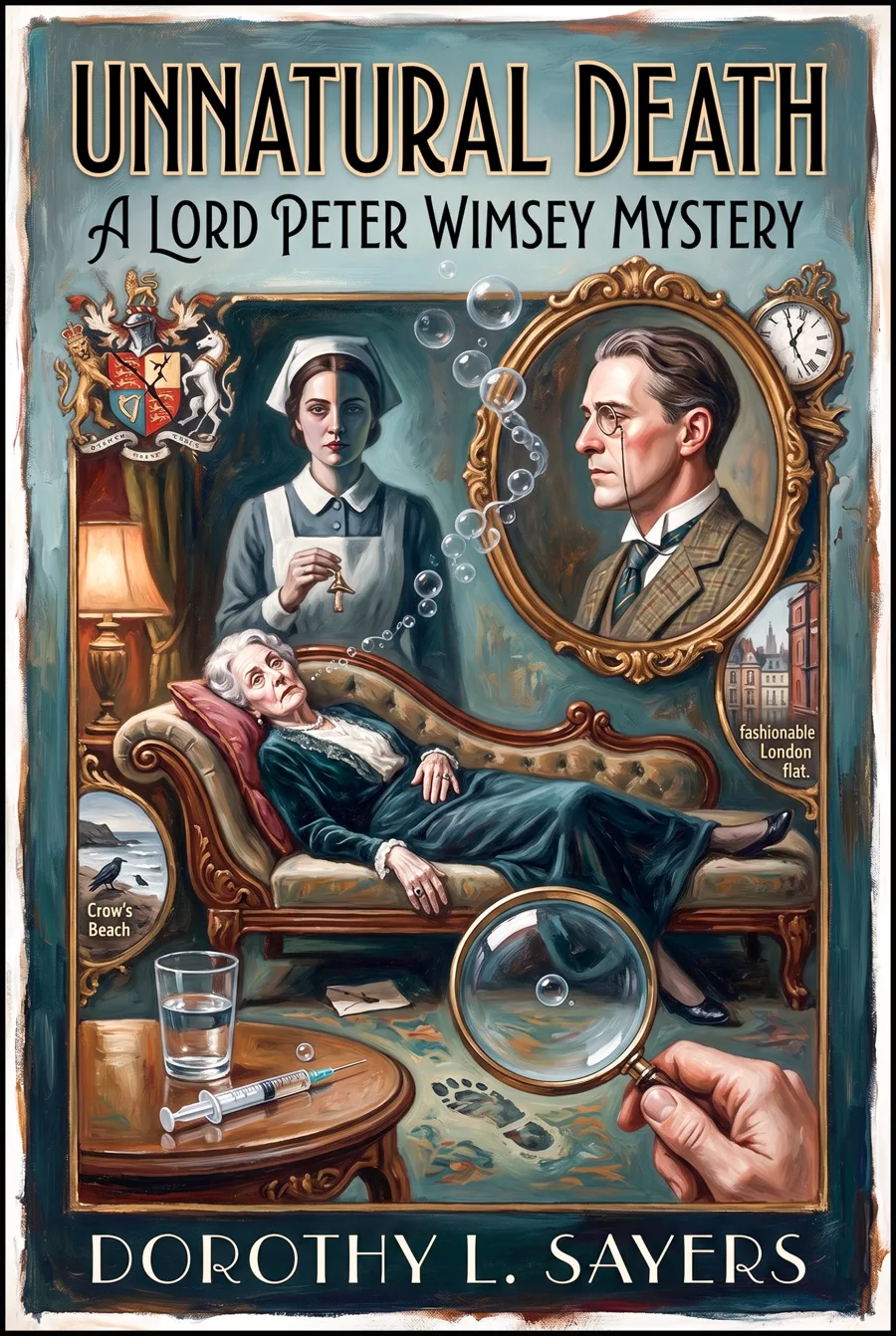
Unnatural Death
eBook
• INR 51.00
• English
• 9788169359993
No ratings yet
| Publisher | General Press |
|---|---|
| ISBN13 | 9788169359993 |
| ASIN/SKU | 8169359996 |
| Book Format | eBook |
| Language | English |
| List Price | INR 51.00 |
| Subject Code | FIC022030, FIC022100, FIC022060 |
| Publishing Date | 01/09/2026 |
| Book Code | BD00070240 |
Buy this Book
Amazon Stores
Ebook Stores
Other Stores
Discover Unnatural Death by Sayers L. Dorothy. This book is published by General Press in eBook format, ISBN 9788169359993, ASIN 8169359996, under Literature and Fiction, Traditional Detective Mysteries, Amateur Sleuths Mystery.
Book Description
A death that looks perfectly natural can sometimes hide the most carefully planned crime. 'Unnatural Death' by Dorothy L. Sayers is a classic mystery novel featuring the brilliant and aristocratic detective Lord Peter Wimsey, combining a puzzling murder, subtle clues, clever deductions, and the refined atmosphere of a traditional British detective story.
The novel begins with the death of Miss Agatha Dawson, an elderly woman whose passing appears to have been caused by natural illness. There is no obvious sign of violence, and the circumstances seem too ordinary to attract much suspicion. Yet Lord Peter Wimsey becomes intrigued when he learns that the medical evidence surrounding the death may not be as straightforward as it first appears. What looks like an unfortunate end may actually be the result of deliberate murder.
Wimsey's investigation takes him into the complicated world surrounding the victim, where money, inheritance, family relationships, and hidden motives create a web of possibilities. As he carefully examines the circumstances, apparently insignificant details begin to take on greater importance. The mystery becomes even more difficult when the possibility of another suspicious death emerges, suggesting that someone may have gone to considerable lengths to conceal the truth.
Sayers keeps the investigation focused on reasoning rather than simple action, allowing readers to follow Wimsey as he tests theories, questions assumptions, and searches for the one detail that can connect everything. Alongside the puzzle is her sharp observation of social manners, class, and human behavior. For anyone who enjoys classic British detective fiction, 'Unnatural Death' offers an elegant and absorbing mystery where the most important clue may be hiding in plain sight—and where discovering the truth means looking beyond what appears perfectly natural.
The novel begins with the death of Miss Agatha Dawson, an elderly woman whose passing appears to have been caused by natural illness. There is no obvious sign of violence, and the circumstances seem too ordinary to attract much suspicion. Yet Lord Peter Wimsey becomes intrigued when he learns that the medical evidence surrounding the death may not be as straightforward as it first appears. What looks like an unfortunate end may actually be the result of deliberate murder.
Wimsey's investigation takes him into the complicated world surrounding the victim, where money, inheritance, family relationships, and hidden motives create a web of possibilities. As he carefully examines the circumstances, apparently insignificant details begin to take on greater importance. The mystery becomes even more difficult when the possibility of another suspicious death emerges, suggesting that someone may have gone to considerable lengths to conceal the truth.
Sayers keeps the investigation focused on reasoning rather than simple action, allowing readers to follow Wimsey as he tests theories, questions assumptions, and searches for the one detail that can connect everything. Alongside the puzzle is her sharp observation of social manners, class, and human behavior. For anyone who enjoys classic British detective fiction, 'Unnatural Death' offers an elegant and absorbing mystery where the most important clue may be hiding in plain sight—and where discovering the truth means looking beyond what appears perfectly natural.
Author Biography
A brilliant mind who could turn a murder mystery into a thoughtful exploration of character, morality, and society, Dorothy Leigh Sayers was one of the most influential English crime writers of the Golden Age of Detective Fiction. Best known for her Lord Peter Wimsey mysteries, she was also a poet, playwright, essayist, translator, and Christian thinker whose work reached far beyond detective fiction.
Born in Oxford on June 13, 1893, Sayers grew up in rural England and later won a scholarship to Somerville College, Oxford, where she studied modern languages and graduated with first-class honours. After university, she worked for publishers and as an advertising copywriter, even creating the memorable Guinness slogan “My Goodness, My Guinness.” Her literary career took a major turn in 1923 with the publication of 'Whose Body?', which introduced the sophisticated and witty amateur detective Lord Peter Wimsey.
Sayers went on to write a celebrated series of Wimsey stories, including 'Strong Poison', 'Murder Must Advertise', 'The Nine Tailors', and 'Gaudy Night'. Her mysteries stood out for their intelligent plots, rich characterisation, humour, literary references, and careful attention to social issues. Harriet Vane, introduced in 'Strong Poison', became one of her most memorable characters and brought greater emotional and intellectual depth to the later Wimsey novels. Sayers was also a founding member of the Detection Club, helping shape the traditions of classic British detective fiction.
In the later part of her career, Sayers moved beyond crime writing into religious drama, essays, and literary translation. Her radio drama 'The Man Born to Be King' attracted considerable attention, while her translation of Dante’s 'Divine Comedy' became one of her most ambitious achievements. She died in 1957 while working on 'Paradiso'. Today, Dorothy L. Sayers remains admired for bringing intelligence, wit, faith, and humanity together in writing that continues to engage readers across generations.
Born in Oxford on June 13, 1893, Sayers grew up in rural England and later won a scholarship to Somerville College, Oxford, where she studied modern languages and graduated with first-class honours. After university, she worked for publishers and as an advertising copywriter, even creating the memorable Guinness slogan “My Goodness, My Guinness.” Her literary career took a major turn in 1923 with the publication of 'Whose Body?', which introduced the sophisticated and witty amateur detective Lord Peter Wimsey.
Sayers went on to write a celebrated series of Wimsey stories, including 'Strong Poison', 'Murder Must Advertise', 'The Nine Tailors', and 'Gaudy Night'. Her mysteries stood out for their intelligent plots, rich characterisation, humour, literary references, and careful attention to social issues. Harriet Vane, introduced in 'Strong Poison', became one of her most memorable characters and brought greater emotional and intellectual depth to the later Wimsey novels. Sayers was also a founding member of the Detection Club, helping shape the traditions of classic British detective fiction.
In the later part of her career, Sayers moved beyond crime writing into religious drama, essays, and literary translation. Her radio drama 'The Man Born to Be King' attracted considerable attention, while her translation of Dante’s 'Divine Comedy' became one of her most ambitious achievements. She died in 1957 while working on 'Paradiso'. Today, Dorothy L. Sayers remains admired for bringing intelligence, wit, faith, and humanity together in writing that continues to engage readers across generations.
Editorial Reviews
Editorial Reviews will be added soon…
Book Summary
Dorothy L. Sayers’s "Unnatural Death", first published in 1927, is one of the early Lord Peter Wimsey mysteries and an excellent example of the classic British detective novel. The story begins with what appears to be an ordinary death and gradually develops into a sophisticated murder investigation involving inheritance, medical knowledge, disguise, false evidence, and an unusually clever method of killing. Lord Peter Wimsey becomes interested in the case not because the police have evidence of murder, but precisely because they have none. An elderly woman has died while suffering from cancer, and her death has been accepted as natural. Yet Wimsey suspects that a seemingly perfect crime may have taken place. His investigation eventually uncovers a carefully constructed chain of deception involving Mary Whittaker, her wealthy great-aunt Agatha Dawson, the dismissed servants who know too much, the mysterious Mrs. Forrest, and several people whose apparent innocence hides important pieces of the puzzle.
The novel opens in a London restaurant, where Lord Peter Wimsey and his friend Chief Inspector Charles Parker happen to hear a doctor discussing a troubling case. The doctor, Dr. Edward Carr, has suffered professionally because he questioned the circumstances surrounding the death of an elderly woman. His patient, Agatha Dawson, had been suffering from cancer but had apparently reached a period of improvement shortly before her sudden death. There was no obvious evidence of poisoning, violence, or any other criminal act. A post-mortem examination failed to establish anything suspicious, and the doctor's doubts ultimately damaged his reputation. For Parker, the story is largely an unfortunate medical mystery. For Wimsey, however, the absence of evidence makes the case fascinating. If a person could be murdered in such a way that even a doctor could not establish the cause of death, it might represent the perfect crime.
Wimsey therefore decides to investigate. His first challenge is that he does not even know the identities of the people involved. Instead of beginning with dramatic police work, he uses a quieter and more ingenious method. He asks Miss Katharine Climpson, a middle-aged woman with an extraordinary talent for gathering information through ordinary conversation, to investigate. Miss Climpson is one of the most memorable supporting characters in the Lord Peter Wimsey series. Her appearance and manner make people underestimate her, which is exactly what allows her to collect information without attracting suspicion. Sayers uses her character to show that detective work does not always require authority or physical intimidation. Sometimes an apparently harmless woman asking apparently harmless questions can discover things that a policeman cannot.
Miss Climpson eventually identifies the dead woman as Miss Agatha Dawson, a wealthy elderly woman who lived in the country with her great-niece, Mary Whittaker. Mary had been caring for her aunt and stood to inherit her property. At first glance, this seems to eliminate the obvious motive for murder. If Mary was already the heir, why would she kill the woman whose death would eventually make her wealthy? Yet Wimsey is not satisfied with this explanation. He begins to suspect that inheritance law may have created a more complicated situation than anyone realizes. The timing of Miss Dawson's death, particularly the fact that she died shortly before a change in property law, becomes a crucial clue.
The investigation reveals that Miss Dawson had been reluctant to make a will. She believed that, if she died without one, Mary Whittaker would inherit because Mary was her closest known relative. But a new Property Act was due to come into force on January 1, 1926, and it changed important aspects of inheritance in cases of intestacy. Wimsey consults legal experts and discovers that Mary's position may not have been as secure as she believed. If a closer relative could be discovered, or if Mary were legally considered too distant a relative under the new rules, the estate might not pass to her at all. This discovery gives Wimsey a much stronger motive for murder: Mary may have had a financial reason to ensure that her aunt died before the new law took effect.
The details surrounding Miss Dawson's household deepen the mystery. Shortly before her death, both of her servants, the sisters Bertha and Evelyn Gotobed, were dismissed. This is suspicious because servants often notice details that members of a household overlook. Miss Climpson discovers that Mary had tried to get the sisters to witness Miss Dawson signing a will. The attempt had failed, but the episode suggests that Mary was thinking very carefully about the inheritance and about the legal status of her aunt's property. Wimsey therefore wants to question the two sisters. He places advertisements asking them to contact him, but before he can properly question both women, the mystery becomes a murder investigation in a much more obvious sense.
Bertha Gotobed is found dead in Epping Forest. A five-pound banknote discovered on her body provides an important clue. The note had originally been issued to a mysterious woman named Mrs. Muriel Forrest, who lives in an elegant London flat in South Audley Street. Wimsey and Parker visit Mrs. Forrest and question her about the banknote. She claims not to remember how she lost it and suggests that she may have used it in connection with betting on a horse. Her explanation is unconvincing, and Wimsey becomes increasingly interested in her identity. During the visit, he cleverly obtains her fingerprints from a wineglass, a small detail that later becomes one of the most important pieces of evidence in the entire case.
The investigators also notice a hypodermic syringe in Mrs. Forrest's possession. It carries a doctor's prescription instructing that it be used when pain becomes severe. At first, the syringe appears to be an innocent medical object. Yet in a mystery novel built around an apparently natural death, a syringe has obvious significance. Sayers carefully plants the object without immediately explaining its purpose. The reader knows that it matters, but not exactly how. This is characteristic of the novel's construction: ordinary objects become sinister only after their meaning is understood.
Another person enters the investigation when Hallelujah Dawson, a poor West Indian clergyman, appears and claims to be related to the dead woman. His relationship to Agatha Dawson suggests that he may actually be a closer relative than Mary Whittaker. He is struggling financially and has a large family, giving him a possible motive of his own. The novel therefore complicates the inheritance question further. Mary may have believed that she would inherit, but Hallelujah Dawson's existence could potentially change everything. Wimsey must determine not only who had the motive to kill but who actually benefited from the circumstances surrounding Miss Dawson's death.
The case becomes more urgent when Evelyn Gotobed disappears. Shortly afterward, Vera Findlater, a young woman who has been closely associated with Mary Whittaker, is also reported missing. Vera is devoted to Mary and has apparently become emotionally attached to her. Their relationship adds another layer of complexity to Mary's character and to the investigation. Miss Climpson reports that Mary is "not of the marrying sort," and Vera's attachment to her appears unusually intense. Mary and Vera had apparently discussed plans for a future together, including buying a chicken farm. Yet the disappearance soon takes a darker turn when Vera's body is discovered.
Vera has been brutally struck on the head, and the scene appears to point toward Hallelujah Dawson. There are footprints suggesting the presence of a man, and other details seem designed to implicate him. But Wimsey and the medical investigators look more closely. The evidence does not make sense. The post-mortem examination reveals that Vera was already dead before the blow to her head was inflicted. In other words, the apparent cause of death was staged. The footprints are also discovered to have been manufactured. Someone has deliberately constructed a false crime scene in order to direct suspicion toward Hallelujah Dawson. This is a major turning point because it demonstrates that the murderer is not simply violent but exceptionally calculating.
The tire tracks near the scene provide another clue. They suggest that a car connected with Mrs. Forrest may have been present. Wimsey begins to suspect that the mysterious woman in South Audley Street may be connected with Mary Whittaker. Yet he still lacks the decisive evidence needed to prove that they are working together. The case now appears to involve multiple identities, carefully manufactured evidence, and a murderer who understands how investigators are likely to interpret physical clues.
The breakthrough comes through fingerprints. Bunter, Wimsey's highly capable manservant, compares the fingerprints obtained from Mrs. Forrest's wineglass with fingerprints found on a cheque associated with Mary Whittaker. The prints match. The revelation transforms the entire investigation. Mrs. Muriel Forrest and Mary Whittaker are not two different women. They are the same person. Mary has been using a disguise and a false identity to move through society without being recognized. The apparently mysterious woman living in luxury in South Audley Street is therefore the same woman who has been at the center of the inheritance mystery from the beginning.
Once Wimsey understands the connection, the earlier clues fall into place. Mary has not simply been lucky enough to benefit from several suspicious deaths. She has been deliberately manipulating events. Her knowledge of nursing and medicine gives her an advantage because she understands how to produce a death that appears natural. The hypodermic syringe becomes the key to the original murder. Mary has been using it to inject air into the bloodstream, producing a fatal embolism that can resemble sudden natural death and may be extremely difficult to detect through ordinary examination. This method is the heart of the novel's "perfect crime" idea. The murder is effective because it leaves so little conventional evidence.
The revelation also explains the deaths of the other victims. Bertha Gotobed had to be eliminated because she knew too much about the household and the suspicious events surrounding Miss Dawson's death. Vera Findlater became another victim because her relationship with Mary placed her in a dangerous position. The elaborate staging of Vera's death was designed to misdirect the investigators and protect Mary's identity. The mystery's separate clues therefore become parts of one coherent plan: inheritance, medical knowledge, disguise, false evidence, and the removal of witnesses all serve the same purpose.
Miss Climpson plays an especially important role in the final stages of the investigation. Her seemingly harmless manner allows her to move closer to the truth without immediately alarming Mary. She eventually goes to South Audley Street and encounters Mary in her assumed identity as Mrs. Forrest. The situation becomes extremely dangerous when Mary realizes that Miss Climpson may have discovered too much. Mary attacks her, apparently intending to eliminate yet another witness. Miss Climpson is saved only by the timely arrival of Wimsey and Parker.
Mary Whittaker is finally arrested and committed to prison to await trial. Yet Sayers does not give the story a conventional courtroom ending. Before she can be brought to trial, Mary commits suicide in prison. Her death leaves Wimsey with a strong sense of disgust rather than triumph. The case has been solved, but the solution does not feel like a satisfying victory. Too many people have died, and the motive behind the murders is ultimately rooted in greed and calculation. Wimsey has proved the existence of the crime, but he cannot undo its consequences.
The novel ends with one of its most striking images. After leaving the prison, Wimsey and Parker emerge into a world temporarily darkened by a total solar eclipse. The eclipse creates an atmospheric final note that echoes the title and the moral darkness of the story. The sun is present, but its light is temporarily obscured. In much the same way, the truth existed throughout the investigation but remained hidden beneath appearances, disguises, false explanations, and deliberate deception. The final darkness is therefore more than an atmospheric detail; it provides an elegant symbolic conclusion to a story about hidden evil.
For readers searching for an ''in-depth summary of 'Unnatural Death' by Dorothy L. Sayers'', the novel's central mystery begins with the apparently natural death of Agatha Dawson, an elderly cancer patient. Lord Peter Wimsey becomes suspicious after hearing from Dr. Carr that her death was unexpected and medically puzzling. He sends Miss Climpson to investigate and discovers that the woman's great-niece, Mary Whittaker, had a possible financial motive connected with changes in inheritance law. The dismissal of two servants raises further suspicion, and when one of them is murdered, the case expands. A mysterious woman named Mrs. Forrest, a syringe, a suspicious banknote, the disappearance of Vera Findlater, and a staged murder scene all eventually point toward a carefully planned conspiracy. Wimsey ultimately discovers that Mrs. Forrest is actually Mary Whittaker in disguise and that she has been killing people through a subtle medical method designed to make the deaths appear natural.
One of the novel's strongest themes is the danger of ''appearances''. Almost everything in 'Unnatural Death' initially appears to be something other than what it really is. A natural death may be murder. A stranger may actually be a familiar person in disguise. A violent blow may not be the real cause of death. Footprints may have been deliberately manufactured. A medical instrument may be both legitimate equipment and a murder weapon. Even a seemingly innocent financial detail can become evidence of a larger crime. Sayers builds the mystery around this gap between appearance and reality, forcing both Wimsey and the reader to look beyond the obvious explanation.
The novel also explores the relationship between ''intelligence and morality''. Mary Whittaker is not a foolish criminal. She is intelligent, observant, medically knowledgeable, and capable of planning several steps ahead. Her downfall does not come from a lack of intelligence but from her inability to recognize the moral consequences of her actions. She treats human beings as obstacles to be removed and uses her intelligence in the service of greed and self-preservation. Sayers therefore suggests that intelligence without conscience can become more dangerous than ignorance.
Another major theme is the vulnerability of people whose deaths can easily be explained by age or illness. Miss Dawson's illness provides the perfect cover for murder because everyone expects her health to deteriorate. Sayers turns this ordinary assumption into the central mechanism of the crime. The novel asks readers to consider how easily a death can be overlooked when the victim already appears medically vulnerable.
Miss Climpson is also significant because she represents an alternative model of detective work. She does not resemble the stereotypical hard-boiled investigator. Her greatest strengths are patience, social observation, conversation, and the ability to become invisible in ordinary social settings. Her contribution to the case demonstrates that intelligence can operate quietly and that people who are underestimated may possess the greatest investigative advantages.
Ultimately, 'Unnatural Death' is a carefully constructed ''classic detective mystery, Golden Age crime novel, Lord Peter Wimsey mystery, and locked-down psychological investigation'' centered on the idea of the perfect murder. Dorothy L. Sayers combines logical deduction with character study, social observation, medical mystery, and a subtle awareness of how appearances influence judgment. The novel's greatest achievement is the way it transforms an apparently uneventful death into an intricate chain of murders and disguises.
The novel opens in a London restaurant, where Lord Peter Wimsey and his friend Chief Inspector Charles Parker happen to hear a doctor discussing a troubling case. The doctor, Dr. Edward Carr, has suffered professionally because he questioned the circumstances surrounding the death of an elderly woman. His patient, Agatha Dawson, had been suffering from cancer but had apparently reached a period of improvement shortly before her sudden death. There was no obvious evidence of poisoning, violence, or any other criminal act. A post-mortem examination failed to establish anything suspicious, and the doctor's doubts ultimately damaged his reputation. For Parker, the story is largely an unfortunate medical mystery. For Wimsey, however, the absence of evidence makes the case fascinating. If a person could be murdered in such a way that even a doctor could not establish the cause of death, it might represent the perfect crime.
Wimsey therefore decides to investigate. His first challenge is that he does not even know the identities of the people involved. Instead of beginning with dramatic police work, he uses a quieter and more ingenious method. He asks Miss Katharine Climpson, a middle-aged woman with an extraordinary talent for gathering information through ordinary conversation, to investigate. Miss Climpson is one of the most memorable supporting characters in the Lord Peter Wimsey series. Her appearance and manner make people underestimate her, which is exactly what allows her to collect information without attracting suspicion. Sayers uses her character to show that detective work does not always require authority or physical intimidation. Sometimes an apparently harmless woman asking apparently harmless questions can discover things that a policeman cannot.
Miss Climpson eventually identifies the dead woman as Miss Agatha Dawson, a wealthy elderly woman who lived in the country with her great-niece, Mary Whittaker. Mary had been caring for her aunt and stood to inherit her property. At first glance, this seems to eliminate the obvious motive for murder. If Mary was already the heir, why would she kill the woman whose death would eventually make her wealthy? Yet Wimsey is not satisfied with this explanation. He begins to suspect that inheritance law may have created a more complicated situation than anyone realizes. The timing of Miss Dawson's death, particularly the fact that she died shortly before a change in property law, becomes a crucial clue.
The investigation reveals that Miss Dawson had been reluctant to make a will. She believed that, if she died without one, Mary Whittaker would inherit because Mary was her closest known relative. But a new Property Act was due to come into force on January 1, 1926, and it changed important aspects of inheritance in cases of intestacy. Wimsey consults legal experts and discovers that Mary's position may not have been as secure as she believed. If a closer relative could be discovered, or if Mary were legally considered too distant a relative under the new rules, the estate might not pass to her at all. This discovery gives Wimsey a much stronger motive for murder: Mary may have had a financial reason to ensure that her aunt died before the new law took effect.
The details surrounding Miss Dawson's household deepen the mystery. Shortly before her death, both of her servants, the sisters Bertha and Evelyn Gotobed, were dismissed. This is suspicious because servants often notice details that members of a household overlook. Miss Climpson discovers that Mary had tried to get the sisters to witness Miss Dawson signing a will. The attempt had failed, but the episode suggests that Mary was thinking very carefully about the inheritance and about the legal status of her aunt's property. Wimsey therefore wants to question the two sisters. He places advertisements asking them to contact him, but before he can properly question both women, the mystery becomes a murder investigation in a much more obvious sense.
Bertha Gotobed is found dead in Epping Forest. A five-pound banknote discovered on her body provides an important clue. The note had originally been issued to a mysterious woman named Mrs. Muriel Forrest, who lives in an elegant London flat in South Audley Street. Wimsey and Parker visit Mrs. Forrest and question her about the banknote. She claims not to remember how she lost it and suggests that she may have used it in connection with betting on a horse. Her explanation is unconvincing, and Wimsey becomes increasingly interested in her identity. During the visit, he cleverly obtains her fingerprints from a wineglass, a small detail that later becomes one of the most important pieces of evidence in the entire case.
The investigators also notice a hypodermic syringe in Mrs. Forrest's possession. It carries a doctor's prescription instructing that it be used when pain becomes severe. At first, the syringe appears to be an innocent medical object. Yet in a mystery novel built around an apparently natural death, a syringe has obvious significance. Sayers carefully plants the object without immediately explaining its purpose. The reader knows that it matters, but not exactly how. This is characteristic of the novel's construction: ordinary objects become sinister only after their meaning is understood.
Another person enters the investigation when Hallelujah Dawson, a poor West Indian clergyman, appears and claims to be related to the dead woman. His relationship to Agatha Dawson suggests that he may actually be a closer relative than Mary Whittaker. He is struggling financially and has a large family, giving him a possible motive of his own. The novel therefore complicates the inheritance question further. Mary may have believed that she would inherit, but Hallelujah Dawson's existence could potentially change everything. Wimsey must determine not only who had the motive to kill but who actually benefited from the circumstances surrounding Miss Dawson's death.
The case becomes more urgent when Evelyn Gotobed disappears. Shortly afterward, Vera Findlater, a young woman who has been closely associated with Mary Whittaker, is also reported missing. Vera is devoted to Mary and has apparently become emotionally attached to her. Their relationship adds another layer of complexity to Mary's character and to the investigation. Miss Climpson reports that Mary is "not of the marrying sort," and Vera's attachment to her appears unusually intense. Mary and Vera had apparently discussed plans for a future together, including buying a chicken farm. Yet the disappearance soon takes a darker turn when Vera's body is discovered.
Vera has been brutally struck on the head, and the scene appears to point toward Hallelujah Dawson. There are footprints suggesting the presence of a man, and other details seem designed to implicate him. But Wimsey and the medical investigators look more closely. The evidence does not make sense. The post-mortem examination reveals that Vera was already dead before the blow to her head was inflicted. In other words, the apparent cause of death was staged. The footprints are also discovered to have been manufactured. Someone has deliberately constructed a false crime scene in order to direct suspicion toward Hallelujah Dawson. This is a major turning point because it demonstrates that the murderer is not simply violent but exceptionally calculating.
The tire tracks near the scene provide another clue. They suggest that a car connected with Mrs. Forrest may have been present. Wimsey begins to suspect that the mysterious woman in South Audley Street may be connected with Mary Whittaker. Yet he still lacks the decisive evidence needed to prove that they are working together. The case now appears to involve multiple identities, carefully manufactured evidence, and a murderer who understands how investigators are likely to interpret physical clues.
The breakthrough comes through fingerprints. Bunter, Wimsey's highly capable manservant, compares the fingerprints obtained from Mrs. Forrest's wineglass with fingerprints found on a cheque associated with Mary Whittaker. The prints match. The revelation transforms the entire investigation. Mrs. Muriel Forrest and Mary Whittaker are not two different women. They are the same person. Mary has been using a disguise and a false identity to move through society without being recognized. The apparently mysterious woman living in luxury in South Audley Street is therefore the same woman who has been at the center of the inheritance mystery from the beginning.
Once Wimsey understands the connection, the earlier clues fall into place. Mary has not simply been lucky enough to benefit from several suspicious deaths. She has been deliberately manipulating events. Her knowledge of nursing and medicine gives her an advantage because she understands how to produce a death that appears natural. The hypodermic syringe becomes the key to the original murder. Mary has been using it to inject air into the bloodstream, producing a fatal embolism that can resemble sudden natural death and may be extremely difficult to detect through ordinary examination. This method is the heart of the novel's "perfect crime" idea. The murder is effective because it leaves so little conventional evidence.
The revelation also explains the deaths of the other victims. Bertha Gotobed had to be eliminated because she knew too much about the household and the suspicious events surrounding Miss Dawson's death. Vera Findlater became another victim because her relationship with Mary placed her in a dangerous position. The elaborate staging of Vera's death was designed to misdirect the investigators and protect Mary's identity. The mystery's separate clues therefore become parts of one coherent plan: inheritance, medical knowledge, disguise, false evidence, and the removal of witnesses all serve the same purpose.
Miss Climpson plays an especially important role in the final stages of the investigation. Her seemingly harmless manner allows her to move closer to the truth without immediately alarming Mary. She eventually goes to South Audley Street and encounters Mary in her assumed identity as Mrs. Forrest. The situation becomes extremely dangerous when Mary realizes that Miss Climpson may have discovered too much. Mary attacks her, apparently intending to eliminate yet another witness. Miss Climpson is saved only by the timely arrival of Wimsey and Parker.
Mary Whittaker is finally arrested and committed to prison to await trial. Yet Sayers does not give the story a conventional courtroom ending. Before she can be brought to trial, Mary commits suicide in prison. Her death leaves Wimsey with a strong sense of disgust rather than triumph. The case has been solved, but the solution does not feel like a satisfying victory. Too many people have died, and the motive behind the murders is ultimately rooted in greed and calculation. Wimsey has proved the existence of the crime, but he cannot undo its consequences.
The novel ends with one of its most striking images. After leaving the prison, Wimsey and Parker emerge into a world temporarily darkened by a total solar eclipse. The eclipse creates an atmospheric final note that echoes the title and the moral darkness of the story. The sun is present, but its light is temporarily obscured. In much the same way, the truth existed throughout the investigation but remained hidden beneath appearances, disguises, false explanations, and deliberate deception. The final darkness is therefore more than an atmospheric detail; it provides an elegant symbolic conclusion to a story about hidden evil.
For readers searching for an ''in-depth summary of 'Unnatural Death' by Dorothy L. Sayers'', the novel's central mystery begins with the apparently natural death of Agatha Dawson, an elderly cancer patient. Lord Peter Wimsey becomes suspicious after hearing from Dr. Carr that her death was unexpected and medically puzzling. He sends Miss Climpson to investigate and discovers that the woman's great-niece, Mary Whittaker, had a possible financial motive connected with changes in inheritance law. The dismissal of two servants raises further suspicion, and when one of them is murdered, the case expands. A mysterious woman named Mrs. Forrest, a syringe, a suspicious banknote, the disappearance of Vera Findlater, and a staged murder scene all eventually point toward a carefully planned conspiracy. Wimsey ultimately discovers that Mrs. Forrest is actually Mary Whittaker in disguise and that she has been killing people through a subtle medical method designed to make the deaths appear natural.
One of the novel's strongest themes is the danger of ''appearances''. Almost everything in 'Unnatural Death' initially appears to be something other than what it really is. A natural death may be murder. A stranger may actually be a familiar person in disguise. A violent blow may not be the real cause of death. Footprints may have been deliberately manufactured. A medical instrument may be both legitimate equipment and a murder weapon. Even a seemingly innocent financial detail can become evidence of a larger crime. Sayers builds the mystery around this gap between appearance and reality, forcing both Wimsey and the reader to look beyond the obvious explanation.
The novel also explores the relationship between ''intelligence and morality''. Mary Whittaker is not a foolish criminal. She is intelligent, observant, medically knowledgeable, and capable of planning several steps ahead. Her downfall does not come from a lack of intelligence but from her inability to recognize the moral consequences of her actions. She treats human beings as obstacles to be removed and uses her intelligence in the service of greed and self-preservation. Sayers therefore suggests that intelligence without conscience can become more dangerous than ignorance.
Another major theme is the vulnerability of people whose deaths can easily be explained by age or illness. Miss Dawson's illness provides the perfect cover for murder because everyone expects her health to deteriorate. Sayers turns this ordinary assumption into the central mechanism of the crime. The novel asks readers to consider how easily a death can be overlooked when the victim already appears medically vulnerable.
Miss Climpson is also significant because she represents an alternative model of detective work. She does not resemble the stereotypical hard-boiled investigator. Her greatest strengths are patience, social observation, conversation, and the ability to become invisible in ordinary social settings. Her contribution to the case demonstrates that intelligence can operate quietly and that people who are underestimated may possess the greatest investigative advantages.
Ultimately, 'Unnatural Death' is a carefully constructed ''classic detective mystery, Golden Age crime novel, Lord Peter Wimsey mystery, and locked-down psychological investigation'' centered on the idea of the perfect murder. Dorothy L. Sayers combines logical deduction with character study, social observation, medical mystery, and a subtle awareness of how appearances influence judgment. The novel's greatest achievement is the way it transforms an apparently uneventful death into an intricate chain of murders and disguises.
Sample Chapters
Sample Chapters will be added soon…
Reader Reviews
No reviews yet.
Unnatural Death
Download Cover Image
Do you want to download the full cover image for Unnatural Death?