
Washington Confidential
eBook
• INR 51.00
• English
• 9788169359689
No ratings yet
| Publisher | General Press |
|---|---|
| ISBN13 | 9788169359689 |
| ASIN/SKU | 8169359686 |
| Book Format | eBook |
| Language | English |
| List Price | INR 51.00 |
| Subject Code | POL064000, HIS036060, TRU003000 |
| Publishing Date | 01/09/2026 |
| Book Code | BD00070241 |
Buy this Book
Amazon Stores
Ebook Stores
Other Stores
Discover Washington Confidential by Jack Lait. This book is published by General Press in eBook format, ISBN 9788169359689, ASIN 8169359686, under Non Fiction, Political Corruption and Misconduct, United States History.
Book Description
What really happens behind the polished doors of the American capital when the politicians, officials, criminals, gamblers, and socialites are out of public view? 'Washington Confidential' by Jack Lait and Lee Mortimer is a provocative true-crime and social history exposé that takes a sensational, street-level look at Washington, D.C., revealing the city’s political intrigues, nightlife, corruption, crime, and hidden social world. Published in 1951, the book was part of the authors’ popular “Confidential” series and quickly became a controversial bestseller.
Rather than telling one continuous story, Lait and Mortimer construct their portrait of Washington through a collection of observations, investigations, anecdotes, and reported encounters. They move beyond the familiar monuments and government buildings to explore neighborhoods, hotels, restaurants, nightclubs, police stations, courts, gambling operations, and the city’s more secretive corners. Their attention repeatedly returns to the uneasy relationship between political power and the unofficial networks surrounding it, including vice, organized crime, prostitution, narcotics, gambling, and influence.
The authors write in an aggressive, witty, and deliberately sensational newspaper style, presenting Washington as a city where respectable appearances can conceal a far more complicated reality. Their account also looks at politicians, federal agencies, diplomats, lobbyists, police, and figures connected to the underworld, often challenging the clean public image associated with the nation’s capital.
Today, the book is best approached as a colorful and controversial snapshot of postwar Washington rather than an unquestioned historical record. Its mix of journalism, gossip, scandal, and social observation makes 'Washington Confidential' an intriguing window into how mid-century America imagined power—and what might be hiding just beneath its surface.
Rather than telling one continuous story, Lait and Mortimer construct their portrait of Washington through a collection of observations, investigations, anecdotes, and reported encounters. They move beyond the familiar monuments and government buildings to explore neighborhoods, hotels, restaurants, nightclubs, police stations, courts, gambling operations, and the city’s more secretive corners. Their attention repeatedly returns to the uneasy relationship between political power and the unofficial networks surrounding it, including vice, organized crime, prostitution, narcotics, gambling, and influence.
The authors write in an aggressive, witty, and deliberately sensational newspaper style, presenting Washington as a city where respectable appearances can conceal a far more complicated reality. Their account also looks at politicians, federal agencies, diplomats, lobbyists, police, and figures connected to the underworld, often challenging the clean public image associated with the nation’s capital.
Today, the book is best approached as a colorful and controversial snapshot of postwar Washington rather than an unquestioned historical record. Its mix of journalism, gossip, scandal, and social observation makes 'Washington Confidential' an intriguing window into how mid-century America imagined power—and what might be hiding just beneath its surface.
Author Biography
Few writing partnerships captured the hidden, restless side of mid-century American city life as boldly as Jack Lait and Lee Mortimer. Jack Lait was an American journalist, author, and playwright, while Lee Mortimer was a newspaper columnist, radio commentator, and author best known for their controversial nonfiction “Confidential” books about crime, nightlife, politics, and urban culture.
Lait was born in New York City in 1883 and raised in Chicago, where he began his journalism career as a police reporter. His experience covering crime and the underworld helped shape the tough, fast-moving style that later became his trademark. He went on to work for major newspapers, eventually becoming an influential editor at the New York Daily Mirror. Alongside journalism, he wrote novels, short stories, plays, and screen-related works, establishing himself as an exceptionally prolific writer.
Mortimer, born Mortimer Lieberman in Chicago in 1904, developed his career in New York journalism. He worked as a reporter, critic, and Broadway and nightclub columnist, eventually joining forces with Lait. Their partnership produced New York Confidential! in 1948, followed by Chicago Confidential, Washington Confidential, and U.S.A. Confidential. These books offered sensational, insider-style portraits of cities, exploring their nightlife, organized crime, scandals, and colorful personalities.
Their writing was lively, provocative, and deliberately sensational, attracting huge audiences while also generating criticism and several libel lawsuits. Their books became bestsellers and influenced later popular portrayals of urban crime and vice, including film and television adaptations.
Today, Lait and Mortimer remain notable figures in American journalism and popular nonfiction, remembered for turning their newspaper experience and street-level knowledge into vivid portraits of an era fascinated by the secrets behind respectable city life.
Lait was born in New York City in 1883 and raised in Chicago, where he began his journalism career as a police reporter. His experience covering crime and the underworld helped shape the tough, fast-moving style that later became his trademark. He went on to work for major newspapers, eventually becoming an influential editor at the New York Daily Mirror. Alongside journalism, he wrote novels, short stories, plays, and screen-related works, establishing himself as an exceptionally prolific writer.
Mortimer, born Mortimer Lieberman in Chicago in 1904, developed his career in New York journalism. He worked as a reporter, critic, and Broadway and nightclub columnist, eventually joining forces with Lait. Their partnership produced New York Confidential! in 1948, followed by Chicago Confidential, Washington Confidential, and U.S.A. Confidential. These books offered sensational, insider-style portraits of cities, exploring their nightlife, organized crime, scandals, and colorful personalities.
Their writing was lively, provocative, and deliberately sensational, attracting huge audiences while also generating criticism and several libel lawsuits. Their books became bestsellers and influenced later popular portrayals of urban crime and vice, including film and television adaptations.
Today, Lait and Mortimer remain notable figures in American journalism and popular nonfiction, remembered for turning their newspaper experience and street-level knowledge into vivid portraits of an era fascinated by the secrets behind respectable city life.
Editorial Reviews
Editorial Reviews will be added soon…
Book Summary
"Washington Confidential", published in 1951 by Jack Lait and Lee Mortimer, is not a conventional history of Washington, D.C., nor is it a traditional political biography. It is a sensational, street-level exposé of the American capital as the authors claimed to have encountered it: a city of politicians, lobbyists, government employees, gamblers, prostitutes, criminals, social climbers, businessmen, diplomats, journalists, police officers, and people trying to make money from the enormous concentration of power in Washington. The book belongs to the same 'Confidential' series that included 'New York Confidential' and 'Chicago Confidential', and it uses the hard-boiled language and tabloid sensibility associated with Lait and Mortimer. Published by Crown Publishers in 1951, it runs roughly 310 pages in the original edition.
The first thing to understand about 'Washington Confidential' is that it is structured less like a single narrative and more like a guided tour through the hidden life of the capital. The authors divide their investigation into sections dealing with places, people, institutions, politics, vice, crime, and social life. The opening section, for example, begins with "District of Confusion," followed by chapters on Georgetown, Northwest Washington, the Tenderloin, the city's skid-row districts, Black Washington, crime, and Chinatown. Later sections turn toward the people and institutions that make Washington function—or, in the authors' provocative view, fail to function.
The book's central argument is that Washington possesses two very different faces. One is the ceremonial capital familiar to tourists: the Capitol dome, the White House, the Washington Monument, government buildings, embassies, monuments, and broad avenues representing the dignity of American democracy. The other is a much messier city operating behind this official image. Lait and Mortimer want readers to believe that beneath the polished surface lies a world of gambling, corruption, sexual vice, political influence-peddling, organized crime, racial inequality, and bureaucratic absurdity. Their method is deliberately provocative. They do not write like detached urban historians; they write like newspaper reporters determined to shock the reader with what they claim exists behind respectable doors.
Their opening portrait of Washington establishes this attitude immediately. They treat the city's history almost as a joke, suggesting that the capital's origins in political compromise and speculative real-estate schemes help explain its later culture. The authors repeatedly connect Washington's physical history with its modern appetite for money and influence. Even the city's famous monumental landscape becomes part of their satire. The beautiful buildings are real, but they represent only one layer of the city. Behind them are people conducting business of a much less dignified kind.
Georgetown receives particular attention because it represents old money, social prestige, and Washington's fashionable establishment. Yet the authors refuse to treat the neighborhood reverently. They portray it as a place of inherited privilege, eccentricity, parties, social maneuvering, and hidden scandals. This is a recurring technique throughout 'Washington Confidential': wherever Washington presents an institution or neighborhood as respectable, Lait and Mortimer look for the people and activities that contradict that respectability.
Northwest Washington, the city's most politically and socially important section, becomes the center of their examination of government power. Here the authors observe that Washington is unlike a normal American city because its population is unusually shaped by the federal government. Government workers, politicians, lobbyists, contractors, military personnel, journalists, and diplomats create a social ecosystem unlike that of ordinary metropolitan America. The city is therefore presented as a place where political influence is not an abstract concept but an everyday currency.
One of the book's most important themes is ''money and influence''. Lait and Mortimer repeatedly suggest that Washington's true economy is not simply based on salaries, shops, and government spending. It is also based on access. People who can get an introduction, arrange a meeting, influence a decision, secure a contract, obtain information, or provide a favor can turn proximity to government into financial advantage. The authors depict lobbyists, fixers, lawyers, businessmen, and political operators as participants in a marketplace in which influence itself has value. Their famous image of the Washington "sharpie" who has moved beyond selling the Brooklyn Bridge and now sells the Washington Monument captures the book's deliberately cynical attitude toward political opportunity.
The discussion of gambling provides another major strand. According to the authors, Washington's gambling culture is distinctive because the city has a large policy or numbers racket. They connect this with the city's historical roots in lotteries and suggest that illegal gambling has become a major part of its underground economy. The authors also discuss bookmaking, betting, and the establishments where people gamble. Rather than presenting vice as something existing only among criminals, they emphasize how ordinary citizens and people connected with respectable institutions participate in it.
The book's treatment of the city's Tenderloin and nightlife districts continues this exploration of Washington after dark. Restaurants, bars, clubs, hotels, gambling establishments, and places associated with prostitution become part of the authors' alternative map of the capital. Their Washington is a city that changes character after government offices close. During the day, it is the seat of national power; at night, according to their narrative, it becomes a marketplace of entertainment, vice, sex, drinking, and informal transactions.
The authors also devote considerable attention to prostitution and the sexual culture surrounding Washington's political and diplomatic communities. They describe hotels, nightclubs, escort arrangements, and women who move through the city's nightlife economy. Some of their claims are sensational and were criticized as unreliable or exaggerated. Later accounts have specifically warned readers that many of the book's stories should not be treated as straightforward historical fact.
This issue of reliability is crucial when reading 'Washington Confidential' today. The book presents itself as an insider's exposé, but its reputation has always been controversial. The authors were veteran newspapermen associated with the New York tabloid world, and their writing is intentionally sensational. Contemporary and later observers have noted that the book contains dubious stories, recycled anecdotes, sweeping generalizations, and allegations that are difficult to verify. It also generated lawsuits because of its accusations about individuals and organizations.
The racial material is another area that requires especially careful reading. The book describes Black Washington through the prejudices and assumptions of its period and includes language that modern readers will rightly find offensive. At the same time, its descriptions unintentionally reveal important aspects of segregated Washington. The authors comment on the city's Black population and social structure but do not consistently analyze the institutional discrimination that produced the inequalities they observe. A modern reader should therefore distinguish between the book's observations about historical conditions and its own prejudiced explanations for them. The book is valuable as a document of 1951 attitudes, but it should not be mistaken for an objective account of race relations.
The chapter devoted to Chinatown continues the authors' interest in immigrant communities and underground economies. They portray Washington's Chinatown not simply as a cultural neighborhood but as a place connected with gambling, nightlife, and criminal activity. Again, the descriptions reflect the stereotypes of the period and should be approached critically. Yet they also demonstrate how mid-century American popular journalism often constructed ethnic neighborhoods as mysterious spaces existing outside mainstream society.
The authors then widen their investigation to Washington's institutions. Congress naturally occupies a central position because it is the place where political power becomes visible. Lait and Mortimer are interested less in legislative history than in the personalities, habits, relationships, scandals, and private behavior surrounding politicians. They present Capitol Hill as a human environment in which ambition, vanity, money, lobbying, friendship, rivalry, and personal weakness constantly intersect.
The White House receives similar treatment. Rather than focusing on constitutional powers or presidential policy, the authors are interested in the people around the presidency and the informal networks surrounding political authority. Their central question is essentially: what happens when ordinary human beings are placed close to extraordinary power? Their answer is that personal relationships, favors, ambitions, scandals, and private interests inevitably become intertwined with public business.
The State Department and diplomatic community are also presented as fertile territory for scandal. Foreign embassies, diplomats, parties, protocol, and international visitors provide the authors with opportunities to describe a Washington where official diplomacy exists alongside private social arrangements. Some of their most sensational allegations concern diplomats and government officials. These claims contributed heavily to the book's notoriety, but they are precisely the material that requires the greatest skepticism. The Washington Post later described some of these stories as historically questionable while acknowledging the book's importance as a portrait of the city's mid-century mythology and atmosphere.
The FBI and law enforcement occupy another important place in the book. Lait and Mortimer are fascinated by crime and by the institutions supposedly fighting it. They describe police, investigators, criminals, informants, and the relationship between organized vice and political power. This creates a recurring paradox: Washington is both the city where national law is created and a city in which, according to the authors, lawbreaking flourishes in the shadows.
The book's fascination with organized crime reflects the broader culture of American crime journalism in the mid-twentieth century. Gangsters, bookmakers, gamblers, prostitutes, corrupt officials, and political fixers are presented as characters in an urban drama. The authors write with the vocabulary of pulp journalism, emphasizing colorful personalities and dramatic anecdotes rather than statistical analysis or institutional history.
One of the more revealing aspects of 'Washington Confidential' is its treatment of government employees. The authors repeatedly joke about bureaucracy, inefficiency, absenteeism, office romances, political connections, and the enormous federal workforce. Washington is portrayed as a city whose rhythms are determined by government schedules. The contrast between the city's importance to the nation and its sometimes sleepy local life becomes a recurring source of humor.
This is one reason the book occasionally rises above its sensationalism. Beneath the gossip and scandal, Lait and Mortimer recognize something genuinely distinctive about Washington: it is a company town on a national scale, but the "company" is the federal government. The city's economy, social life, transportation, real estate, nightlife, and population are profoundly affected by political institutions. A visitor might see monuments and government offices; the authors want readers to see the enormous network of people whose livelihoods depend upon Washington's political machinery.
Their description of downtown Washington is particularly revealing. The city of 1951 was not yet the Washington of modern nightlife and revitalized downtown districts. Many commercial areas became quiet after office hours. The authors observe this unusual rhythm, and later commentators have noted that some of their descriptions of downtown's early closing hours and peculiar social patterns were surprisingly accurate.
The book also contains a great deal of humor. Lait and Mortimer use exaggeration, nicknames, jokes, insults, and vivid metaphors to keep the reader entertained. Their prose is deliberately hard-boiled, reflecting the language of newspaper tabloids and pulp crime stories. This explains both the book's popularity and its weaknesses. The same writing style that makes the book lively also encourages sensationalism. Everything is presented as outrageous, corrupt, scandalous, or secretly rotten.
For readers searching for an ''in-depth summary of 'Washington Confidential' by Jack Lait'', the book can therefore be understood as a sprawling exposé of Washington, D.C., in the early 1950s. It begins by mapping the city's neighborhoods and contrasting its monumental public face with its nightlife and poorer districts. It then moves into gambling, prostitution, crime, racial divisions, Chinatown, politics, Congress, the White House, government agencies, diplomats, lobbyists, and the informal networks surrounding political power. Rather than telling one continuous story, Lait and Mortimer assemble hundreds of observations, anecdotes, allegations, and character sketches to create a portrait of Washington as a city where respectable public institutions coexist with a busy underground world.
The book's enduring importance lies less in whether every allegation is true than in what it reveals about the culture of its own time. 'Washington Confidential' captures the anxieties and fantasies of postwar America: fear of corruption, fascination with Communism, distrust of politicians, curiosity about sexual scandal, suspicion of organized crime, fascination with government power, and the belief that respectable institutions might conceal disturbing secrets. It is as much a cultural artifact as an exposé.
The enormous popularity of the book confirms how effectively it touched those anxieties. In 1951, 'Washington Confidential' became a bestseller and reportedly displaced 'Kon-Tiki' at the top of the 'New York Times' bestseller list after only a few weeks. It sold about 150,000 copies during its first three weeks, including thousands in Washington itself. The success demonstrates that readers were fascinated by the promise of seeing the nation's capital without its official mask.
Yet modern readers should approach the book with two ideas in mind at the same time. First, it is an extraordinarily vivid source of period detail. It preserves names of places, descriptions of neighborhoods, nightlife, businesses, social habits, racial divisions, and political culture that can help us imagine Washington in 1951. Second, it is not a neutral historical record. Its sensational tone, stereotypes, unverified accusations, and prejudices make it unreliable when treated as literal fact. Its value is therefore partly documentary and partly theatrical: it tells us both what Washington was like and what Americans in the early Cold War era wanted to believe about Washington.
Ultimately, 'Washington Confidential' is best understood as a ''mid-century American exposé, urban social history, political scandal book, and piece of sensational investigative journalism''. Jack Lait and Lee Mortimer strip away the ceremonial image of the capital and replace it with a crowded panorama of gamblers, politicians, government workers, criminals, socialites, diplomats, prostitutes, lobbyists, journalists, and ordinary residents. Their Washington is messy, contradictory, cynical, colorful, and often deeply prejudiced. That is precisely why the book remains interesting.
The first thing to understand about 'Washington Confidential' is that it is structured less like a single narrative and more like a guided tour through the hidden life of the capital. The authors divide their investigation into sections dealing with places, people, institutions, politics, vice, crime, and social life. The opening section, for example, begins with "District of Confusion," followed by chapters on Georgetown, Northwest Washington, the Tenderloin, the city's skid-row districts, Black Washington, crime, and Chinatown. Later sections turn toward the people and institutions that make Washington function—or, in the authors' provocative view, fail to function.
The book's central argument is that Washington possesses two very different faces. One is the ceremonial capital familiar to tourists: the Capitol dome, the White House, the Washington Monument, government buildings, embassies, monuments, and broad avenues representing the dignity of American democracy. The other is a much messier city operating behind this official image. Lait and Mortimer want readers to believe that beneath the polished surface lies a world of gambling, corruption, sexual vice, political influence-peddling, organized crime, racial inequality, and bureaucratic absurdity. Their method is deliberately provocative. They do not write like detached urban historians; they write like newspaper reporters determined to shock the reader with what they claim exists behind respectable doors.
Their opening portrait of Washington establishes this attitude immediately. They treat the city's history almost as a joke, suggesting that the capital's origins in political compromise and speculative real-estate schemes help explain its later culture. The authors repeatedly connect Washington's physical history with its modern appetite for money and influence. Even the city's famous monumental landscape becomes part of their satire. The beautiful buildings are real, but they represent only one layer of the city. Behind them are people conducting business of a much less dignified kind.
Georgetown receives particular attention because it represents old money, social prestige, and Washington's fashionable establishment. Yet the authors refuse to treat the neighborhood reverently. They portray it as a place of inherited privilege, eccentricity, parties, social maneuvering, and hidden scandals. This is a recurring technique throughout 'Washington Confidential': wherever Washington presents an institution or neighborhood as respectable, Lait and Mortimer look for the people and activities that contradict that respectability.
Northwest Washington, the city's most politically and socially important section, becomes the center of their examination of government power. Here the authors observe that Washington is unlike a normal American city because its population is unusually shaped by the federal government. Government workers, politicians, lobbyists, contractors, military personnel, journalists, and diplomats create a social ecosystem unlike that of ordinary metropolitan America. The city is therefore presented as a place where political influence is not an abstract concept but an everyday currency.
One of the book's most important themes is ''money and influence''. Lait and Mortimer repeatedly suggest that Washington's true economy is not simply based on salaries, shops, and government spending. It is also based on access. People who can get an introduction, arrange a meeting, influence a decision, secure a contract, obtain information, or provide a favor can turn proximity to government into financial advantage. The authors depict lobbyists, fixers, lawyers, businessmen, and political operators as participants in a marketplace in which influence itself has value. Their famous image of the Washington "sharpie" who has moved beyond selling the Brooklyn Bridge and now sells the Washington Monument captures the book's deliberately cynical attitude toward political opportunity.
The discussion of gambling provides another major strand. According to the authors, Washington's gambling culture is distinctive because the city has a large policy or numbers racket. They connect this with the city's historical roots in lotteries and suggest that illegal gambling has become a major part of its underground economy. The authors also discuss bookmaking, betting, and the establishments where people gamble. Rather than presenting vice as something existing only among criminals, they emphasize how ordinary citizens and people connected with respectable institutions participate in it.
The book's treatment of the city's Tenderloin and nightlife districts continues this exploration of Washington after dark. Restaurants, bars, clubs, hotels, gambling establishments, and places associated with prostitution become part of the authors' alternative map of the capital. Their Washington is a city that changes character after government offices close. During the day, it is the seat of national power; at night, according to their narrative, it becomes a marketplace of entertainment, vice, sex, drinking, and informal transactions.
The authors also devote considerable attention to prostitution and the sexual culture surrounding Washington's political and diplomatic communities. They describe hotels, nightclubs, escort arrangements, and women who move through the city's nightlife economy. Some of their claims are sensational and were criticized as unreliable or exaggerated. Later accounts have specifically warned readers that many of the book's stories should not be treated as straightforward historical fact.
This issue of reliability is crucial when reading 'Washington Confidential' today. The book presents itself as an insider's exposé, but its reputation has always been controversial. The authors were veteran newspapermen associated with the New York tabloid world, and their writing is intentionally sensational. Contemporary and later observers have noted that the book contains dubious stories, recycled anecdotes, sweeping generalizations, and allegations that are difficult to verify. It also generated lawsuits because of its accusations about individuals and organizations.
The racial material is another area that requires especially careful reading. The book describes Black Washington through the prejudices and assumptions of its period and includes language that modern readers will rightly find offensive. At the same time, its descriptions unintentionally reveal important aspects of segregated Washington. The authors comment on the city's Black population and social structure but do not consistently analyze the institutional discrimination that produced the inequalities they observe. A modern reader should therefore distinguish between the book's observations about historical conditions and its own prejudiced explanations for them. The book is valuable as a document of 1951 attitudes, but it should not be mistaken for an objective account of race relations.
The chapter devoted to Chinatown continues the authors' interest in immigrant communities and underground economies. They portray Washington's Chinatown not simply as a cultural neighborhood but as a place connected with gambling, nightlife, and criminal activity. Again, the descriptions reflect the stereotypes of the period and should be approached critically. Yet they also demonstrate how mid-century American popular journalism often constructed ethnic neighborhoods as mysterious spaces existing outside mainstream society.
The authors then widen their investigation to Washington's institutions. Congress naturally occupies a central position because it is the place where political power becomes visible. Lait and Mortimer are interested less in legislative history than in the personalities, habits, relationships, scandals, and private behavior surrounding politicians. They present Capitol Hill as a human environment in which ambition, vanity, money, lobbying, friendship, rivalry, and personal weakness constantly intersect.
The White House receives similar treatment. Rather than focusing on constitutional powers or presidential policy, the authors are interested in the people around the presidency and the informal networks surrounding political authority. Their central question is essentially: what happens when ordinary human beings are placed close to extraordinary power? Their answer is that personal relationships, favors, ambitions, scandals, and private interests inevitably become intertwined with public business.
The State Department and diplomatic community are also presented as fertile territory for scandal. Foreign embassies, diplomats, parties, protocol, and international visitors provide the authors with opportunities to describe a Washington where official diplomacy exists alongside private social arrangements. Some of their most sensational allegations concern diplomats and government officials. These claims contributed heavily to the book's notoriety, but they are precisely the material that requires the greatest skepticism. The Washington Post later described some of these stories as historically questionable while acknowledging the book's importance as a portrait of the city's mid-century mythology and atmosphere.
The FBI and law enforcement occupy another important place in the book. Lait and Mortimer are fascinated by crime and by the institutions supposedly fighting it. They describe police, investigators, criminals, informants, and the relationship between organized vice and political power. This creates a recurring paradox: Washington is both the city where national law is created and a city in which, according to the authors, lawbreaking flourishes in the shadows.
The book's fascination with organized crime reflects the broader culture of American crime journalism in the mid-twentieth century. Gangsters, bookmakers, gamblers, prostitutes, corrupt officials, and political fixers are presented as characters in an urban drama. The authors write with the vocabulary of pulp journalism, emphasizing colorful personalities and dramatic anecdotes rather than statistical analysis or institutional history.
One of the more revealing aspects of 'Washington Confidential' is its treatment of government employees. The authors repeatedly joke about bureaucracy, inefficiency, absenteeism, office romances, political connections, and the enormous federal workforce. Washington is portrayed as a city whose rhythms are determined by government schedules. The contrast between the city's importance to the nation and its sometimes sleepy local life becomes a recurring source of humor.
This is one reason the book occasionally rises above its sensationalism. Beneath the gossip and scandal, Lait and Mortimer recognize something genuinely distinctive about Washington: it is a company town on a national scale, but the "company" is the federal government. The city's economy, social life, transportation, real estate, nightlife, and population are profoundly affected by political institutions. A visitor might see monuments and government offices; the authors want readers to see the enormous network of people whose livelihoods depend upon Washington's political machinery.
Their description of downtown Washington is particularly revealing. The city of 1951 was not yet the Washington of modern nightlife and revitalized downtown districts. Many commercial areas became quiet after office hours. The authors observe this unusual rhythm, and later commentators have noted that some of their descriptions of downtown's early closing hours and peculiar social patterns were surprisingly accurate.
The book also contains a great deal of humor. Lait and Mortimer use exaggeration, nicknames, jokes, insults, and vivid metaphors to keep the reader entertained. Their prose is deliberately hard-boiled, reflecting the language of newspaper tabloids and pulp crime stories. This explains both the book's popularity and its weaknesses. The same writing style that makes the book lively also encourages sensationalism. Everything is presented as outrageous, corrupt, scandalous, or secretly rotten.
For readers searching for an ''in-depth summary of 'Washington Confidential' by Jack Lait'', the book can therefore be understood as a sprawling exposé of Washington, D.C., in the early 1950s. It begins by mapping the city's neighborhoods and contrasting its monumental public face with its nightlife and poorer districts. It then moves into gambling, prostitution, crime, racial divisions, Chinatown, politics, Congress, the White House, government agencies, diplomats, lobbyists, and the informal networks surrounding political power. Rather than telling one continuous story, Lait and Mortimer assemble hundreds of observations, anecdotes, allegations, and character sketches to create a portrait of Washington as a city where respectable public institutions coexist with a busy underground world.
The book's enduring importance lies less in whether every allegation is true than in what it reveals about the culture of its own time. 'Washington Confidential' captures the anxieties and fantasies of postwar America: fear of corruption, fascination with Communism, distrust of politicians, curiosity about sexual scandal, suspicion of organized crime, fascination with government power, and the belief that respectable institutions might conceal disturbing secrets. It is as much a cultural artifact as an exposé.
The enormous popularity of the book confirms how effectively it touched those anxieties. In 1951, 'Washington Confidential' became a bestseller and reportedly displaced 'Kon-Tiki' at the top of the 'New York Times' bestseller list after only a few weeks. It sold about 150,000 copies during its first three weeks, including thousands in Washington itself. The success demonstrates that readers were fascinated by the promise of seeing the nation's capital without its official mask.
Yet modern readers should approach the book with two ideas in mind at the same time. First, it is an extraordinarily vivid source of period detail. It preserves names of places, descriptions of neighborhoods, nightlife, businesses, social habits, racial divisions, and political culture that can help us imagine Washington in 1951. Second, it is not a neutral historical record. Its sensational tone, stereotypes, unverified accusations, and prejudices make it unreliable when treated as literal fact. Its value is therefore partly documentary and partly theatrical: it tells us both what Washington was like and what Americans in the early Cold War era wanted to believe about Washington.
Ultimately, 'Washington Confidential' is best understood as a ''mid-century American exposé, urban social history, political scandal book, and piece of sensational investigative journalism''. Jack Lait and Lee Mortimer strip away the ceremonial image of the capital and replace it with a crowded panorama of gamblers, politicians, government workers, criminals, socialites, diplomats, prostitutes, lobbyists, journalists, and ordinary residents. Their Washington is messy, contradictory, cynical, colorful, and often deeply prejudiced. That is precisely why the book remains interesting.
Sample Chapters
Sample Chapters will be added soon…
Reader Reviews
No reviews yet.
Washington Confidential
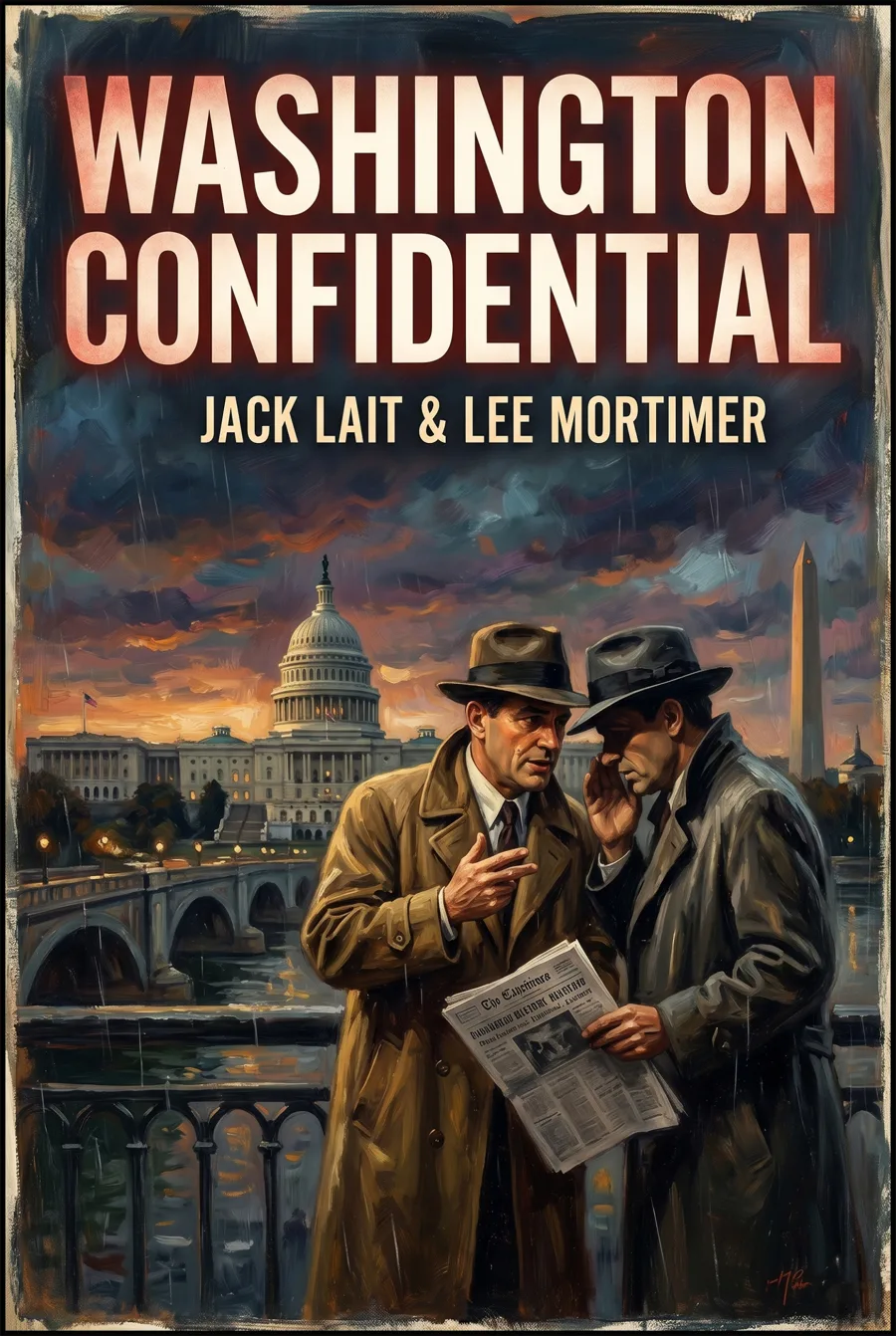
Download Cover Image
Do you want to download the full cover image for Washington Confidential?