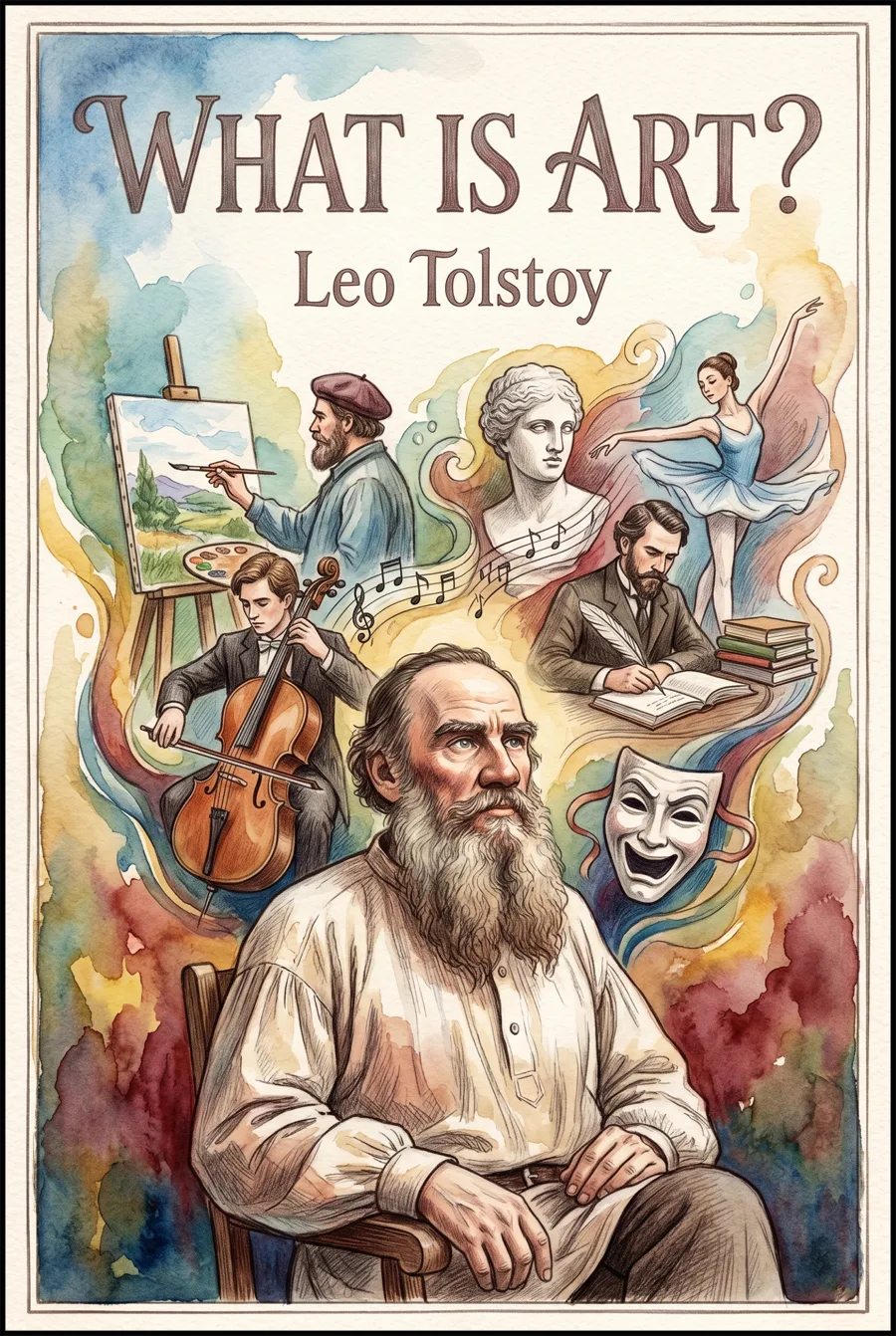
What Is Art?
eBook
• INR 51.00
• English
• 9788169359030
No ratings yet
| Publisher | General Press |
|---|---|
| ISBN13 | 9788169359030 |
| ASIN/SKU | 8169359031 |
| Book Format | eBook |
| Language | English |
| List Price | INR 51.00 |
| Subject Code | PHI001000, PHI005000, ART009000 |
| Publishing Date | 01/09/2026 |
| Book Code | BD00070242 |
Buy this Book
Amazon Stores
Ebook Stores
Other Stores
Discover What Is Art? by Leo Tolstoy. This book is published by General Press in eBook format, ISBN 9788169359030, ASIN 8169359031, under Non Fiction, Philosophy Aesthetics, Philosophy of Ethics and Morality.
Book Description
What if the value of a great painting, novel, or piece of music had less to do with beauty and more to do with what it makes us feel and share with others? 'What Is Art?' by Leo Tolstoy is a classic work of philosophy, aesthetics, and social criticism in which the Russian novelist questions the purpose of art and challenges many of the assumptions surrounding artistic greatness. Written with the directness and moral seriousness that became characteristic of Tolstoy's later work, the book asks a deceptively simple question: what makes something truly art?
Tolstoy begins by examining common definitions of art and finds them inadequate. He argues against the idea that art exists mainly to produce beauty, pleasure, or admiration among educated elites. Instead, he presents art as a form of human communication through which one person conveys feelings to another. For Tolstoy, genuine art succeeds when it creates a sincere emotional connection between the creator and the audience.
The book then develops a strong moral argument. Tolstoy believes that art should contribute to the shared life of humanity by encouraging empathy, compassion, and a sense of fellowship. He is sharply critical of works created primarily for wealth, status, fashion, or the approval of privileged audiences. He also questions the cultural systems that celebrate complexity and exclusivity while leaving ordinary people disconnected from art.
Throughout 'What Is Art?', Tolstoy challenges readers to reconsider familiar ideas about beauty, artistic genius, taste, and cultural prestige. His arguments can be provocative and uncompromising, but they remain remarkably relevant in a world filled with competing ideas about what deserves to be called art. Whether you agree with Tolstoy or not, this thought-provoking book offers a fascinating invitation to look at creativity—and the human need to connect—in an entirely different way.
Tolstoy begins by examining common definitions of art and finds them inadequate. He argues against the idea that art exists mainly to produce beauty, pleasure, or admiration among educated elites. Instead, he presents art as a form of human communication through which one person conveys feelings to another. For Tolstoy, genuine art succeeds when it creates a sincere emotional connection between the creator and the audience.
The book then develops a strong moral argument. Tolstoy believes that art should contribute to the shared life of humanity by encouraging empathy, compassion, and a sense of fellowship. He is sharply critical of works created primarily for wealth, status, fashion, or the approval of privileged audiences. He also questions the cultural systems that celebrate complexity and exclusivity while leaving ordinary people disconnected from art.
Throughout 'What Is Art?', Tolstoy challenges readers to reconsider familiar ideas about beauty, artistic genius, taste, and cultural prestige. His arguments can be provocative and uncompromising, but they remain remarkably relevant in a world filled with competing ideas about what deserves to be called art. Whether you agree with Tolstoy or not, this thought-provoking book offers a fascinating invitation to look at creativity—and the human need to connect—in an entirely different way.
Author Biography
Few writers have explored the human heart, family, society, and morality as deeply as Leo Tolstoy. Leo Tolstoy, whose full name was Lev Nikolayevich Tolstoy, was a Russian novelist and philosopher best known for his monumental works of literature, including 'War and Peace' and 'Anna Karenina'.
Born on September 9, 1828, at Yasnaya Polyana, a family estate in the Russian Empire, Tolstoy grew up in an aristocratic family but developed a lifelong concern for ordinary people and social injustice. After studying at Kazan University and serving in the military, he began publishing stories inspired by his experiences. His early works, including 'Childhood', 'Boyhood', and 'Youth', established him as a promising young writer.
Tolstoy reached his greatest literary heights with 'War and Peace', an expansive novel that combines historical events, philosophy, and the personal lives of several families during the Napoleonic Wars. He followed it with 'Anna Karenina', a powerful exploration of love, marriage, family, social expectations, and personal happiness. His writing is admired for its psychological depth, vivid characters, realistic details, and thoughtful examination of moral questions.
In his later years, Tolstoy became increasingly interested in spirituality, pacifism, simple living, and social reform. Works such as 'The Death of Ivan Ilyich', 'Resurrection', and 'The Kreutzer Sonata' reflected his changing beliefs and criticism of social inequality and organized institutions. His ideas influenced writers, activists, and thinkers around the world, including Mahatma Gandhi.
Tolstoy died in 1910, but his influence has never faded. His timeless stories and profound questions about love, conscience, society, and the meaning of life continue to make him one of the most important and widely read authors in world literature.
Born on September 9, 1828, at Yasnaya Polyana, a family estate in the Russian Empire, Tolstoy grew up in an aristocratic family but developed a lifelong concern for ordinary people and social injustice. After studying at Kazan University and serving in the military, he began publishing stories inspired by his experiences. His early works, including 'Childhood', 'Boyhood', and 'Youth', established him as a promising young writer.
Tolstoy reached his greatest literary heights with 'War and Peace', an expansive novel that combines historical events, philosophy, and the personal lives of several families during the Napoleonic Wars. He followed it with 'Anna Karenina', a powerful exploration of love, marriage, family, social expectations, and personal happiness. His writing is admired for its psychological depth, vivid characters, realistic details, and thoughtful examination of moral questions.
In his later years, Tolstoy became increasingly interested in spirituality, pacifism, simple living, and social reform. Works such as 'The Death of Ivan Ilyich', 'Resurrection', and 'The Kreutzer Sonata' reflected his changing beliefs and criticism of social inequality and organized institutions. His ideas influenced writers, activists, and thinkers around the world, including Mahatma Gandhi.
Tolstoy died in 1910, but his influence has never faded. His timeless stories and profound questions about love, conscience, society, and the meaning of life continue to make him one of the most important and widely read authors in world literature.
Editorial Reviews
Editorial Reviews will be added soon…
Book Summary
Leo Tolstoy’s "What Is Art?" is one of the most challenging, provocative, and morally serious books ever written about the meaning and purpose of art. First published in Russian in 1897, the work is not simply an aesthetic theory or a discussion of painting, music, and literature. Tolstoy asks a much larger question: ''What is art for, and what makes one work of art better or more valuable than another?'' His answer is radical. He argues that genuine art is not primarily about beauty, fame, technical brilliance, originality, or the pleasure of wealthy and educated audiences. True art is a form of human communication. An artist experiences a feeling and, through artistic expression, transmits that feeling to other people. Art succeeds when this emotional experience passes from one human being to another and creates a genuine sense of connection. For readers searching for an ''in-depth summary of 'What Is Art?' by Leo Tolstoy'', the book is ultimately a powerful argument that art should serve human fellowship rather than vanity, luxury, entertainment, or social prestige.
Tolstoy begins by examining the traditional definitions of art. He is dissatisfied with the idea that art can be explained simply as the production of beauty. For centuries, philosophers and critics had associated art with beauty and aesthetic pleasure, but Tolstoy believes that this definition is inadequate. Beauty is difficult to define objectively, and people's ideas of beauty vary enormously across cultures and historical periods. If beauty alone determines whether something is art, then there is no reliable way to distinguish great art from fashionable decoration or cultural habit. Tolstoy therefore looks for a more fundamental explanation of what happens when people create and experience art.
He eventually defines art in terms of ''emotional transmission''. According to Tolstoy, an artist first experiences a particular feeling—perhaps joy, sadness, fear, tenderness, admiration, loneliness, or spiritual devotion. The artist then expresses that feeling through words, sounds, images, gestures, or other artistic forms. When another person encounters the work and experiences something similar, the artist has successfully communicated the emotion. In this sense, art is comparable to language, but it communicates feelings rather than merely ideas. Tolstoy famously describes art as a means by which human beings infect one another with feeling. The metaphor is deliberately striking: an emotion moves from artist to audience and creates a shared human experience.
This definition allows Tolstoy to separate genuine art from things that merely look artistic. A technically impressive painting, a complicated musical composition, or an elegant poem is not necessarily good art. Technical skill can help an artist communicate, but technique by itself is not the essence of art. Likewise, originality and beauty do not guarantee artistic value. What matters is whether the work sincerely communicates a feeling that another person can experience.
For Tolstoy, ''sincerity'' is therefore one of the most important qualities of genuine art. The artist must actually experience the emotion being communicated. If an artist creates something merely to impress critics, earn money, gain social status, or imitate fashionable artistic conventions, the resulting work may be technically accomplished but spiritually empty. Genuine art comes from an authentic inner experience. The artist must have something real to communicate rather than simply demonstrating artistic skill.
Tolstoy then turns his attention to the development of European art and becomes increasingly critical of the artistic establishment of his own time. He argues that modern European culture has created an artificial distinction between a small class of sophisticated people who consume "high art" and the enormous majority of ordinary people who are excluded from it. Museums, concert halls, literary institutions, academies, and wealthy patrons often determine what is considered valuable. Tolstoy believes this system has encouraged artists to produce increasingly complicated and obscure works for an elite audience rather than creating art capable of speaking to humanity as a whole.
His criticism becomes particularly severe when he discusses ''modern elite art''. Tolstoy believes that much of the art celebrated by wealthy European society is difficult to understand precisely because it is designed for a narrow social class. Artists compete to appear original, sophisticated, and intellectually advanced. Audiences, meanwhile, learn to admire works because authorities tell them that the works are important. Tolstoy considers this process deeply unhealthy. A person may claim to appreciate a difficult work not because it genuinely moves them, but because they have been taught that a cultivated person is supposed to admire it.
This leads Tolstoy to challenge the idea of artistic "genius." He does not deny that artists can possess extraordinary talent, but he rejects the notion that great art should be judged primarily according to the artist's reputation or technical mastery. A celebrated masterpiece may communicate a narrow, artificial feeling to a small audience, while a simple song, story, or painting may communicate a profound human emotion to millions. In Tolstoy's view, the latter can be artistically superior even if critics dismiss it as unsophisticated.
One of the most important concepts in 'What Is Art?' is therefore ''universality''. Tolstoy believes that the greatest art communicates feelings that human beings can share regardless of education, nationality, wealth, or social position. Art should cross boundaries rather than reinforce them. A work that communicates sincere human affection, compassion, courage, sorrow, or spiritual hope can be understood by people from very different backgrounds. The more widely and naturally a feeling can be communicated, the more powerful the art may become.
Tolstoy distinguishes between what he sees as ''good art'' and ''bad art'' partly through three qualities: individuality, clarity, and sincerity. Individuality means that the artist genuinely has something personal to communicate. Clarity means that the feeling is expressed in a way that allows other people to experience it. Sincerity means that the artist truly feels what is being communicated. These qualities work together. An artist may be sincere but unable to communicate effectively; another may be technically clear but emotionally insincere. Great art requires a genuine union of feeling and expression.
Tolstoy also proposes a distinction between three broad levels or kinds of artistic communication. The first involves feelings that are simple and familiar, such as amusement, excitement, pleasure, or sadness. The second involves more elevated feelings that may unite people around shared human experiences. The third involves what Tolstoy considers the highest form of art: works that communicate ''religious and moral feelings capable of uniting humanity''. This final category reflects Tolstoy's own spiritual development and his increasing belief that human beings should move toward compassion, equality, love, and moral responsibility.
This is where 'What Is Art?' becomes more than an aesthetic treatise. Tolstoy argues that art has a ''moral purpose''. Because art allows people to experience feelings that originate in another person's consciousness, it can break down the barriers between individuals. A person who experiences another person's suffering through a work of art may become more compassionate. Art can therefore help people recognize their shared humanity.
Tolstoy is especially interested in the relationship between art and ''Christian love''. His religious ideas were highly individual and controversial, but they strongly influence the book. He believes that humanity's moral development depends on replacing selfishness, violence, competition, and social division with love and brotherhood. Art can contribute to this development when it communicates feelings that bring people together.
This moral emphasis also leads Tolstoy to reject the doctrine of ''"art for art's sake."'' The idea that art should exist purely for aesthetic pleasure strikes him as misguided. If art is fundamentally a form of human communication, then it cannot be separated completely from human life. Art always communicates something, and what it communicates affects people. The question, therefore, is not whether art should influence society, but whether it influences society toward greater human unity or toward vanity, cruelty, sensual excess, and social division.
Tolstoy is particularly suspicious of art that glorifies sexual passion, luxury, violence, or aristocratic life. He believes that much of the prestigious art of nineteenth-century Europe reflects the values of a privileged minority rather than the needs of humanity as a whole. Opera, elaborate theater, fashionable novels, and certain forms of classical music come under his criticism. His examples can seem surprisingly severe, especially because he sometimes dismisses works that later generations regard as masterpieces.
His criticism of ''Beethoven, Shakespeare, Dante, Wagner, and other celebrated artists'' is one reason the book remains controversial. Tolstoy does not hesitate to question artistic reputations that appear almost untouchable. He argues that certain famous works fail his test of sincere and accessible emotional communication. Readers do not have to agree with his judgments to appreciate what he is attempting to do: he wants to free artistic evaluation from inherited prestige and ask what a work actually does to the human beings who encounter it.
Tolstoy's discussion of music is especially revealing. He acknowledges music's extraordinary power to communicate emotion but argues that technical complexity does not automatically make a composition superior. A simple musical work that genuinely communicates an emotion can be more valuable than an elaborate composition whose emotional content is artificial or inaccessible. Again, his standard is not complexity but communication.
The same principle applies to literature. Tolstoy values stories that allow readers to experience the lives and feelings of other people. Literature can make strangers emotionally familiar. A reader can enter the consciousness of someone from another country, class, profession, or historical period and experience that person's fears and hopes. In this way, literature can enlarge sympathy.
Tolstoy also distinguishes between ''art and entertainment''. Entertainment can certainly produce pleasure, but pleasure alone does not determine artistic value. A popular spectacle may excite an audience without creating meaningful emotional communication. Conversely, a quiet story about ordinary human life may possess enormous artistic power because it allows readers to feel something deeply and honestly.
His preference for ordinary human experience is part of his broader social philosophy. Tolstoy believes that the privileged classes have become separated from the majority of humanity. Their art reflects this separation. By contrast, art rooted in everyday human experience—folk songs, simple stories, children's art, religious works, and sincere representations of ordinary life—can communicate across social boundaries.
One of the book's most important arguments is that ''art should be accessible''. Tolstoy does not mean that every artwork must be simplistic or that all difficult ideas are bad. Rather, he believes that unnecessary obscurity is a defect. If the purpose of art is communication, deliberately making art incomprehensible defeats that purpose. An artist should strive to communicate rather than hide behind complexity.
Tolstoy also believes that the true artist should not be excessively concerned with money or fame. Commercial pressures can distort artistic expression by encouraging artists to produce what wealthy patrons, critics, or fashionable audiences want. Once art becomes a luxury commodity, it risks losing its connection with ordinary human life. For Tolstoy, this is not merely an economic problem; it is a spiritual problem.
The book's moral vision eventually leads Tolstoy to a powerful conclusion: ''the future of art should belong to works that unite rather than divide humanity''. As society develops morally, art should increasingly communicate universal human feelings. The greatest art will not be reserved for elites. It will be accessible to ordinary people and will encourage love, compassion, solidarity, and spiritual growth.
For readers searching for a ''detailed summary of 'What Is Art?' by Leo Tolstoy'', the central argument can therefore be stated simply: art is a form of emotional communication. An artist experiences a feeling and communicates it through an artistic medium so that others can share that feeling. The value of art depends not primarily on beauty, complexity, originality, or prestige but on sincerity, clarity, individuality, and its capacity to unite people. Tolstoy rejects art created primarily for wealthy elites and criticizes the idea of art existing solely for aesthetic pleasure. He believes the highest art should contribute to humanity's moral progress by communicating feelings of love, compassion, brotherhood, and spiritual unity.
The book's central theme is ultimately ''human connection''. Tolstoy sees people as separated by language, nationality, class, education, wealth, and social institutions. Art offers a way around those barriers. When a person thousands of miles away or centuries in the past communicates a genuine feeling that we can experience ourselves, the distance between human beings suddenly becomes smaller.
At the same time, 'What Is Art?' raises an enduring question about the responsibilities of artists. Should art simply entertain? Should artists pursue beauty regardless of moral consequences? Or does every artistic act carry a social and ethical responsibility? Tolstoy's answer is uncompromising: because art affects human emotions, artists cannot escape responsibility for what they communicate.
Modern readers may disagree with many of Tolstoy's individual artistic judgments, and some of his religious and moral conclusions can feel restrictive. His attacks on famous works can also seem deliberately provocative. Yet the fundamental question he raises remains remarkably relevant. In an age of mass entertainment, commercial publishing, social media, streaming platforms, and algorithmically produced content, we still ask what separates meaningful artistic expression from something designed merely to attract attention.
Ultimately, 'What Is Art?' is not simply a book about painting, literature, music, or aesthetics. It is a book about ''what human beings owe one another''. Tolstoy believes that art at its best allows one person to enter another person's emotional world. It makes strangers feel connected, turns private experience into shared experience, and can enlarge our capacity for sympathy. His ideal artist is therefore not merely a skilled craftsman but a human being sincerely communicating something that matters.
That is what makes 'What Is Art?' an enduring classic of ''aesthetics, philosophy of art, literary criticism, moral philosophy, and social thought''. Tolstoy's definition of art is simple enough to understand but profound enough to provoke argument more than a century after the book was published. For Tolstoy, the highest purpose of art is not to decorate life or flatter the powerful. It is to bring human beings closer together. When art succeeds in doing that sincerely and powerfully, it becomes more than entertainment or beauty: it becomes a means of human fellowship, moral awakening, and shared understanding.
Tolstoy begins by examining the traditional definitions of art. He is dissatisfied with the idea that art can be explained simply as the production of beauty. For centuries, philosophers and critics had associated art with beauty and aesthetic pleasure, but Tolstoy believes that this definition is inadequate. Beauty is difficult to define objectively, and people's ideas of beauty vary enormously across cultures and historical periods. If beauty alone determines whether something is art, then there is no reliable way to distinguish great art from fashionable decoration or cultural habit. Tolstoy therefore looks for a more fundamental explanation of what happens when people create and experience art.
He eventually defines art in terms of ''emotional transmission''. According to Tolstoy, an artist first experiences a particular feeling—perhaps joy, sadness, fear, tenderness, admiration, loneliness, or spiritual devotion. The artist then expresses that feeling through words, sounds, images, gestures, or other artistic forms. When another person encounters the work and experiences something similar, the artist has successfully communicated the emotion. In this sense, art is comparable to language, but it communicates feelings rather than merely ideas. Tolstoy famously describes art as a means by which human beings infect one another with feeling. The metaphor is deliberately striking: an emotion moves from artist to audience and creates a shared human experience.
This definition allows Tolstoy to separate genuine art from things that merely look artistic. A technically impressive painting, a complicated musical composition, or an elegant poem is not necessarily good art. Technical skill can help an artist communicate, but technique by itself is not the essence of art. Likewise, originality and beauty do not guarantee artistic value. What matters is whether the work sincerely communicates a feeling that another person can experience.
For Tolstoy, ''sincerity'' is therefore one of the most important qualities of genuine art. The artist must actually experience the emotion being communicated. If an artist creates something merely to impress critics, earn money, gain social status, or imitate fashionable artistic conventions, the resulting work may be technically accomplished but spiritually empty. Genuine art comes from an authentic inner experience. The artist must have something real to communicate rather than simply demonstrating artistic skill.
Tolstoy then turns his attention to the development of European art and becomes increasingly critical of the artistic establishment of his own time. He argues that modern European culture has created an artificial distinction between a small class of sophisticated people who consume "high art" and the enormous majority of ordinary people who are excluded from it. Museums, concert halls, literary institutions, academies, and wealthy patrons often determine what is considered valuable. Tolstoy believes this system has encouraged artists to produce increasingly complicated and obscure works for an elite audience rather than creating art capable of speaking to humanity as a whole.
His criticism becomes particularly severe when he discusses ''modern elite art''. Tolstoy believes that much of the art celebrated by wealthy European society is difficult to understand precisely because it is designed for a narrow social class. Artists compete to appear original, sophisticated, and intellectually advanced. Audiences, meanwhile, learn to admire works because authorities tell them that the works are important. Tolstoy considers this process deeply unhealthy. A person may claim to appreciate a difficult work not because it genuinely moves them, but because they have been taught that a cultivated person is supposed to admire it.
This leads Tolstoy to challenge the idea of artistic "genius." He does not deny that artists can possess extraordinary talent, but he rejects the notion that great art should be judged primarily according to the artist's reputation or technical mastery. A celebrated masterpiece may communicate a narrow, artificial feeling to a small audience, while a simple song, story, or painting may communicate a profound human emotion to millions. In Tolstoy's view, the latter can be artistically superior even if critics dismiss it as unsophisticated.
One of the most important concepts in 'What Is Art?' is therefore ''universality''. Tolstoy believes that the greatest art communicates feelings that human beings can share regardless of education, nationality, wealth, or social position. Art should cross boundaries rather than reinforce them. A work that communicates sincere human affection, compassion, courage, sorrow, or spiritual hope can be understood by people from very different backgrounds. The more widely and naturally a feeling can be communicated, the more powerful the art may become.
Tolstoy distinguishes between what he sees as ''good art'' and ''bad art'' partly through three qualities: individuality, clarity, and sincerity. Individuality means that the artist genuinely has something personal to communicate. Clarity means that the feeling is expressed in a way that allows other people to experience it. Sincerity means that the artist truly feels what is being communicated. These qualities work together. An artist may be sincere but unable to communicate effectively; another may be technically clear but emotionally insincere. Great art requires a genuine union of feeling and expression.
Tolstoy also proposes a distinction between three broad levels or kinds of artistic communication. The first involves feelings that are simple and familiar, such as amusement, excitement, pleasure, or sadness. The second involves more elevated feelings that may unite people around shared human experiences. The third involves what Tolstoy considers the highest form of art: works that communicate ''religious and moral feelings capable of uniting humanity''. This final category reflects Tolstoy's own spiritual development and his increasing belief that human beings should move toward compassion, equality, love, and moral responsibility.
This is where 'What Is Art?' becomes more than an aesthetic treatise. Tolstoy argues that art has a ''moral purpose''. Because art allows people to experience feelings that originate in another person's consciousness, it can break down the barriers between individuals. A person who experiences another person's suffering through a work of art may become more compassionate. Art can therefore help people recognize their shared humanity.
Tolstoy is especially interested in the relationship between art and ''Christian love''. His religious ideas were highly individual and controversial, but they strongly influence the book. He believes that humanity's moral development depends on replacing selfishness, violence, competition, and social division with love and brotherhood. Art can contribute to this development when it communicates feelings that bring people together.
This moral emphasis also leads Tolstoy to reject the doctrine of ''"art for art's sake."'' The idea that art should exist purely for aesthetic pleasure strikes him as misguided. If art is fundamentally a form of human communication, then it cannot be separated completely from human life. Art always communicates something, and what it communicates affects people. The question, therefore, is not whether art should influence society, but whether it influences society toward greater human unity or toward vanity, cruelty, sensual excess, and social division.
Tolstoy is particularly suspicious of art that glorifies sexual passion, luxury, violence, or aristocratic life. He believes that much of the prestigious art of nineteenth-century Europe reflects the values of a privileged minority rather than the needs of humanity as a whole. Opera, elaborate theater, fashionable novels, and certain forms of classical music come under his criticism. His examples can seem surprisingly severe, especially because he sometimes dismisses works that later generations regard as masterpieces.
His criticism of ''Beethoven, Shakespeare, Dante, Wagner, and other celebrated artists'' is one reason the book remains controversial. Tolstoy does not hesitate to question artistic reputations that appear almost untouchable. He argues that certain famous works fail his test of sincere and accessible emotional communication. Readers do not have to agree with his judgments to appreciate what he is attempting to do: he wants to free artistic evaluation from inherited prestige and ask what a work actually does to the human beings who encounter it.
Tolstoy's discussion of music is especially revealing. He acknowledges music's extraordinary power to communicate emotion but argues that technical complexity does not automatically make a composition superior. A simple musical work that genuinely communicates an emotion can be more valuable than an elaborate composition whose emotional content is artificial or inaccessible. Again, his standard is not complexity but communication.
The same principle applies to literature. Tolstoy values stories that allow readers to experience the lives and feelings of other people. Literature can make strangers emotionally familiar. A reader can enter the consciousness of someone from another country, class, profession, or historical period and experience that person's fears and hopes. In this way, literature can enlarge sympathy.
Tolstoy also distinguishes between ''art and entertainment''. Entertainment can certainly produce pleasure, but pleasure alone does not determine artistic value. A popular spectacle may excite an audience without creating meaningful emotional communication. Conversely, a quiet story about ordinary human life may possess enormous artistic power because it allows readers to feel something deeply and honestly.
His preference for ordinary human experience is part of his broader social philosophy. Tolstoy believes that the privileged classes have become separated from the majority of humanity. Their art reflects this separation. By contrast, art rooted in everyday human experience—folk songs, simple stories, children's art, religious works, and sincere representations of ordinary life—can communicate across social boundaries.
One of the book's most important arguments is that ''art should be accessible''. Tolstoy does not mean that every artwork must be simplistic or that all difficult ideas are bad. Rather, he believes that unnecessary obscurity is a defect. If the purpose of art is communication, deliberately making art incomprehensible defeats that purpose. An artist should strive to communicate rather than hide behind complexity.
Tolstoy also believes that the true artist should not be excessively concerned with money or fame. Commercial pressures can distort artistic expression by encouraging artists to produce what wealthy patrons, critics, or fashionable audiences want. Once art becomes a luxury commodity, it risks losing its connection with ordinary human life. For Tolstoy, this is not merely an economic problem; it is a spiritual problem.
The book's moral vision eventually leads Tolstoy to a powerful conclusion: ''the future of art should belong to works that unite rather than divide humanity''. As society develops morally, art should increasingly communicate universal human feelings. The greatest art will not be reserved for elites. It will be accessible to ordinary people and will encourage love, compassion, solidarity, and spiritual growth.
For readers searching for a ''detailed summary of 'What Is Art?' by Leo Tolstoy'', the central argument can therefore be stated simply: art is a form of emotional communication. An artist experiences a feeling and communicates it through an artistic medium so that others can share that feeling. The value of art depends not primarily on beauty, complexity, originality, or prestige but on sincerity, clarity, individuality, and its capacity to unite people. Tolstoy rejects art created primarily for wealthy elites and criticizes the idea of art existing solely for aesthetic pleasure. He believes the highest art should contribute to humanity's moral progress by communicating feelings of love, compassion, brotherhood, and spiritual unity.
The book's central theme is ultimately ''human connection''. Tolstoy sees people as separated by language, nationality, class, education, wealth, and social institutions. Art offers a way around those barriers. When a person thousands of miles away or centuries in the past communicates a genuine feeling that we can experience ourselves, the distance between human beings suddenly becomes smaller.
At the same time, 'What Is Art?' raises an enduring question about the responsibilities of artists. Should art simply entertain? Should artists pursue beauty regardless of moral consequences? Or does every artistic act carry a social and ethical responsibility? Tolstoy's answer is uncompromising: because art affects human emotions, artists cannot escape responsibility for what they communicate.
Modern readers may disagree with many of Tolstoy's individual artistic judgments, and some of his religious and moral conclusions can feel restrictive. His attacks on famous works can also seem deliberately provocative. Yet the fundamental question he raises remains remarkably relevant. In an age of mass entertainment, commercial publishing, social media, streaming platforms, and algorithmically produced content, we still ask what separates meaningful artistic expression from something designed merely to attract attention.
Ultimately, 'What Is Art?' is not simply a book about painting, literature, music, or aesthetics. It is a book about ''what human beings owe one another''. Tolstoy believes that art at its best allows one person to enter another person's emotional world. It makes strangers feel connected, turns private experience into shared experience, and can enlarge our capacity for sympathy. His ideal artist is therefore not merely a skilled craftsman but a human being sincerely communicating something that matters.
That is what makes 'What Is Art?' an enduring classic of ''aesthetics, philosophy of art, literary criticism, moral philosophy, and social thought''. Tolstoy's definition of art is simple enough to understand but profound enough to provoke argument more than a century after the book was published. For Tolstoy, the highest purpose of art is not to decorate life or flatter the powerful. It is to bring human beings closer together. When art succeeds in doing that sincerely and powerfully, it becomes more than entertainment or beauty: it becomes a means of human fellowship, moral awakening, and shared understanding.
Sample Chapters
Sample Chapters will be added soon…
Reader Reviews
No reviews yet.
What Is Art?