
What Is Man? and Other Essays
eBook
• INR 51.00
• English
• 9788169359306
No ratings yet
| Publisher | General Press |
|---|---|
| ISBN13 | 9788169359306 |
| ASIN/SKU | 8169359309 |
| Book Format | eBook |
| Language | English |
| List Price | INR 51.00 |
| Subject Code | LCO010000, PHI005000, LCO002000 |
| Publishing Date | 01/09/2026 |
| Book Code | BD00070243 |
Buy this Book
Amazon Stores
Ebook Stores
Other Stores
Discover What Is Man? and Other Essays by Mark Twain. This book is published by General Press in eBook format, ISBN 9788169359306, ASIN 8169359309, under Non Fiction, Essays and Correspondence, Philosophy of Ethics and Morality.
Book Description
What if human beings are far less independent and original than they like to believe? 'What Is Man and Other Essays' by Mark Twain is a thought-provoking collection of philosophical essays that explores human nature, free will, morality, motivation, and the forces that shape our behavior. Written with Twain's familiar wit, skepticism, and sharp sense of humor, the collection challenges comfortable assumptions about what makes people who they are.
The central essay, “What Is Man?”, takes the form of a conversation between an older man and a younger man as they debate whether human beings possess genuine free will. Twain presents the provocative idea that people are largely shaped by their environment, upbringing, education, habits, and experiences rather than being completely independent thinkers. The discussion examines why people seek approval, pursue success, behave morally, or make sacrifices, often suggesting that even our noblest actions may be influenced by self-interest or the desire for personal satisfaction.
The remaining essays continue Twain's examination of society and human behavior from different angles. He considers subjects such as patriotism, religion, morality, historical progress, and the ways people justify their beliefs. His arguments can be deliberately uncomfortable, but they are rarely dull. Twain combines serious philosophical questions with irony and humor, encouraging readers to question ideas they might normally accept without reflection.
Rather than offering easy answers, the collection invites readers to examine their own assumptions about freedom, responsibility, and the motives behind everyday choices. More than a century after its publication, 'What Is Man and Other Essays' remains an intriguing introduction to Twain's darker, more philosophical side. Its questions are deceptively simple—and once you begin considering them, they are difficult to leave behind.
The central essay, “What Is Man?”, takes the form of a conversation between an older man and a younger man as they debate whether human beings possess genuine free will. Twain presents the provocative idea that people are largely shaped by their environment, upbringing, education, habits, and experiences rather than being completely independent thinkers. The discussion examines why people seek approval, pursue success, behave morally, or make sacrifices, often suggesting that even our noblest actions may be influenced by self-interest or the desire for personal satisfaction.
The remaining essays continue Twain's examination of society and human behavior from different angles. He considers subjects such as patriotism, religion, morality, historical progress, and the ways people justify their beliefs. His arguments can be deliberately uncomfortable, but they are rarely dull. Twain combines serious philosophical questions with irony and humor, encouraging readers to question ideas they might normally accept without reflection.
Rather than offering easy answers, the collection invites readers to examine their own assumptions about freedom, responsibility, and the motives behind everyday choices. More than a century after its publication, 'What Is Man and Other Essays' remains an intriguing introduction to Twain's darker, more philosophical side. Its questions are deceptively simple—and once you begin considering them, they are difficult to leave behind.
Author Biography
Mark Twain turned everyday American life into unforgettable stories filled with humor, adventure, and sharp social observation. Born Samuel Langhorne Clemens, Mark Twain was an American novelist, essayist, humorist, and journalist best known for classic works such as 'The Adventures of Tom Sawyer' and 'Adventures of Huckleberry Finn', which helped shape American literature.
He was born on November 30, 1835, in Florida, Missouri, and grew up in Hannibal, a Mississippi River town that later inspired many settings in his fiction. After leaving school as a teenager, Clemens worked as a printer and typesetter before becoming a riverboat pilot on the Mississippi. His experience on the river led him to adopt the pen name “Mark Twain,” a term used by riverboat workers to indicate safe navigable water.
Twain began gaining national attention as a writer with humorous newspaper and magazine pieces. His 1865 story “The Celebrated Jumping Frog of Calaveras County” brought him widespread recognition. He went on to publish 'The Innocents Abroad', 'The Prince and the Pauper', 'A Connecticut Yankee in King Arthur's Court', and other influential works. His writing combined wit, vivid characters, regional speech, and adventurous storytelling with serious criticism of racism, inequality, hypocrisy, and social injustice.
'Adventures of Huckleberry Finn', published in 1884, is widely regarded as one of the great American novels. Twain’s ability to capture the voices and attitudes of his time gave his work unusual realism, while his humor made difficult subjects accessible to broad audiences. His lectures and public appearances also made him one of the best-known literary figures of his era.
Mark Twain died on April 21, 1910, but his distinctive voice and fearless humor continue to influence writers and entertain readers. His books remain enduring works of American literature, keeping his legacy alive across generations.
He was born on November 30, 1835, in Florida, Missouri, and grew up in Hannibal, a Mississippi River town that later inspired many settings in his fiction. After leaving school as a teenager, Clemens worked as a printer and typesetter before becoming a riverboat pilot on the Mississippi. His experience on the river led him to adopt the pen name “Mark Twain,” a term used by riverboat workers to indicate safe navigable water.
Twain began gaining national attention as a writer with humorous newspaper and magazine pieces. His 1865 story “The Celebrated Jumping Frog of Calaveras County” brought him widespread recognition. He went on to publish 'The Innocents Abroad', 'The Prince and the Pauper', 'A Connecticut Yankee in King Arthur's Court', and other influential works. His writing combined wit, vivid characters, regional speech, and adventurous storytelling with serious criticism of racism, inequality, hypocrisy, and social injustice.
'Adventures of Huckleberry Finn', published in 1884, is widely regarded as one of the great American novels. Twain’s ability to capture the voices and attitudes of his time gave his work unusual realism, while his humor made difficult subjects accessible to broad audiences. His lectures and public appearances also made him one of the best-known literary figures of his era.
Mark Twain died on April 21, 1910, but his distinctive voice and fearless humor continue to influence writers and entertain readers. His books remain enduring works of American literature, keeping his legacy alive across generations.
Editorial Reviews
Editorial Reviews will be added soon…
Book Summary
Mark Twain’s "What Is Man? and Other Essays" is one of his most philosophical, skeptical, and intellectually provocative collections. Published in book form in 1906, it brings together a series of essays and reflections in which Twain questions some of the beliefs people most commonly accept about human nature, free will, morality, religion, civilization, ambition, and personal responsibility. Unlike the humorous adventures of Tom Sawyer and Huckleberry Finn, these writings are not primarily concerned with plot or entertainment. They are Twain thinking aloud about the human condition. His tone can be funny, bitter, pessimistic, playful, or deliberately provocative, but underneath the wit is a serious attempt to answer a deceptively simple question: ''What is man?'' Twain’s answer is unsettling. He portrays human beings as creatures shaped by circumstances, impulses, environment, habit, and social pressure, often far less independent and morally autonomous than they like to believe.
The central essay, “What Is Man?”, takes the form of a philosophical dialogue between an Old Man and a Young Man. This structure allows Twain to dramatize two opposing ideas about human nature. The Young Man represents the conventional belief that human beings possess free will, individuality, courage, originality, and the ability to act according to their own independent judgment. The Old Man systematically challenges these assumptions. He argues that human beings are essentially products of their circumstances and that what people call “character” is largely created by influences over which they have little or no control. The dialogue therefore becomes an extended examination of the question of whether people truly choose their actions or merely respond to forces that have shaped them.
The Old Man’s argument is built around the idea that human beings are driven by motives. People may believe that they act freely, but Twain suggests that behind every decision there is some combination of desire, fear, habit, training, experience, or external pressure. If a person chooses generosity, courage, honesty, ambition, or cruelty, that choice has been influenced by the person’s upbringing and circumstances. Change the circumstances, Twain argues, and you may change the behavior. This argument attacks the comforting idea that people are completely self-created. We like to imagine ourselves as independent authors of our lives, but Twain asks us to consider how much of our personality was formed before we were capable of consciously choosing anything.
One of the most important concepts in 'What Is Man?' is the ''training of the human being''. Twain compares the development of people to a process of conditioning. From childhood onward, individuals absorb ideas from parents, teachers, religion, society, friends, books, experiences, and rewards and punishments. These influences gradually create habits of thought and behavior. What adults later call their “principles” may therefore be inherited or learned rather than independently invented. Twain does not necessarily deny that people think or reason. Instead, he questions the extent to which reasoning itself is independent. Even our desires and preferences have histories.
This leads Twain to his provocative idea that the human being is essentially a “machine.” The metaphor is intentionally uncomfortable. Twain does not mean that people are literally mechanical objects without feelings. Rather, he argues that human actions follow causes just as physical events do. A person responds to circumstances according to the character that previous circumstances have produced. If someone behaves heroically, the heroism may result from temperament, education, experience, and social conditioning. If another person behaves selfishly, that behavior may have equally deep causes. From this perspective, blaming or praising individuals as though they had created themselves becomes much more complicated.
Twain’s argument naturally leads to his discussion of ''free will''. Traditional morality often assumes that people could have chosen differently. Twain questions this assumption. If a person’s decision is produced by their character and circumstances, and if that character itself was produced by previous causes, then where exactly is the completely independent “free” choice? The question becomes almost impossible to answer. Twain’s determinism is one of the most controversial aspects of the book, and it gives the essay its philosophical force.
Yet Twain’s argument is not simply that nothing matters because people have no freedom. His deeper purpose is to encourage readers to reconsider their judgments of others. If human beings are shaped by forces they did not choose, then hatred and moral arrogance become less defensible. A person born into poverty, violence, ignorance, or prejudice begins life with different influences from someone raised in security, education, and affection. Twain wants readers to recognize the enormous role played by environment. His philosophy can therefore be interpreted not only as pessimistic but also as an argument for compassion.
The collection repeatedly returns to the relationship between ''individual character and society''. People often imagine that they are independent thinkers, yet Twain suggests that social pressure is extraordinarily powerful. Customs, national traditions, political beliefs, religious teachings, and accepted moral standards shape people's perceptions of right and wrong. What one society praises, another may condemn. What one generation considers obvious may seem absurd to the next. Twain uses this variability to question claims that human beings naturally possess a universal and independent moral sense.
Religion is another major subject in the collection. Twain was deeply skeptical of organized religion and of the idea that traditional religious beliefs should be accepted simply because they are inherited. His criticism is often sharp and sometimes deliberately irreverent. He questions the belief that human beings occupy a uniquely favored position in the universe and challenges religious explanations that place human morality at the center of creation. In Twain’s view, people frequently create explanations that flatter their own importance. They imagine themselves to be the special focus of divine attention partly because they are psychologically uncomfortable with the possibility that the universe does not revolve around them.
This skepticism becomes particularly visible in “The Lowest Animal,” another important essay in the collection. Twain turns the conventional belief in human superiority upside down. Instead of beginning with the assumption that humans are the highest form of life, he asks whether they might actually be among the most destructive creatures. He compares human behavior with that of animals and argues that many of humanity’s supposedly noble qualities are exaggerated. Animals, he suggests, often kill for practical reasons such as hunger or self-defense, whereas human beings can kill on enormous scales for abstract ideas, pride, territory, politics, religion, or prestige.
The essay is therefore a biting criticism of ''human cruelty and civilization''. Twain points to war as one of the clearest examples of humanity’s strange capacity for organized destruction. Human beings are capable of developing sophisticated technology, philosophy, art, and political institutions, yet they can also use their intelligence to create more efficient ways of killing one another. The contradiction fascinates Twain. Civilization is supposed to represent progress, but technological and intellectual progress does not necessarily produce moral progress.
Twain’s treatment of the animal world is partly humorous, but the underlying argument is serious. Humans often congratulate themselves on being rational and civilized while behaving in ways that are irrational, violent, and self-destructive. The title “The Lowest Animal” is deliberately ironic because Twain uses it to challenge the assumption that humans automatically deserve the highest moral ranking. Intelligence, he implies, is not enough. If intelligence is used to justify cruelty, it may actually make human beings more dangerous rather than more virtuous.
Another recurring subject is ''the human need for approval''. Twain argues that people frequently make decisions because they want the respect, admiration, or acceptance of others. Even acts that appear selfless may contain an element of self-interest. A person may sacrifice money or comfort not simply because generosity is inherently satisfying but because the act creates a favorable feeling about oneself or earns praise from others. Twain’s analysis can seem cynical, but it reflects his broader interest in exposing the motives beneath socially respectable behavior.
This theme connects closely with Twain’s skepticism about ''altruism and morality''. He does not necessarily deny that people perform kind acts. Instead, he asks why they perform them. If a person gives money to someone in need and feels pleasure afterward, does that make the action selfish? If someone behaves bravely because they want admiration, is the courage less real? Twain repeatedly refuses to accept easy moral categories. He wants readers to look beneath behavior and examine the motives and conditioning that produce it.
The collection also contains reflections on ''ambition, success, and social values''. Twain questions the idea that conventional success automatically indicates personal worth. Wealth, fame, prestige, and social status are often treated as evidence of merit, but Twain sees them as unstable measures created by society. A person can become successful because of circumstances, connections, luck, or inherited advantages rather than exceptional virtue. Likewise, someone who fails may not be morally inferior. The distinction between success and worth is another example of Twain challenging assumptions that society takes for granted.
His skepticism extends to the idea of ''originality''. People like to think that their opinions are uniquely their own, but Twain suggests that most opinions are inherited. Individuals absorb political, religious, cultural, and social beliefs from their surroundings and then experience those beliefs as personal convictions. This does not mean that thought is impossible. Rather, Twain asks readers to become more conscious of the invisible influences that shape what they think they believe.
The humane side of Twain’s philosophy becomes especially important here. His determinism might initially sound harsh because it seems to reduce human beings to products of cause and effect. But it can also encourage humility. If our character has been formed by countless influences, then we have less reason to feel superior to people whose circumstances produced different behaviors. The person we condemn may have been shaped by experiences we never endured. Twain’s philosophy therefore contains an implicit invitation to replace moral arrogance with understanding.
At the same time, Twain does not become sentimental. He remains suspicious of human beings because he believes they possess an extraordinary capacity for self-deception. People can rationalize almost anything. They can turn selfishness into virtue, prejudice into principle, aggression into patriotism, and cruelty into righteousness. Much of Twain’s satire comes from this ability to invent noble explanations for questionable behavior. His humor works because readers recognize the uncomfortable truth beneath the joke.
The collection’s importance also comes from its relationship to Twain’s later thought. In many of his late writings, his earlier faith in progress and civilization becomes increasingly difficult to sustain. The optimism associated with nineteenth-century ideas of inevitable human improvement is replaced by a more skeptical vision. Human beings have acquired enormous knowledge and technological power, but they have not necessarily become wiser. Twain sees the possibility that civilization may simply make human contradictions more powerful.
Ultimately, 'What Is Man? and Other Essays' is a challenging exploration of ''human nature, determinism, free will, morality, religion, social conditioning, animal behavior, war, ambition, and the problem of self-knowledge''. Its central question remains powerful because it is personal as well as philosophical. Every reader must eventually ask how much of their personality is genuinely their own. How much comes from family, culture, education, fear, desire, habit, or chance? How much freedom do we actually possess? And if our behavior is shaped by forces we did not choose, how should we judge other people?
Twain does not provide comforting answers. He deliberately leaves readers unsettled. His vision of humanity is often pessimistic, but it is not empty. Beneath his sarcasm lies a serious demand for intellectual honesty. We should be suspicious of easy claims about human superiority, morality, freedom, and virtue. We should recognize the influence of circumstances. We should question the motives behind our actions. Most importantly, we should be slower to condemn others and less eager to congratulate ourselves.
The enduring value of 'What Is Man? and Other Essays' lies precisely in this uncomfortable honesty. Mark Twain uses humor and skepticism to strip away some of the flattering stories human beings tell about themselves. He presents people as creatures capable of extraordinary kindness and extraordinary cruelty, but always shaped by forces larger than they understand. The book asks readers to look inward without illusions and outward without arrogance. Its deepest lesson is perhaps that understanding human weakness should not lead to despair but to humility and compassion. Twain may doubt humanity’s claim to greatness, but his relentless examination of human behavior reveals something profoundly humane: the more we understand how fragile and conditioned we are, the more carefully we should treat one another.
The central essay, “What Is Man?”, takes the form of a philosophical dialogue between an Old Man and a Young Man. This structure allows Twain to dramatize two opposing ideas about human nature. The Young Man represents the conventional belief that human beings possess free will, individuality, courage, originality, and the ability to act according to their own independent judgment. The Old Man systematically challenges these assumptions. He argues that human beings are essentially products of their circumstances and that what people call “character” is largely created by influences over which they have little or no control. The dialogue therefore becomes an extended examination of the question of whether people truly choose their actions or merely respond to forces that have shaped them.
The Old Man’s argument is built around the idea that human beings are driven by motives. People may believe that they act freely, but Twain suggests that behind every decision there is some combination of desire, fear, habit, training, experience, or external pressure. If a person chooses generosity, courage, honesty, ambition, or cruelty, that choice has been influenced by the person’s upbringing and circumstances. Change the circumstances, Twain argues, and you may change the behavior. This argument attacks the comforting idea that people are completely self-created. We like to imagine ourselves as independent authors of our lives, but Twain asks us to consider how much of our personality was formed before we were capable of consciously choosing anything.
One of the most important concepts in 'What Is Man?' is the ''training of the human being''. Twain compares the development of people to a process of conditioning. From childhood onward, individuals absorb ideas from parents, teachers, religion, society, friends, books, experiences, and rewards and punishments. These influences gradually create habits of thought and behavior. What adults later call their “principles” may therefore be inherited or learned rather than independently invented. Twain does not necessarily deny that people think or reason. Instead, he questions the extent to which reasoning itself is independent. Even our desires and preferences have histories.
This leads Twain to his provocative idea that the human being is essentially a “machine.” The metaphor is intentionally uncomfortable. Twain does not mean that people are literally mechanical objects without feelings. Rather, he argues that human actions follow causes just as physical events do. A person responds to circumstances according to the character that previous circumstances have produced. If someone behaves heroically, the heroism may result from temperament, education, experience, and social conditioning. If another person behaves selfishly, that behavior may have equally deep causes. From this perspective, blaming or praising individuals as though they had created themselves becomes much more complicated.
Twain’s argument naturally leads to his discussion of ''free will''. Traditional morality often assumes that people could have chosen differently. Twain questions this assumption. If a person’s decision is produced by their character and circumstances, and if that character itself was produced by previous causes, then where exactly is the completely independent “free” choice? The question becomes almost impossible to answer. Twain’s determinism is one of the most controversial aspects of the book, and it gives the essay its philosophical force.
Yet Twain’s argument is not simply that nothing matters because people have no freedom. His deeper purpose is to encourage readers to reconsider their judgments of others. If human beings are shaped by forces they did not choose, then hatred and moral arrogance become less defensible. A person born into poverty, violence, ignorance, or prejudice begins life with different influences from someone raised in security, education, and affection. Twain wants readers to recognize the enormous role played by environment. His philosophy can therefore be interpreted not only as pessimistic but also as an argument for compassion.
The collection repeatedly returns to the relationship between ''individual character and society''. People often imagine that they are independent thinkers, yet Twain suggests that social pressure is extraordinarily powerful. Customs, national traditions, political beliefs, religious teachings, and accepted moral standards shape people's perceptions of right and wrong. What one society praises, another may condemn. What one generation considers obvious may seem absurd to the next. Twain uses this variability to question claims that human beings naturally possess a universal and independent moral sense.
Religion is another major subject in the collection. Twain was deeply skeptical of organized religion and of the idea that traditional religious beliefs should be accepted simply because they are inherited. His criticism is often sharp and sometimes deliberately irreverent. He questions the belief that human beings occupy a uniquely favored position in the universe and challenges religious explanations that place human morality at the center of creation. In Twain’s view, people frequently create explanations that flatter their own importance. They imagine themselves to be the special focus of divine attention partly because they are psychologically uncomfortable with the possibility that the universe does not revolve around them.
This skepticism becomes particularly visible in “The Lowest Animal,” another important essay in the collection. Twain turns the conventional belief in human superiority upside down. Instead of beginning with the assumption that humans are the highest form of life, he asks whether they might actually be among the most destructive creatures. He compares human behavior with that of animals and argues that many of humanity’s supposedly noble qualities are exaggerated. Animals, he suggests, often kill for practical reasons such as hunger or self-defense, whereas human beings can kill on enormous scales for abstract ideas, pride, territory, politics, religion, or prestige.
The essay is therefore a biting criticism of ''human cruelty and civilization''. Twain points to war as one of the clearest examples of humanity’s strange capacity for organized destruction. Human beings are capable of developing sophisticated technology, philosophy, art, and political institutions, yet they can also use their intelligence to create more efficient ways of killing one another. The contradiction fascinates Twain. Civilization is supposed to represent progress, but technological and intellectual progress does not necessarily produce moral progress.
Twain’s treatment of the animal world is partly humorous, but the underlying argument is serious. Humans often congratulate themselves on being rational and civilized while behaving in ways that are irrational, violent, and self-destructive. The title “The Lowest Animal” is deliberately ironic because Twain uses it to challenge the assumption that humans automatically deserve the highest moral ranking. Intelligence, he implies, is not enough. If intelligence is used to justify cruelty, it may actually make human beings more dangerous rather than more virtuous.
Another recurring subject is ''the human need for approval''. Twain argues that people frequently make decisions because they want the respect, admiration, or acceptance of others. Even acts that appear selfless may contain an element of self-interest. A person may sacrifice money or comfort not simply because generosity is inherently satisfying but because the act creates a favorable feeling about oneself or earns praise from others. Twain’s analysis can seem cynical, but it reflects his broader interest in exposing the motives beneath socially respectable behavior.
This theme connects closely with Twain’s skepticism about ''altruism and morality''. He does not necessarily deny that people perform kind acts. Instead, he asks why they perform them. If a person gives money to someone in need and feels pleasure afterward, does that make the action selfish? If someone behaves bravely because they want admiration, is the courage less real? Twain repeatedly refuses to accept easy moral categories. He wants readers to look beneath behavior and examine the motives and conditioning that produce it.
The collection also contains reflections on ''ambition, success, and social values''. Twain questions the idea that conventional success automatically indicates personal worth. Wealth, fame, prestige, and social status are often treated as evidence of merit, but Twain sees them as unstable measures created by society. A person can become successful because of circumstances, connections, luck, or inherited advantages rather than exceptional virtue. Likewise, someone who fails may not be morally inferior. The distinction between success and worth is another example of Twain challenging assumptions that society takes for granted.
His skepticism extends to the idea of ''originality''. People like to think that their opinions are uniquely their own, but Twain suggests that most opinions are inherited. Individuals absorb political, religious, cultural, and social beliefs from their surroundings and then experience those beliefs as personal convictions. This does not mean that thought is impossible. Rather, Twain asks readers to become more conscious of the invisible influences that shape what they think they believe.
The humane side of Twain’s philosophy becomes especially important here. His determinism might initially sound harsh because it seems to reduce human beings to products of cause and effect. But it can also encourage humility. If our character has been formed by countless influences, then we have less reason to feel superior to people whose circumstances produced different behaviors. The person we condemn may have been shaped by experiences we never endured. Twain’s philosophy therefore contains an implicit invitation to replace moral arrogance with understanding.
At the same time, Twain does not become sentimental. He remains suspicious of human beings because he believes they possess an extraordinary capacity for self-deception. People can rationalize almost anything. They can turn selfishness into virtue, prejudice into principle, aggression into patriotism, and cruelty into righteousness. Much of Twain’s satire comes from this ability to invent noble explanations for questionable behavior. His humor works because readers recognize the uncomfortable truth beneath the joke.
The collection’s importance also comes from its relationship to Twain’s later thought. In many of his late writings, his earlier faith in progress and civilization becomes increasingly difficult to sustain. The optimism associated with nineteenth-century ideas of inevitable human improvement is replaced by a more skeptical vision. Human beings have acquired enormous knowledge and technological power, but they have not necessarily become wiser. Twain sees the possibility that civilization may simply make human contradictions more powerful.
Ultimately, 'What Is Man? and Other Essays' is a challenging exploration of ''human nature, determinism, free will, morality, religion, social conditioning, animal behavior, war, ambition, and the problem of self-knowledge''. Its central question remains powerful because it is personal as well as philosophical. Every reader must eventually ask how much of their personality is genuinely their own. How much comes from family, culture, education, fear, desire, habit, or chance? How much freedom do we actually possess? And if our behavior is shaped by forces we did not choose, how should we judge other people?
Twain does not provide comforting answers. He deliberately leaves readers unsettled. His vision of humanity is often pessimistic, but it is not empty. Beneath his sarcasm lies a serious demand for intellectual honesty. We should be suspicious of easy claims about human superiority, morality, freedom, and virtue. We should recognize the influence of circumstances. We should question the motives behind our actions. Most importantly, we should be slower to condemn others and less eager to congratulate ourselves.
The enduring value of 'What Is Man? and Other Essays' lies precisely in this uncomfortable honesty. Mark Twain uses humor and skepticism to strip away some of the flattering stories human beings tell about themselves. He presents people as creatures capable of extraordinary kindness and extraordinary cruelty, but always shaped by forces larger than they understand. The book asks readers to look inward without illusions and outward without arrogance. Its deepest lesson is perhaps that understanding human weakness should not lead to despair but to humility and compassion. Twain may doubt humanity’s claim to greatness, but his relentless examination of human behavior reveals something profoundly humane: the more we understand how fragile and conditioned we are, the more carefully we should treat one another.
Sample Chapters
Sample Chapters will be added soon…
Reader Reviews
No reviews yet.
What Is Man? and Other Essays
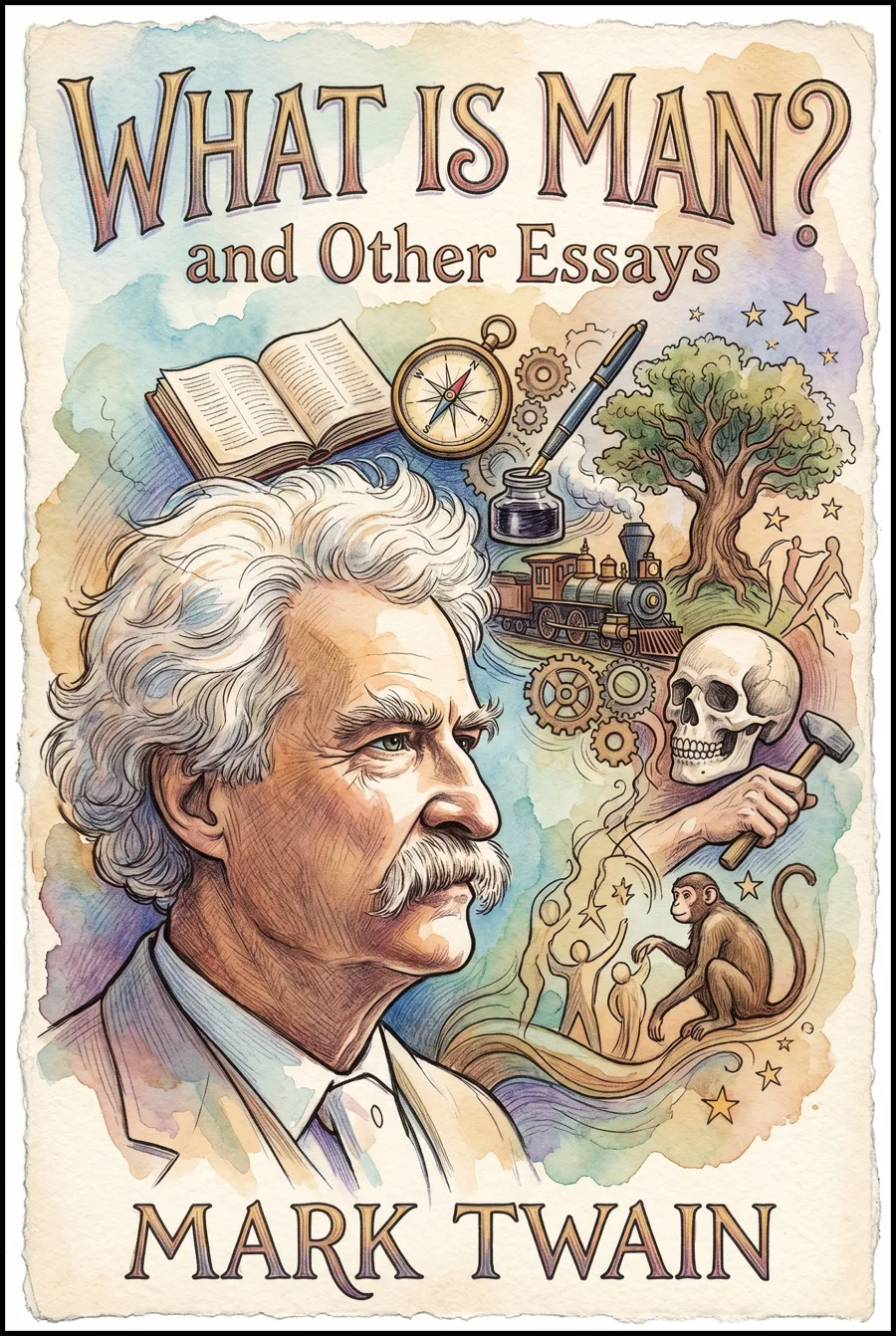
Download Cover Image
Do you want to download the full cover image for What Is Man? and Other Essays?