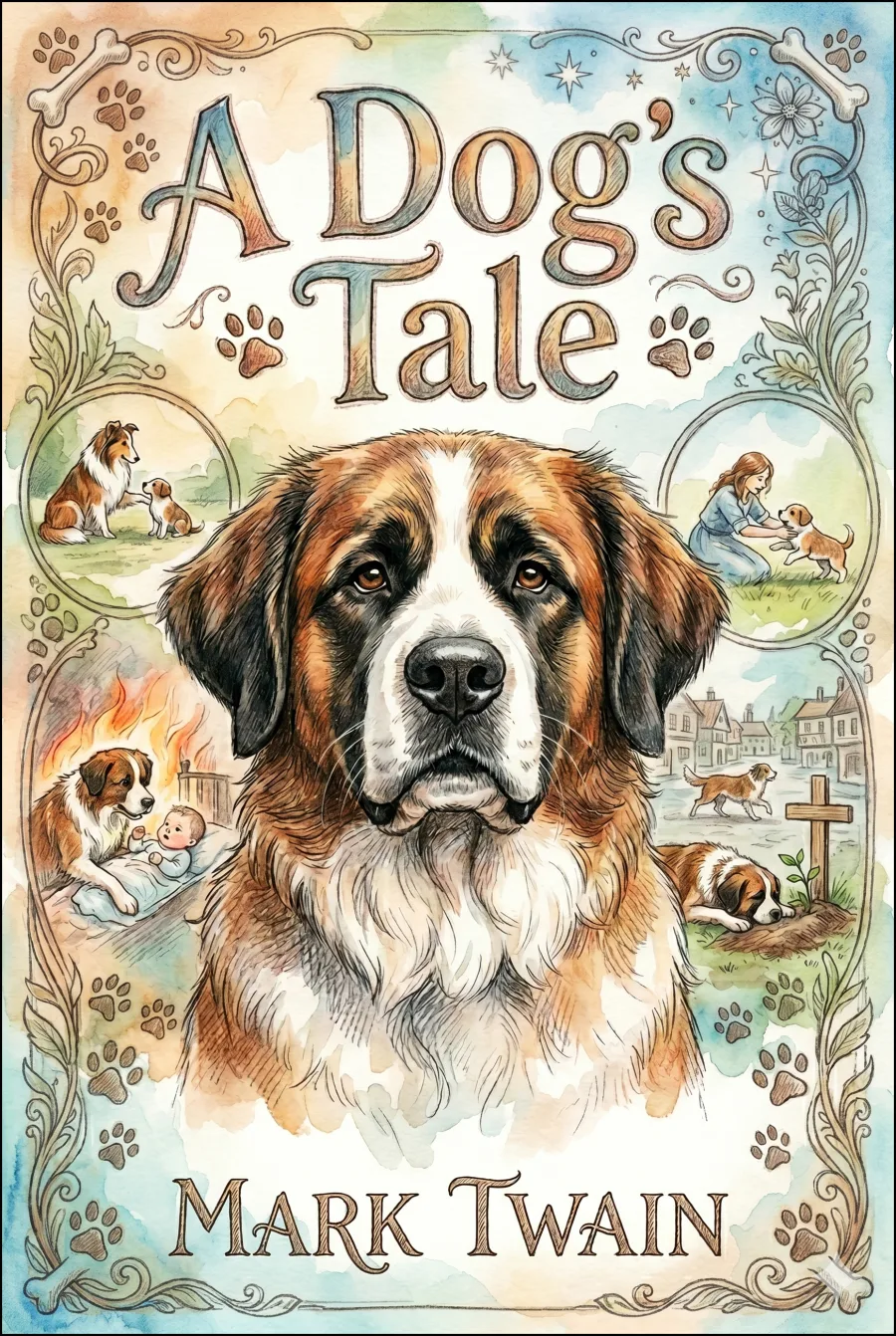
A Dog's Tale
eBook
• INR 51.00
• English
• 9788169359528
No ratings yet
| Publisher | General Press |
|---|---|
| ISBN13 | 9788169359528 |
| Book Format | eBook |
| Language | English |
| List Price | INR 51.00 |
| Subject Code | JUV002070, JUV007000, FIC029000 |
| Publishing Date | 05/09/2026 |
| Book Code | BD00070386 |
Buy this Book
Amazon Stores
Ebook Stores
Other Stores
Discover A Dog's Tale by Mark Twain. This book is published by General Press in eBook format, ISBN 9788169359528, under Children's Dog Books, Children's Classics.
Book Description
Few stories reveal the depth of human kindness—and the cruelty of human behavior—as powerfully as a story told through the eyes of a loyal dog. "A Dog’s Tale" by Mark Twain is a classic work of literary fiction and social satire that uses the simple, trusting perspective of a dog to explore compassion, loyalty, suffering, and the troubling ways people can justify their actions.
The story follows a devoted dog who looks back on her life with affection and innocence. From her earliest days, she learns to trust the people around her and develops a particularly strong bond with her human family. Her world is shaped by love, obedience, and a sincere belief that the humans she depends on are good and caring. Through the dog’s straightforward understanding of events, Twain creates an emotional contrast between what she believes is happening and what the reader can recognize beneath the surface.
As the narrative unfolds, the dog becomes connected to an episode involving scientific experimentation and the treatment of animals. She cannot fully understand the motives behind the actions of the people around her, yet she responds with the same loyalty and trust she has always shown. Twain’s decision to tell the story from an animal’s point of view makes the moral questions especially striking. The dog does not judge the world with sophisticated arguments; instead, she experiences it through feelings of affection, fear, confusion, and devotion.
First published in 1903, "A Dog’s Tale" is much more than a sentimental animal story. Mark Twain uses its apparently simple narrative to question human morality and expose the contradictions between compassion and cruelty. The story also reflects Twain’s long-standing concern with social injustice and his criticism of institutions and behaviors that cause suffering while claiming to serve a greater purpose. Its accessible language makes the work easy to follow, while its underlying message gives it lasting relevance.
Both heartbreaking and thought-provoking, this short classic invites readers to consider what animals feel, what humans owe them, and how innocence can reveal truths that people prefer to ignore. If you enjoy classic literature with an emotional story and a deeper moral message, "A Dog’s Tale" is a memorable read that may stay with you long after the final page.
The story follows a devoted dog who looks back on her life with affection and innocence. From her earliest days, she learns to trust the people around her and develops a particularly strong bond with her human family. Her world is shaped by love, obedience, and a sincere belief that the humans she depends on are good and caring. Through the dog’s straightforward understanding of events, Twain creates an emotional contrast between what she believes is happening and what the reader can recognize beneath the surface.
As the narrative unfolds, the dog becomes connected to an episode involving scientific experimentation and the treatment of animals. She cannot fully understand the motives behind the actions of the people around her, yet she responds with the same loyalty and trust she has always shown. Twain’s decision to tell the story from an animal’s point of view makes the moral questions especially striking. The dog does not judge the world with sophisticated arguments; instead, she experiences it through feelings of affection, fear, confusion, and devotion.
First published in 1903, "A Dog’s Tale" is much more than a sentimental animal story. Mark Twain uses its apparently simple narrative to question human morality and expose the contradictions between compassion and cruelty. The story also reflects Twain’s long-standing concern with social injustice and his criticism of institutions and behaviors that cause suffering while claiming to serve a greater purpose. Its accessible language makes the work easy to follow, while its underlying message gives it lasting relevance.
Both heartbreaking and thought-provoking, this short classic invites readers to consider what animals feel, what humans owe them, and how innocence can reveal truths that people prefer to ignore. If you enjoy classic literature with an emotional story and a deeper moral message, "A Dog’s Tale" is a memorable read that may stay with you long after the final page.
Author Biography
Mark Twain (1835–1910), the pen name of “Samuel Langhorne Clemens”, was an American novelist, humorist, journalist, lecturer, and social critic who became one of the most important voices in American literature. Born on November 30, 1835, in Florida, Missouri, Twain moved with his family to Hannibal, Missouri, when he was four. Growing up beside the Mississippi River, he absorbed the stories, speech, humor, conflicts, and adventures of river life that would later shape his most famous books. His father died when Twain was eleven, and he left school early to work as a printer and typesetter. He later pursued his childhood ambition of becoming a Mississippi River steamboat pilot, an experience that deeply influenced his writing.
Twain's career changed direction after the Civil War disrupted river traffic. He traveled west, worked in Nevada, and began writing for the ‘Territorial Enterprise’ in Virginia City in 1862. It was during this period that Samuel Clemens adopted the name “Mark Twain”, a river expression referring to a water depth of two fathoms. His humorous writing quickly attracted attention, and his 1865 story “The Celebrated Jumping Frog of Calaveras County” brought him national recognition. He subsequently worked as a journalist and lecturer and traveled widely, turning his observations of people and places into memorable comic writing.
Twain's greatest literary achievements include ‘The Adventures of Tom Sawyer’ (1876), ‘The Prince and the Pauper’ (1881), ‘Life on the Mississippi’ (1883), and ‘Adventures of Huckleberry Finn’ (1884). ‘Tom Sawyer’ drew heavily on his childhood experiences in Hannibal, while ‘Huckleberry Finn’ used the Mississippi River journey to examine slavery, racism, conscience, friendship, and the contradictions of American society. The novel's distinctive voice and use of regional speech helped establish Twain as a major figure in American realism. The Library of Congress describes ‘Huckleberry Finn’ as his masterpiece and identifies ‘Tom Sawyer’ and ‘Huckleberry Finn’ as the works most closely associated with his Mississippi childhood.
Behind Twain's humor was a sharp and increasingly critical social conscience. He satirized political corruption, greed, religious hypocrisy, racism, imperialism, and the obsession with wealth and technological progress. His later writings, including ‘A Connecticut Yankee in King Arthur's Court’, ‘Following the Equator’, and ‘The War Prayer’, revealed a more openly skeptical and critical side. He eventually became a prominent opponent of American imperialism and joined the Anti-Imperialist League.
Twain's private life contained considerable hardship. He married Olivia Langdon in 1870, and they had four children, though only three daughters survived infancy. Financial difficulties caused by unsuccessful investments eventually forced him into bankruptcy, after which he undertook a worldwide lecture tour to repay his debts. He also endured the deaths of his wife and three daughters. Twain died on April 21, 1910, in Redding, Connecticut, at the age of seventy-four.
Today, Mark Twain remains essential for readers searching for “Mark Twain's biography, Samuel Clemens, ‘The Adventures of Huckleberry Finn’, ‘The Adventures of Tom Sawyer’, American literature, humor, satire, and nineteenth-century American history”. His greatest strength was his ability to make readers laugh while quietly forcing them to question society. Through unforgettable characters, natural dialogue, sharp satire, and a deep understanding of human weakness, Twain transformed distinctly American experiences into literature with universal appeal.
Twain's career changed direction after the Civil War disrupted river traffic. He traveled west, worked in Nevada, and began writing for the ‘Territorial Enterprise’ in Virginia City in 1862. It was during this period that Samuel Clemens adopted the name “Mark Twain”, a river expression referring to a water depth of two fathoms. His humorous writing quickly attracted attention, and his 1865 story “The Celebrated Jumping Frog of Calaveras County” brought him national recognition. He subsequently worked as a journalist and lecturer and traveled widely, turning his observations of people and places into memorable comic writing.
Twain's greatest literary achievements include ‘The Adventures of Tom Sawyer’ (1876), ‘The Prince and the Pauper’ (1881), ‘Life on the Mississippi’ (1883), and ‘Adventures of Huckleberry Finn’ (1884). ‘Tom Sawyer’ drew heavily on his childhood experiences in Hannibal, while ‘Huckleberry Finn’ used the Mississippi River journey to examine slavery, racism, conscience, friendship, and the contradictions of American society. The novel's distinctive voice and use of regional speech helped establish Twain as a major figure in American realism. The Library of Congress describes ‘Huckleberry Finn’ as his masterpiece and identifies ‘Tom Sawyer’ and ‘Huckleberry Finn’ as the works most closely associated with his Mississippi childhood.
Behind Twain's humor was a sharp and increasingly critical social conscience. He satirized political corruption, greed, religious hypocrisy, racism, imperialism, and the obsession with wealth and technological progress. His later writings, including ‘A Connecticut Yankee in King Arthur's Court’, ‘Following the Equator’, and ‘The War Prayer’, revealed a more openly skeptical and critical side. He eventually became a prominent opponent of American imperialism and joined the Anti-Imperialist League.
Twain's private life contained considerable hardship. He married Olivia Langdon in 1870, and they had four children, though only three daughters survived infancy. Financial difficulties caused by unsuccessful investments eventually forced him into bankruptcy, after which he undertook a worldwide lecture tour to repay his debts. He also endured the deaths of his wife and three daughters. Twain died on April 21, 1910, in Redding, Connecticut, at the age of seventy-four.
Today, Mark Twain remains essential for readers searching for “Mark Twain's biography, Samuel Clemens, ‘The Adventures of Huckleberry Finn’, ‘The Adventures of Tom Sawyer’, American literature, humor, satire, and nineteenth-century American history”. His greatest strength was his ability to make readers laugh while quietly forcing them to question society. Through unforgettable characters, natural dialogue, sharp satire, and a deep understanding of human weakness, Twain transformed distinctly American experiences into literature with universal appeal.
Editorial Reviews
Editorial Reviews will be added soon…
Book Summary
Mark Twain’s 'A Dog’s Tale' is a short but deeply moving work of fiction that uses the simple life of a family dog to explore loyalty, cruelty, innocence, grief, and the troubling relationship between human beings and animals. First published in 'Harper’s Magazine' in December 1903 and later issued as a standalone book in 1904, the story is especially remembered for its criticism of vivisection and the way scientific experimentation can become detached from compassion. What makes the story so powerful is not its complicated plot but its unusual point of view. Twain allows a dog to tell her own story, and because she understands human actions only through the emotions and experiences immediately before her, the reader sees the world with a kind of innocent honesty. The dog does not possess scientific knowledge, social sophistication, or the vocabulary of moral philosophy, yet she understands love, fear, loyalty, pain, and loss far more naturally than many of the educated human beings around her. Through this contrast, Twain quietly asks an uncomfortable question: what does it really mean to be civilized?
The narrator begins by describing her family background in a humorous way. Her father was a St. Bernard and her mother was a collie, but she jokingly says that she is “a Presbyterian,” a phrase she does not understand but has heard her mother use. Her mother has a habit of collecting impressive human words and repeating them without fully understanding their meanings. This opening gives the story a light, playful quality and immediately establishes Twain’s characteristic humor. The dog sees human language from the outside. Words that seem important to people often mean very little to her, while simple things such as kindness, hunger, affection, fear, and companionship are completely clear. This difference becomes important later because the humans in the story use sophisticated language to discuss science and intelligence, yet their behavior can be shockingly cruel. The dog may not understand words such as “laboratory” or “experiment,” but she understands suffering when she sees it.
The dog’s early life is marked by separation and uncertainty. She is eventually taken away from her mother and placed in a new home. From the dog’s perspective, the separation is heartbreaking because she cannot understand why humans would take a young creature away from the mother who loves her. Her mother had taught her that doing good was valuable even when no reward was expected. This simple lesson becomes one of the moral foundations of the story. The dog grows up believing in loyalty and service, and she gives her affection freely to the human family that adopts her. Twain makes this devotion especially meaningful because the dog never calculates whether the family deserves her loyalty. She does not ask whether she will be rewarded. She simply loves them.
The dog eventually becomes part of a household belonging to Mr. Gray, a respected and intelligent scientist. She describes him through the limited understanding of an animal, noticing his appearance, manner, and intellectual reputation. Mr. Gray represents the world of educated human beings, especially the scientific world that values observation, experiment, and rational explanation. The dog is fascinated by the activity around his laboratory, although she cannot make sense of the machines, bottles, wires, and discussions that take place there. Twain uses this setting to create an important contrast between scientific intelligence and moral intelligence. Mr. Gray and his colleagues possess knowledge that the dog cannot understand, but the story gradually suggests that knowledge without compassion can become dangerous.
The central heroic episode occurs when a fire breaks out in the nursery. The family’s baby is in danger, and the dog instinctively acts to save the child. She enters the dangerous room, takes hold of the baby, and drags the child away from the flames. She risks her own life without hesitation. Her action is not the result of training, calculation, or a desire for praise. It is an act of pure instinctive love. Yet when the father sees her carrying the baby, he misunderstands what is happening. Instead of realizing that she is rescuing the child, he believes she is attacking it. In a moment of terrible injustice, he beats her severely with a cane and breaks her leg.
This scene is one of the most important moments in 'A Dog’s Tale' because it reveals how easily human beings can misinterpret innocence. The dog has done something extraordinarily brave, but she is punished because the people around her do not understand her motives. Her suffering is made even more painful by the fact that she cannot understand why the person she loves is hurting her. She has no concept of human suspicion or misunderstanding. She only knows that she has tried to help. Eventually, the truth becomes clear: the child has been saved because of the dog’s actions. The family realizes their mistake, and the dog becomes a hero. People praise her, admire her courage, and treat her affectionately. Yet Twain does not allow this happy recognition to erase what happened. The broken leg and the emotional wound remain reminders that praise after cruelty cannot completely undo cruelty.
The dog’s happiness returns when she is accepted and celebrated by the family. She feels proud that she has done something worthy, and she imagines how pleased her mother would have been with her. This part of the story is deliberately tender. The dog does not become bitter or resentful. Her nature remains generous. She continues to love the people who have misunderstood and hurt her. Twain therefore presents the dog as a symbol of unconditional loyalty. She gives affection even when human beings fail to deserve it. Her goodness is not dependent on receiving goodness in return.
The story takes a much darker turn when the dog has a puppy of her own. Her relationship with the puppy represents another form of love: maternal love. The puppy becomes a source of joy and meaning in her life, and she is naturally proud of it. She has no reason to suspect that anything terrible will happen. Because she trusts the people around her, she assumes that the puppy is safe. This innocent trust makes what follows especially devastating.
Mr. Gray and his scientific colleagues become interested in conducting an experiment involving the puppy. They want to use the animal to demonstrate a scientific point. The exact intellectual argument matters less to Twain than the moral reality of what is happening: a living, feeling creature is reduced to an object for experimentation. The dog narrator cannot understand the scientific purpose behind the experiment. She sees only what happens to her puppy. The animal is subjected to terrible treatment, and the mother watches in confusion and horror. Her inability to understand the language of science actually strengthens Twain’s argument. The reader understands the scientific vocabulary, but the dog understands the suffering.
The contrast between the laboratory and the dog’s emotional world becomes the heart of the story. The scientists discuss intelligence, reasoning, and the supposed differences between human beings and animals. They consider themselves sophisticated observers of life, yet they fail to recognize the emotional reality of the creature in front of them. The dog, meanwhile, has already demonstrated courage, devotion, maternal love, and self-sacrifice. Twain reverses the usual hierarchy between humans and animals. The humans possess knowledge, but the dog possesses compassion. The humans conduct experiments in the name of intelligence, while the dog behaves morally without needing a theory of morality.
The puppy eventually dies as a result of the experiment. Twain does not make the tragedy complicated; its simplicity is what makes it painful. The dog sees her beloved puppy suffer and then disappear, but she does not immediately understand the finality of death. When the puppy is buried, she watches the process and waits for him to return. Her understanding is innocent and heartbreaking. She has seen things planted in the earth grow, so she cannot grasp that burial is not a temporary separation. She waits faithfully for her puppy to come back. This scene transforms the story from a satire into a profound meditation on grief.
One of the most devastating moments comes when the servant recognizes the injustice that the others ignore. The servant sees the dog grieving and understands the cruel irony: the same dog who saved the family’s child has lost her own child because of the actions of the very people she trusted. His reaction gives voice to the moral truth that the scientific men refuse to acknowledge. The dog has given her life and loyalty to human beings, yet when she needs compassion herself, she receives almost none. Twain uses this moment to expose the difference between intellectual understanding and emotional understanding. The servant does not need scientific expertise to recognize cruelty. He simply sees suffering and feels pity.
The ending is deliberately tragic. The dog continues to wait by the grave of her puppy, unable to accept that he will never return. She stops eating properly and becomes consumed by sorrow. The family tries to bring her back, but her grief is deeper than their attempts to comfort her. Her entire world has been reduced to the memory of the puppy she loved. Eventually, she dies beside the grave. Her death is not presented as a dramatic revenge or a heroic conclusion. It is the quiet end of a creature whose capacity for love has been met repeatedly by human failure. The final impression is therefore one of profound sadness, because the dog has remained faithful to the end even though the humans around her have repeatedly failed her.
The major theme of 'A Dog’s Tale' is compassion, particularly compassion toward animals. Twain’s criticism of vivisection is unmistakable, and the story was historically connected with anti-vivisection advocacy. But the story is more than a simple argument against a particular scientific practice. Twain is asking readers to examine what happens when human beings convince themselves that another living creature is less important simply because it cannot speak their language or participate in their intellectual world. The dog cannot explain philosophy, science, or ethics, but she can suffer. She can love. She can protect a child. She can mourn her offspring. Twain suggests that these emotional realities should be enough to establish a moral obligation toward animals.
Another important theme is the hypocrisy of human beings. Mr. Gray is portrayed as intelligent, educated, and scientifically accomplished, yet his treatment of the puppy reveals a serious moral blindness. Twain does not argue that intelligence itself is bad. Instead, he challenges the assumption that intelligence automatically makes someone morally superior. A person can understand complex scientific ideas and still fail to understand the simplest truth about another creature’s pain. The dog, by contrast, never needs to be taught compassion. She naturally protects the baby, loves her family, cares for her puppy, and mourns when he dies.
The story also explores the danger of judging by appearances. When the dog drags the baby from the fire, her action looks violent to someone who does not know the circumstances. She is punished before the truth is discovered. This episode reflects a larger pattern in the story: humans repeatedly interpret animals according to human assumptions rather than trying to understand their actual experience. Twain encourages readers to question quick judgments and to recognize that innocence can be misunderstood when people refuse to look beyond appearances.
Despite its tragic subject, 'A Dog’s Tale' contains much of Mark Twain’s characteristic humor and irony. The dog’s innocent descriptions of human words, religious labels, scientific terminology, and social behavior create comic moments throughout the narrative. Yet the humor gradually becomes darker because the reader realizes that the dog’s innocent perspective exposes truths the supposedly intelligent humans cannot see. This combination of humor and sorrow is one reason the story remains memorable. Twain does not lecture the reader continuously. Instead, he allows the dog’s experiences to make the argument.
Ultimately, 'A Dog’s Tale' is a story about the moral value of every living creature and the responsibilities that come with power. The dog is physically weaker than the humans, intellectually unable to understand their scientific world, and completely dependent upon them. Yet she possesses qualities that make her deeply admirable: loyalty, courage, tenderness, trust, and unconditional love. Her tragedy comes from the fact that those qualities are not returned with equal humanity. Twain leaves the reader with an uncomfortable but lasting realization: civilization cannot be measured only by how much people know, but also by how gently they treat those who are weaker than themselves. The dog’s tale is therefore both a heartbreaking story about an animal and a sharp criticism of human arrogance. More than a century after its publication, its central question remains relevant: if intelligence gives human beings greater power over other forms of life, should it not also give them a greater responsibility to protect rather than exploit them?
The narrator begins by describing her family background in a humorous way. Her father was a St. Bernard and her mother was a collie, but she jokingly says that she is “a Presbyterian,” a phrase she does not understand but has heard her mother use. Her mother has a habit of collecting impressive human words and repeating them without fully understanding their meanings. This opening gives the story a light, playful quality and immediately establishes Twain’s characteristic humor. The dog sees human language from the outside. Words that seem important to people often mean very little to her, while simple things such as kindness, hunger, affection, fear, and companionship are completely clear. This difference becomes important later because the humans in the story use sophisticated language to discuss science and intelligence, yet their behavior can be shockingly cruel. The dog may not understand words such as “laboratory” or “experiment,” but she understands suffering when she sees it.
The dog’s early life is marked by separation and uncertainty. She is eventually taken away from her mother and placed in a new home. From the dog’s perspective, the separation is heartbreaking because she cannot understand why humans would take a young creature away from the mother who loves her. Her mother had taught her that doing good was valuable even when no reward was expected. This simple lesson becomes one of the moral foundations of the story. The dog grows up believing in loyalty and service, and she gives her affection freely to the human family that adopts her. Twain makes this devotion especially meaningful because the dog never calculates whether the family deserves her loyalty. She does not ask whether she will be rewarded. She simply loves them.
The dog eventually becomes part of a household belonging to Mr. Gray, a respected and intelligent scientist. She describes him through the limited understanding of an animal, noticing his appearance, manner, and intellectual reputation. Mr. Gray represents the world of educated human beings, especially the scientific world that values observation, experiment, and rational explanation. The dog is fascinated by the activity around his laboratory, although she cannot make sense of the machines, bottles, wires, and discussions that take place there. Twain uses this setting to create an important contrast between scientific intelligence and moral intelligence. Mr. Gray and his colleagues possess knowledge that the dog cannot understand, but the story gradually suggests that knowledge without compassion can become dangerous.
The central heroic episode occurs when a fire breaks out in the nursery. The family’s baby is in danger, and the dog instinctively acts to save the child. She enters the dangerous room, takes hold of the baby, and drags the child away from the flames. She risks her own life without hesitation. Her action is not the result of training, calculation, or a desire for praise. It is an act of pure instinctive love. Yet when the father sees her carrying the baby, he misunderstands what is happening. Instead of realizing that she is rescuing the child, he believes she is attacking it. In a moment of terrible injustice, he beats her severely with a cane and breaks her leg.
This scene is one of the most important moments in 'A Dog’s Tale' because it reveals how easily human beings can misinterpret innocence. The dog has done something extraordinarily brave, but she is punished because the people around her do not understand her motives. Her suffering is made even more painful by the fact that she cannot understand why the person she loves is hurting her. She has no concept of human suspicion or misunderstanding. She only knows that she has tried to help. Eventually, the truth becomes clear: the child has been saved because of the dog’s actions. The family realizes their mistake, and the dog becomes a hero. People praise her, admire her courage, and treat her affectionately. Yet Twain does not allow this happy recognition to erase what happened. The broken leg and the emotional wound remain reminders that praise after cruelty cannot completely undo cruelty.
The dog’s happiness returns when she is accepted and celebrated by the family. She feels proud that she has done something worthy, and she imagines how pleased her mother would have been with her. This part of the story is deliberately tender. The dog does not become bitter or resentful. Her nature remains generous. She continues to love the people who have misunderstood and hurt her. Twain therefore presents the dog as a symbol of unconditional loyalty. She gives affection even when human beings fail to deserve it. Her goodness is not dependent on receiving goodness in return.
The story takes a much darker turn when the dog has a puppy of her own. Her relationship with the puppy represents another form of love: maternal love. The puppy becomes a source of joy and meaning in her life, and she is naturally proud of it. She has no reason to suspect that anything terrible will happen. Because she trusts the people around her, she assumes that the puppy is safe. This innocent trust makes what follows especially devastating.
Mr. Gray and his scientific colleagues become interested in conducting an experiment involving the puppy. They want to use the animal to demonstrate a scientific point. The exact intellectual argument matters less to Twain than the moral reality of what is happening: a living, feeling creature is reduced to an object for experimentation. The dog narrator cannot understand the scientific purpose behind the experiment. She sees only what happens to her puppy. The animal is subjected to terrible treatment, and the mother watches in confusion and horror. Her inability to understand the language of science actually strengthens Twain’s argument. The reader understands the scientific vocabulary, but the dog understands the suffering.
The contrast between the laboratory and the dog’s emotional world becomes the heart of the story. The scientists discuss intelligence, reasoning, and the supposed differences between human beings and animals. They consider themselves sophisticated observers of life, yet they fail to recognize the emotional reality of the creature in front of them. The dog, meanwhile, has already demonstrated courage, devotion, maternal love, and self-sacrifice. Twain reverses the usual hierarchy between humans and animals. The humans possess knowledge, but the dog possesses compassion. The humans conduct experiments in the name of intelligence, while the dog behaves morally without needing a theory of morality.
The puppy eventually dies as a result of the experiment. Twain does not make the tragedy complicated; its simplicity is what makes it painful. The dog sees her beloved puppy suffer and then disappear, but she does not immediately understand the finality of death. When the puppy is buried, she watches the process and waits for him to return. Her understanding is innocent and heartbreaking. She has seen things planted in the earth grow, so she cannot grasp that burial is not a temporary separation. She waits faithfully for her puppy to come back. This scene transforms the story from a satire into a profound meditation on grief.
One of the most devastating moments comes when the servant recognizes the injustice that the others ignore. The servant sees the dog grieving and understands the cruel irony: the same dog who saved the family’s child has lost her own child because of the actions of the very people she trusted. His reaction gives voice to the moral truth that the scientific men refuse to acknowledge. The dog has given her life and loyalty to human beings, yet when she needs compassion herself, she receives almost none. Twain uses this moment to expose the difference between intellectual understanding and emotional understanding. The servant does not need scientific expertise to recognize cruelty. He simply sees suffering and feels pity.
The ending is deliberately tragic. The dog continues to wait by the grave of her puppy, unable to accept that he will never return. She stops eating properly and becomes consumed by sorrow. The family tries to bring her back, but her grief is deeper than their attempts to comfort her. Her entire world has been reduced to the memory of the puppy she loved. Eventually, she dies beside the grave. Her death is not presented as a dramatic revenge or a heroic conclusion. It is the quiet end of a creature whose capacity for love has been met repeatedly by human failure. The final impression is therefore one of profound sadness, because the dog has remained faithful to the end even though the humans around her have repeatedly failed her.
The major theme of 'A Dog’s Tale' is compassion, particularly compassion toward animals. Twain’s criticism of vivisection is unmistakable, and the story was historically connected with anti-vivisection advocacy. But the story is more than a simple argument against a particular scientific practice. Twain is asking readers to examine what happens when human beings convince themselves that another living creature is less important simply because it cannot speak their language or participate in their intellectual world. The dog cannot explain philosophy, science, or ethics, but she can suffer. She can love. She can protect a child. She can mourn her offspring. Twain suggests that these emotional realities should be enough to establish a moral obligation toward animals.
Another important theme is the hypocrisy of human beings. Mr. Gray is portrayed as intelligent, educated, and scientifically accomplished, yet his treatment of the puppy reveals a serious moral blindness. Twain does not argue that intelligence itself is bad. Instead, he challenges the assumption that intelligence automatically makes someone morally superior. A person can understand complex scientific ideas and still fail to understand the simplest truth about another creature’s pain. The dog, by contrast, never needs to be taught compassion. She naturally protects the baby, loves her family, cares for her puppy, and mourns when he dies.
The story also explores the danger of judging by appearances. When the dog drags the baby from the fire, her action looks violent to someone who does not know the circumstances. She is punished before the truth is discovered. This episode reflects a larger pattern in the story: humans repeatedly interpret animals according to human assumptions rather than trying to understand their actual experience. Twain encourages readers to question quick judgments and to recognize that innocence can be misunderstood when people refuse to look beyond appearances.
Despite its tragic subject, 'A Dog’s Tale' contains much of Mark Twain’s characteristic humor and irony. The dog’s innocent descriptions of human words, religious labels, scientific terminology, and social behavior create comic moments throughout the narrative. Yet the humor gradually becomes darker because the reader realizes that the dog’s innocent perspective exposes truths the supposedly intelligent humans cannot see. This combination of humor and sorrow is one reason the story remains memorable. Twain does not lecture the reader continuously. Instead, he allows the dog’s experiences to make the argument.
Ultimately, 'A Dog’s Tale' is a story about the moral value of every living creature and the responsibilities that come with power. The dog is physically weaker than the humans, intellectually unable to understand their scientific world, and completely dependent upon them. Yet she possesses qualities that make her deeply admirable: loyalty, courage, tenderness, trust, and unconditional love. Her tragedy comes from the fact that those qualities are not returned with equal humanity. Twain leaves the reader with an uncomfortable but lasting realization: civilization cannot be measured only by how much people know, but also by how gently they treat those who are weaker than themselves. The dog’s tale is therefore both a heartbreaking story about an animal and a sharp criticism of human arrogance. More than a century after its publication, its central question remains relevant: if intelligence gives human beings greater power over other forms of life, should it not also give them a greater responsibility to protect rather than exploit them?
Sample Chapters
Sample Chapters will be added soon…
Reader Reviews
No reviews yet.
A Dog's Tale