
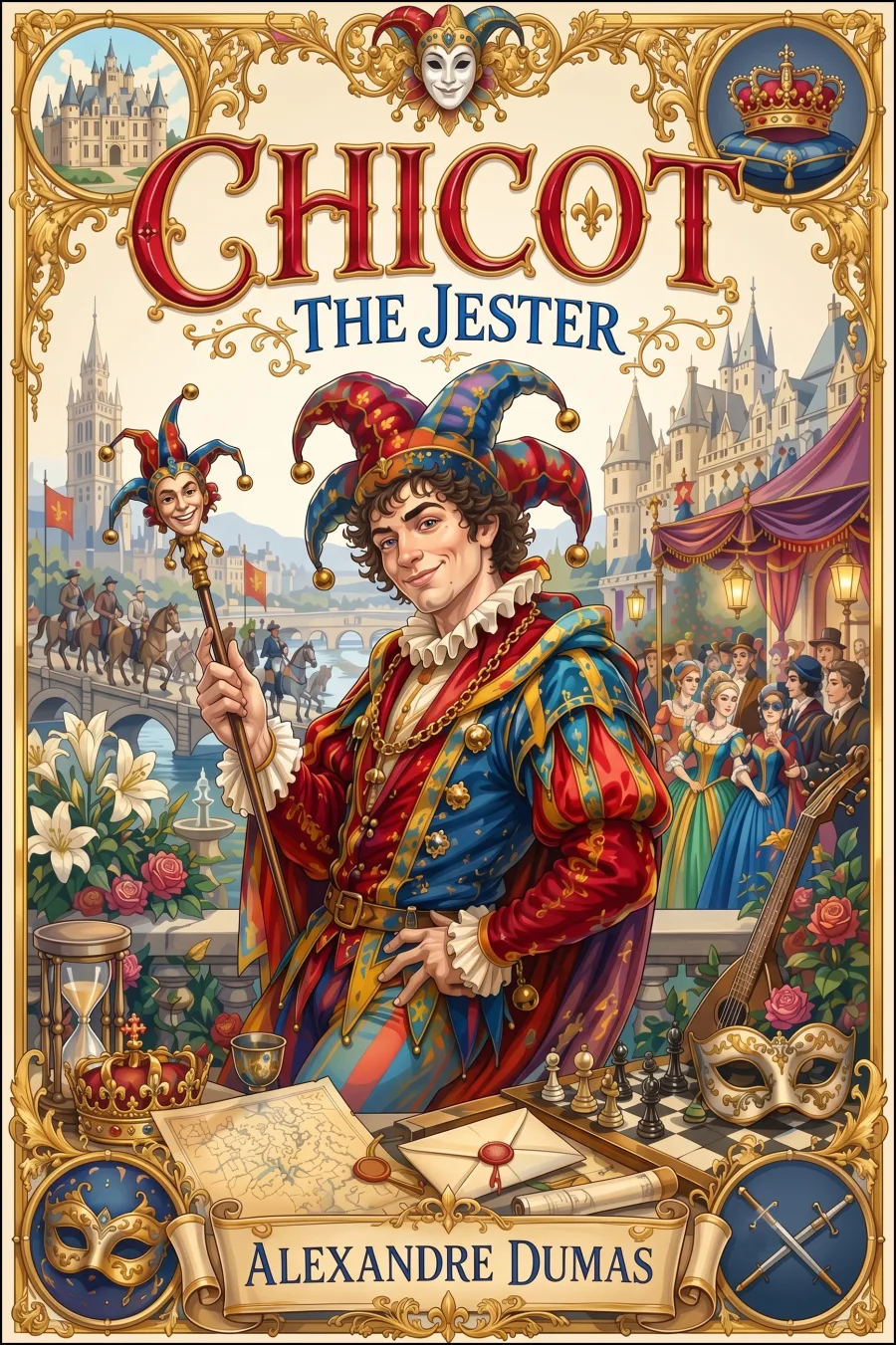
Chicot the Jester
eBook
• INR 51.00
• English
• 9788169359580
No ratings yet
| Publisher | General Press |
|---|---|
| ISBN13 | 9788169359580 |
| Book Format | eBook |
| Language | English |
| List Price | INR 51.00 |
| Subject Code | FIC031020, FIC027050, FIC002000 |
| Publishing Date | 05/09/2026 |
| Book Code | BD00070389 |
Buy this Book
Amazon Stores
Ebook Stores
Other Stores
Discover Chicot the Jester by Alexandre Dumas. This book is published by General Press in eBook format, ISBN 9788169359580, under Literature and Fiction, Historical Thrillers, Historical Romances.
Book Description
When a kingdom is ruled by ambition, deception, and deadly political rivalries, the person standing closest to the throne may be the one who sees the most clearly. "Chicot the Jester" by Alexandre Dumas is a classic historical adventure and political fiction novel set in sixteenth-century France, where royal intrigue, religious conflict, secret alliances, and dangerous rivalries turn the royal court into a battlefield of wit and power.
The story centers on Chicot, the clever and fearless jester of King Henry III. Although he appears to be merely an entertainer, Chicot is far more perceptive than the powerful men surrounding the king. Behind his jokes and playful manner lies a sharp political mind, and he understands that humor can sometimes provide a safer weapon than a sword. As France becomes increasingly divided by religious and political tensions, Chicot finds himself drawn into a dangerous struggle involving the royal family, ambitious nobles, and rival factions determined to control the future of the country.
Dumas brings together several of the era’s most memorable historical figures, including King Henry III, the Duke of Anjou, and the powerful Duke of Guise. Their relationships are shaped by suspicion, rivalry, loyalty, and personal ambition. Alliances shift quickly, and even those who appear to be friends may have hidden motives. Chicot moves through this unstable world with remarkable confidence, using intelligence, courage, and humor to navigate situations in which a single mistake could have fatal consequences.
The novel combines fast-moving adventure with the rich atmosphere of Renaissance France. Political schemes unfold alongside sword fights, disguises, secret meetings, royal ceremonies, and moments of comic relief. Dumas is particularly skilled at making historical events feel immediate and personal, giving readers characters whose emotions and ambitions drive the action as strongly as the larger political conflicts.
At the heart of "Chicot the Jester" is the contrast between appearance and reality. The court may be filled with titles, ceremony, and elaborate manners, but beneath the surface lies a ruthless contest for influence and survival. Chicot’s humor allows him to expose this hypocrisy while remaining deeply involved in the dangerous affairs of the kingdom. For readers who enjoy Alexandre Dumas, historical fiction, political intrigue, and classic adventure novels, this story offers an entertaining blend of wit, suspense, romance, and action. With every clever remark and secret alliance, the danger grows—and Chicot’s next move may be the one that changes everything.
The story centers on Chicot, the clever and fearless jester of King Henry III. Although he appears to be merely an entertainer, Chicot is far more perceptive than the powerful men surrounding the king. Behind his jokes and playful manner lies a sharp political mind, and he understands that humor can sometimes provide a safer weapon than a sword. As France becomes increasingly divided by religious and political tensions, Chicot finds himself drawn into a dangerous struggle involving the royal family, ambitious nobles, and rival factions determined to control the future of the country.
Dumas brings together several of the era’s most memorable historical figures, including King Henry III, the Duke of Anjou, and the powerful Duke of Guise. Their relationships are shaped by suspicion, rivalry, loyalty, and personal ambition. Alliances shift quickly, and even those who appear to be friends may have hidden motives. Chicot moves through this unstable world with remarkable confidence, using intelligence, courage, and humor to navigate situations in which a single mistake could have fatal consequences.
The novel combines fast-moving adventure with the rich atmosphere of Renaissance France. Political schemes unfold alongside sword fights, disguises, secret meetings, royal ceremonies, and moments of comic relief. Dumas is particularly skilled at making historical events feel immediate and personal, giving readers characters whose emotions and ambitions drive the action as strongly as the larger political conflicts.
At the heart of "Chicot the Jester" is the contrast between appearance and reality. The court may be filled with titles, ceremony, and elaborate manners, but beneath the surface lies a ruthless contest for influence and survival. Chicot’s humor allows him to expose this hypocrisy while remaining deeply involved in the dangerous affairs of the kingdom. For readers who enjoy Alexandre Dumas, historical fiction, political intrigue, and classic adventure novels, this story offers an entertaining blend of wit, suspense, romance, and action. With every clever remark and secret alliance, the danger grows—and Chicot’s next move may be the one that changes everything.
Author Biography
Alexandre Dumas (1802–1870), also known as ‘Alexandre Dumas père’, was one of the most popular French novelists and playwrights of the nineteenth century. Best known for ‘The Three Musketeers’ and ‘The Count of Monte Cristo’, Dumas created some of the most enduring adventure stories in world literature. His novels combine history, romance, revenge, friendship, courage, political intrigue, and fast-moving action, making his work accessible to generations of readers. Born on ‘July 24, 1802, in Villers-Cotterêts, France’, Dumas was the son of General Thomas-Alexandre Dumas, a celebrated military commander of mixed-race heritage, and Marie-Louise Labouret. His father died when Alexandre was only four, leaving his mother to raise him with limited financial resources. Dumas received little formal education and largely educated himself through reading.
As a young man, Dumas moved to Paris, where his excellent handwriting helped him obtain a position in the household of the ‘Duke of Orléans’. He soon became fascinated by literature and theater and began writing plays. His early dramatic successes established him as a promising figure in the French Romantic movement. Dumas eventually turned increasingly toward historical fiction, where his extraordinary storytelling abilities found their fullest expression.
The great turning point in ‘Alexandre Dumas's literary career’ came in the 1840s, when serialized fiction became enormously popular in French newspapers. His most famous novels appeared in this format, reaching readers chapter by chapter. ‘The Three Musketeers’, published in 1844, introduced readers to d'Artagnan, Athos, Porthos, and Aramis and became a landmark of historical adventure fiction. Dumas followed it with ‘The Count of Monte Cristo’, published between 1844 and 1846, a sweeping story of wrongful imprisonment, escape, revenge, justice, and transformation. He also wrote major historical novels such as ‘The Queen's Necklace’, ‘La Reine Margot’, and the later Musketeer novels. His collaboration with writer ‘Auguste Maquet’ played an important role in the development of several of his major works.
Dumas was extraordinarily energetic and lived a colorful, sometimes extravagant life. He traveled widely, wrote memoirs and travel books, founded a theater, established newspapers, and became involved in political events. His enthusiasm for expensive projects and lavish living, however, contributed to serious financial difficulties. He also traveled to Italy and became associated with ‘Giuseppe Garibaldi’ during the struggle for Italian unification.
Alexandre Dumas died on ‘December 5, 1870’, near Dieppe, France. His literary legacy has proved remarkably durable. His books have been translated into numerous languages and adapted repeatedly for film, television, theater, and other media. Dumas remains especially important to readers searching for ‘classic adventure novels, historical fiction, revenge stories, swashbuckling heroes, and timeless tales of friendship and courage’. His greatest achievement was turning history into vivid human drama, creating stories that remain exciting, emotional, and surprisingly modern more than a century after his death.
As a young man, Dumas moved to Paris, where his excellent handwriting helped him obtain a position in the household of the ‘Duke of Orléans’. He soon became fascinated by literature and theater and began writing plays. His early dramatic successes established him as a promising figure in the French Romantic movement. Dumas eventually turned increasingly toward historical fiction, where his extraordinary storytelling abilities found their fullest expression.
The great turning point in ‘Alexandre Dumas's literary career’ came in the 1840s, when serialized fiction became enormously popular in French newspapers. His most famous novels appeared in this format, reaching readers chapter by chapter. ‘The Three Musketeers’, published in 1844, introduced readers to d'Artagnan, Athos, Porthos, and Aramis and became a landmark of historical adventure fiction. Dumas followed it with ‘The Count of Monte Cristo’, published between 1844 and 1846, a sweeping story of wrongful imprisonment, escape, revenge, justice, and transformation. He also wrote major historical novels such as ‘The Queen's Necklace’, ‘La Reine Margot’, and the later Musketeer novels. His collaboration with writer ‘Auguste Maquet’ played an important role in the development of several of his major works.
Dumas was extraordinarily energetic and lived a colorful, sometimes extravagant life. He traveled widely, wrote memoirs and travel books, founded a theater, established newspapers, and became involved in political events. His enthusiasm for expensive projects and lavish living, however, contributed to serious financial difficulties. He also traveled to Italy and became associated with ‘Giuseppe Garibaldi’ during the struggle for Italian unification.
Alexandre Dumas died on ‘December 5, 1870’, near Dieppe, France. His literary legacy has proved remarkably durable. His books have been translated into numerous languages and adapted repeatedly for film, television, theater, and other media. Dumas remains especially important to readers searching for ‘classic adventure novels, historical fiction, revenge stories, swashbuckling heroes, and timeless tales of friendship and courage’. His greatest achievement was turning history into vivid human drama, creating stories that remain exciting, emotional, and surprisingly modern more than a century after his death.
Editorial Reviews
Editorial Reviews will be added soon…
Book Summary
'Chicot the Jester' by Alexandre Dumas is a sweeping historical adventure filled with romance, political intrigue, sword fights, deception, jealousy, friendship, and the dangerous ambitions of the French royal court. Originally published in 1846 as 'La Dame de Monsoreau', the novel is the second major installment in Dumas's Valois series, following 'Queen Margot' and preceding 'The Forty-Five Guardsmen'. The English title 'Chicot the Jester' emphasizes one of the novel's most memorable characters, Chicot, the witty and fearless court jester of King Henri III. Yet the novel's central tragic romance belongs to Louis de Clermont, known as Bussy d'Amboise, and Diane de Méridor, a beautiful and virtuous woman whose life becomes trapped between love, political ambition, and the possessive cruelty of her husband, the Comte de Monsoreau. Set in France in 1578, the story presents a court where laughter can conceal treason, friendship can become a political weapon, and a romantic promise can lead directly to death.
The novel opens at the wedding celebration of François d'Épinay de Saint-Luc and Jeanne de Crosse-Brissac. What should be a joyful occasion is immediately overshadowed by the strange behavior of King Henri III. The king is jealous of Saint-Luc and does not want to lose the companionship of one of his favorites. He therefore keeps Saint-Luc close to him at the Louvre instead of allowing him to enjoy his wedding night with his new wife. This mixture of childish jealousy, royal authority, and courtly comedy establishes the atmosphere of the entire book. At Henri's side is Chicot, his court jester, who is much more than an entertainer. Chicot is intelligent, courageous, observant, and deeply loyal to the king. Because a jester is allowed to say things that ordinary courtiers cannot, Chicot can mock Henri, criticize him, and speak uncomfortable truths without immediately being punished. Beneath his jokes is a shrewd political mind, and he quickly becomes one of the few people capable of seeing the dangers gathering around the throne.
Chicot's relationship with Henri III is one of the most interesting parts of the story because it is based on a strange mixture of friendship, loyalty, mockery, and genuine political advice. Henri is surrounded by ambitious men who flatter him because they want something from him, but Chicot has little interest in flattering anyone. He can make the king laugh while simultaneously warning him about his enemies. His humor is therefore a form of protection. In a court full of masks, the fool is ironically one of the few people who can afford to be honest. Dumas uses this contrast repeatedly: those who appear dignified and respectable are often scheming behind closed doors, while the man dressed as a fool frequently understands the political situation better than everyone else.
The story then introduces Bussy d'Amboise, one of the most impressive swordsmen and noblemen in the novel. Bussy is handsome, proud, fearless, energetic, and famous for his courage. He is associated with the king's brother, the Duke of Anjou, and therefore stands on the opposite side of the dangerous rivalry developing within the royal family. Bussy has enemies among Henri III's favorites, particularly the group of young nobles commonly called the king's mignons. These men resent Bussy's reputation and popularity, and their hostility eventually leads to an attempt to kill him. Bussy is attacked by several opponents and, although he fights with extraordinary skill, he is seriously wounded. His survival leads to one of the novel's most romantic episodes because, while recovering, he becomes haunted by the image of a beautiful woman whose face he remembers from the strange circumstances surrounding his rescue.
Bussy's mysterious woman is Diane de Méridor. Diane is one of the emotional centers of the novel. She is beautiful, intelligent, and fundamentally honorable, but she is living under terrible circumstances. Her life has become entangled with the ambitions of the Duke of Anjou and the manipulations of the Comte de Monsoreau. The count has presented himself as her protector, but his protection is really another form of control. Diane's situation becomes increasingly desperate because she has little freedom to determine her own future. She is effectively surrounded by powerful men who believe that her beauty gives them a right to possess her. When Bussy discovers her, their attraction is immediate and sincere. Unlike the men who want Diane for political or personal advantage, Bussy genuinely loves her and wants to protect her.
The romance between Bussy and Diane develops in secrecy because Diane is already married to the Comte de Monsoreau. Her marriage is one of the novel's central tragedies. Monsoreau is jealous, calculating, suspicious, and possessive. He does not simply fear losing Diane; he treats her as something that belongs to him. His jealousy becomes increasingly destructive as he realizes that Bussy and Diane are falling in love. Dumas portrays Monsoreau as dangerous precisely because his obsession is mixed with patience and calculation. He does not need to attack every enemy immediately. He watches, gathers information, and waits for the right moment. His marriage to Diane therefore becomes a prison from which love alone cannot easily free her.
The Duke of Anjou adds another layer of danger. He is Henri III's younger brother and one of the most ambitious figures in the story. His rivalry with the king is not simply a family disagreement. It is connected to the larger struggle for political power in France. Anjou is intelligent and capable, but he is also manipulative and self-interested. He wants influence, and he is willing to use other people to obtain it. Diane becomes particularly vulnerable because Anjou desires her as well. The conflict between Anjou, Monsoreau, and Bussy demonstrates how easily a woman's private life can become a battlefield for powerful men. Diane's love for Bussy is genuine, but her freedom to act on that love is constantly threatened by forces beyond her control.
Meanwhile, the political plot grows increasingly dangerous. France remains deeply divided by religious and political conflict, and the rivalry between the royal family and the powerful Guise faction creates the possibility of a much larger crisis. Chicot becomes involved in uncovering a conspiracy connected to the Catholic League. His friendship with the monk Gorenflot gives him an opportunity to enter a world of political and religious plotting that would otherwise be difficult to penetrate. Gorenflot is a comic character whose appetite and vanity make him easy for Chicot to manipulate. Through disguise, deception, and clever improvisation, Chicot gains access to information that could threaten the security of the kingdom. This part of the novel shows why Chicot is so important: while Bussy fights enemies with a sword, Chicot fights them with intelligence.
One of the novel's great pleasures is the contrast between Bussy and Chicot. Bussy represents physical courage, romantic passion, and the ideal of the fearless gentleman. Chicot represents intelligence, humor, political instinct, and survival. Bussy charges directly into danger because he trusts his sword and his courage. Chicot prefers to understand the situation first and then manipulate it to his advantage. Yet both men share an important quality: loyalty. Bussy is loyal to the people he loves, while Chicot is fiercely loyal to Henri III. Neither man is simply motivated by personal advantage, and this makes them more sympathetic than many of the powerful figures surrounding them.
The marriage of Saint-Luc and Jeanne provides a lighter but important parallel to the tragic relationship of Bussy and Diane. Saint-Luc has to deal with Henri's jealousy, but he and Jeanne genuinely love each other. Bussy helps the newly married couple find a way to be together despite the king's interference. Their relationship provides a glimpse of the kind of happiness that Bussy and Diane might have enjoyed under different circumstances. The contrast is painful. Saint-Luc and Jeanne's love survives through cleverness and escape, while Bussy and Diane's love is surrounded by people who are determined to control and destroy it.
As Bussy's relationship with Diane deepens, he becomes increasingly determined to rescue her. He travels to Méridor, where Diane's father, the Baron de Méridor, lives. There Bussy learns more about the complicated circumstances that have shaped Diane's life. His journey is not merely a romantic adventure; it represents his attempt to move Diane out of the dangerous world of the Parisian court and into a place where she might be safe. But the political reach of her enemies is too great. The Duke of Anjou, Monsoreau, and others are all connected to the same network of ambition and rivalry, meaning that Bussy cannot simply remove Diane from the conflict.
The relationship between Bussy and Diane becomes increasingly secretive and emotionally intense. They understand that their love is dangerous, yet they cannot easily abandon it. This is one of the most humane aspects of the novel. Dumas does not portray love as something that magically solves problems. Instead, love makes the characters more vulnerable. Bussy, who has been almost fearless in battle, becomes vulnerable because he has something precious to lose. Diane, who has endured manipulation and control, finally finds someone who sees her as a person rather than an object of possession. Their love gives them hope, but it also gives their enemies a weapon against them.
The Comte de Monsoreau eventually discovers enough about the affair to become consumed by jealousy. His response is not simply anger but calculated revenge. The count's behavior illustrates one of the novel's strongest themes: the destructive nature of possession. He believes that because Diane is his wife, he has the right to control her. His inability to accept her emotional independence turns his marriage into a source of violence. Dumas makes the tragedy especially powerful by showing that the real threat to Diane is not simply that she has fallen in love with another man, but that the people around her refuse to recognize her freedom to choose whom she loves.
At the same time, the political situation becomes more unstable. Henri III struggles to maintain authority while dealing with his brother, powerful nobles, and the growing influence of the Guise family. The king's personality is often comic, but the political circumstances surrounding him are serious. He can be vain, emotional, and unpredictable, yet he also understands that his throne is threatened. Chicot's role becomes increasingly important because he can interpret the intentions of people whom Henri might otherwise trust. Through him, Dumas explores the paradox of political power: the king has enormous authority, but because everyone around him wants something, he cannot easily know whom to trust.
The novel's political and romantic plots eventually collide. Bussy's enemies understand that his love for Diane is one of his greatest vulnerabilities. His courage, which makes him nearly unbeatable in a fair fight, becomes less useful when his opponents rely on deception and numbers. The final stages of the story move toward the tragic confrontation between Bussy and the people determined to destroy him. His death is one of the most memorable and heartbreaking moments in the novel because it does not feel like the defeat of a coward or an ordinary villain. Bussy dies as a brave man who has found love too late. His courage remains intact, but courage cannot always overcome conspiracy, betrayal, and overwhelming political hostility.
Diane's fate is equally tragic because Bussy's death destroys the future she had imagined. Her love story becomes a symbol of how private happiness can be crushed by jealousy and political ambition. She has spent much of the novel trying to maintain her dignity in circumstances controlled by powerful men, and Bussy's death shows how little protection she ultimately has against the forces surrounding her. Her tragedy is not simply that she loses the man she loves; it is that the society around her repeatedly treats her choices as less important than the desires of men who claim authority over her.
Chicot's story provides a different kind of resolution. Unlike Bussy, he survives by using intelligence and humor, but his adventures reveal how dangerous the political world has become. His investigations into the Catholic League and the ambitions of the Guise family expose a conspiracy much larger than the personal rivalries of the court. Chicot is therefore both comic and serious. He can make the reader laugh in one scene and then reveal the terrifying consequences of political ambition in the next. His role as the king's jester becomes almost symbolic: the man whose official duty is to entertain is actually one of the people most seriously engaged in protecting the kingdom.
One of the central themes of 'Chicot the Jester' is the contrast between appearance and reality. Court life is full of people pretending to be loyal while plotting against one another. A husband who claims to love his wife may actually want to possess her. A prince who speaks of friendship may be thinking about power. A king surrounded by magnificent courtiers may be lonelier than the man who tells him jokes. Chicot embodies this theme perfectly because his outward identity as a fool conceals his real intelligence. Dumas repeatedly reminds readers that appearances can be dangerously misleading, particularly in a political environment where everyone has something to hide.
Another major theme is the conflict between love and power. Bussy and Diane want something simple: to love each other and live without fear. But they are caught in a world where powerful men believe that love, marriage, loyalty, and even friendship can be used for political advantage. Their tragedy demonstrates that personal happiness becomes extremely fragile when people are treated as possessions or instruments. Bussy's love gives him a reason to fight, but it also places him in greater danger. Diane's love gives her hope, but it also exposes her to Monsoreau's jealousy.
The novel also explores friendship and loyalty through Chicot, Henri III, Bussy, and Saint-Luc. Dumas does not suggest that loyalty is always easy or morally simple. Henri is an imperfect king, and Chicot knows his weaknesses better than anyone. Yet Chicot remains loyal because he believes that protecting Henri is preferable to allowing his enemies to seize power. Similarly, Bussy remains loyal to his friends and to his own sense of honor even when doing so puts his life at risk. In Dumas's world, loyalty is valuable precisely because betrayal is so common.
Ultimately, 'Chicot the Jester' is a story about people trying to preserve their humanity inside a world dominated by ambition. Bussy d'Amboise represents passionate courage and romantic idealism; Diane represents dignity and the desire for freedom; Chicot represents intelligence, loyalty, and the ability to see through political deception; and Monsoreau represents jealousy transformed into possession. Around them, kings, princes, nobles, religious factions, and courtiers compete for influence. The result is a novel that combines the excitement of historical adventure with the emotional force of tragedy. Its sword fights and conspiracies keep the story moving, but its deepest appeal comes from the human relationships beneath them.
For readers looking for a 'Chicot the Jester' book summary, the heart of the story is the tragic love between Bussy d'Amboise and Diane de Méridor, set against the dangerous political world of Henri III's France. Bussy discovers Diane, falls deeply in love with her, and tries to protect her from the possessive Comte de Monsoreau and the ambitions of the Duke of Anjou. At the same time, Chicot uses his position as the king's fool to uncover conspiracies and protect Henri III from enemies within and outside the court. Romance, jealousy, political rivalry, friendship, and religious conflict eventually converge in a devastating tragedy. Dumas's great achievement is that he makes this turbulent historical world feel intensely personal. Behind the battles for kingdoms are people longing to be loved, trusted, protected, and free. That is what gives 'Chicot the Jester' its enduring power: it is not merely a tale of kings and conspirators, but a vivid story about the terrible price people sometimes pay when love and human dignity collide with ambition and power.
The novel opens at the wedding celebration of François d'Épinay de Saint-Luc and Jeanne de Crosse-Brissac. What should be a joyful occasion is immediately overshadowed by the strange behavior of King Henri III. The king is jealous of Saint-Luc and does not want to lose the companionship of one of his favorites. He therefore keeps Saint-Luc close to him at the Louvre instead of allowing him to enjoy his wedding night with his new wife. This mixture of childish jealousy, royal authority, and courtly comedy establishes the atmosphere of the entire book. At Henri's side is Chicot, his court jester, who is much more than an entertainer. Chicot is intelligent, courageous, observant, and deeply loyal to the king. Because a jester is allowed to say things that ordinary courtiers cannot, Chicot can mock Henri, criticize him, and speak uncomfortable truths without immediately being punished. Beneath his jokes is a shrewd political mind, and he quickly becomes one of the few people capable of seeing the dangers gathering around the throne.
Chicot's relationship with Henri III is one of the most interesting parts of the story because it is based on a strange mixture of friendship, loyalty, mockery, and genuine political advice. Henri is surrounded by ambitious men who flatter him because they want something from him, but Chicot has little interest in flattering anyone. He can make the king laugh while simultaneously warning him about his enemies. His humor is therefore a form of protection. In a court full of masks, the fool is ironically one of the few people who can afford to be honest. Dumas uses this contrast repeatedly: those who appear dignified and respectable are often scheming behind closed doors, while the man dressed as a fool frequently understands the political situation better than everyone else.
The story then introduces Bussy d'Amboise, one of the most impressive swordsmen and noblemen in the novel. Bussy is handsome, proud, fearless, energetic, and famous for his courage. He is associated with the king's brother, the Duke of Anjou, and therefore stands on the opposite side of the dangerous rivalry developing within the royal family. Bussy has enemies among Henri III's favorites, particularly the group of young nobles commonly called the king's mignons. These men resent Bussy's reputation and popularity, and their hostility eventually leads to an attempt to kill him. Bussy is attacked by several opponents and, although he fights with extraordinary skill, he is seriously wounded. His survival leads to one of the novel's most romantic episodes because, while recovering, he becomes haunted by the image of a beautiful woman whose face he remembers from the strange circumstances surrounding his rescue.
Bussy's mysterious woman is Diane de Méridor. Diane is one of the emotional centers of the novel. She is beautiful, intelligent, and fundamentally honorable, but she is living under terrible circumstances. Her life has become entangled with the ambitions of the Duke of Anjou and the manipulations of the Comte de Monsoreau. The count has presented himself as her protector, but his protection is really another form of control. Diane's situation becomes increasingly desperate because she has little freedom to determine her own future. She is effectively surrounded by powerful men who believe that her beauty gives them a right to possess her. When Bussy discovers her, their attraction is immediate and sincere. Unlike the men who want Diane for political or personal advantage, Bussy genuinely loves her and wants to protect her.
The romance between Bussy and Diane develops in secrecy because Diane is already married to the Comte de Monsoreau. Her marriage is one of the novel's central tragedies. Monsoreau is jealous, calculating, suspicious, and possessive. He does not simply fear losing Diane; he treats her as something that belongs to him. His jealousy becomes increasingly destructive as he realizes that Bussy and Diane are falling in love. Dumas portrays Monsoreau as dangerous precisely because his obsession is mixed with patience and calculation. He does not need to attack every enemy immediately. He watches, gathers information, and waits for the right moment. His marriage to Diane therefore becomes a prison from which love alone cannot easily free her.
The Duke of Anjou adds another layer of danger. He is Henri III's younger brother and one of the most ambitious figures in the story. His rivalry with the king is not simply a family disagreement. It is connected to the larger struggle for political power in France. Anjou is intelligent and capable, but he is also manipulative and self-interested. He wants influence, and he is willing to use other people to obtain it. Diane becomes particularly vulnerable because Anjou desires her as well. The conflict between Anjou, Monsoreau, and Bussy demonstrates how easily a woman's private life can become a battlefield for powerful men. Diane's love for Bussy is genuine, but her freedom to act on that love is constantly threatened by forces beyond her control.
Meanwhile, the political plot grows increasingly dangerous. France remains deeply divided by religious and political conflict, and the rivalry between the royal family and the powerful Guise faction creates the possibility of a much larger crisis. Chicot becomes involved in uncovering a conspiracy connected to the Catholic League. His friendship with the monk Gorenflot gives him an opportunity to enter a world of political and religious plotting that would otherwise be difficult to penetrate. Gorenflot is a comic character whose appetite and vanity make him easy for Chicot to manipulate. Through disguise, deception, and clever improvisation, Chicot gains access to information that could threaten the security of the kingdom. This part of the novel shows why Chicot is so important: while Bussy fights enemies with a sword, Chicot fights them with intelligence.
One of the novel's great pleasures is the contrast between Bussy and Chicot. Bussy represents physical courage, romantic passion, and the ideal of the fearless gentleman. Chicot represents intelligence, humor, political instinct, and survival. Bussy charges directly into danger because he trusts his sword and his courage. Chicot prefers to understand the situation first and then manipulate it to his advantage. Yet both men share an important quality: loyalty. Bussy is loyal to the people he loves, while Chicot is fiercely loyal to Henri III. Neither man is simply motivated by personal advantage, and this makes them more sympathetic than many of the powerful figures surrounding them.
The marriage of Saint-Luc and Jeanne provides a lighter but important parallel to the tragic relationship of Bussy and Diane. Saint-Luc has to deal with Henri's jealousy, but he and Jeanne genuinely love each other. Bussy helps the newly married couple find a way to be together despite the king's interference. Their relationship provides a glimpse of the kind of happiness that Bussy and Diane might have enjoyed under different circumstances. The contrast is painful. Saint-Luc and Jeanne's love survives through cleverness and escape, while Bussy and Diane's love is surrounded by people who are determined to control and destroy it.
As Bussy's relationship with Diane deepens, he becomes increasingly determined to rescue her. He travels to Méridor, where Diane's father, the Baron de Méridor, lives. There Bussy learns more about the complicated circumstances that have shaped Diane's life. His journey is not merely a romantic adventure; it represents his attempt to move Diane out of the dangerous world of the Parisian court and into a place where she might be safe. But the political reach of her enemies is too great. The Duke of Anjou, Monsoreau, and others are all connected to the same network of ambition and rivalry, meaning that Bussy cannot simply remove Diane from the conflict.
The relationship between Bussy and Diane becomes increasingly secretive and emotionally intense. They understand that their love is dangerous, yet they cannot easily abandon it. This is one of the most humane aspects of the novel. Dumas does not portray love as something that magically solves problems. Instead, love makes the characters more vulnerable. Bussy, who has been almost fearless in battle, becomes vulnerable because he has something precious to lose. Diane, who has endured manipulation and control, finally finds someone who sees her as a person rather than an object of possession. Their love gives them hope, but it also gives their enemies a weapon against them.
The Comte de Monsoreau eventually discovers enough about the affair to become consumed by jealousy. His response is not simply anger but calculated revenge. The count's behavior illustrates one of the novel's strongest themes: the destructive nature of possession. He believes that because Diane is his wife, he has the right to control her. His inability to accept her emotional independence turns his marriage into a source of violence. Dumas makes the tragedy especially powerful by showing that the real threat to Diane is not simply that she has fallen in love with another man, but that the people around her refuse to recognize her freedom to choose whom she loves.
At the same time, the political situation becomes more unstable. Henri III struggles to maintain authority while dealing with his brother, powerful nobles, and the growing influence of the Guise family. The king's personality is often comic, but the political circumstances surrounding him are serious. He can be vain, emotional, and unpredictable, yet he also understands that his throne is threatened. Chicot's role becomes increasingly important because he can interpret the intentions of people whom Henri might otherwise trust. Through him, Dumas explores the paradox of political power: the king has enormous authority, but because everyone around him wants something, he cannot easily know whom to trust.
The novel's political and romantic plots eventually collide. Bussy's enemies understand that his love for Diane is one of his greatest vulnerabilities. His courage, which makes him nearly unbeatable in a fair fight, becomes less useful when his opponents rely on deception and numbers. The final stages of the story move toward the tragic confrontation between Bussy and the people determined to destroy him. His death is one of the most memorable and heartbreaking moments in the novel because it does not feel like the defeat of a coward or an ordinary villain. Bussy dies as a brave man who has found love too late. His courage remains intact, but courage cannot always overcome conspiracy, betrayal, and overwhelming political hostility.
Diane's fate is equally tragic because Bussy's death destroys the future she had imagined. Her love story becomes a symbol of how private happiness can be crushed by jealousy and political ambition. She has spent much of the novel trying to maintain her dignity in circumstances controlled by powerful men, and Bussy's death shows how little protection she ultimately has against the forces surrounding her. Her tragedy is not simply that she loses the man she loves; it is that the society around her repeatedly treats her choices as less important than the desires of men who claim authority over her.
Chicot's story provides a different kind of resolution. Unlike Bussy, he survives by using intelligence and humor, but his adventures reveal how dangerous the political world has become. His investigations into the Catholic League and the ambitions of the Guise family expose a conspiracy much larger than the personal rivalries of the court. Chicot is therefore both comic and serious. He can make the reader laugh in one scene and then reveal the terrifying consequences of political ambition in the next. His role as the king's jester becomes almost symbolic: the man whose official duty is to entertain is actually one of the people most seriously engaged in protecting the kingdom.
One of the central themes of 'Chicot the Jester' is the contrast between appearance and reality. Court life is full of people pretending to be loyal while plotting against one another. A husband who claims to love his wife may actually want to possess her. A prince who speaks of friendship may be thinking about power. A king surrounded by magnificent courtiers may be lonelier than the man who tells him jokes. Chicot embodies this theme perfectly because his outward identity as a fool conceals his real intelligence. Dumas repeatedly reminds readers that appearances can be dangerously misleading, particularly in a political environment where everyone has something to hide.
Another major theme is the conflict between love and power. Bussy and Diane want something simple: to love each other and live without fear. But they are caught in a world where powerful men believe that love, marriage, loyalty, and even friendship can be used for political advantage. Their tragedy demonstrates that personal happiness becomes extremely fragile when people are treated as possessions or instruments. Bussy's love gives him a reason to fight, but it also places him in greater danger. Diane's love gives her hope, but it also exposes her to Monsoreau's jealousy.
The novel also explores friendship and loyalty through Chicot, Henri III, Bussy, and Saint-Luc. Dumas does not suggest that loyalty is always easy or morally simple. Henri is an imperfect king, and Chicot knows his weaknesses better than anyone. Yet Chicot remains loyal because he believes that protecting Henri is preferable to allowing his enemies to seize power. Similarly, Bussy remains loyal to his friends and to his own sense of honor even when doing so puts his life at risk. In Dumas's world, loyalty is valuable precisely because betrayal is so common.
Ultimately, 'Chicot the Jester' is a story about people trying to preserve their humanity inside a world dominated by ambition. Bussy d'Amboise represents passionate courage and romantic idealism; Diane represents dignity and the desire for freedom; Chicot represents intelligence, loyalty, and the ability to see through political deception; and Monsoreau represents jealousy transformed into possession. Around them, kings, princes, nobles, religious factions, and courtiers compete for influence. The result is a novel that combines the excitement of historical adventure with the emotional force of tragedy. Its sword fights and conspiracies keep the story moving, but its deepest appeal comes from the human relationships beneath them.
For readers looking for a 'Chicot the Jester' book summary, the heart of the story is the tragic love between Bussy d'Amboise and Diane de Méridor, set against the dangerous political world of Henri III's France. Bussy discovers Diane, falls deeply in love with her, and tries to protect her from the possessive Comte de Monsoreau and the ambitions of the Duke of Anjou. At the same time, Chicot uses his position as the king's fool to uncover conspiracies and protect Henri III from enemies within and outside the court. Romance, jealousy, political rivalry, friendship, and religious conflict eventually converge in a devastating tragedy. Dumas's great achievement is that he makes this turbulent historical world feel intensely personal. Behind the battles for kingdoms are people longing to be loved, trusted, protected, and free. That is what gives 'Chicot the Jester' its enduring power: it is not merely a tale of kings and conspirators, but a vivid story about the terrible price people sometimes pay when love and human dignity collide with ambition and power.
Sample Chapters
Sample Chapters will be added soon…
Reader Reviews
No reviews yet.
Chicot the Jester
Download Cover Image
Do you want to download the full cover image for Chicot the Jester?