
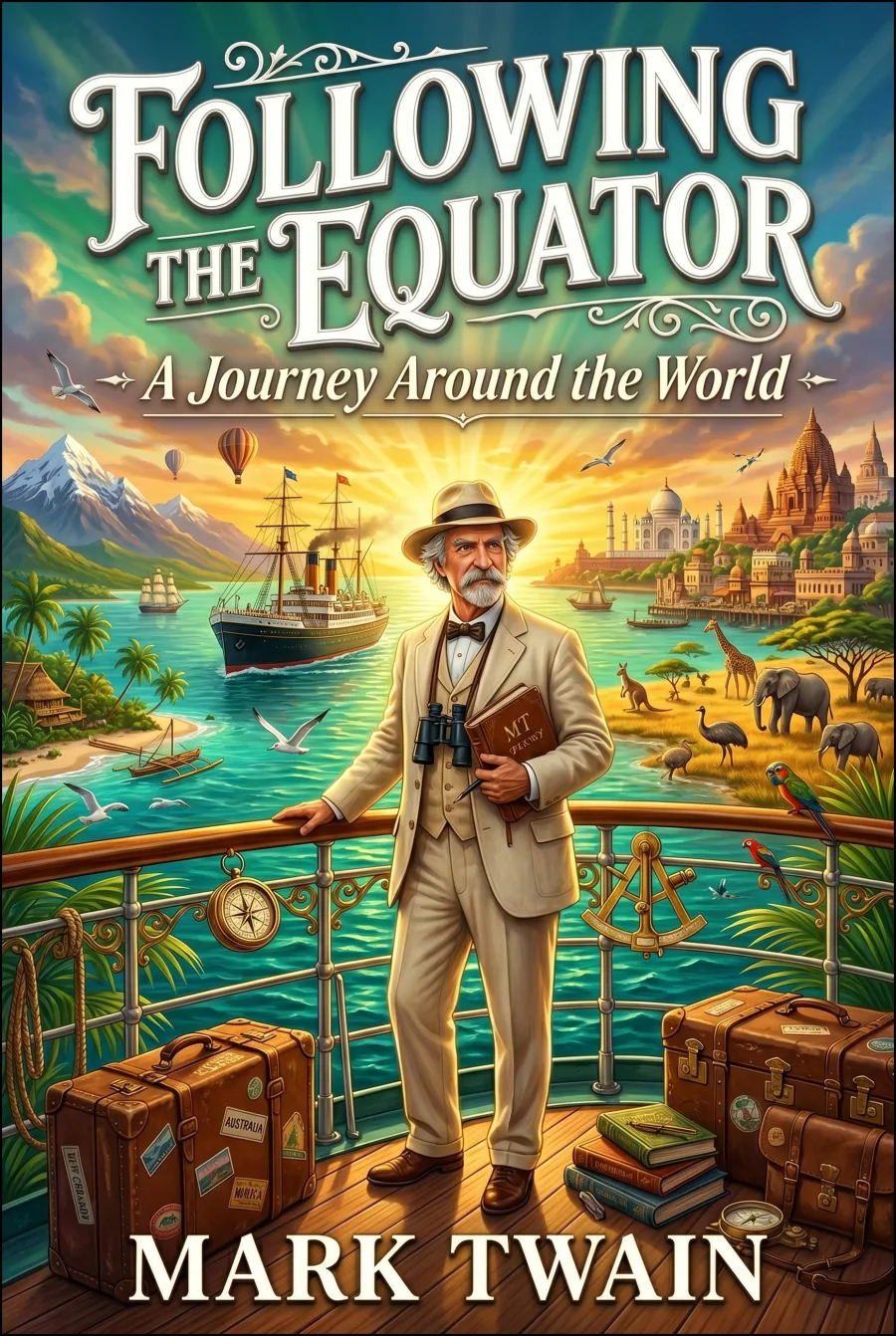
Following the Equator: A Journey Around the World
eBook
• INR 51.00
• English
• 9788169359627
No ratings yet
| Publisher | General Press |
|---|---|
| ISBN13 | 9788169359627 |
| Book Format | eBook |
| Language | English |
| List Price | INR 51.00 |
| Subject Code | TRV010000, TRV003040, TRV004000 |
| Publishing Date | 05/09/2026 |
| Book Code | BD00070390 |
Buy this Book
Amazon Stores
Ebook Stores
Other Stores
Discover Following the Equator: A Journey Around the World by Mark Twain. This book is published by General Press in eBook format, ISBN 9788169359627, under Non Fiction, Travelogues and Travel Essays, Indian Travel Guides.
Book Description
What happens when a sharp-eyed humorist sets out to circle the globe and discovers that the world is far stranger, more fascinating, and more contradictory than any travel guide could suggest? "Following the Equator: A Journey Around the World" by Mark Twain is a classic travel memoir and humorous nonfiction work that chronicles Twain’s remarkable journey across the globe while blending vivid travel observations, cultural commentary, personal experiences, and his unmistakable wit.
Published in 1897, the book grew out of Twain’s extensive lecture tour through parts of the world that were unfamiliar to many American readers of his time. Beginning in North America, Twain travels across the Pacific and visits places including Hawaii, Australia, India, Sri Lanka, China, and South Africa before continuing his journey through other regions. Rather than simply describing famous sights, he pays close attention to the people he meets, the customs he encounters, the landscapes he sees, and the social conditions that shape everyday life.
One of the book’s greatest strengths is Twain’s ability to turn ordinary travel experiences into entertaining stories. He describes long sea voyages, unfamiliar cities, railway journeys, religious traditions, local characters, hotels, food, and unexpected encounters with a mixture of curiosity and humor. His observations are often playful and exaggerated, but they also reveal a serious interest in the differences between cultures and the assumptions travelers bring with them.
As Twain moves through different countries, the book becomes more than a record of places visited. He comments frankly on colonialism, poverty, racism, religion, class, and the unequal treatment of people under imperial rule. Some of his nineteenth-century attitudes and language can feel dated or uncomfortable to modern readers, yet his willingness to question accepted ideas gives the narrative much of its lasting significance. His sharp eye often exposes the gap between the polished image of empire and the realities experienced by ordinary people.
"Following the Equator" is therefore both an entertaining travel adventure and a revealing portrait of the world at the end of the nineteenth century. Twain’s lively storytelling makes distant places feel immediate, while his skepticism encourages readers to look beyond conventional travel narratives. For anyone interested in Mark Twain, classic travel literature, world travel writing, or nineteenth-century history, this book offers an unforgettable journey filled with humor, discovery, and unexpected insight. The farther Twain travels, the more surprising the world becomes—and the next destination may reveal something even more unexpected.
Published in 1897, the book grew out of Twain’s extensive lecture tour through parts of the world that were unfamiliar to many American readers of his time. Beginning in North America, Twain travels across the Pacific and visits places including Hawaii, Australia, India, Sri Lanka, China, and South Africa before continuing his journey through other regions. Rather than simply describing famous sights, he pays close attention to the people he meets, the customs he encounters, the landscapes he sees, and the social conditions that shape everyday life.
One of the book’s greatest strengths is Twain’s ability to turn ordinary travel experiences into entertaining stories. He describes long sea voyages, unfamiliar cities, railway journeys, religious traditions, local characters, hotels, food, and unexpected encounters with a mixture of curiosity and humor. His observations are often playful and exaggerated, but they also reveal a serious interest in the differences between cultures and the assumptions travelers bring with them.
As Twain moves through different countries, the book becomes more than a record of places visited. He comments frankly on colonialism, poverty, racism, religion, class, and the unequal treatment of people under imperial rule. Some of his nineteenth-century attitudes and language can feel dated or uncomfortable to modern readers, yet his willingness to question accepted ideas gives the narrative much of its lasting significance. His sharp eye often exposes the gap between the polished image of empire and the realities experienced by ordinary people.
"Following the Equator" is therefore both an entertaining travel adventure and a revealing portrait of the world at the end of the nineteenth century. Twain’s lively storytelling makes distant places feel immediate, while his skepticism encourages readers to look beyond conventional travel narratives. For anyone interested in Mark Twain, classic travel literature, world travel writing, or nineteenth-century history, this book offers an unforgettable journey filled with humor, discovery, and unexpected insight. The farther Twain travels, the more surprising the world becomes—and the next destination may reveal something even more unexpected.
Author Biography
Mark Twain (1835–1910), the pen name of “Samuel Langhorne Clemens”, was an American novelist, humorist, journalist, lecturer, and social critic who became one of the most important voices in American literature. Born on November 30, 1835, in Florida, Missouri, Twain moved with his family to Hannibal, Missouri, when he was four. Growing up beside the Mississippi River, he absorbed the stories, speech, humor, conflicts, and adventures of river life that would later shape his most famous books. His father died when Twain was eleven, and he left school early to work as a printer and typesetter. He later pursued his childhood ambition of becoming a Mississippi River steamboat pilot, an experience that deeply influenced his writing.
Twain's career changed direction after the Civil War disrupted river traffic. He traveled west, worked in Nevada, and began writing for the ‘Territorial Enterprise’ in Virginia City in 1862. It was during this period that Samuel Clemens adopted the name “Mark Twain”, a river expression referring to a water depth of two fathoms. His humorous writing quickly attracted attention, and his 1865 story “The Celebrated Jumping Frog of Calaveras County” brought him national recognition. He subsequently worked as a journalist and lecturer and traveled widely, turning his observations of people and places into memorable comic writing.
Twain's greatest literary achievements include ‘The Adventures of Tom Sawyer’ (1876), ‘The Prince and the Pauper’ (1881), ‘Life on the Mississippi’ (1883), and ‘Adventures of Huckleberry Finn’ (1884). ‘Tom Sawyer’ drew heavily on his childhood experiences in Hannibal, while ‘Huckleberry Finn’ used the Mississippi River journey to examine slavery, racism, conscience, friendship, and the contradictions of American society. The novel's distinctive voice and use of regional speech helped establish Twain as a major figure in American realism. The Library of Congress describes ‘Huckleberry Finn’ as his masterpiece and identifies ‘Tom Sawyer’ and ‘Huckleberry Finn’ as the works most closely associated with his Mississippi childhood.
Behind Twain's humor was a sharp and increasingly critical social conscience. He satirized political corruption, greed, religious hypocrisy, racism, imperialism, and the obsession with wealth and technological progress. His later writings, including ‘A Connecticut Yankee in King Arthur's Court’, ‘Following the Equator’, and ‘The War Prayer’, revealed a more openly skeptical and critical side. He eventually became a prominent opponent of American imperialism and joined the Anti-Imperialist League.
Twain's private life contained considerable hardship. He married Olivia Langdon in 1870, and they had four children, though only three daughters survived infancy. Financial difficulties caused by unsuccessful investments eventually forced him into bankruptcy, after which he undertook a worldwide lecture tour to repay his debts. He also endured the deaths of his wife and three daughters. Twain died on April 21, 1910, in Redding, Connecticut, at the age of seventy-four.
Today, Mark Twain remains essential for readers searching for “Mark Twain's biography, Samuel Clemens, ‘The Adventures of Huckleberry Finn’, ‘The Adventures of Tom Sawyer’, American literature, humor, satire, and nineteenth-century American history”. His greatest strength was his ability to make readers laugh while quietly forcing them to question society. Through unforgettable characters, natural dialogue, sharp satire, and a deep understanding of human weakness, Twain transformed distinctly American experiences into literature with universal appeal.
Twain's career changed direction after the Civil War disrupted river traffic. He traveled west, worked in Nevada, and began writing for the ‘Territorial Enterprise’ in Virginia City in 1862. It was during this period that Samuel Clemens adopted the name “Mark Twain”, a river expression referring to a water depth of two fathoms. His humorous writing quickly attracted attention, and his 1865 story “The Celebrated Jumping Frog of Calaveras County” brought him national recognition. He subsequently worked as a journalist and lecturer and traveled widely, turning his observations of people and places into memorable comic writing.
Twain's greatest literary achievements include ‘The Adventures of Tom Sawyer’ (1876), ‘The Prince and the Pauper’ (1881), ‘Life on the Mississippi’ (1883), and ‘Adventures of Huckleberry Finn’ (1884). ‘Tom Sawyer’ drew heavily on his childhood experiences in Hannibal, while ‘Huckleberry Finn’ used the Mississippi River journey to examine slavery, racism, conscience, friendship, and the contradictions of American society. The novel's distinctive voice and use of regional speech helped establish Twain as a major figure in American realism. The Library of Congress describes ‘Huckleberry Finn’ as his masterpiece and identifies ‘Tom Sawyer’ and ‘Huckleberry Finn’ as the works most closely associated with his Mississippi childhood.
Behind Twain's humor was a sharp and increasingly critical social conscience. He satirized political corruption, greed, religious hypocrisy, racism, imperialism, and the obsession with wealth and technological progress. His later writings, including ‘A Connecticut Yankee in King Arthur's Court’, ‘Following the Equator’, and ‘The War Prayer’, revealed a more openly skeptical and critical side. He eventually became a prominent opponent of American imperialism and joined the Anti-Imperialist League.
Twain's private life contained considerable hardship. He married Olivia Langdon in 1870, and they had four children, though only three daughters survived infancy. Financial difficulties caused by unsuccessful investments eventually forced him into bankruptcy, after which he undertook a worldwide lecture tour to repay his debts. He also endured the deaths of his wife and three daughters. Twain died on April 21, 1910, in Redding, Connecticut, at the age of seventy-four.
Today, Mark Twain remains essential for readers searching for “Mark Twain's biography, Samuel Clemens, ‘The Adventures of Huckleberry Finn’, ‘The Adventures of Tom Sawyer’, American literature, humor, satire, and nineteenth-century American history”. His greatest strength was his ability to make readers laugh while quietly forcing them to question society. Through unforgettable characters, natural dialogue, sharp satire, and a deep understanding of human weakness, Twain transformed distinctly American experiences into literature with universal appeal.
Editorial Reviews
Editorial Reviews will be added soon…
Book Summary
'Following the Equator: A Journey Around the World' by Mark Twain is one of Mark Twain’s most engaging travel books, but it is much more than a simple record of places visited. First published in 1897, the book recounts Twain’s journey around the world during the early 1890s, when he traveled across the Pacific, through Australia, India, Sri Lanka, South Africa, and other regions. He observes landscapes, cities, customs, religions, colonial societies, class divisions, and ordinary people with his characteristic mixture of humor, curiosity, skepticism, and sharp social criticism. The result is a travel narrative that is entertaining on the surface but deeply thoughtful underneath. Twain does not merely ask what the world looks like; he repeatedly asks why societies are organized as they are, why some people are considered superior to others, and how much human behavior is shaped by prejudice, money, religion, empire, and habit.
The journey begins as Twain leaves the United States and crosses the Pacific Ocean toward Hawaii, then known as the Sandwich Islands. His first impressions establish an important pattern for the entire book. Twain is fascinated by the natural beauty of the islands, their climate, volcanic landscapes, and local culture, but he is also aware of the complicated effects of foreign influence. He does not view travel as simply an opportunity to admire exotic scenery. Wherever he goes, he looks beneath the surface. He notices how native populations have been affected by Western commercial and political interests, and he is particularly interested in the contradictions created when powerful countries claim to bring civilization while simultaneously exploiting the societies they encounter. His observations of Hawaii therefore introduce one of the book’s central concerns: the gap between the language of civilization and the reality of power.
From Hawaii, Twain travels onward toward Australia, where his narrative becomes filled with observations about a rapidly developing colonial society. He visits major cities and encounters a population shaped by immigration, commerce, gold discoveries, and British colonial institutions. Twain is struck by Australia’s enormous distances and its mixture of modern development and harsh natural conditions. He describes cities that are energetic and ambitious, yet he also finds plenty of vanity, inequality, and social absurdity. His humor frequently comes from comparing the self-image of a society with what he sees in everyday life. Australia appears prosperous and modern in many respects, but Twain is never willing to accept prosperity as proof of moral superiority.
One of the most memorable aspects of Twain’s Australian journey is his attention to ordinary people and public life. He watches crowds, attends performances, visits institutions, and listens to stories. His travel writing is lively because he is constantly interested in human behavior. A street, hotel, railway station, theater, or public gathering becomes an opportunity to study character. Twain's humor often depends on exaggeration, but behind the jokes is a serious belief that people everywhere are remarkably similar. They may speak different languages, follow different religions, and live under different political systems, but they still possess vanity, ambition, fear, generosity, jealousy, and curiosity. This recognition of human similarity becomes increasingly important as his journey progresses.
Twain also pays close attention to Australia’s history and social divisions. He reflects on the country's convict origins and the ways in which societies construct ideas about respectability. People may try to hide unpleasant aspects of their past, yet Twain suggests that history cannot simply be erased. His observations repeatedly expose the human tendency to judge others while ignoring one's own contradictions. This becomes one of the recurring moral jokes of 'Following the Equator': civilized societies are often remarkably skilled at declaring themselves civilized and equally skilled at finding reasons why other societies are inferior.
After Australia, Twain travels to Ceylon, now Sri Lanka, and then to India, which becomes one of the most substantial and memorable portions of the book. India fascinates him because of its enormous diversity, ancient traditions, religious practices, crowded cities, grand architecture, poverty, and colonial administration. Twain's descriptions frequently move between wonder and discomfort. He is impressed by temples, ceremonies, landscapes, and historical monuments, yet he also sees suffering and social inequality. His travel account therefore resists being merely picturesque. India is presented as a place of immense beauty and complexity, but also as a society affected by poverty and colonial rule.
Twain's observations of Indian religion are particularly important. He encounters Hindu practices that are unfamiliar to him and sometimes reacts with humor or bewilderment. At times his nineteenth-century attitudes can seem dated, and modern readers may disagree with some of his descriptions or generalizations. Yet his larger method is revealing: he constantly compares religious beliefs across cultures and questions the assumption that one tradition possesses a monopoly on rationality or truth. He notices that people often regard their own religious practices as natural while considering unfamiliar practices strange or irrational. Through this contrast, Twain exposes the human tendency to mistake familiarity for truth.
His encounters with India's caste system and social hierarchy also lead him toward broader reflections on inequality. Twain is interested in the way social categories become accepted as if they were part of nature. People inherit positions, prejudices, privileges, and expectations, and society teaches them to regard these arrangements as normal. His descriptions of poverty are sometimes filtered through the attitudes of his time, but his criticism of human inequality remains a significant part of the narrative. He repeatedly notices the enormous distance between the wealthy and the poor and questions the moral assumptions that allow privileged people to live comfortably while others suffer.
Religion, in general, becomes a recurring subject throughout 'Following the Equator'. Twain is fascinated by the diversity of religious belief he encounters, but he is also skeptical of religious certainty. He observes that people everywhere can become deeply attached to beliefs that appear strange to outsiders. Rather than simply mocking religion, he uses these differences to examine human psychology. People often inherit beliefs from their families and communities, then assume those beliefs must be objectively correct because they are familiar. Twain's travel around the world gives him an opportunity to see this pattern repeated in different forms.
His journey through India also brings him into contact with British colonial society. Twain observes the behavior of British officials and residents, as well as the enormous difference between colonial rulers and the people they govern. He recognizes that imperial power is frequently justified through claims of civilization and progress, yet he notices the arrogance and privilege that can accompany colonial rule. This critical perspective is one reason the book remains important beyond its value as a travel memoir. Twain is not a systematic political theorist, but his observations often reveal the moral contradictions of empire.
One of the book's strongest features is Twain's use of humor to approach serious subjects. He can describe an absurd social custom in a way that makes the reader laugh, only to reveal a deeper criticism underneath the joke. His humor is frequently ironic: the people who believe themselves sophisticated may behave foolishly, while those dismissed as primitive may display extraordinary dignity or wisdom. Twain's comic style allows him to challenge assumptions without turning every observation into a formal argument. The reader is invited to laugh first and then recognize the uncomfortable truth behind the laughter.
The title 'Following the Equator' reflects the geographical ambition of the journey, but Twain does not literally remain along the equator. The title evokes the idea of circling the globe while observing the extraordinary variety of human life. As the journey continues, geography becomes less important than comparison. Twain is constantly comparing one society with another, one custom with another, one form of prejudice with another. The world becomes a kind of enormous classroom in which human beings repeatedly demonstrate the same weaknesses under different circumstances.
Another important section of the journey takes Twain to South Africa, where he encounters the landscape, cities, political tensions, and racial divisions of the region. His observations again demonstrate his interest in the relationship between power and social hierarchy. He encounters the legacy of European settlement and the conflicts surrounding different populations. As elsewhere in the book, Twain's descriptions reflect the limitations of his nineteenth-century perspective, but they also contain sharp observations about prejudice, domination, and the ways political systems shape ordinary lives.
Twain eventually continues through other parts of the world before returning home. By this stage, the journey has become as much an intellectual voyage as a physical one. He has seen wealthy cities and impoverished communities, ancient traditions and modern technologies, democratic rhetoric and colonial authority. Yet instead of concluding that one culture is simply better than all the others, Twain repeatedly emphasizes the universality of human foolishness. His travelers, officials, businessmen, religious believers, entertainers, and ordinary citizens all become variations on the same human theme.
A particularly memorable element of 'Following the Equator' is Twain's skepticism toward nationalism. People often believe their own country to be uniquely intelligent, moral, or civilized, while describing foreigners as backward or ridiculous. Twain finds this attitude almost everywhere. His journey allows him to see how arbitrary many national prejudices can be. A person who laughs at another culture's customs may have equally strange customs of their own. This realization gives the book much of its enduring relevance. Travel, in Twain's view, can weaken the illusion that one's own habits are universal.
The book also contains some of Twain's famous aphoristic observations about travel, humanity, courage, prejudice, and social behavior. His style frequently turns a travel observation into a broader statement about life. He can move from describing a railway journey to discussing human greed, or from watching a religious ceremony to questioning the nature of belief. This movement between the particular and the universal makes the book feel larger than a conventional travel diary. Every destination becomes a lens through which Twain examines human nature.
At the same time, modern readers should approach the book with historical awareness. Twain wrote during the Victorian era, and some of his language, assumptions, racial descriptions, and cultural judgments reflect attitudes that are objectionable or outdated today. His criticism of prejudice does not mean that he himself always escaped the prejudices of his period. Recognizing this complexity makes the book more valuable, not less. It allows readers to distinguish between Twain's powerful skepticism toward social hypocrisy and the limitations of the worldview through which he sometimes expressed it.
Ultimately, 'Following the Equator: A Journey Around the World' is a book about discovering the world and discovering the uncomfortable similarities between human beings. Twain begins with the excitement of travel but gradually turns the journey into a meditation on civilization, empire, religion, poverty, inequality, prejudice, and human vanity. He shows that modern cities can contain primitive forms of selfishness, that ancient cultures can possess remarkable sophistication, and that technological progress does not automatically produce moral progress. The great lesson of the journey is that distance changes perspective. When people leave the familiar world behind, many of the beliefs they once considered unquestionable begin to look arbitrary.
For readers searching for a detailed summary of 'Following the Equator', the book can ultimately be understood as both a travel adventure and a social critique. Mark Twain takes readers across oceans and continents, describing Hawaii, Australia, Sri Lanka, India, South Africa, and other destinations while using each place to examine larger questions about humanity. His greatest subject is not geography but human nature. He finds kindness and cruelty, wisdom and foolishness, generosity and greed almost everywhere he goes. His journey teaches him that no nation or civilization has a complete claim to virtue, and that the supposedly civilized human being remains capable of extraordinary contradiction. The enduring appeal of the book lies in this combination of humor, curiosity, skepticism, and compassion. Twain invites readers to look at the world with wider eyes, to question easy assumptions, and to recognize that traveling around the earth can sometimes reveal something more important than foreign landscapes: it can reveal how much of ourselves we see in people who initially appear completely different from us.
The journey begins as Twain leaves the United States and crosses the Pacific Ocean toward Hawaii, then known as the Sandwich Islands. His first impressions establish an important pattern for the entire book. Twain is fascinated by the natural beauty of the islands, their climate, volcanic landscapes, and local culture, but he is also aware of the complicated effects of foreign influence. He does not view travel as simply an opportunity to admire exotic scenery. Wherever he goes, he looks beneath the surface. He notices how native populations have been affected by Western commercial and political interests, and he is particularly interested in the contradictions created when powerful countries claim to bring civilization while simultaneously exploiting the societies they encounter. His observations of Hawaii therefore introduce one of the book’s central concerns: the gap between the language of civilization and the reality of power.
From Hawaii, Twain travels onward toward Australia, where his narrative becomes filled with observations about a rapidly developing colonial society. He visits major cities and encounters a population shaped by immigration, commerce, gold discoveries, and British colonial institutions. Twain is struck by Australia’s enormous distances and its mixture of modern development and harsh natural conditions. He describes cities that are energetic and ambitious, yet he also finds plenty of vanity, inequality, and social absurdity. His humor frequently comes from comparing the self-image of a society with what he sees in everyday life. Australia appears prosperous and modern in many respects, but Twain is never willing to accept prosperity as proof of moral superiority.
One of the most memorable aspects of Twain’s Australian journey is his attention to ordinary people and public life. He watches crowds, attends performances, visits institutions, and listens to stories. His travel writing is lively because he is constantly interested in human behavior. A street, hotel, railway station, theater, or public gathering becomes an opportunity to study character. Twain's humor often depends on exaggeration, but behind the jokes is a serious belief that people everywhere are remarkably similar. They may speak different languages, follow different religions, and live under different political systems, but they still possess vanity, ambition, fear, generosity, jealousy, and curiosity. This recognition of human similarity becomes increasingly important as his journey progresses.
Twain also pays close attention to Australia’s history and social divisions. He reflects on the country's convict origins and the ways in which societies construct ideas about respectability. People may try to hide unpleasant aspects of their past, yet Twain suggests that history cannot simply be erased. His observations repeatedly expose the human tendency to judge others while ignoring one's own contradictions. This becomes one of the recurring moral jokes of 'Following the Equator': civilized societies are often remarkably skilled at declaring themselves civilized and equally skilled at finding reasons why other societies are inferior.
After Australia, Twain travels to Ceylon, now Sri Lanka, and then to India, which becomes one of the most substantial and memorable portions of the book. India fascinates him because of its enormous diversity, ancient traditions, religious practices, crowded cities, grand architecture, poverty, and colonial administration. Twain's descriptions frequently move between wonder and discomfort. He is impressed by temples, ceremonies, landscapes, and historical monuments, yet he also sees suffering and social inequality. His travel account therefore resists being merely picturesque. India is presented as a place of immense beauty and complexity, but also as a society affected by poverty and colonial rule.
Twain's observations of Indian religion are particularly important. He encounters Hindu practices that are unfamiliar to him and sometimes reacts with humor or bewilderment. At times his nineteenth-century attitudes can seem dated, and modern readers may disagree with some of his descriptions or generalizations. Yet his larger method is revealing: he constantly compares religious beliefs across cultures and questions the assumption that one tradition possesses a monopoly on rationality or truth. He notices that people often regard their own religious practices as natural while considering unfamiliar practices strange or irrational. Through this contrast, Twain exposes the human tendency to mistake familiarity for truth.
His encounters with India's caste system and social hierarchy also lead him toward broader reflections on inequality. Twain is interested in the way social categories become accepted as if they were part of nature. People inherit positions, prejudices, privileges, and expectations, and society teaches them to regard these arrangements as normal. His descriptions of poverty are sometimes filtered through the attitudes of his time, but his criticism of human inequality remains a significant part of the narrative. He repeatedly notices the enormous distance between the wealthy and the poor and questions the moral assumptions that allow privileged people to live comfortably while others suffer.
Religion, in general, becomes a recurring subject throughout 'Following the Equator'. Twain is fascinated by the diversity of religious belief he encounters, but he is also skeptical of religious certainty. He observes that people everywhere can become deeply attached to beliefs that appear strange to outsiders. Rather than simply mocking religion, he uses these differences to examine human psychology. People often inherit beliefs from their families and communities, then assume those beliefs must be objectively correct because they are familiar. Twain's travel around the world gives him an opportunity to see this pattern repeated in different forms.
His journey through India also brings him into contact with British colonial society. Twain observes the behavior of British officials and residents, as well as the enormous difference between colonial rulers and the people they govern. He recognizes that imperial power is frequently justified through claims of civilization and progress, yet he notices the arrogance and privilege that can accompany colonial rule. This critical perspective is one reason the book remains important beyond its value as a travel memoir. Twain is not a systematic political theorist, but his observations often reveal the moral contradictions of empire.
One of the book's strongest features is Twain's use of humor to approach serious subjects. He can describe an absurd social custom in a way that makes the reader laugh, only to reveal a deeper criticism underneath the joke. His humor is frequently ironic: the people who believe themselves sophisticated may behave foolishly, while those dismissed as primitive may display extraordinary dignity or wisdom. Twain's comic style allows him to challenge assumptions without turning every observation into a formal argument. The reader is invited to laugh first and then recognize the uncomfortable truth behind the laughter.
The title 'Following the Equator' reflects the geographical ambition of the journey, but Twain does not literally remain along the equator. The title evokes the idea of circling the globe while observing the extraordinary variety of human life. As the journey continues, geography becomes less important than comparison. Twain is constantly comparing one society with another, one custom with another, one form of prejudice with another. The world becomes a kind of enormous classroom in which human beings repeatedly demonstrate the same weaknesses under different circumstances.
Another important section of the journey takes Twain to South Africa, where he encounters the landscape, cities, political tensions, and racial divisions of the region. His observations again demonstrate his interest in the relationship between power and social hierarchy. He encounters the legacy of European settlement and the conflicts surrounding different populations. As elsewhere in the book, Twain's descriptions reflect the limitations of his nineteenth-century perspective, but they also contain sharp observations about prejudice, domination, and the ways political systems shape ordinary lives.
Twain eventually continues through other parts of the world before returning home. By this stage, the journey has become as much an intellectual voyage as a physical one. He has seen wealthy cities and impoverished communities, ancient traditions and modern technologies, democratic rhetoric and colonial authority. Yet instead of concluding that one culture is simply better than all the others, Twain repeatedly emphasizes the universality of human foolishness. His travelers, officials, businessmen, religious believers, entertainers, and ordinary citizens all become variations on the same human theme.
A particularly memorable element of 'Following the Equator' is Twain's skepticism toward nationalism. People often believe their own country to be uniquely intelligent, moral, or civilized, while describing foreigners as backward or ridiculous. Twain finds this attitude almost everywhere. His journey allows him to see how arbitrary many national prejudices can be. A person who laughs at another culture's customs may have equally strange customs of their own. This realization gives the book much of its enduring relevance. Travel, in Twain's view, can weaken the illusion that one's own habits are universal.
The book also contains some of Twain's famous aphoristic observations about travel, humanity, courage, prejudice, and social behavior. His style frequently turns a travel observation into a broader statement about life. He can move from describing a railway journey to discussing human greed, or from watching a religious ceremony to questioning the nature of belief. This movement between the particular and the universal makes the book feel larger than a conventional travel diary. Every destination becomes a lens through which Twain examines human nature.
At the same time, modern readers should approach the book with historical awareness. Twain wrote during the Victorian era, and some of his language, assumptions, racial descriptions, and cultural judgments reflect attitudes that are objectionable or outdated today. His criticism of prejudice does not mean that he himself always escaped the prejudices of his period. Recognizing this complexity makes the book more valuable, not less. It allows readers to distinguish between Twain's powerful skepticism toward social hypocrisy and the limitations of the worldview through which he sometimes expressed it.
Ultimately, 'Following the Equator: A Journey Around the World' is a book about discovering the world and discovering the uncomfortable similarities between human beings. Twain begins with the excitement of travel but gradually turns the journey into a meditation on civilization, empire, religion, poverty, inequality, prejudice, and human vanity. He shows that modern cities can contain primitive forms of selfishness, that ancient cultures can possess remarkable sophistication, and that technological progress does not automatically produce moral progress. The great lesson of the journey is that distance changes perspective. When people leave the familiar world behind, many of the beliefs they once considered unquestionable begin to look arbitrary.
For readers searching for a detailed summary of 'Following the Equator', the book can ultimately be understood as both a travel adventure and a social critique. Mark Twain takes readers across oceans and continents, describing Hawaii, Australia, Sri Lanka, India, South Africa, and other destinations while using each place to examine larger questions about humanity. His greatest subject is not geography but human nature. He finds kindness and cruelty, wisdom and foolishness, generosity and greed almost everywhere he goes. His journey teaches him that no nation or civilization has a complete claim to virtue, and that the supposedly civilized human being remains capable of extraordinary contradiction. The enduring appeal of the book lies in this combination of humor, curiosity, skepticism, and compassion. Twain invites readers to look at the world with wider eyes, to question easy assumptions, and to recognize that traveling around the earth can sometimes reveal something more important than foreign landscapes: it can reveal how much of ourselves we see in people who initially appear completely different from us.
Sample Chapters
Sample Chapters will be added soon…
Reader Reviews
No reviews yet.
Following the Equator: A Journey Around the World
Download Cover Image
Do you want to download the full cover image for Following the Equator: A Journey Around the World?