
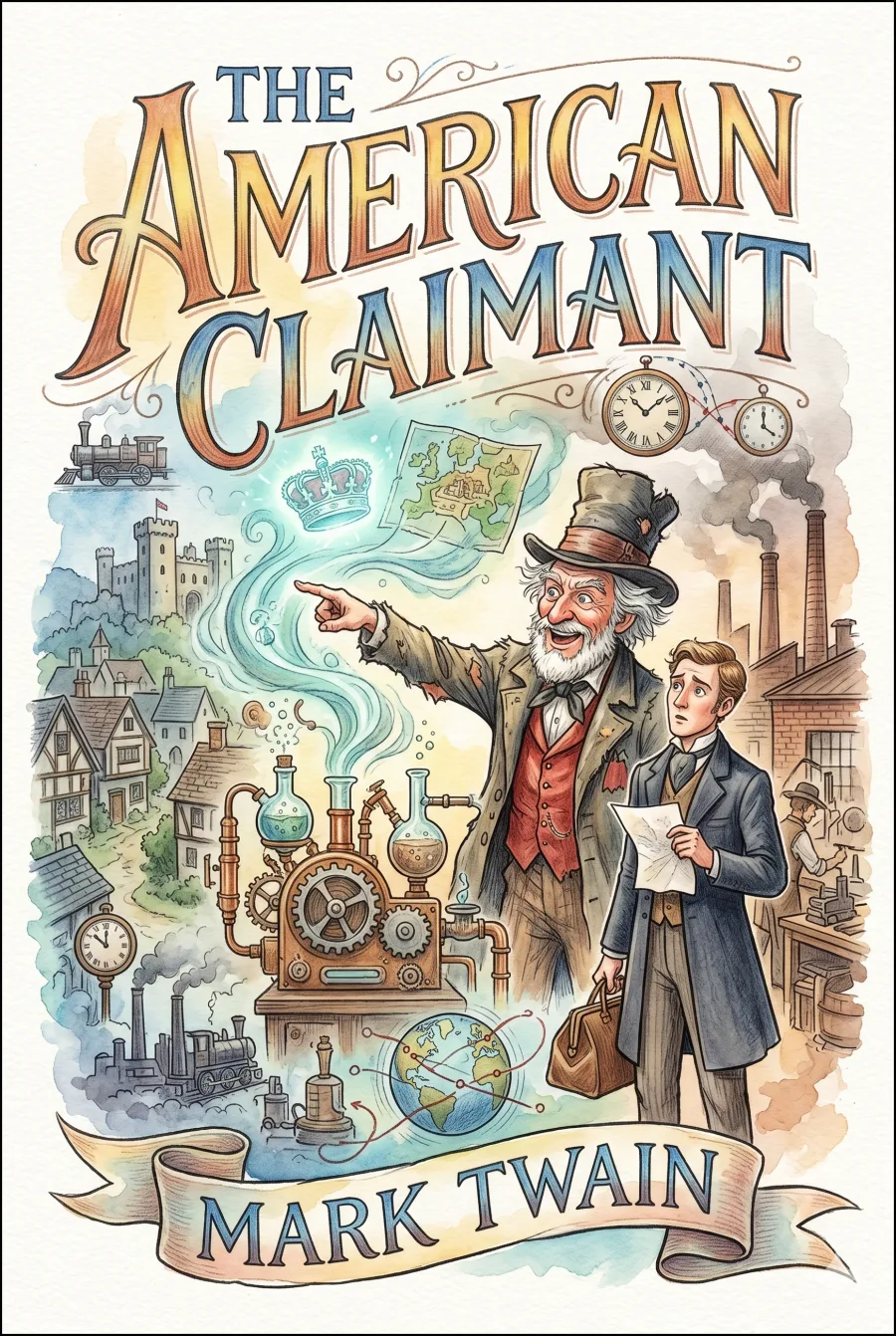
The American Claimant
eBook
• INR 51.00
• English
• 9788169359641
No ratings yet
| Publisher | General Press |
|---|---|
| ISBN13 | 9788169359641 |
| Book Format | eBook |
| Language | English |
| List Price | INR 51.00 |
| Subject Code | FIC016000, FIC052000, FIC037000 |
| Publishing Date | 05/09/2026 |
| Book Code | BD00070392 |
Buy this Book
Amazon Stores
Ebook Stores
Other Stores
Discover The American Claimant by Mark Twain. This book is published by General Press in eBook format, ISBN 9788169359641, under Literature and Fiction, Humorous Fiction, Fiction Satire.
Book Description
What if an ordinary American suddenly discovered that he was heir to a British title, an ancestral estate, and a life he had never imagined? "The American Claimant" by Mark Twain is a humorous historical novel and social satire that turns this extraordinary situation into a lively story about mistaken identity, class, ambition, romance, and the amusing differences between American and British ways of life.
The story follows Colonel Mulberry Sellers, an eccentric and endlessly optimistic American inventor and dreamer, whose latest scheme becomes connected to an old dispute over the British earldom of Rossmore. According to the complicated history behind the title, an American descendant may have a legitimate claim to the estate and position. This possibility sets in motion a remarkable chain of events involving the supposed heir, the British aristocracy, and a collection of characters whose identities and intentions are not always as straightforward as they appear.
Twain uses the inheritance story to create a comic clash between two very different worlds. American practicality, self-confidence, invention, and democratic ideals are placed alongside British traditions, aristocratic manners, inherited privilege, and rigid ideas about social position. The resulting misunderstandings provide much of the novel’s humor, but beneath the comedy Twain is also examining the strange ways people attach importance to titles, wealth, ancestry, and social status.
The novel becomes increasingly complicated as questions of identity and inheritance intersect with romantic interests and personal ambitions. Characters are forced to reconsider what makes a person worthy of respect and whether social position can truly determine a person’s value. Colonel Sellers, with his boundless confidence and talent for imagining improbable opportunities, adds another layer of comedy to the story. His schemes and observations capture Twain’s affection for larger-than-life characters while allowing the author to poke fun at both American optimism and European tradition.
Published in 1892, "The American Claimant" reflects Twain’s characteristic ability to combine farce with social criticism. Its plot moves through mistaken identities, unexpected revelations, family histories, romance, and cultural contrasts, creating an entertaining story that never takes its own absurdities too seriously. For readers interested in Mark Twain, classic American literature, historical comedy, social satire, or stories involving royal and aristocratic intrigue, this novel offers plenty of wit and surprises. Once the American claimant enters the world of British nobility, the question is not simply whether he can claim the title, but what happens when an unconventional American tries to make himself at home among the aristocracy.
The story follows Colonel Mulberry Sellers, an eccentric and endlessly optimistic American inventor and dreamer, whose latest scheme becomes connected to an old dispute over the British earldom of Rossmore. According to the complicated history behind the title, an American descendant may have a legitimate claim to the estate and position. This possibility sets in motion a remarkable chain of events involving the supposed heir, the British aristocracy, and a collection of characters whose identities and intentions are not always as straightforward as they appear.
Twain uses the inheritance story to create a comic clash between two very different worlds. American practicality, self-confidence, invention, and democratic ideals are placed alongside British traditions, aristocratic manners, inherited privilege, and rigid ideas about social position. The resulting misunderstandings provide much of the novel’s humor, but beneath the comedy Twain is also examining the strange ways people attach importance to titles, wealth, ancestry, and social status.
The novel becomes increasingly complicated as questions of identity and inheritance intersect with romantic interests and personal ambitions. Characters are forced to reconsider what makes a person worthy of respect and whether social position can truly determine a person’s value. Colonel Sellers, with his boundless confidence and talent for imagining improbable opportunities, adds another layer of comedy to the story. His schemes and observations capture Twain’s affection for larger-than-life characters while allowing the author to poke fun at both American optimism and European tradition.
Published in 1892, "The American Claimant" reflects Twain’s characteristic ability to combine farce with social criticism. Its plot moves through mistaken identities, unexpected revelations, family histories, romance, and cultural contrasts, creating an entertaining story that never takes its own absurdities too seriously. For readers interested in Mark Twain, classic American literature, historical comedy, social satire, or stories involving royal and aristocratic intrigue, this novel offers plenty of wit and surprises. Once the American claimant enters the world of British nobility, the question is not simply whether he can claim the title, but what happens when an unconventional American tries to make himself at home among the aristocracy.
Author Biography
Mark Twain (1835–1910), the pen name of “Samuel Langhorne Clemens”, was an American novelist, humorist, journalist, lecturer, and social critic who became one of the most important voices in American literature. Born on November 30, 1835, in Florida, Missouri, Twain moved with his family to Hannibal, Missouri, when he was four. Growing up beside the Mississippi River, he absorbed the stories, speech, humor, conflicts, and adventures of river life that would later shape his most famous books. His father died when Twain was eleven, and he left school early to work as a printer and typesetter. He later pursued his childhood ambition of becoming a Mississippi River steamboat pilot, an experience that deeply influenced his writing.
Twain's career changed direction after the Civil War disrupted river traffic. He traveled west, worked in Nevada, and began writing for the ‘Territorial Enterprise’ in Virginia City in 1862. It was during this period that Samuel Clemens adopted the name “Mark Twain”, a river expression referring to a water depth of two fathoms. His humorous writing quickly attracted attention, and his 1865 story “The Celebrated Jumping Frog of Calaveras County” brought him national recognition. He subsequently worked as a journalist and lecturer and traveled widely, turning his observations of people and places into memorable comic writing.
Twain's greatest literary achievements include ‘The Adventures of Tom Sawyer’ (1876), ‘The Prince and the Pauper’ (1881), ‘Life on the Mississippi’ (1883), and ‘Adventures of Huckleberry Finn’ (1884). ‘Tom Sawyer’ drew heavily on his childhood experiences in Hannibal, while ‘Huckleberry Finn’ used the Mississippi River journey to examine slavery, racism, conscience, friendship, and the contradictions of American society. The novel's distinctive voice and use of regional speech helped establish Twain as a major figure in American realism. The Library of Congress describes ‘Huckleberry Finn’ as his masterpiece and identifies ‘Tom Sawyer’ and ‘Huckleberry Finn’ as the works most closely associated with his Mississippi childhood.
Behind Twain's humor was a sharp and increasingly critical social conscience. He satirized political corruption, greed, religious hypocrisy, racism, imperialism, and the obsession with wealth and technological progress. His later writings, including ‘A Connecticut Yankee in King Arthur's Court’, ‘Following the Equator’, and ‘The War Prayer’, revealed a more openly skeptical and critical side. He eventually became a prominent opponent of American imperialism and joined the Anti-Imperialist League.
Twain's private life contained considerable hardship. He married Olivia Langdon in 1870, and they had four children, though only three daughters survived infancy. Financial difficulties caused by unsuccessful investments eventually forced him into bankruptcy, after which he undertook a worldwide lecture tour to repay his debts. He also endured the deaths of his wife and three daughters. Twain died on April 21, 1910, in Redding, Connecticut, at the age of seventy-four.
Today, Mark Twain remains essential for readers searching for “Mark Twain's biography, Samuel Clemens, ‘The Adventures of Huckleberry Finn’, ‘The Adventures of Tom Sawyer’, American literature, humor, satire, and nineteenth-century American history”. His greatest strength was his ability to make readers laugh while quietly forcing them to question society. Through unforgettable characters, natural dialogue, sharp satire, and a deep understanding of human weakness, Twain transformed distinctly American experiences into literature with universal appeal.
Twain's career changed direction after the Civil War disrupted river traffic. He traveled west, worked in Nevada, and began writing for the ‘Territorial Enterprise’ in Virginia City in 1862. It was during this period that Samuel Clemens adopted the name “Mark Twain”, a river expression referring to a water depth of two fathoms. His humorous writing quickly attracted attention, and his 1865 story “The Celebrated Jumping Frog of Calaveras County” brought him national recognition. He subsequently worked as a journalist and lecturer and traveled widely, turning his observations of people and places into memorable comic writing.
Twain's greatest literary achievements include ‘The Adventures of Tom Sawyer’ (1876), ‘The Prince and the Pauper’ (1881), ‘Life on the Mississippi’ (1883), and ‘Adventures of Huckleberry Finn’ (1884). ‘Tom Sawyer’ drew heavily on his childhood experiences in Hannibal, while ‘Huckleberry Finn’ used the Mississippi River journey to examine slavery, racism, conscience, friendship, and the contradictions of American society. The novel's distinctive voice and use of regional speech helped establish Twain as a major figure in American realism. The Library of Congress describes ‘Huckleberry Finn’ as his masterpiece and identifies ‘Tom Sawyer’ and ‘Huckleberry Finn’ as the works most closely associated with his Mississippi childhood.
Behind Twain's humor was a sharp and increasingly critical social conscience. He satirized political corruption, greed, religious hypocrisy, racism, imperialism, and the obsession with wealth and technological progress. His later writings, including ‘A Connecticut Yankee in King Arthur's Court’, ‘Following the Equator’, and ‘The War Prayer’, revealed a more openly skeptical and critical side. He eventually became a prominent opponent of American imperialism and joined the Anti-Imperialist League.
Twain's private life contained considerable hardship. He married Olivia Langdon in 1870, and they had four children, though only three daughters survived infancy. Financial difficulties caused by unsuccessful investments eventually forced him into bankruptcy, after which he undertook a worldwide lecture tour to repay his debts. He also endured the deaths of his wife and three daughters. Twain died on April 21, 1910, in Redding, Connecticut, at the age of seventy-four.
Today, Mark Twain remains essential for readers searching for “Mark Twain's biography, Samuel Clemens, ‘The Adventures of Huckleberry Finn’, ‘The Adventures of Tom Sawyer’, American literature, humor, satire, and nineteenth-century American history”. His greatest strength was his ability to make readers laugh while quietly forcing them to question society. Through unforgettable characters, natural dialogue, sharp satire, and a deep understanding of human weakness, Twain transformed distinctly American experiences into literature with universal appeal.
Editorial Reviews
Editorial Reviews will be added soon…
Book Summary
'The American Claimant' by Mark Twain is a comic novel about identity, social class, inheritance, ambition, and the absurd ways people construct their ideas of status. First published in 1892, the novel takes the familiar literary theme of the lost heir and turns it into a lively satire of both American democracy and British aristocracy. At the center of the story is Colonel Mulberry Sellers, a wonderfully eccentric American who believes that almost any impossible scheme can be turned into a fortune. Around him, Twain creates a group of characters whose lives become tangled through mistaken identities, romantic expectations, inherited titles, and competing ideas about what makes a person important. The result is a humorous but surprisingly thoughtful story about the difference between who people are and who society expects them to be.
The novel's central character, Colonel Mulberry Sellers, is one of Mark Twain's most memorable comic creations. Sellers is optimistic, imaginative, generous, and almost completely detached from practical reality. He constantly invents business schemes that promise enormous wealth, but his schemes rarely produce anything except confusion. Yet Sellers is not presented as a dishonest villain. He genuinely believes in the possibilities he describes. His imagination is so powerful that failure never permanently discourages him. Whenever one plan collapses, another immediately takes its place. Through Sellers, Twain gently mocks the American tendency to believe that extraordinary success is always just around the corner. The Colonel's confidence may be ridiculous, but there is also something lovable about his refusal to surrender hope.
The story becomes complicated when Washington Hawkins, an American living in England, becomes connected with an extraordinary inheritance claim. Hawkins is the descendant of an English aristocratic family and may have a legitimate claim to the title of Earl of Rossmore. The possibility that an American could become an English aristocrat creates the central comic situation of the novel. Twain uses this premise to reverse the traditional direction of social ambition. Instead of an ordinary European character dreaming of America, an American is suddenly given the opportunity to enter the world of British nobility. This allows Twain to compare American and British ideas of social status and to expose the absurdity of treating inherited titles as proof of human worth.
Washington Hawkins is not naturally suited to aristocratic life. He is an American, and his habits, attitudes, and democratic instincts make him very different from the people who surround the English estate. Yet the possibility of becoming an earl immediately changes the way others view him. People who might otherwise have ignored him begin treating him with respect because of the title he may inherit. Twain uses this transformation to ask an important question: if a person becomes valuable in the eyes of society merely because of a title, does that say something about the person or about society? The answer is obviously the latter, and much of the novel's humor comes from watching people become fascinated by an identity that may be nothing more than a legal accident.
The inheritance question is closely connected with the novel's exploration of mistaken identity. Characters are repeatedly forced to reconsider who they are dealing with because appearances, names, family histories, and social positions can all be misleading. Twain had already used mistaken identity brilliantly in earlier works, but in 'The American Claimant' he makes identity itself the subject of the joke. People behave differently depending on whom they believe someone to be. A person without a title can be treated as insignificant, while the same individual can suddenly become important when believed to be an aristocrat. Twain's point is both comic and serious: human beings often respond not to reality but to the stories they tell themselves about other people.
This is especially clear in the contrast between America and Britain. America represents democracy, restless ambition, invention, and social mobility. Britain represents inherited wealth, tradition, aristocratic hierarchy, and established social rules. Twain does not portray either society as completely perfect. Instead, he finds absurdities in both. Americans may be obsessed with making money and constantly dreaming of sudden wealth, while British society may be excessively impressed by ancestry and titles. The American claimant therefore becomes a kind of bridge between two systems. His possible transformation from American citizen into English nobleman allows Twain to place these opposing cultures side by side and laugh at both.
Colonel Sellers provides much of the novel's comic energy. His mind is constantly producing inventions, investments, political ideas, and grand financial plans. He has an extraordinary talent for making impossible projects sound convincing. One moment he may be discussing a spectacular business opportunity; the next, he may be imagining some enormous political or technological development. The humor comes from the contrast between his confidence and the obvious impracticality of his ideas. Yet Twain gives him enough warmth to prevent the character from becoming merely foolish. Sellers possesses a kind of emotional generosity that makes his fantasies attractive. He wants prosperity not only for himself but also for the people around him. His optimism represents a distinctly American faith in possibility, even when that faith becomes excessive.
The character of Sellers also connects 'The American Claimant' to Twain's earlier novel 'The Gilded Age', where Sellers first appeared. Readers familiar with that earlier work will recognize his characteristic mixture of extravagant schemes and unstoppable confidence. However, in 'The American Claimant', Twain places Sellers inside a different kind of story, allowing the character to interact with the themes of aristocracy and inheritance. His American practicality—or rather his imaginative version of practicality—contrasts sharply with the rigid traditions of British society. This cultural collision produces many of the novel's funniest situations.
The romance within the story adds another layer to the question of social class. Love becomes complicated because people are influenced by money, family background, and expectations about marriage. In a society obsessed with status, romantic relationships cannot remain completely separate from social ambition. A person's supposed identity can affect whether another person considers them desirable, respectable, or worthy. Twain exposes the absurdity of this by showing how quickly attitudes can change when someone's social position changes. The novel suggests that love is most genuine when it recognizes the individual behind the title, wealth, or reputation.
At the same time, the novel does not treat its characters as simple symbols. They have personal desires, weaknesses, hopes, and fears. Twain's comedy works because the people involved take their circumstances seriously even when the reader can see how ridiculous those circumstances are. This is a recurring strength of Twain's humor. He does not need every character to be deliberately funny. Instead, he creates situations in which ordinary human seriousness becomes comic when placed against an absurd background. Characters worry about inheritance, respectability, marriage, and reputation because these things genuinely matter to them. The reader laughs because the social rules governing those concerns are so arbitrary.
One of the most important ideas in 'The American Claimant' is that social status is often a performance. People learn how to behave according to their position, and others respond to them according to the role they appear to occupy. The novel repeatedly exposes the artificial nature of these roles. An American can become an English lord because of ancestry, while a person who has spent a lifetime without privilege can suddenly be treated as important. Twain invites readers to see how little these external distinctions tell us about a person's character. A title may be inherited, but honesty, kindness, intelligence, and courage cannot be inherited in the same way.
The novel also satirizes the American dream of sudden wealth. Colonel Sellers represents the belief that enormous success is always possible through one brilliant idea. This belief has an appealing side: it encourages creativity, ambition, and optimism. But Twain also shows its dangers. When people become too fascinated with imagined wealth, they can lose their connection with reality. Sellers' schemes are funny because they are so exaggerated, yet the underlying idea is recognizable. Twain understood that the promise of becoming rich quickly can be one of the most powerful fantasies in society. His comedy allows him to criticize that fantasy without becoming completely cynical about ambition itself.
Similarly, Twain's treatment of British aristocracy is humorous but pointed. The inherited title of Earl of Rossmore has enormous symbolic power even though possessing a title does not automatically make someone wiser, kinder, or more capable. The characters who become excited about the inheritance reveal their own assumptions about class. They have been trained to believe that aristocratic blood carries special value. By placing an American inside this system, Twain makes its assumptions look strange. The American claimant does not necessarily understand why everyone is so impressed, and that very distance helps expose the artificiality of the social hierarchy.
The story's many complications eventually bring the characters toward a greater understanding of identity and belonging. The confusion surrounding inheritance and social position cannot continue forever, and the various characters must confront the consequences of their assumptions. What matters most is not simply who possesses a title but whether the people involved can form genuine relationships based on trust and affection. The comic machinery of the plot therefore leads toward a broader human message: people are more than the labels attached to them.
Mark Twain's language and comic style are central to the book's appeal. He uses exaggeration, irony, absurd situations, and conversational humor to keep the story lively. His satire is rarely delivered as a dry lecture. Instead, he lets ridiculous characters and circumstances reveal the weaknesses of society for him. The reader is entertained first and then gradually realizes that the joke has a serious target. This combination of humor and social criticism is one reason 'The American Claimant' remains interesting more than a century after its publication.
The novel is also valuable as a picture of Twain's attitude toward social pretension. He distrusted systems that encouraged people to believe they were superior simply because of birth, money, or reputation. At the same time, he was fascinated by the American culture of ambition and self-invention. 'The American Claimant' brings these two concerns together. The American claimant is caught between a world where identity can be created through ambition and a world where identity is supposedly fixed by ancestry. Twain finds comedy in both ideas because both can become absurd when taken too seriously.
Ultimately, 'The American Claimant' is a humorous story about people searching for wealth, recognition, love, and a secure place in society. Washington Hawkins' possible inheritance provides the central plot, but the deeper subject is the strange power that social labels have over human behavior. Colonel Mulberry Sellers embodies the optimism and wild imagination of America, while the aristocratic world of England represents a different kind of fantasy—the belief that inherited status creates inherent superiority. By bringing these worlds together, Twain creates a lively satire of class, money, ambition, and identity.
For readers looking for an in-depth 'The American Claimant' summary, the novel can ultimately be understood as Mark Twain's comic examination of a simple but enduring question: what makes a person valuable? Is it wealth, ancestry, a title, reputation, or social position? Twain's answer is that these things are unreliable measures of human worth. A person may become an earl without becoming a better human being, just as a person with no fortune or title may possess extraordinary generosity and character. Through mistaken identities, extravagant schemes, romantic complications, and cultural satire, Twain turns the old lost-heir story into a broader criticism of society's obsession with status. The book remains entertaining because its characters are so vividly human, but its humor also carries a lasting message: people often spend enormous energy trying to become what society considers important, while overlooking the qualities that make a life genuinely meaningful.
The novel's central character, Colonel Mulberry Sellers, is one of Mark Twain's most memorable comic creations. Sellers is optimistic, imaginative, generous, and almost completely detached from practical reality. He constantly invents business schemes that promise enormous wealth, but his schemes rarely produce anything except confusion. Yet Sellers is not presented as a dishonest villain. He genuinely believes in the possibilities he describes. His imagination is so powerful that failure never permanently discourages him. Whenever one plan collapses, another immediately takes its place. Through Sellers, Twain gently mocks the American tendency to believe that extraordinary success is always just around the corner. The Colonel's confidence may be ridiculous, but there is also something lovable about his refusal to surrender hope.
The story becomes complicated when Washington Hawkins, an American living in England, becomes connected with an extraordinary inheritance claim. Hawkins is the descendant of an English aristocratic family and may have a legitimate claim to the title of Earl of Rossmore. The possibility that an American could become an English aristocrat creates the central comic situation of the novel. Twain uses this premise to reverse the traditional direction of social ambition. Instead of an ordinary European character dreaming of America, an American is suddenly given the opportunity to enter the world of British nobility. This allows Twain to compare American and British ideas of social status and to expose the absurdity of treating inherited titles as proof of human worth.
Washington Hawkins is not naturally suited to aristocratic life. He is an American, and his habits, attitudes, and democratic instincts make him very different from the people who surround the English estate. Yet the possibility of becoming an earl immediately changes the way others view him. People who might otherwise have ignored him begin treating him with respect because of the title he may inherit. Twain uses this transformation to ask an important question: if a person becomes valuable in the eyes of society merely because of a title, does that say something about the person or about society? The answer is obviously the latter, and much of the novel's humor comes from watching people become fascinated by an identity that may be nothing more than a legal accident.
The inheritance question is closely connected with the novel's exploration of mistaken identity. Characters are repeatedly forced to reconsider who they are dealing with because appearances, names, family histories, and social positions can all be misleading. Twain had already used mistaken identity brilliantly in earlier works, but in 'The American Claimant' he makes identity itself the subject of the joke. People behave differently depending on whom they believe someone to be. A person without a title can be treated as insignificant, while the same individual can suddenly become important when believed to be an aristocrat. Twain's point is both comic and serious: human beings often respond not to reality but to the stories they tell themselves about other people.
This is especially clear in the contrast between America and Britain. America represents democracy, restless ambition, invention, and social mobility. Britain represents inherited wealth, tradition, aristocratic hierarchy, and established social rules. Twain does not portray either society as completely perfect. Instead, he finds absurdities in both. Americans may be obsessed with making money and constantly dreaming of sudden wealth, while British society may be excessively impressed by ancestry and titles. The American claimant therefore becomes a kind of bridge between two systems. His possible transformation from American citizen into English nobleman allows Twain to place these opposing cultures side by side and laugh at both.
Colonel Sellers provides much of the novel's comic energy. His mind is constantly producing inventions, investments, political ideas, and grand financial plans. He has an extraordinary talent for making impossible projects sound convincing. One moment he may be discussing a spectacular business opportunity; the next, he may be imagining some enormous political or technological development. The humor comes from the contrast between his confidence and the obvious impracticality of his ideas. Yet Twain gives him enough warmth to prevent the character from becoming merely foolish. Sellers possesses a kind of emotional generosity that makes his fantasies attractive. He wants prosperity not only for himself but also for the people around him. His optimism represents a distinctly American faith in possibility, even when that faith becomes excessive.
The character of Sellers also connects 'The American Claimant' to Twain's earlier novel 'The Gilded Age', where Sellers first appeared. Readers familiar with that earlier work will recognize his characteristic mixture of extravagant schemes and unstoppable confidence. However, in 'The American Claimant', Twain places Sellers inside a different kind of story, allowing the character to interact with the themes of aristocracy and inheritance. His American practicality—or rather his imaginative version of practicality—contrasts sharply with the rigid traditions of British society. This cultural collision produces many of the novel's funniest situations.
The romance within the story adds another layer to the question of social class. Love becomes complicated because people are influenced by money, family background, and expectations about marriage. In a society obsessed with status, romantic relationships cannot remain completely separate from social ambition. A person's supposed identity can affect whether another person considers them desirable, respectable, or worthy. Twain exposes the absurdity of this by showing how quickly attitudes can change when someone's social position changes. The novel suggests that love is most genuine when it recognizes the individual behind the title, wealth, or reputation.
At the same time, the novel does not treat its characters as simple symbols. They have personal desires, weaknesses, hopes, and fears. Twain's comedy works because the people involved take their circumstances seriously even when the reader can see how ridiculous those circumstances are. This is a recurring strength of Twain's humor. He does not need every character to be deliberately funny. Instead, he creates situations in which ordinary human seriousness becomes comic when placed against an absurd background. Characters worry about inheritance, respectability, marriage, and reputation because these things genuinely matter to them. The reader laughs because the social rules governing those concerns are so arbitrary.
One of the most important ideas in 'The American Claimant' is that social status is often a performance. People learn how to behave according to their position, and others respond to them according to the role they appear to occupy. The novel repeatedly exposes the artificial nature of these roles. An American can become an English lord because of ancestry, while a person who has spent a lifetime without privilege can suddenly be treated as important. Twain invites readers to see how little these external distinctions tell us about a person's character. A title may be inherited, but honesty, kindness, intelligence, and courage cannot be inherited in the same way.
The novel also satirizes the American dream of sudden wealth. Colonel Sellers represents the belief that enormous success is always possible through one brilliant idea. This belief has an appealing side: it encourages creativity, ambition, and optimism. But Twain also shows its dangers. When people become too fascinated with imagined wealth, they can lose their connection with reality. Sellers' schemes are funny because they are so exaggerated, yet the underlying idea is recognizable. Twain understood that the promise of becoming rich quickly can be one of the most powerful fantasies in society. His comedy allows him to criticize that fantasy without becoming completely cynical about ambition itself.
Similarly, Twain's treatment of British aristocracy is humorous but pointed. The inherited title of Earl of Rossmore has enormous symbolic power even though possessing a title does not automatically make someone wiser, kinder, or more capable. The characters who become excited about the inheritance reveal their own assumptions about class. They have been trained to believe that aristocratic blood carries special value. By placing an American inside this system, Twain makes its assumptions look strange. The American claimant does not necessarily understand why everyone is so impressed, and that very distance helps expose the artificiality of the social hierarchy.
The story's many complications eventually bring the characters toward a greater understanding of identity and belonging. The confusion surrounding inheritance and social position cannot continue forever, and the various characters must confront the consequences of their assumptions. What matters most is not simply who possesses a title but whether the people involved can form genuine relationships based on trust and affection. The comic machinery of the plot therefore leads toward a broader human message: people are more than the labels attached to them.
Mark Twain's language and comic style are central to the book's appeal. He uses exaggeration, irony, absurd situations, and conversational humor to keep the story lively. His satire is rarely delivered as a dry lecture. Instead, he lets ridiculous characters and circumstances reveal the weaknesses of society for him. The reader is entertained first and then gradually realizes that the joke has a serious target. This combination of humor and social criticism is one reason 'The American Claimant' remains interesting more than a century after its publication.
The novel is also valuable as a picture of Twain's attitude toward social pretension. He distrusted systems that encouraged people to believe they were superior simply because of birth, money, or reputation. At the same time, he was fascinated by the American culture of ambition and self-invention. 'The American Claimant' brings these two concerns together. The American claimant is caught between a world where identity can be created through ambition and a world where identity is supposedly fixed by ancestry. Twain finds comedy in both ideas because both can become absurd when taken too seriously.
Ultimately, 'The American Claimant' is a humorous story about people searching for wealth, recognition, love, and a secure place in society. Washington Hawkins' possible inheritance provides the central plot, but the deeper subject is the strange power that social labels have over human behavior. Colonel Mulberry Sellers embodies the optimism and wild imagination of America, while the aristocratic world of England represents a different kind of fantasy—the belief that inherited status creates inherent superiority. By bringing these worlds together, Twain creates a lively satire of class, money, ambition, and identity.
For readers looking for an in-depth 'The American Claimant' summary, the novel can ultimately be understood as Mark Twain's comic examination of a simple but enduring question: what makes a person valuable? Is it wealth, ancestry, a title, reputation, or social position? Twain's answer is that these things are unreliable measures of human worth. A person may become an earl without becoming a better human being, just as a person with no fortune or title may possess extraordinary generosity and character. Through mistaken identities, extravagant schemes, romantic complications, and cultural satire, Twain turns the old lost-heir story into a broader criticism of society's obsession with status. The book remains entertaining because its characters are so vividly human, but its humor also carries a lasting message: people often spend enormous energy trying to become what society considers important, while overlooking the qualities that make a life genuinely meaningful.
Sample Chapters
Sample Chapters will be added soon…
Reader Reviews
No reviews yet.
The American Claimant
Download Cover Image
Do you want to download the full cover image for The American Claimant?