
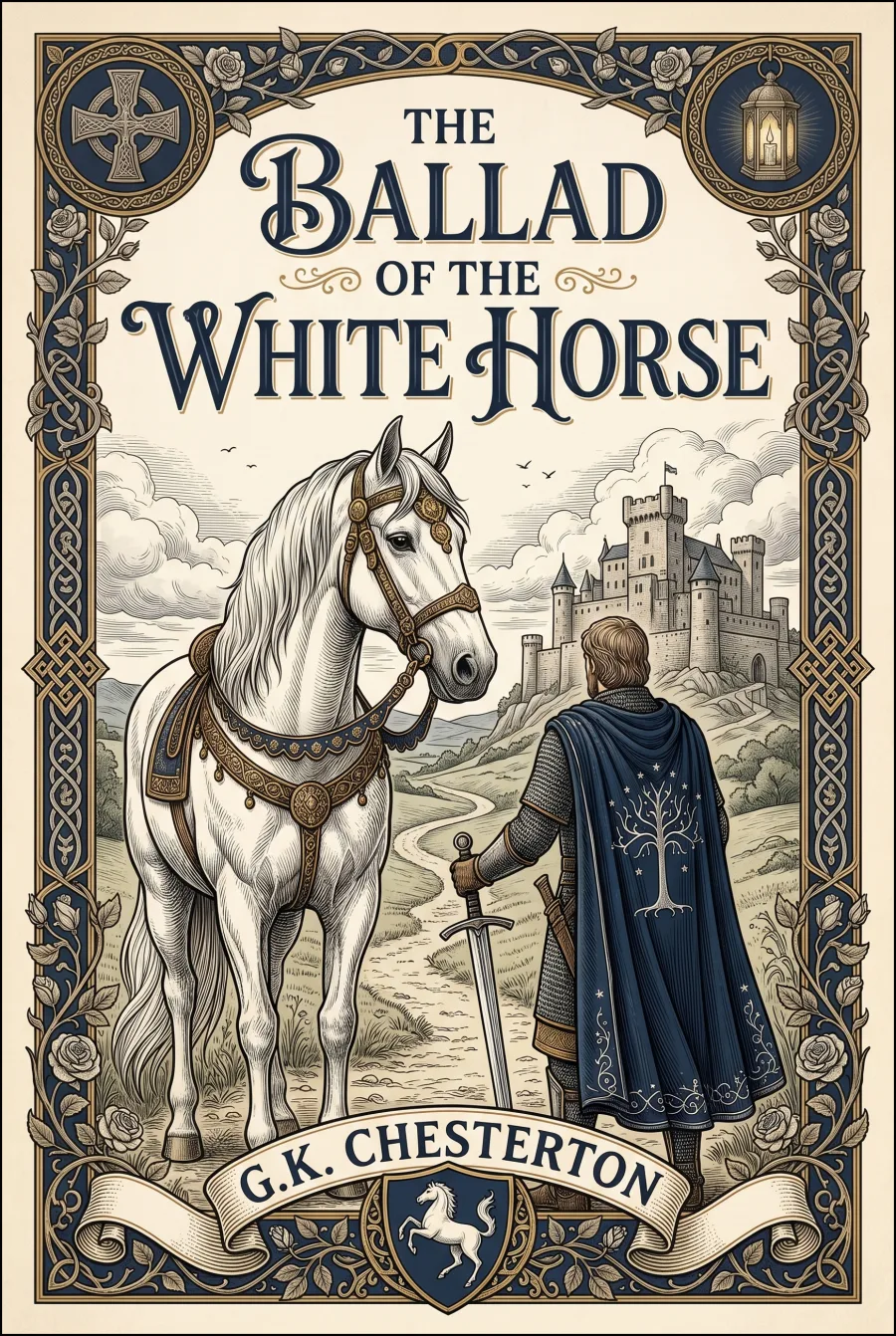
The Ballad of the White Horse
eBook
• INR 51.00
• English
• 9788169359658
No ratings yet
| Publisher | General Press |
|---|---|
| ISBN13 | 9788169359658 |
| Book Format | eBook |
| Language | English |
| List Price | INR 51.00 |
| Subject Code | POE014000, POE005020, POE003000 |
| Publishing Date | 05/09/2026 |
| Book Code | BD00070393 |
Buy this Book
Amazon Stores
Ebook Stores
Other Stores
Discover The Ballad of the White Horse by G.K. Chesterton. This book is published by General Press in eBook format, ISBN 9788169359658, under Epic Poetry, British and Irish Poetry.
Book Description
When an exhausted king stands against an overwhelming enemy, courage becomes more than a matter of winning—it becomes a choice to defend what one believes is worth preserving. "The Ballad of the White Horse" by G. K. Chesterton is a classic historical epic poem and narrative poem that retells the legendary struggle of King Alfred the Great against the invading Danes, combining heroic adventure, religious faith, vivid imagery, and deep reflections on civilization, freedom, and human courage.
Set in ninth-century England, the poem opens during a dark period when Alfred’s kingdom has suffered repeated attacks and much of the land has fallen under Danish control. Alfred, forced into hiding and surrounded by uncertainty, refuses to surrender hope. Though his resources are limited and his position seems almost hopeless, he begins to gather support for one final effort to resist the invaders. His determination becomes the foundation for a larger story about ordinary people finding strength when their world appears to be collapsing.
As Alfred prepares for battle, Chesterton introduces a group of memorable warriors and companions who represent different backgrounds, personalities, and ideas. Their conversations are as important as their fighting, allowing the poem to explore questions about faith, doubt, freedom, courage, and the nature of evil. Chesterton does not portray the conflict as a simple contest between heroes and villains; instead, he gives the story a larger philosophical dimension, asking what kind of beliefs can sustain people when victory seems impossible.
The central battle provides the poem with its great dramatic momentum. Chesterton’s energetic language and striking descriptions create a powerful sense of movement, from the quiet landscapes of England to the noise and danger of warfare. Yet the poem’s real focus lies beyond the battlefield. Alfred’s struggle becomes a symbol of resistance against despair and of the determination to preserve a culture and way of life in the face of overwhelming odds.
Written in 1911, "The Ballad of the White Horse" remains one of Chesterton’s most celebrated works of poetry. Its mixture of history, legend, spirituality, humor, philosophy, and heroic storytelling gives it a distinctive character. Readers interested in King Alfred, medieval England, historical poetry, epic literature, or Chesterton’s ideas will find a work that is both dramatic and thought-provoking. As Alfred gathers his forces for a seemingly impossible confrontation, the poem invites readers to discover what courage can accomplish when hope itself becomes an act of defiance.
Set in ninth-century England, the poem opens during a dark period when Alfred’s kingdom has suffered repeated attacks and much of the land has fallen under Danish control. Alfred, forced into hiding and surrounded by uncertainty, refuses to surrender hope. Though his resources are limited and his position seems almost hopeless, he begins to gather support for one final effort to resist the invaders. His determination becomes the foundation for a larger story about ordinary people finding strength when their world appears to be collapsing.
As Alfred prepares for battle, Chesterton introduces a group of memorable warriors and companions who represent different backgrounds, personalities, and ideas. Their conversations are as important as their fighting, allowing the poem to explore questions about faith, doubt, freedom, courage, and the nature of evil. Chesterton does not portray the conflict as a simple contest between heroes and villains; instead, he gives the story a larger philosophical dimension, asking what kind of beliefs can sustain people when victory seems impossible.
The central battle provides the poem with its great dramatic momentum. Chesterton’s energetic language and striking descriptions create a powerful sense of movement, from the quiet landscapes of England to the noise and danger of warfare. Yet the poem’s real focus lies beyond the battlefield. Alfred’s struggle becomes a symbol of resistance against despair and of the determination to preserve a culture and way of life in the face of overwhelming odds.
Written in 1911, "The Ballad of the White Horse" remains one of Chesterton’s most celebrated works of poetry. Its mixture of history, legend, spirituality, humor, philosophy, and heroic storytelling gives it a distinctive character. Readers interested in King Alfred, medieval England, historical poetry, epic literature, or Chesterton’s ideas will find a work that is both dramatic and thought-provoking. As Alfred gathers his forces for a seemingly impossible confrontation, the poem invites readers to discover what courage can accomplish when hope itself becomes an act of defiance.
Author Biography
Gilbert Keith Chesterton (1874–1936) was a man who literally and figuratively took up an enormous amount of space in the world. Standing six feet four inches tall and weighing nearly 300 pounds, he was an instantly recognizable figure in early 20th-century London, known for his trademark cape, crumpled hat, and ever-present cigar. Far more massive than his physical frame, however, was his intellectual output and his boundless capacity for wonder. Originally trained in illustration at art school, Chesterton soon found his true calling in journalism and literature, embarking on a career that would make him one of the most prolific, joyful defenders of Christianity, the family, and everyday common sense.
Often celebrated for his unique literary style, Chesterton possessed an uncanny ability to turn an argument on its head using paradox to reveal deeper, often neglected truths. Across his lifetime, he authored over a hundred books, roughly two hundred short stories, and more than 4,000 newspaper essays. His philosophical masterpieces, notably ‘Orthodoxy’ and ‘The Everlasting Man’, profoundly shaped modern Christian apologetics; the latter famously played a crucial role in the conversion of a young atheist named C.S. Lewis. Yet, despite the sheer depth of his intellect, Chesterton wrote with an intoxicating lightness and humor that made complex theology accessible and highly engaging.
In the realm of fiction, Chesterton is most widely celebrated for creating the beloved priest-detective, Father Brown. Unlike Sherlock Holmes, who relied on cold, clinical deduction, Father Brown solved grisly crimes through deep empathy and a profound psychological understanding of human brokenness—a perspective he honed in the confessional box. This focus on spiritual redemption over mere justice highlighted Chesterton’s own deepening faith, which ultimately culminated in his formal conversion to Roman Catholicism in 1922.
Though he passed away in 1936, G.K. Chesterton's legacy remains vibrantly alive today. He was a ferocious public debater who frequently sparred with intellectual heavyweights like George Bernard Shaw and H.G. Wells, yet he loved his opponents dearly and never let philosophical disagreements destroy a personal friendship. Modern readers from all walks of life continue to turn to Chesterton for his infectious optimism, his profoundly charitable spirit, and his timeless reminder that the ordinary world is a place of profound magic and meaning.
Often celebrated for his unique literary style, Chesterton possessed an uncanny ability to turn an argument on its head using paradox to reveal deeper, often neglected truths. Across his lifetime, he authored over a hundred books, roughly two hundred short stories, and more than 4,000 newspaper essays. His philosophical masterpieces, notably ‘Orthodoxy’ and ‘The Everlasting Man’, profoundly shaped modern Christian apologetics; the latter famously played a crucial role in the conversion of a young atheist named C.S. Lewis. Yet, despite the sheer depth of his intellect, Chesterton wrote with an intoxicating lightness and humor that made complex theology accessible and highly engaging.
In the realm of fiction, Chesterton is most widely celebrated for creating the beloved priest-detective, Father Brown. Unlike Sherlock Holmes, who relied on cold, clinical deduction, Father Brown solved grisly crimes through deep empathy and a profound psychological understanding of human brokenness—a perspective he honed in the confessional box. This focus on spiritual redemption over mere justice highlighted Chesterton’s own deepening faith, which ultimately culminated in his formal conversion to Roman Catholicism in 1922.
Though he passed away in 1936, G.K. Chesterton's legacy remains vibrantly alive today. He was a ferocious public debater who frequently sparred with intellectual heavyweights like George Bernard Shaw and H.G. Wells, yet he loved his opponents dearly and never let philosophical disagreements destroy a personal friendship. Modern readers from all walks of life continue to turn to Chesterton for his infectious optimism, his profoundly charitable spirit, and his timeless reminder that the ordinary world is a place of profound magic and meaning.
Editorial Reviews
Editorial Reviews will be added soon…
Book Summary
'The Ballad of the White Horse' by G. K. Chesterton is a sweeping historical narrative poem about King Alfred the Great, the Viking invasions of England, and the struggle to preserve a fragile Christian kingdom against overwhelming military force. Published in 1911, the poem combines history, legend, Christian symbolism, philosophy, patriotism, and heroic adventure. Although it tells the story of a battle between Alfred and the invading Danes, its deeper subject is the defense of civilization itself. Chesterton is less interested in presenting a strictly historical account than in exploring what courage means when victory seems almost impossible. The poem's famous image of the White Horse, carved into the chalk hills of Oxfordshire, becomes a symbol of memory, faith, endurance, and the determination of ordinary people to preserve something precious even when it appears that all is lost.
The poem begins at a moment of extreme crisis for England. The country has been repeatedly attacked by the Danes, whose armies have defeated the English in battle and seized much of the kingdom. King Alfred has suffered terrible losses and has been driven into hiding. The situation seems hopeless. The English have been scattered, their leaders have been defeated, and the invaders appear stronger, more organized, and more confident. Yet Chesterton immediately establishes that Alfred's defeat is not the end of the story. Alfred remains spiritually alive even when his political power has nearly disappeared. The opening atmosphere is therefore one of darkness, uncertainty, and impending destruction, but beneath it lies the possibility of renewal.
Alfred is presented not simply as a warrior king but as a deeply thoughtful and spiritually serious man. He has experienced defeat closely enough to understand fear, loneliness, and failure. This is important because Chesterton's hero is not powerful because he never suffers. Instead, his greatness comes from the fact that suffering does not destroy his sense of purpose. Alfred's faith allows him to continue believing in the value of England even when there is little visible evidence that England can survive. He is not portrayed as someone who possesses a magical certainty about the future. He acts because he believes action is necessary, even without knowing whether it will succeed.
One of the poem's most memorable episodes occurs when Alfred, disguised and living in hiding, comes into contact with an old woman who does not recognize him as the king. She asks him to watch some cakes cooking while she attends to other work. Alfred becomes distracted by his thoughts and allows the cakes to burn. When the woman returns, she angrily rebukes him. The scene is humorous, but Chesterton uses it to humanize Alfred. A great king can be helpless, hungry, disguised, and capable of making an ordinary mistake. His greatness is not based on being superhuman. He shares the weaknesses of common people. This encounter also reminds the reader that history is shaped not only by kings and armies but by ordinary human lives.
Alfred's period of hiding eventually leads him to begin gathering information about the Danish army. He travels through enemy territory in disguise, observing their strength and learning about their plans. He discovers that the Danes are confident because they believe they have already won. Their confidence is not entirely irrational. They have powerful forces, military experience, and the momentum of repeated victories. Chesterton makes their confidence convincing so that Alfred's eventual resistance will not feel easy or artificial. The enemy is formidable precisely because the English have genuine reasons to fear them.
The Danish leader Guthrum is an important figure in the poem. He represents a powerful pagan force confronting Alfred's Christian vision of England. The poem does not reduce the conflict to a simple difference between good individuals and bad individuals. Chesterton gives the Danes a certain grandeur and recognizes their courage, strength, and fierce independence. Their threat comes partly from the fact that they possess virtues of their own, especially bravery and determination. The central struggle is therefore between competing visions of life rather than merely between heroes and villains.
After gathering intelligence, Alfred begins planning a counterattack. He sends messages and calls the English forces together. Slowly, scattered men begin to gather around him. These soldiers are not presented as an invincible army. They are frightened and uncertain, and many have already experienced defeat. Their willingness to fight again therefore becomes an act of courage. Chesterton emphasizes that courage is meaningful only when fear exists. A person who has nothing to fear does not demonstrate the same kind of bravery as someone who knows exactly how terrible the consequences of failure could be.
The gathering of Alfred's forces leads toward the decisive Battle of Ethandune, generally identified with Edington in Wiltshire. Before the battle, Alfred's men face an enemy that appears stronger than they are. Chesterton creates a dramatic contrast between the confidence of the Danes and the desperate determination of the English. The English fight not because victory seems guaranteed but because surrender would mean the destruction of the society and spiritual tradition they value. This makes the battle both physical and symbolic. The survival of Alfred's kingdom becomes a representation of the survival of hope itself.
Chesterton's description of the battle is filled with vivid images, rapid movement, and heroic energy. The fighting is brutal and chaotic, but it is also presented as a moment when individual courage matters. Alfred's men must overcome exhaustion and fear, and the battle repeatedly seems capable of turning against them. The poem's dramatic power comes from uncertainty. The reader knows that Alfred is a historical king who eventually succeeds, but Chesterton makes the struggle feel dangerous because he focuses on the human experience of people who do not know what the future holds.
A central idea in 'The Ballad of the White Horse' is that civilization is fragile. Modern readers may imagine England as an established nation with centuries of institutions behind it, but Chesterton asks them to remember that such stability was once uncertain. The kingdom could have disappeared. Its religious and cultural traditions could have been destroyed or transformed. Alfred's struggle therefore becomes a reminder that the things people later regard as permanent may have survived only because earlier generations refused to surrender them.
Chesterton's Christianity is equally central to the poem. Alfred's faith does not make him passive. Instead, it gives him a reason to act. Chesterton rejects the idea that religious belief necessarily means withdrawing from worldly conflict. For Alfred, faith and courage belong together. He believes that human beings must defend what is good even when they cannot know the final outcome. The poem repeatedly returns to the mystery of divine providence. God does not appear as a simple mechanism guaranteeing that Alfred will win. Rather, Alfred must act faithfully without possessing complete knowledge of God's plan.
This idea becomes especially powerful in the poem's treatment of victory. Alfred wins the battle, but Chesterton does not allow victory to become a simplistic message that good people always triumph immediately. Alfred's victory is hard-earned, uncertain, and dependent upon courage, sacrifice, and perseverance. The poem suggests that historical progress cannot be taken for granted. A generation may win a battle and still face new threats. What matters is the willingness to continue defending truth and freedom rather than assuming that one victory permanently solves the problem.
The poem's famous discussion of the White Horse deepens this message. The Uffington White Horse is an ancient figure carved into the chalk landscape, and Chesterton uses it as a symbol of the persistence of memory. The horse is older than Alfred and older than the Christian England he is defending. It survives because successive generations maintain it. This becomes an image for civilization itself. Traditions remain alive because people choose to remember and renew them. If people forget, even the most enduring symbols can disappear beneath time and neglect.
Another major theme is Chesterton's suspicion of both pessimism and simplistic optimism. The poem refuses to say that the world is naturally progressing toward perfection. History contains violence, destruction, betrayal, and failure. Yet Chesterton also refuses the conclusion that nothing matters. Alfred's position is more difficult and more hopeful: the world may be dangerous and imperfect, but that does not excuse people from trying to make it better. The hero must act without guarantees. This is one of the poem's most enduring philosophical ideas.
Chesterton also celebrates the ordinary person. Alfred may be the central historical figure, but the poem's emotional force comes from the people who stand with him. Farmers, soldiers, sailors, and common Englishmen become part of the defense of the kingdom. They are not merely background characters. Their courage demonstrates that civilization is preserved collectively. Kings may lead, but nations survive through the decisions of countless individuals who are willing to sacrifice comfort and safety for something larger than themselves.
The contrast between Alfred and the Danish worldview also allows Chesterton to explore different attitudes toward life and death. The pagan Danes are often associated with a heroic acceptance of destruction. They can be fearless because they believe the world is ultimately tragic and that glory may be found in defying death. Alfred's Christianity offers a different answer. It does not deny death or suffering; instead, it places them within a larger understanding of meaning, sacrifice, and hope. For Chesterton, Christian courage is therefore not merely the courage to die but the courage to live and build after suffering.
The poem's language is intentionally grand, musical, and dramatic. Chesterton uses ballad rhythms, repetition, strong contrasts, memorable images, and deliberately heightened language to create the atmosphere of an epic. Yet moments of humor and ordinary human detail prevent the poem from becoming emotionally distant. This mixture of the heroic and the everyday is one of its distinctive qualities. Alfred can stand as a symbol of Christian civilization while also being a tired man who burns cakes. Chesterton wants greatness to remain connected to ordinary human weakness.
As the battle reaches its conclusion, Alfred and his forces overcome Guthrum's army. The victory is not simply a military triumph; it becomes a moment of renewal. The Danes are defeated, and Alfred is able to restore his kingdom. Guthrum eventually accepts baptism and agrees to a settlement, suggesting that the conflict does not have to end in endless destruction. The enemy can become part of a new political order. Chesterton therefore gives the conclusion a sense of reconciliation as well as victory.
Yet the poem's final meaning goes beyond Alfred's historical achievement. 'The Ballad of the White Horse' asks what human beings should do when they face circumstances that appear overwhelmingly hostile. Chesterton's answer is that despair is not wisdom. The fact that the future is uncertain does not make courage irrational; rather, uncertainty is precisely what makes courage necessary. People must defend love, faith, freedom, family, culture, and human dignity without waiting for absolute guarantees that their efforts will succeed.
For readers searching for a 'The Ballad of the White Horse' book summary, the heart of the poem is therefore the story of King Alfred's decision to resist the Danish invasion after suffering devastating defeat. He hides, observes the enemy, gathers his scattered people, prepares for battle, and eventually leads them to victory at Ethandune. But the deeper story is about the human refusal to surrender hope. Alfred's journey represents the movement from despair to courage, from isolation to community, and from apparent defeat to renewed purpose.
Ultimately, 'The Ballad of the White Horse' remains powerful because it does not define heroism as certainty. Alfred does not know that he will win when he begins fighting. He does not possess unlimited strength, and he does not escape suffering. What distinguishes him is his willingness to act faithfully in the face of uncertainty. Chesterton turns this historical episode into a larger reflection on civilization, faith, courage, memory, and the responsibility of each generation to preserve what it has received. The White Horse becomes the lasting symbol of that responsibility: something ancient, vulnerable, and worth preserving. The poem's final lesson is deeply humane. Darkness may be real, defeat may be painful, and the future may be impossible to predict, but none of these facts remove the need to stand up, remember what matters, and try again.
The poem begins at a moment of extreme crisis for England. The country has been repeatedly attacked by the Danes, whose armies have defeated the English in battle and seized much of the kingdom. King Alfred has suffered terrible losses and has been driven into hiding. The situation seems hopeless. The English have been scattered, their leaders have been defeated, and the invaders appear stronger, more organized, and more confident. Yet Chesterton immediately establishes that Alfred's defeat is not the end of the story. Alfred remains spiritually alive even when his political power has nearly disappeared. The opening atmosphere is therefore one of darkness, uncertainty, and impending destruction, but beneath it lies the possibility of renewal.
Alfred is presented not simply as a warrior king but as a deeply thoughtful and spiritually serious man. He has experienced defeat closely enough to understand fear, loneliness, and failure. This is important because Chesterton's hero is not powerful because he never suffers. Instead, his greatness comes from the fact that suffering does not destroy his sense of purpose. Alfred's faith allows him to continue believing in the value of England even when there is little visible evidence that England can survive. He is not portrayed as someone who possesses a magical certainty about the future. He acts because he believes action is necessary, even without knowing whether it will succeed.
One of the poem's most memorable episodes occurs when Alfred, disguised and living in hiding, comes into contact with an old woman who does not recognize him as the king. She asks him to watch some cakes cooking while she attends to other work. Alfred becomes distracted by his thoughts and allows the cakes to burn. When the woman returns, she angrily rebukes him. The scene is humorous, but Chesterton uses it to humanize Alfred. A great king can be helpless, hungry, disguised, and capable of making an ordinary mistake. His greatness is not based on being superhuman. He shares the weaknesses of common people. This encounter also reminds the reader that history is shaped not only by kings and armies but by ordinary human lives.
Alfred's period of hiding eventually leads him to begin gathering information about the Danish army. He travels through enemy territory in disguise, observing their strength and learning about their plans. He discovers that the Danes are confident because they believe they have already won. Their confidence is not entirely irrational. They have powerful forces, military experience, and the momentum of repeated victories. Chesterton makes their confidence convincing so that Alfred's eventual resistance will not feel easy or artificial. The enemy is formidable precisely because the English have genuine reasons to fear them.
The Danish leader Guthrum is an important figure in the poem. He represents a powerful pagan force confronting Alfred's Christian vision of England. The poem does not reduce the conflict to a simple difference between good individuals and bad individuals. Chesterton gives the Danes a certain grandeur and recognizes their courage, strength, and fierce independence. Their threat comes partly from the fact that they possess virtues of their own, especially bravery and determination. The central struggle is therefore between competing visions of life rather than merely between heroes and villains.
After gathering intelligence, Alfred begins planning a counterattack. He sends messages and calls the English forces together. Slowly, scattered men begin to gather around him. These soldiers are not presented as an invincible army. They are frightened and uncertain, and many have already experienced defeat. Their willingness to fight again therefore becomes an act of courage. Chesterton emphasizes that courage is meaningful only when fear exists. A person who has nothing to fear does not demonstrate the same kind of bravery as someone who knows exactly how terrible the consequences of failure could be.
The gathering of Alfred's forces leads toward the decisive Battle of Ethandune, generally identified with Edington in Wiltshire. Before the battle, Alfred's men face an enemy that appears stronger than they are. Chesterton creates a dramatic contrast between the confidence of the Danes and the desperate determination of the English. The English fight not because victory seems guaranteed but because surrender would mean the destruction of the society and spiritual tradition they value. This makes the battle both physical and symbolic. The survival of Alfred's kingdom becomes a representation of the survival of hope itself.
Chesterton's description of the battle is filled with vivid images, rapid movement, and heroic energy. The fighting is brutal and chaotic, but it is also presented as a moment when individual courage matters. Alfred's men must overcome exhaustion and fear, and the battle repeatedly seems capable of turning against them. The poem's dramatic power comes from uncertainty. The reader knows that Alfred is a historical king who eventually succeeds, but Chesterton makes the struggle feel dangerous because he focuses on the human experience of people who do not know what the future holds.
A central idea in 'The Ballad of the White Horse' is that civilization is fragile. Modern readers may imagine England as an established nation with centuries of institutions behind it, but Chesterton asks them to remember that such stability was once uncertain. The kingdom could have disappeared. Its religious and cultural traditions could have been destroyed or transformed. Alfred's struggle therefore becomes a reminder that the things people later regard as permanent may have survived only because earlier generations refused to surrender them.
Chesterton's Christianity is equally central to the poem. Alfred's faith does not make him passive. Instead, it gives him a reason to act. Chesterton rejects the idea that religious belief necessarily means withdrawing from worldly conflict. For Alfred, faith and courage belong together. He believes that human beings must defend what is good even when they cannot know the final outcome. The poem repeatedly returns to the mystery of divine providence. God does not appear as a simple mechanism guaranteeing that Alfred will win. Rather, Alfred must act faithfully without possessing complete knowledge of God's plan.
This idea becomes especially powerful in the poem's treatment of victory. Alfred wins the battle, but Chesterton does not allow victory to become a simplistic message that good people always triumph immediately. Alfred's victory is hard-earned, uncertain, and dependent upon courage, sacrifice, and perseverance. The poem suggests that historical progress cannot be taken for granted. A generation may win a battle and still face new threats. What matters is the willingness to continue defending truth and freedom rather than assuming that one victory permanently solves the problem.
The poem's famous discussion of the White Horse deepens this message. The Uffington White Horse is an ancient figure carved into the chalk landscape, and Chesterton uses it as a symbol of the persistence of memory. The horse is older than Alfred and older than the Christian England he is defending. It survives because successive generations maintain it. This becomes an image for civilization itself. Traditions remain alive because people choose to remember and renew them. If people forget, even the most enduring symbols can disappear beneath time and neglect.
Another major theme is Chesterton's suspicion of both pessimism and simplistic optimism. The poem refuses to say that the world is naturally progressing toward perfection. History contains violence, destruction, betrayal, and failure. Yet Chesterton also refuses the conclusion that nothing matters. Alfred's position is more difficult and more hopeful: the world may be dangerous and imperfect, but that does not excuse people from trying to make it better. The hero must act without guarantees. This is one of the poem's most enduring philosophical ideas.
Chesterton also celebrates the ordinary person. Alfred may be the central historical figure, but the poem's emotional force comes from the people who stand with him. Farmers, soldiers, sailors, and common Englishmen become part of the defense of the kingdom. They are not merely background characters. Their courage demonstrates that civilization is preserved collectively. Kings may lead, but nations survive through the decisions of countless individuals who are willing to sacrifice comfort and safety for something larger than themselves.
The contrast between Alfred and the Danish worldview also allows Chesterton to explore different attitudes toward life and death. The pagan Danes are often associated with a heroic acceptance of destruction. They can be fearless because they believe the world is ultimately tragic and that glory may be found in defying death. Alfred's Christianity offers a different answer. It does not deny death or suffering; instead, it places them within a larger understanding of meaning, sacrifice, and hope. For Chesterton, Christian courage is therefore not merely the courage to die but the courage to live and build after suffering.
The poem's language is intentionally grand, musical, and dramatic. Chesterton uses ballad rhythms, repetition, strong contrasts, memorable images, and deliberately heightened language to create the atmosphere of an epic. Yet moments of humor and ordinary human detail prevent the poem from becoming emotionally distant. This mixture of the heroic and the everyday is one of its distinctive qualities. Alfred can stand as a symbol of Christian civilization while also being a tired man who burns cakes. Chesterton wants greatness to remain connected to ordinary human weakness.
As the battle reaches its conclusion, Alfred and his forces overcome Guthrum's army. The victory is not simply a military triumph; it becomes a moment of renewal. The Danes are defeated, and Alfred is able to restore his kingdom. Guthrum eventually accepts baptism and agrees to a settlement, suggesting that the conflict does not have to end in endless destruction. The enemy can become part of a new political order. Chesterton therefore gives the conclusion a sense of reconciliation as well as victory.
Yet the poem's final meaning goes beyond Alfred's historical achievement. 'The Ballad of the White Horse' asks what human beings should do when they face circumstances that appear overwhelmingly hostile. Chesterton's answer is that despair is not wisdom. The fact that the future is uncertain does not make courage irrational; rather, uncertainty is precisely what makes courage necessary. People must defend love, faith, freedom, family, culture, and human dignity without waiting for absolute guarantees that their efforts will succeed.
For readers searching for a 'The Ballad of the White Horse' book summary, the heart of the poem is therefore the story of King Alfred's decision to resist the Danish invasion after suffering devastating defeat. He hides, observes the enemy, gathers his scattered people, prepares for battle, and eventually leads them to victory at Ethandune. But the deeper story is about the human refusal to surrender hope. Alfred's journey represents the movement from despair to courage, from isolation to community, and from apparent defeat to renewed purpose.
Ultimately, 'The Ballad of the White Horse' remains powerful because it does not define heroism as certainty. Alfred does not know that he will win when he begins fighting. He does not possess unlimited strength, and he does not escape suffering. What distinguishes him is his willingness to act faithfully in the face of uncertainty. Chesterton turns this historical episode into a larger reflection on civilization, faith, courage, memory, and the responsibility of each generation to preserve what it has received. The White Horse becomes the lasting symbol of that responsibility: something ancient, vulnerable, and worth preserving. The poem's final lesson is deeply humane. Darkness may be real, defeat may be painful, and the future may be impossible to predict, but none of these facts remove the need to stand up, remember what matters, and try again.
Sample Chapters
Sample Chapters will be added soon…
Reader Reviews
No reviews yet.
The Ballad of the White Horse
Download Cover Image
Do you want to download the full cover image for The Ballad of the White Horse?