
The Black Tulip
eBook
• INR 51.00
• English
• 9788169359696
No ratings yet
| Publisher | General Press |
|---|---|
| ISBN13 | 9788169359696 |
| Book Format | eBook |
| Language | English |
| List Price | INR 51.00 |
| Subject Code | FIC027050, FIC002000, FIC031020 |
| Publishing Date | 05/09/2026 |
| Book Code | BD00070394 |
Buy this Book
Amazon Stores
Ebook Stores
Other Stores
Discover The Black Tulip by Alexandre Dumas. This book is published by General Press in eBook format, ISBN 9788169359696, under Literature and Fiction, Historical Romances, Action and Adventure Fiction.
Book Description
A single flower can become the prize in a deadly struggle when ambition, jealousy, and political revenge take root alongside obsession. "The Black Tulip" by Alexandre Dumas is a classic historical romance and adventure novel set in seventeenth-century Holland, where the dream of creating a truly black tulip becomes entangled with imprisonment, political conspiracy, love, and the fierce competition for recognition.
The story follows Cornelius van Baerle, a wealthy and talented young man whose greatest passion is growing tulips. Living in the Dutch Republic during a period of intense political unrest, Cornelius becomes absorbed in an ambitious horticultural challenge: producing a completely black tulip, a flower that has never successfully been created. His peaceful life changes dramatically when political jealousy and an old rivalry draw him into circumstances he cannot control. Accused of treason and caught in the dangerous aftermath of political conflict, Cornelius is arrested and faces the possibility of losing everything.
Even in prison, however, Cornelius refuses to abandon his beloved tulip project. His determination leads him into contact with Rosa, the kind and courageous daughter of the prison governor. Their relationship gradually develops into one of the novel’s most touching elements. Rosa becomes not only a source of emotional support but also an important partner in Cornelius’s struggle to protect his dream. Together, they must contend with suspicion, deception, and a ruthless rival who is determined to prevent Cornelius from achieving success.
Dumas skillfully combines historical events with romance and suspense. The political tensions surrounding the Dutch Republic provide a dramatic backdrop, while the competition for the black tulip gives the story a simple but compelling central goal. The flower itself becomes a symbol of perseverance, beauty, hope, and the human desire to create something extraordinary despite overwhelming obstacles.
First published in 1850, "The Black Tulip" remains one of Dumas’s most accessible historical novels. Its mixture of political intrigue, prison drama, romance, rivalry, and adventure keeps the story moving while giving readers memorable characters to care about. For anyone searching for Alexandre Dumas novels, classic historical fiction, romantic adventure, or stories about the legendary black tulip, this book offers a richly entertaining reading experience. As Cornelius struggles to protect both his freedom and his extraordinary creation, the question remains: can a fragile flower survive when powerful enemies are determined to destroy it?
The story follows Cornelius van Baerle, a wealthy and talented young man whose greatest passion is growing tulips. Living in the Dutch Republic during a period of intense political unrest, Cornelius becomes absorbed in an ambitious horticultural challenge: producing a completely black tulip, a flower that has never successfully been created. His peaceful life changes dramatically when political jealousy and an old rivalry draw him into circumstances he cannot control. Accused of treason and caught in the dangerous aftermath of political conflict, Cornelius is arrested and faces the possibility of losing everything.
Even in prison, however, Cornelius refuses to abandon his beloved tulip project. His determination leads him into contact with Rosa, the kind and courageous daughter of the prison governor. Their relationship gradually develops into one of the novel’s most touching elements. Rosa becomes not only a source of emotional support but also an important partner in Cornelius’s struggle to protect his dream. Together, they must contend with suspicion, deception, and a ruthless rival who is determined to prevent Cornelius from achieving success.
Dumas skillfully combines historical events with romance and suspense. The political tensions surrounding the Dutch Republic provide a dramatic backdrop, while the competition for the black tulip gives the story a simple but compelling central goal. The flower itself becomes a symbol of perseverance, beauty, hope, and the human desire to create something extraordinary despite overwhelming obstacles.
First published in 1850, "The Black Tulip" remains one of Dumas’s most accessible historical novels. Its mixture of political intrigue, prison drama, romance, rivalry, and adventure keeps the story moving while giving readers memorable characters to care about. For anyone searching for Alexandre Dumas novels, classic historical fiction, romantic adventure, or stories about the legendary black tulip, this book offers a richly entertaining reading experience. As Cornelius struggles to protect both his freedom and his extraordinary creation, the question remains: can a fragile flower survive when powerful enemies are determined to destroy it?
Author Biography
Alexandre Dumas (1802–1870), also known as ‘Alexandre Dumas père’, was one of the most popular French novelists and playwrights of the nineteenth century. Best known for ‘The Three Musketeers’ and ‘The Count of Monte Cristo’, Dumas created some of the most enduring adventure stories in world literature. His novels combine history, romance, revenge, friendship, courage, political intrigue, and fast-moving action, making his work accessible to generations of readers. Born on ‘July 24, 1802, in Villers-Cotterêts, France’, Dumas was the son of General Thomas-Alexandre Dumas, a celebrated military commander of mixed-race heritage, and Marie-Louise Labouret. His father died when Alexandre was only four, leaving his mother to raise him with limited financial resources. Dumas received little formal education and largely educated himself through reading.
As a young man, Dumas moved to Paris, where his excellent handwriting helped him obtain a position in the household of the ‘Duke of Orléans’. He soon became fascinated by literature and theater and began writing plays. His early dramatic successes established him as a promising figure in the French Romantic movement. Dumas eventually turned increasingly toward historical fiction, where his extraordinary storytelling abilities found their fullest expression.
The great turning point in ‘Alexandre Dumas's literary career’ came in the 1840s, when serialized fiction became enormously popular in French newspapers. His most famous novels appeared in this format, reaching readers chapter by chapter. ‘The Three Musketeers’, published in 1844, introduced readers to d'Artagnan, Athos, Porthos, and Aramis and became a landmark of historical adventure fiction. Dumas followed it with ‘The Count of Monte Cristo’, published between 1844 and 1846, a sweeping story of wrongful imprisonment, escape, revenge, justice, and transformation. He also wrote major historical novels such as ‘The Queen's Necklace’, ‘La Reine Margot’, and the later Musketeer novels. His collaboration with writer ‘Auguste Maquet’ played an important role in the development of several of his major works.
Dumas was extraordinarily energetic and lived a colorful, sometimes extravagant life. He traveled widely, wrote memoirs and travel books, founded a theater, established newspapers, and became involved in political events. His enthusiasm for expensive projects and lavish living, however, contributed to serious financial difficulties. He also traveled to Italy and became associated with ‘Giuseppe Garibaldi’ during the struggle for Italian unification.
Alexandre Dumas died on ‘December 5, 1870’, near Dieppe, France. His literary legacy has proved remarkably durable. His books have been translated into numerous languages and adapted repeatedly for film, television, theater, and other media. Dumas remains especially important to readers searching for ‘classic adventure novels, historical fiction, revenge stories, swashbuckling heroes, and timeless tales of friendship and courage’. His greatest achievement was turning history into vivid human drama, creating stories that remain exciting, emotional, and surprisingly modern more than a century after his death.
As a young man, Dumas moved to Paris, where his excellent handwriting helped him obtain a position in the household of the ‘Duke of Orléans’. He soon became fascinated by literature and theater and began writing plays. His early dramatic successes established him as a promising figure in the French Romantic movement. Dumas eventually turned increasingly toward historical fiction, where his extraordinary storytelling abilities found their fullest expression.
The great turning point in ‘Alexandre Dumas's literary career’ came in the 1840s, when serialized fiction became enormously popular in French newspapers. His most famous novels appeared in this format, reaching readers chapter by chapter. ‘The Three Musketeers’, published in 1844, introduced readers to d'Artagnan, Athos, Porthos, and Aramis and became a landmark of historical adventure fiction. Dumas followed it with ‘The Count of Monte Cristo’, published between 1844 and 1846, a sweeping story of wrongful imprisonment, escape, revenge, justice, and transformation. He also wrote major historical novels such as ‘The Queen's Necklace’, ‘La Reine Margot’, and the later Musketeer novels. His collaboration with writer ‘Auguste Maquet’ played an important role in the development of several of his major works.
Dumas was extraordinarily energetic and lived a colorful, sometimes extravagant life. He traveled widely, wrote memoirs and travel books, founded a theater, established newspapers, and became involved in political events. His enthusiasm for expensive projects and lavish living, however, contributed to serious financial difficulties. He also traveled to Italy and became associated with ‘Giuseppe Garibaldi’ during the struggle for Italian unification.
Alexandre Dumas died on ‘December 5, 1870’, near Dieppe, France. His literary legacy has proved remarkably durable. His books have been translated into numerous languages and adapted repeatedly for film, television, theater, and other media. Dumas remains especially important to readers searching for ‘classic adventure novels, historical fiction, revenge stories, swashbuckling heroes, and timeless tales of friendship and courage’. His greatest achievement was turning history into vivid human drama, creating stories that remain exciting, emotional, and surprisingly modern more than a century after his death.
Editorial Reviews
Editorial Reviews will be added soon…
Book Summary
'The Black Tulip' by Alexandre Dumas is a historical romance and adventure novel set in the Netherlands during the politically turbulent year 1672. First published in 1850, the novel combines political intrigue, imprisonment, jealousy, betrayal, romance, and the pursuit of an almost impossible dream. At the center of the story is Cornelius van Baerle, a wealthy, gentle, and highly accomplished young tulip grower whose greatest ambition is to create a completely black tulip. What begins as a botanical challenge soon becomes a struggle for survival when Cornelius is caught in the violent political conflicts of his country. Dumas uses the story to explore how innocence can be threatened by envy and political power, while also showing how patience, love, and determination can help a person survive even the most unfair circumstances.
The story opens in The Hague in 1672, a year remembered in Dutch history for political instability, war, and public violence. The Dutch Republic is under severe pressure, and the brothers Johan de Witt and Cornelis de Witt, powerful political figures associated with the republican government, have become targets of public anger. Their enemies exploit the fears of the population, and the political situation quickly becomes dangerous. Dumas establishes this troubled background to show how easily ordinary people can become victims when political passions overwhelm reason. While the country is being shaken by events of enormous importance, Cornelius van Baerle is living a remarkably peaceful life. He is wealthy, respected, and almost completely absorbed in his passion for cultivating tulips.
Cornelius is an unusual hero because he is not naturally interested in politics, wealth, or social ambition. His world is his garden, and his greatest pleasure comes from experimenting with flowers. He has inherited a considerable fortune, but money means little to him compared with the beauty of a rare tulip. His particular obsession is the creation of a perfectly black tulip, something that has never been successfully produced. This goal becomes a symbol of his character: Cornelius is patient, idealistic, innocent, and devoted to achieving something beautiful simply because it is difficult and meaningful.
Cornelius's peaceful existence is connected to the political world through his friendship with Johan de Witt. He does not fully understand the danger created by his association with the De Witt family. Because Cornelius is a friend and godson of Johan de Witt, political enemies can use that relationship against him. His innocence does not protect him. In fact, his lack of political awareness makes him particularly vulnerable because he does not recognize how dangerous the surrounding situation has become.
One of the most important characters in the novel is Isaac Boxtel, Cornelius's neighbor and fellow tulip enthusiast. Boxtel is consumed by jealousy. He has watched Cornelius succeed where he himself has failed, and instead of admiring Cornelius's talent, he becomes obsessed with defeating him. Boxtel represents the destructive power of envy. His feelings become increasingly unhealthy as he watches Cornelius cultivate rare tulips and build a reputation for excellence. The contrast between the two men is central to the story. Cornelius pursues beauty for its own sake, while Boxtel wants recognition, victory, and possession. Their shared interest in tulips therefore reveals two very different attitudes toward achievement.
The political crisis soon reaches Cornelius's life. Johan and Cornelis de Witt are murdered by an angry mob in one of the most shocking episodes of the novel's historical background. Their deaths demonstrate the terrifying instability of the period and create an atmosphere in which suspicion can be turned into punishment without genuine justice. Cornelius becomes vulnerable because of his connection with Johan de Witt. Although he has done nothing wrong, his association with the fallen political leader is enough to make him a target.
Boxtel sees an opportunity in this chaos. Driven by jealousy and greed, he attempts to destroy Cornelius by involving him in a supposed political conspiracy. Cornelius possesses documents connected with the De Witt family, and Boxtel uses this circumstance to make it appear that Cornelius is involved in treasonous activity. Cornelius is arrested and condemned, even though he has no real understanding of the political plot surrounding him. His life changes completely in a short period. The wealthy and respected tulip grower suddenly becomes a prisoner whose future is controlled by men who know little about his actual character.
Cornelius is sentenced to death, and for the first time he must confront the possibility that his life may end because of something he never intended to do. The injustice is particularly painful because Cornelius is not a political revolutionary. He has spent his life cultivating flowers, and his greatest ambition has been scientific and aesthetic rather than political. Yet the world outside his garden has become so violent that innocence is almost powerless against accusation.
Before his execution, however, Cornelius is able to obtain a reprieve. His case eventually comes under the attention of William of Orange, who has emerged as an important political figure during the crisis. Cornelius's death sentence is reduced to imprisonment for life. He is sent to Loevestein Castle, a prison fortress where he is separated from his former life. This moment marks the beginning of the novel's central emotional and romantic story.
At Loevestein, Cornelius is placed under the authority of the prison governor, Gryphus. Gryphus is suspicious, harsh, and deeply committed to controlling his prisoners. His daughter, Rosa, is very different from him. Rosa is kind, intelligent, compassionate, and courageous. She works within the prison environment and gradually becomes aware of Cornelius's innocence. Their relationship begins cautiously because Cornelius has little reason to trust anyone and Rosa has grown up under her father's authority. Yet Rosa soon becomes one of the few people willing to treat Cornelius as a human being rather than as a criminal.
The relationship between Cornelius and Rosa is the emotional heart of 'The Black Tulip'. Their love develops naturally through shared hardship. Rosa is not simply a passive romantic heroine. She actively helps Cornelius, risks punishment, and becomes determined to prove his innocence. She also becomes fascinated by his devotion to the black tulip. Cornelius's dream, which might seem insignificant compared with imprisonment and political violence, becomes meaningful to Rosa because she understands how deeply it represents his identity and hope.
Cornelius has secretly preserved three tulip bulbs that he believes could produce the black tulip. These bulbs are among his most precious possessions, and their survival becomes almost as important as his own. His imprisonment makes it extremely difficult to continue his experiments, but Rosa helps him create a way to cultivate the bulbs. The black tulip therefore becomes more than a flower. It represents Cornelius's hope for freedom, his faith in beauty, and his refusal to allow injustice to destroy the part of himself that remains innocent.
The novel's famous tulip competition gives the story another layer of tension. The Haarlem Tulip Society has offered a substantial prize for anyone who can produce a completely black tulip. This prize creates a public standard by which Cornelius's private dream can finally be recognized. Yet Cornelius's imprisonment means that he cannot openly participate. Rosa therefore becomes essential to the possibility of fulfilling his ambition. Their shared effort transforms the flower into a symbol of cooperation and trust.
At the same time, Boxtel has not disappeared. He remains obsessed with Cornelius and eventually discovers that the prisoner possesses the valuable tulip bulbs. His jealousy becomes even more dangerous because he realizes that the black tulip could bring both fame and financial reward. Boxtel steals one of Cornelius's bulbs and attempts to pass it off as his own creation. His actions reveal the difference between genuine achievement and stolen success. Cornelius's flower is the product of patience, knowledge, and love, while Boxtel wants the reward without the labor.
Rosa's courage gradually becomes decisive. She learns to read and write, works to communicate with Cornelius, and becomes involved in the effort to establish his innocence. Their relationship is built not only on affection but also on mutual respect. Cornelius begins to understand that Rosa is much stronger than the circumstances of her life suggest, while Rosa discovers that Cornelius's apparent gentleness conceals remarkable resilience. Their love gives both characters a reason to hope.
The black tulip itself becomes one of the most important symbols in the novel. It represents the human desire to create something extraordinary despite obstacles. A black tulip is almost an impossible ideal, and Cornelius's pursuit of it reflects the way people sometimes dedicate themselves to goals that others consider pointless or unattainable. The flower also symbolizes innocence because Cornelius cultivates it without political ambition or desire for power. At the same time, it symbolizes Rosa's love because she helps protect and nurture it when Cornelius can no longer do so himself.
The novel reaches its most dramatic stage when the truth about Cornelius's political innocence and Boxtel's deception begins to emerge. Boxtel's attempt to steal the credit for the black tulip cannot remain hidden forever. The various strands of the story—politics, jealousy, imprisonment, romance, and botanical achievement—come together. Cornelius's fate is gradually separated from the false accusations that originally destroyed his life.
One of the most satisfying aspects of the ending is that Cornelius ultimately receives recognition not only for his innocence but also for his achievement. The black tulip is successfully produced, and the accomplishment gives tangible form to the dream he maintained even while imprisoned. His success demonstrates that oppression may control a person's circumstances without completely controlling the person's imagination. Cornelius loses his freedom temporarily, but he refuses to surrender his ability to create and hope.
Rosa also receives a form of justice through the recognition of her loyalty and courage. Her relationship with Cornelius becomes possible because she refuses to accept the assumptions of the people around her. She does not judge him according to his imprisonment; instead, she observes his character and chooses to believe in him. Her love is therefore an act of moral courage. She represents compassion in a world dominated by suspicion, political hatred, and personal jealousy.
Boxtel's downfall provides the moral counterpoint to Cornelius's success. His jealousy consumes him because he cannot tolerate another person's achievement. He could have pursued his own work, but instead he chooses deception and destruction. Dumas shows that envy can become more dangerous than ordinary ambition because it makes another person's happiness feel like a personal injury. Boxtel's tragedy is that he possesses an opportunity to create something of his own but becomes so focused on destroying Cornelius that he loses himself.
The historical background of 'The Black Tulip' is important, but the novel is not simply a history lesson. Dumas uses the political events of 1672 to place his characters in a world where innocent people can become victims of forces much larger than themselves. The murder of the De Witt brothers creates the conditions for Cornelius's persecution, but the novel's deepest concerns are universal. It asks what happens when fear replaces reason, when jealousy replaces admiration, and when power is separated from justice.
At its core, 'The Black Tulip' is a story about innocence surviving a hostile world. Cornelius does not defeat his enemies through physical strength or political influence. His greatest strengths are patience, integrity, intelligence, and his ability to continue believing in something beautiful. Rosa's compassion gives that hope a human dimension, while the black tulip gives it a physical form. Together, the three elements—Cornelius, Rosa, and the flower—create the emotional center of the novel.
For readers searching for a 'The Black Tulip' book summary, the story can ultimately be understood as a tale of love, betrayal, jealousy, justice, and perseverance. Cornelius van Baerle begins as a wealthy tulip enthusiast whose greatest dream is to cultivate a perfect black tulip. Because of his connection to the De Witt family and the political turmoil of seventeenth-century Holland, he is falsely accused, imprisoned, and separated from his peaceful life. In prison, he meets Rosa, whose compassion and courage change everything. Together they protect his precious tulip bulbs and work toward proving his innocence, while Isaac Boxtel tries to steal both the flower and the glory. The eventual success of the black tulip and the restoration of Cornelius's freedom provide a satisfying resolution, but the novel's deeper message lies in what the flower represents: the possibility of creating beauty even when life becomes cruel.
Ultimately, Alexandre Dumas's 'The Black Tulip' remains memorable because it brings together the excitement of historical adventure with a deeply human emotional story. It is a novel about how easily innocence can be damaged by politics and envy, but also about how love and perseverance can restore what injustice has taken away. Cornelius's black tulip is not merely a rare flower; it is a symbol of hope, patience, and the human desire to accomplish something beautiful despite seemingly impossible circumstances. Rosa's devotion shows that love can become a form of courage, while Boxtel's jealousy demonstrates the destructive consequences of measuring one's worth against another person's success. By the end, the black tulip stands as a quiet victory over hatred and dishonesty, making the novel not only an entertaining historical romance but also a touching story about integrity, resilience, and the enduring power of hope.
The story opens in The Hague in 1672, a year remembered in Dutch history for political instability, war, and public violence. The Dutch Republic is under severe pressure, and the brothers Johan de Witt and Cornelis de Witt, powerful political figures associated with the republican government, have become targets of public anger. Their enemies exploit the fears of the population, and the political situation quickly becomes dangerous. Dumas establishes this troubled background to show how easily ordinary people can become victims when political passions overwhelm reason. While the country is being shaken by events of enormous importance, Cornelius van Baerle is living a remarkably peaceful life. He is wealthy, respected, and almost completely absorbed in his passion for cultivating tulips.
Cornelius is an unusual hero because he is not naturally interested in politics, wealth, or social ambition. His world is his garden, and his greatest pleasure comes from experimenting with flowers. He has inherited a considerable fortune, but money means little to him compared with the beauty of a rare tulip. His particular obsession is the creation of a perfectly black tulip, something that has never been successfully produced. This goal becomes a symbol of his character: Cornelius is patient, idealistic, innocent, and devoted to achieving something beautiful simply because it is difficult and meaningful.
Cornelius's peaceful existence is connected to the political world through his friendship with Johan de Witt. He does not fully understand the danger created by his association with the De Witt family. Because Cornelius is a friend and godson of Johan de Witt, political enemies can use that relationship against him. His innocence does not protect him. In fact, his lack of political awareness makes him particularly vulnerable because he does not recognize how dangerous the surrounding situation has become.
One of the most important characters in the novel is Isaac Boxtel, Cornelius's neighbor and fellow tulip enthusiast. Boxtel is consumed by jealousy. He has watched Cornelius succeed where he himself has failed, and instead of admiring Cornelius's talent, he becomes obsessed with defeating him. Boxtel represents the destructive power of envy. His feelings become increasingly unhealthy as he watches Cornelius cultivate rare tulips and build a reputation for excellence. The contrast between the two men is central to the story. Cornelius pursues beauty for its own sake, while Boxtel wants recognition, victory, and possession. Their shared interest in tulips therefore reveals two very different attitudes toward achievement.
The political crisis soon reaches Cornelius's life. Johan and Cornelis de Witt are murdered by an angry mob in one of the most shocking episodes of the novel's historical background. Their deaths demonstrate the terrifying instability of the period and create an atmosphere in which suspicion can be turned into punishment without genuine justice. Cornelius becomes vulnerable because of his connection with Johan de Witt. Although he has done nothing wrong, his association with the fallen political leader is enough to make him a target.
Boxtel sees an opportunity in this chaos. Driven by jealousy and greed, he attempts to destroy Cornelius by involving him in a supposed political conspiracy. Cornelius possesses documents connected with the De Witt family, and Boxtel uses this circumstance to make it appear that Cornelius is involved in treasonous activity. Cornelius is arrested and condemned, even though he has no real understanding of the political plot surrounding him. His life changes completely in a short period. The wealthy and respected tulip grower suddenly becomes a prisoner whose future is controlled by men who know little about his actual character.
Cornelius is sentenced to death, and for the first time he must confront the possibility that his life may end because of something he never intended to do. The injustice is particularly painful because Cornelius is not a political revolutionary. He has spent his life cultivating flowers, and his greatest ambition has been scientific and aesthetic rather than political. Yet the world outside his garden has become so violent that innocence is almost powerless against accusation.
Before his execution, however, Cornelius is able to obtain a reprieve. His case eventually comes under the attention of William of Orange, who has emerged as an important political figure during the crisis. Cornelius's death sentence is reduced to imprisonment for life. He is sent to Loevestein Castle, a prison fortress where he is separated from his former life. This moment marks the beginning of the novel's central emotional and romantic story.
At Loevestein, Cornelius is placed under the authority of the prison governor, Gryphus. Gryphus is suspicious, harsh, and deeply committed to controlling his prisoners. His daughter, Rosa, is very different from him. Rosa is kind, intelligent, compassionate, and courageous. She works within the prison environment and gradually becomes aware of Cornelius's innocence. Their relationship begins cautiously because Cornelius has little reason to trust anyone and Rosa has grown up under her father's authority. Yet Rosa soon becomes one of the few people willing to treat Cornelius as a human being rather than as a criminal.
The relationship between Cornelius and Rosa is the emotional heart of 'The Black Tulip'. Their love develops naturally through shared hardship. Rosa is not simply a passive romantic heroine. She actively helps Cornelius, risks punishment, and becomes determined to prove his innocence. She also becomes fascinated by his devotion to the black tulip. Cornelius's dream, which might seem insignificant compared with imprisonment and political violence, becomes meaningful to Rosa because she understands how deeply it represents his identity and hope.
Cornelius has secretly preserved three tulip bulbs that he believes could produce the black tulip. These bulbs are among his most precious possessions, and their survival becomes almost as important as his own. His imprisonment makes it extremely difficult to continue his experiments, but Rosa helps him create a way to cultivate the bulbs. The black tulip therefore becomes more than a flower. It represents Cornelius's hope for freedom, his faith in beauty, and his refusal to allow injustice to destroy the part of himself that remains innocent.
The novel's famous tulip competition gives the story another layer of tension. The Haarlem Tulip Society has offered a substantial prize for anyone who can produce a completely black tulip. This prize creates a public standard by which Cornelius's private dream can finally be recognized. Yet Cornelius's imprisonment means that he cannot openly participate. Rosa therefore becomes essential to the possibility of fulfilling his ambition. Their shared effort transforms the flower into a symbol of cooperation and trust.
At the same time, Boxtel has not disappeared. He remains obsessed with Cornelius and eventually discovers that the prisoner possesses the valuable tulip bulbs. His jealousy becomes even more dangerous because he realizes that the black tulip could bring both fame and financial reward. Boxtel steals one of Cornelius's bulbs and attempts to pass it off as his own creation. His actions reveal the difference between genuine achievement and stolen success. Cornelius's flower is the product of patience, knowledge, and love, while Boxtel wants the reward without the labor.
Rosa's courage gradually becomes decisive. She learns to read and write, works to communicate with Cornelius, and becomes involved in the effort to establish his innocence. Their relationship is built not only on affection but also on mutual respect. Cornelius begins to understand that Rosa is much stronger than the circumstances of her life suggest, while Rosa discovers that Cornelius's apparent gentleness conceals remarkable resilience. Their love gives both characters a reason to hope.
The black tulip itself becomes one of the most important symbols in the novel. It represents the human desire to create something extraordinary despite obstacles. A black tulip is almost an impossible ideal, and Cornelius's pursuit of it reflects the way people sometimes dedicate themselves to goals that others consider pointless or unattainable. The flower also symbolizes innocence because Cornelius cultivates it without political ambition or desire for power. At the same time, it symbolizes Rosa's love because she helps protect and nurture it when Cornelius can no longer do so himself.
The novel reaches its most dramatic stage when the truth about Cornelius's political innocence and Boxtel's deception begins to emerge. Boxtel's attempt to steal the credit for the black tulip cannot remain hidden forever. The various strands of the story—politics, jealousy, imprisonment, romance, and botanical achievement—come together. Cornelius's fate is gradually separated from the false accusations that originally destroyed his life.
One of the most satisfying aspects of the ending is that Cornelius ultimately receives recognition not only for his innocence but also for his achievement. The black tulip is successfully produced, and the accomplishment gives tangible form to the dream he maintained even while imprisoned. His success demonstrates that oppression may control a person's circumstances without completely controlling the person's imagination. Cornelius loses his freedom temporarily, but he refuses to surrender his ability to create and hope.
Rosa also receives a form of justice through the recognition of her loyalty and courage. Her relationship with Cornelius becomes possible because she refuses to accept the assumptions of the people around her. She does not judge him according to his imprisonment; instead, she observes his character and chooses to believe in him. Her love is therefore an act of moral courage. She represents compassion in a world dominated by suspicion, political hatred, and personal jealousy.
Boxtel's downfall provides the moral counterpoint to Cornelius's success. His jealousy consumes him because he cannot tolerate another person's achievement. He could have pursued his own work, but instead he chooses deception and destruction. Dumas shows that envy can become more dangerous than ordinary ambition because it makes another person's happiness feel like a personal injury. Boxtel's tragedy is that he possesses an opportunity to create something of his own but becomes so focused on destroying Cornelius that he loses himself.
The historical background of 'The Black Tulip' is important, but the novel is not simply a history lesson. Dumas uses the political events of 1672 to place his characters in a world where innocent people can become victims of forces much larger than themselves. The murder of the De Witt brothers creates the conditions for Cornelius's persecution, but the novel's deepest concerns are universal. It asks what happens when fear replaces reason, when jealousy replaces admiration, and when power is separated from justice.
At its core, 'The Black Tulip' is a story about innocence surviving a hostile world. Cornelius does not defeat his enemies through physical strength or political influence. His greatest strengths are patience, integrity, intelligence, and his ability to continue believing in something beautiful. Rosa's compassion gives that hope a human dimension, while the black tulip gives it a physical form. Together, the three elements—Cornelius, Rosa, and the flower—create the emotional center of the novel.
For readers searching for a 'The Black Tulip' book summary, the story can ultimately be understood as a tale of love, betrayal, jealousy, justice, and perseverance. Cornelius van Baerle begins as a wealthy tulip enthusiast whose greatest dream is to cultivate a perfect black tulip. Because of his connection to the De Witt family and the political turmoil of seventeenth-century Holland, he is falsely accused, imprisoned, and separated from his peaceful life. In prison, he meets Rosa, whose compassion and courage change everything. Together they protect his precious tulip bulbs and work toward proving his innocence, while Isaac Boxtel tries to steal both the flower and the glory. The eventual success of the black tulip and the restoration of Cornelius's freedom provide a satisfying resolution, but the novel's deeper message lies in what the flower represents: the possibility of creating beauty even when life becomes cruel.
Ultimately, Alexandre Dumas's 'The Black Tulip' remains memorable because it brings together the excitement of historical adventure with a deeply human emotional story. It is a novel about how easily innocence can be damaged by politics and envy, but also about how love and perseverance can restore what injustice has taken away. Cornelius's black tulip is not merely a rare flower; it is a symbol of hope, patience, and the human desire to accomplish something beautiful despite seemingly impossible circumstances. Rosa's devotion shows that love can become a form of courage, while Boxtel's jealousy demonstrates the destructive consequences of measuring one's worth against another person's success. By the end, the black tulip stands as a quiet victory over hatred and dishonesty, making the novel not only an entertaining historical romance but also a touching story about integrity, resilience, and the enduring power of hope.
Sample Chapters
Sample Chapters will be added soon…
Reader Reviews
No reviews yet.
The Black Tulip
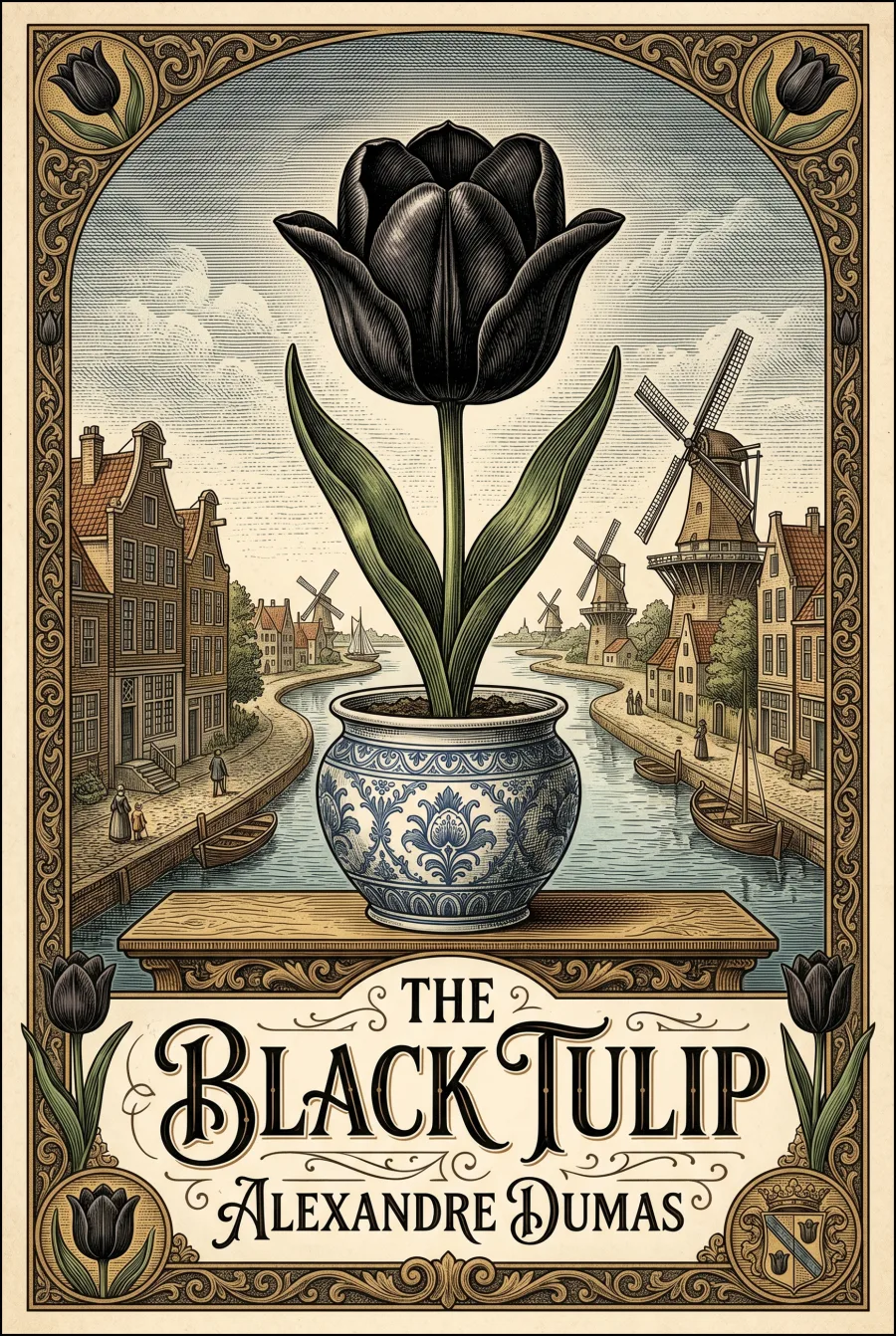
Download Cover Image
Do you want to download the full cover image for The Black Tulip?