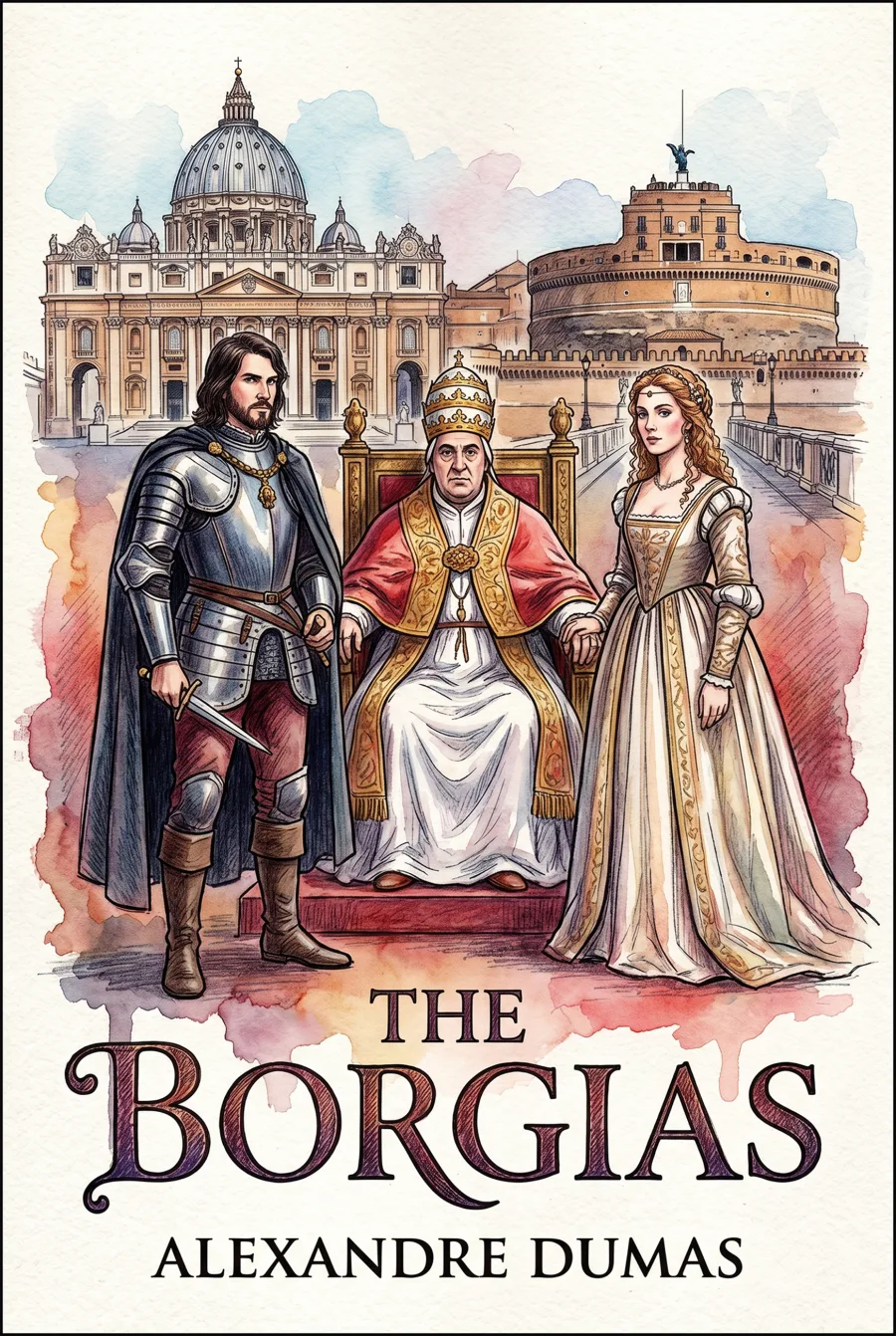
The Borgias
eBook
• INR 51.00
• English
• 9788169359702
No ratings yet
| Publisher | General Press |
|---|---|
| ISBN13 | 9788169359702 |
| Book Format | eBook |
| Language | English |
| List Price | INR 51.00 |
| Subject Code | FIC037000, HIS020000, HIS037020 |
| Publishing Date | 05/09/2026 |
| Book Code | BD00070395 |
Buy this Book
Amazon Stores
Ebook Stores
Other Stores
Discover The Borgias by Alexandre Dumas. This book is published by General Press in eBook format, ISBN 9788169359702, under Literature and Fiction, Political Fiction, Italian History.
Book Description
Few families in Renaissance Italy combined wealth, political ambition, religious power, and scandal as dramatically as the Borgias. "The Borgias" by Alexandre Dumas is a classic historical fiction work that explores the rise and influence of the notorious Borgia family, bringing readers into a world of papal politics, ruthless ambition, secret alliances, betrayal, and dangerous struggles for power.
The story centers on Rodrigo Borgia, who rises within the Catholic Church and eventually becomes Pope Alexander VI. His elevation gives the Borgia family extraordinary political influence, but it also places them at the center of intense rivalries. Dumas portrays a world in which religious authority and worldly ambition are closely intertwined, and where positions of power can be used to advance family interests as much as spiritual responsibilities.
Around Rodrigo Borgia are figures whose lives become inseparable from the family’s rise, including his children Cesare, Lucrezia, and Juan. Each becomes involved in the complicated web of relationships surrounding the Borgia household. Cesare is ambitious and determined to establish his own power, while Lucrezia is caught between family loyalty, political arrangements, and the expectations placed upon her. Their personal lives unfold against a backdrop of shifting alliances, rival noble families, military campaigns, and struggles for control over Italian territories.
Dumas brings the turbulent Renaissance period to life through dramatic scenes of court intrigue, political maneuvering, romance, violence, and betrayal. The novel explores how ambition can transform family relationships and how political power can make trust almost impossible. Characters must constantly judge whether those around them are genuine allies or potential enemies, creating an atmosphere in which danger can emerge from both public conflicts and private decisions.
While "The Borgias" draws upon historical figures and events, Dumas approaches the material with the storytelling instincts of a novelist, turning history into a dramatic narrative filled with memorable personalities and high-stakes conflicts. Readers interested in the Borgia family, Renaissance Italy, Pope Alexander VI, Cesare Borgia, Lucrezia Borgia, or historical novels about political intrigue will find plenty to explore.
Dark, dramatic, and filled with ambition, "The Borgias" offers a vivid portrait of a family determined to secure its place at the center of European power. As alliances shift and the Borgias reach ever higher, the real question is how much they are willing to sacrifice to keep their power.
The story centers on Rodrigo Borgia, who rises within the Catholic Church and eventually becomes Pope Alexander VI. His elevation gives the Borgia family extraordinary political influence, but it also places them at the center of intense rivalries. Dumas portrays a world in which religious authority and worldly ambition are closely intertwined, and where positions of power can be used to advance family interests as much as spiritual responsibilities.
Around Rodrigo Borgia are figures whose lives become inseparable from the family’s rise, including his children Cesare, Lucrezia, and Juan. Each becomes involved in the complicated web of relationships surrounding the Borgia household. Cesare is ambitious and determined to establish his own power, while Lucrezia is caught between family loyalty, political arrangements, and the expectations placed upon her. Their personal lives unfold against a backdrop of shifting alliances, rival noble families, military campaigns, and struggles for control over Italian territories.
Dumas brings the turbulent Renaissance period to life through dramatic scenes of court intrigue, political maneuvering, romance, violence, and betrayal. The novel explores how ambition can transform family relationships and how political power can make trust almost impossible. Characters must constantly judge whether those around them are genuine allies or potential enemies, creating an atmosphere in which danger can emerge from both public conflicts and private decisions.
While "The Borgias" draws upon historical figures and events, Dumas approaches the material with the storytelling instincts of a novelist, turning history into a dramatic narrative filled with memorable personalities and high-stakes conflicts. Readers interested in the Borgia family, Renaissance Italy, Pope Alexander VI, Cesare Borgia, Lucrezia Borgia, or historical novels about political intrigue will find plenty to explore.
Dark, dramatic, and filled with ambition, "The Borgias" offers a vivid portrait of a family determined to secure its place at the center of European power. As alliances shift and the Borgias reach ever higher, the real question is how much they are willing to sacrifice to keep their power.
Author Biography
Alexandre Dumas (1802–1870), also known as ‘Alexandre Dumas père’, was one of the most popular French novelists and playwrights of the nineteenth century. Best known for ‘The Three Musketeers’ and ‘The Count of Monte Cristo’, Dumas created some of the most enduring adventure stories in world literature. His novels combine history, romance, revenge, friendship, courage, political intrigue, and fast-moving action, making his work accessible to generations of readers. Born on ‘July 24, 1802, in Villers-Cotterêts, France’, Dumas was the son of General Thomas-Alexandre Dumas, a celebrated military commander of mixed-race heritage, and Marie-Louise Labouret. His father died when Alexandre was only four, leaving his mother to raise him with limited financial resources. Dumas received little formal education and largely educated himself through reading.
As a young man, Dumas moved to Paris, where his excellent handwriting helped him obtain a position in the household of the ‘Duke of Orléans’. He soon became fascinated by literature and theater and began writing plays. His early dramatic successes established him as a promising figure in the French Romantic movement. Dumas eventually turned increasingly toward historical fiction, where his extraordinary storytelling abilities found their fullest expression.
The great turning point in ‘Alexandre Dumas's literary career’ came in the 1840s, when serialized fiction became enormously popular in French newspapers. His most famous novels appeared in this format, reaching readers chapter by chapter. ‘The Three Musketeers’, published in 1844, introduced readers to d'Artagnan, Athos, Porthos, and Aramis and became a landmark of historical adventure fiction. Dumas followed it with ‘The Count of Monte Cristo’, published between 1844 and 1846, a sweeping story of wrongful imprisonment, escape, revenge, justice, and transformation. He also wrote major historical novels such as ‘The Queen's Necklace’, ‘La Reine Margot’, and the later Musketeer novels. His collaboration with writer ‘Auguste Maquet’ played an important role in the development of several of his major works.
Dumas was extraordinarily energetic and lived a colorful, sometimes extravagant life. He traveled widely, wrote memoirs and travel books, founded a theater, established newspapers, and became involved in political events. His enthusiasm for expensive projects and lavish living, however, contributed to serious financial difficulties. He also traveled to Italy and became associated with ‘Giuseppe Garibaldi’ during the struggle for Italian unification.
Alexandre Dumas died on ‘December 5, 1870’, near Dieppe, France. His literary legacy has proved remarkably durable. His books have been translated into numerous languages and adapted repeatedly for film, television, theater, and other media. Dumas remains especially important to readers searching for ‘classic adventure novels, historical fiction, revenge stories, swashbuckling heroes, and timeless tales of friendship and courage’. His greatest achievement was turning history into vivid human drama, creating stories that remain exciting, emotional, and surprisingly modern more than a century after his death.
As a young man, Dumas moved to Paris, where his excellent handwriting helped him obtain a position in the household of the ‘Duke of Orléans’. He soon became fascinated by literature and theater and began writing plays. His early dramatic successes established him as a promising figure in the French Romantic movement. Dumas eventually turned increasingly toward historical fiction, where his extraordinary storytelling abilities found their fullest expression.
The great turning point in ‘Alexandre Dumas's literary career’ came in the 1840s, when serialized fiction became enormously popular in French newspapers. His most famous novels appeared in this format, reaching readers chapter by chapter. ‘The Three Musketeers’, published in 1844, introduced readers to d'Artagnan, Athos, Porthos, and Aramis and became a landmark of historical adventure fiction. Dumas followed it with ‘The Count of Monte Cristo’, published between 1844 and 1846, a sweeping story of wrongful imprisonment, escape, revenge, justice, and transformation. He also wrote major historical novels such as ‘The Queen's Necklace’, ‘La Reine Margot’, and the later Musketeer novels. His collaboration with writer ‘Auguste Maquet’ played an important role in the development of several of his major works.
Dumas was extraordinarily energetic and lived a colorful, sometimes extravagant life. He traveled widely, wrote memoirs and travel books, founded a theater, established newspapers, and became involved in political events. His enthusiasm for expensive projects and lavish living, however, contributed to serious financial difficulties. He also traveled to Italy and became associated with ‘Giuseppe Garibaldi’ during the struggle for Italian unification.
Alexandre Dumas died on ‘December 5, 1870’, near Dieppe, France. His literary legacy has proved remarkably durable. His books have been translated into numerous languages and adapted repeatedly for film, television, theater, and other media. Dumas remains especially important to readers searching for ‘classic adventure novels, historical fiction, revenge stories, swashbuckling heroes, and timeless tales of friendship and courage’. His greatest achievement was turning history into vivid human drama, creating stories that remain exciting, emotional, and surprisingly modern more than a century after his death.
Editorial Reviews
Editorial Reviews will be added soon…
Book Summary
'The Borgias' by Alexandre Dumas is a dramatic historical account of one of the most notorious families of Renaissance Italy, a family remembered for political ambition, corruption, intrigue, violence, and scandal. Dumas approaches the Borgias not as distant historical figures but as intensely human characters driven by power, desire, fear, loyalty, and survival. The central figures are Rodrigo Borgia, who becomes Pope Alexander VI, his son Cesare Borgia, his daughter Lucrezia Borgia, and the powerful political world surrounding them. The book explores how the Borgia family rose to extraordinary influence in Rome and how their personal ambitions became inseparable from the struggles of Renaissance Italy. Although the story is based on historical people and events, Dumas presents the material with the dramatic energy of a novel, emphasizing memorable episodes, dangerous relationships, political maneuvering, and the moral contradictions of the age.
At the center of 'The Borgias' is Rodrigo Borgia, a Spanish-born churchman who rises through the hierarchy of the Catholic Church until he becomes Pope Alexander VI. His rise is one of the clearest examples of the mixture of religion and political power that fascinated writers and historians of the Renaissance. Rodrigo is intelligent, ambitious, charming, calculating, and willing to use almost any available means to strengthen his position. His election to the papacy is surrounded by accusations of bribery and political manipulation, and once he becomes pope, he does not behave as though the papal office has separated him from ordinary worldly ambitions. Instead, he uses the immense authority of the papacy to advance his family's interests. Dumas presents him as a man who can speak the language of religion while thinking constantly in terms of power, alliances, territory, and dynastic advantage.
The political background is essential to understanding the story. Renaissance Italy is not a unified country but a collection of competing states, cities, noble families, kingdoms, and foreign powers. Rome, Florence, Milan, Venice, Naples, and other centers are involved in constantly shifting alliances. France and Spain also seek influence in the Italian peninsula. In this unstable environment, political survival often depends on diplomacy one moment and military force the next. Rodrigo Borgia understands this world extremely well. He recognizes that the papacy is not merely a spiritual institution but also a territorial and political power. His ambition is therefore not limited to personal prestige. He wants to establish the Borgias as a powerful dynasty capable of controlling land and influence even after his own death.
His most important instrument in this plan is his son Cesare Borgia. Cesare is one of the most fascinating figures in the book because he combines intelligence, courage, ruthlessness, and ambition in extraordinary proportions. Originally associated with the Church, Cesare eventually turns toward a military and political career. His father sees him as the ideal person to build a Borgia state in Italy. Cesare is young, energetic, and exceptionally capable, but his ambition is matched by his willingness to eliminate anyone who stands in his way. Dumas presents him as a man who believes that political power must be actively seized rather than passively inherited. His campaigns become an important part of the family's attempt to create a territorial empire.
Cesare's relationship with his father is built on mutual ambition. Rodrigo provides political authority, money, influence, and diplomatic connections, while Cesare provides the military force needed to turn papal plans into reality. Their partnership is therefore both familial and political. Yet it also reveals something disturbing about the Borgia household: family relationships are repeatedly transformed into instruments of power. Marriage, friendship, loyalty, and even religion can become tools in a larger political strategy. The personal is rarely allowed to remain purely personal.
Lucrezia Borgia occupies a different but equally important position in the story. She is often remembered in popular culture as a poisoner and participant in the family's alleged crimes, but the historical reality surrounding her is far more complicated. Dumas portrays her within the world of political marriages and family expectations, where a woman of noble birth can become an important diplomatic asset. Lucrezia's marriages are connected to her father's and brother's political calculations, and she is repeatedly placed in situations where her personal desires are secondary to the interests of the Borgia family. Her life illustrates the limited freedom available to women who were born into powerful Renaissance dynasties.
One of the most important aspects of Lucrezia's story is the contrast between her public reputation and her private humanity. The Borgia name has accumulated legends of incest, murder, poisoning, and sexual corruption, and Dumas is deeply interested in the atmosphere created by these rumors. Yet Lucrezia can also be seen as a woman caught inside a family structure that is much larger and more dangerous than herself. She is surrounded by men who make political decisions on her behalf, and her marriages are repeatedly shaped by shifting alliances. This gives her character an element of tragedy. The reader is encouraged to consider how much responsibility should be placed upon someone whose life is controlled by the ambitions of her family.
The book's atmosphere is dominated by suspicion. No one can be certain who is sincere, who is manipulating whom, or which alliance will survive the next political crisis. The Borgias understand that information is a form of power. Secrets, rumors, private meetings, letters, marriages, promises, and betrayals become weapons. Dumas uses this atmosphere to create a world in which characters rarely feel completely safe. A political ally may become an enemy, a marriage may become a trap, and a friendly conversation may conceal a deadly intention.
Poison is one of the most famous elements associated with the Borgia legend, and Dumas draws upon this reputation to heighten the sense of danger surrounding the family. Renaissance Italy becomes a world in which death can arrive unexpectedly and where political assassination may be disguised as an ordinary event. Whether every famous poisoning attributed to the Borgias actually happened is another historical question, but Dumas is interested in the power of the legend itself. The fear surrounding the family becomes almost as important as any individual crime. A reputation for ruthlessness can itself become a political weapon because enemies hesitate when they believe that their opponents are capable of anything.
The relationship between Cesare and Lucrezia is another major source of fascination. Their closeness has inspired centuries of speculation and sensational stories, and Dumas uses the controversial reputation of the siblings as part of the dramatic world surrounding them. However, the most meaningful aspect of their relationship is not simply scandal. It is the way both siblings are shaped by the same family system. Cesare is pushed toward conquest and military power, while Lucrezia is repeatedly used in marriage diplomacy. Both are expected to serve the ambitions of their father. Their lives demonstrate how a powerful family can offer enormous privilege while simultaneously denying its members ordinary freedom.
Religion also plays a complicated role in the story. Rodrigo's position as pope creates a profound tension between spiritual authority and worldly ambition. The papacy is supposed to represent religious leadership, yet Alexander VI is portrayed as deeply involved in political maneuvering, family advancement, and territorial ambitions. Dumas uses this contradiction to emphasize the moral complexity of the Renaissance. The characters are not living in a modern world in which religion and politics are clearly separated. Instead, religious institutions, noble families, military campaigns, personal relationships, and political alliances are intertwined.
The broader Renaissance setting makes the story even richer. This is an age associated with extraordinary art, learning, science, architecture, and intellectual achievement, yet it is also an age of violent political competition. The same Italy that produces great artists and thinkers is filled with wars, assassinations, rival dynasties, and shifting alliances. The Borgias represent the darker side of this extraordinary period. Their story shows how cultural brilliance can exist beside moral corruption and political brutality. Renaissance Italy is therefore presented as a world of contrasts: beautiful and violent, sophisticated and ruthless, religious and worldly.
Cesare's military ambitions eventually bring him enormous influence. He becomes one of the most feared political figures in Italy, and his campaigns demonstrate his ability to combine military force with strategic intelligence. His methods are ruthless, but he is not portrayed as merely a mindless killer. He understands diplomacy, deception, timing, and the importance of controlling perception. This complexity is part of what makes his character so memorable. He is frightening precisely because he is intelligent. He understands that political power is not maintained by force alone; it also requires manipulation, alliances, reputation, and careful calculation.
The family nevertheless begins to encounter the limits of its power. The Borgia system depends heavily on Rodrigo's authority as pope, Cesare's military strength, and the family's ability to maintain political alliances. When circumstances change, their carefully constructed network becomes vulnerable. Enemies multiply, allies become uncertain, and the political environment shifts. The Borgias discover that power based on fear and opportunism can be extremely effective in the short term but difficult to preserve over time. The family's rise is therefore accompanied by the seeds of its eventual decline.
The death of Pope Alexander VI becomes a particularly important turning point. With Rodrigo gone, Cesare loses the central source of political support that had enabled his ambitions. His military and political position becomes increasingly unstable, and the Borgia dream of creating a lasting dynasty in Italy begins to collapse. Cesare's later fate illustrates one of the central lessons of the story: political power that depends too heavily upon one person can disappear rapidly when that person is removed. The achievements of the Borgias may appear enormous, but they prove fragile.
Lucrezia's later life offers a contrast to the destructive path followed by her father and brother. Her marriage into the Este family of Ferrara gives her a different political and personal environment. She becomes associated with the cultural life of Ferrara and acquires a reputation that is more complicated than the dark legend surrounding her family. Her story suggests that an individual can sometimes move beyond the identity imposed upon them by their family. Although she can never completely escape the Borgia name, she is capable of developing a life that is not defined solely by the crimes and ambitions associated with her father and brother.
Ultimately, 'The Borgias' is a story about the intoxicating nature of power and the price people pay for pursuing it without moral limits. Rodrigo Borgia wants to transform the papacy into the foundation of a family dynasty. Cesare wants conquest, political independence, and lasting greatness. Lucrezia seeks happiness and security in a world where her choices are repeatedly manipulated by others. Their goals are different, but all are caught in the same system of ambition, fear, and political calculation. Dumas shows that power can provide wealth, influence, and extraordinary opportunities, but it can also destroy trust and make genuine human relationships almost impossible.
For readers searching for a 'The Borgias' book summary, the heart of Alexandre Dumas's story lies in the rise and fall of the Borgia family during Renaissance Italy. Rodrigo's transformation into Pope Alexander VI gives the family unprecedented authority, Cesare attempts to convert that authority into a territorial empire, and Lucrezia becomes caught between family ambition and her own humanity. Around them are wars, political conspiracies, marriages of convenience, rumors of poison, betrayal, and shifting alliances. Yet beneath the sensational reputation of the Borgias is a deeply human story about people who want love, security, recognition, and power but repeatedly choose ambition over trust. Dumas's great achievement is to turn historical scandal into dramatic storytelling while making the reader feel the emotional cost of living in a world where almost every relationship can become a political calculation. The Borgias remain memorable not simply because they were surrounded by shocking legends, but because their story raises timeless questions about what happens when power becomes more important than conscience, when family loyalty becomes indistinguishable from political strategy, and when the pursuit of greatness finally leaves people with nothing stable to hold on to.
At the center of 'The Borgias' is Rodrigo Borgia, a Spanish-born churchman who rises through the hierarchy of the Catholic Church until he becomes Pope Alexander VI. His rise is one of the clearest examples of the mixture of religion and political power that fascinated writers and historians of the Renaissance. Rodrigo is intelligent, ambitious, charming, calculating, and willing to use almost any available means to strengthen his position. His election to the papacy is surrounded by accusations of bribery and political manipulation, and once he becomes pope, he does not behave as though the papal office has separated him from ordinary worldly ambitions. Instead, he uses the immense authority of the papacy to advance his family's interests. Dumas presents him as a man who can speak the language of religion while thinking constantly in terms of power, alliances, territory, and dynastic advantage.
The political background is essential to understanding the story. Renaissance Italy is not a unified country but a collection of competing states, cities, noble families, kingdoms, and foreign powers. Rome, Florence, Milan, Venice, Naples, and other centers are involved in constantly shifting alliances. France and Spain also seek influence in the Italian peninsula. In this unstable environment, political survival often depends on diplomacy one moment and military force the next. Rodrigo Borgia understands this world extremely well. He recognizes that the papacy is not merely a spiritual institution but also a territorial and political power. His ambition is therefore not limited to personal prestige. He wants to establish the Borgias as a powerful dynasty capable of controlling land and influence even after his own death.
His most important instrument in this plan is his son Cesare Borgia. Cesare is one of the most fascinating figures in the book because he combines intelligence, courage, ruthlessness, and ambition in extraordinary proportions. Originally associated with the Church, Cesare eventually turns toward a military and political career. His father sees him as the ideal person to build a Borgia state in Italy. Cesare is young, energetic, and exceptionally capable, but his ambition is matched by his willingness to eliminate anyone who stands in his way. Dumas presents him as a man who believes that political power must be actively seized rather than passively inherited. His campaigns become an important part of the family's attempt to create a territorial empire.
Cesare's relationship with his father is built on mutual ambition. Rodrigo provides political authority, money, influence, and diplomatic connections, while Cesare provides the military force needed to turn papal plans into reality. Their partnership is therefore both familial and political. Yet it also reveals something disturbing about the Borgia household: family relationships are repeatedly transformed into instruments of power. Marriage, friendship, loyalty, and even religion can become tools in a larger political strategy. The personal is rarely allowed to remain purely personal.
Lucrezia Borgia occupies a different but equally important position in the story. She is often remembered in popular culture as a poisoner and participant in the family's alleged crimes, but the historical reality surrounding her is far more complicated. Dumas portrays her within the world of political marriages and family expectations, where a woman of noble birth can become an important diplomatic asset. Lucrezia's marriages are connected to her father's and brother's political calculations, and she is repeatedly placed in situations where her personal desires are secondary to the interests of the Borgia family. Her life illustrates the limited freedom available to women who were born into powerful Renaissance dynasties.
One of the most important aspects of Lucrezia's story is the contrast between her public reputation and her private humanity. The Borgia name has accumulated legends of incest, murder, poisoning, and sexual corruption, and Dumas is deeply interested in the atmosphere created by these rumors. Yet Lucrezia can also be seen as a woman caught inside a family structure that is much larger and more dangerous than herself. She is surrounded by men who make political decisions on her behalf, and her marriages are repeatedly shaped by shifting alliances. This gives her character an element of tragedy. The reader is encouraged to consider how much responsibility should be placed upon someone whose life is controlled by the ambitions of her family.
The book's atmosphere is dominated by suspicion. No one can be certain who is sincere, who is manipulating whom, or which alliance will survive the next political crisis. The Borgias understand that information is a form of power. Secrets, rumors, private meetings, letters, marriages, promises, and betrayals become weapons. Dumas uses this atmosphere to create a world in which characters rarely feel completely safe. A political ally may become an enemy, a marriage may become a trap, and a friendly conversation may conceal a deadly intention.
Poison is one of the most famous elements associated with the Borgia legend, and Dumas draws upon this reputation to heighten the sense of danger surrounding the family. Renaissance Italy becomes a world in which death can arrive unexpectedly and where political assassination may be disguised as an ordinary event. Whether every famous poisoning attributed to the Borgias actually happened is another historical question, but Dumas is interested in the power of the legend itself. The fear surrounding the family becomes almost as important as any individual crime. A reputation for ruthlessness can itself become a political weapon because enemies hesitate when they believe that their opponents are capable of anything.
The relationship between Cesare and Lucrezia is another major source of fascination. Their closeness has inspired centuries of speculation and sensational stories, and Dumas uses the controversial reputation of the siblings as part of the dramatic world surrounding them. However, the most meaningful aspect of their relationship is not simply scandal. It is the way both siblings are shaped by the same family system. Cesare is pushed toward conquest and military power, while Lucrezia is repeatedly used in marriage diplomacy. Both are expected to serve the ambitions of their father. Their lives demonstrate how a powerful family can offer enormous privilege while simultaneously denying its members ordinary freedom.
Religion also plays a complicated role in the story. Rodrigo's position as pope creates a profound tension between spiritual authority and worldly ambition. The papacy is supposed to represent religious leadership, yet Alexander VI is portrayed as deeply involved in political maneuvering, family advancement, and territorial ambitions. Dumas uses this contradiction to emphasize the moral complexity of the Renaissance. The characters are not living in a modern world in which religion and politics are clearly separated. Instead, religious institutions, noble families, military campaigns, personal relationships, and political alliances are intertwined.
The broader Renaissance setting makes the story even richer. This is an age associated with extraordinary art, learning, science, architecture, and intellectual achievement, yet it is also an age of violent political competition. The same Italy that produces great artists and thinkers is filled with wars, assassinations, rival dynasties, and shifting alliances. The Borgias represent the darker side of this extraordinary period. Their story shows how cultural brilliance can exist beside moral corruption and political brutality. Renaissance Italy is therefore presented as a world of contrasts: beautiful and violent, sophisticated and ruthless, religious and worldly.
Cesare's military ambitions eventually bring him enormous influence. He becomes one of the most feared political figures in Italy, and his campaigns demonstrate his ability to combine military force with strategic intelligence. His methods are ruthless, but he is not portrayed as merely a mindless killer. He understands diplomacy, deception, timing, and the importance of controlling perception. This complexity is part of what makes his character so memorable. He is frightening precisely because he is intelligent. He understands that political power is not maintained by force alone; it also requires manipulation, alliances, reputation, and careful calculation.
The family nevertheless begins to encounter the limits of its power. The Borgia system depends heavily on Rodrigo's authority as pope, Cesare's military strength, and the family's ability to maintain political alliances. When circumstances change, their carefully constructed network becomes vulnerable. Enemies multiply, allies become uncertain, and the political environment shifts. The Borgias discover that power based on fear and opportunism can be extremely effective in the short term but difficult to preserve over time. The family's rise is therefore accompanied by the seeds of its eventual decline.
The death of Pope Alexander VI becomes a particularly important turning point. With Rodrigo gone, Cesare loses the central source of political support that had enabled his ambitions. His military and political position becomes increasingly unstable, and the Borgia dream of creating a lasting dynasty in Italy begins to collapse. Cesare's later fate illustrates one of the central lessons of the story: political power that depends too heavily upon one person can disappear rapidly when that person is removed. The achievements of the Borgias may appear enormous, but they prove fragile.
Lucrezia's later life offers a contrast to the destructive path followed by her father and brother. Her marriage into the Este family of Ferrara gives her a different political and personal environment. She becomes associated with the cultural life of Ferrara and acquires a reputation that is more complicated than the dark legend surrounding her family. Her story suggests that an individual can sometimes move beyond the identity imposed upon them by their family. Although she can never completely escape the Borgia name, she is capable of developing a life that is not defined solely by the crimes and ambitions associated with her father and brother.
Ultimately, 'The Borgias' is a story about the intoxicating nature of power and the price people pay for pursuing it without moral limits. Rodrigo Borgia wants to transform the papacy into the foundation of a family dynasty. Cesare wants conquest, political independence, and lasting greatness. Lucrezia seeks happiness and security in a world where her choices are repeatedly manipulated by others. Their goals are different, but all are caught in the same system of ambition, fear, and political calculation. Dumas shows that power can provide wealth, influence, and extraordinary opportunities, but it can also destroy trust and make genuine human relationships almost impossible.
For readers searching for a 'The Borgias' book summary, the heart of Alexandre Dumas's story lies in the rise and fall of the Borgia family during Renaissance Italy. Rodrigo's transformation into Pope Alexander VI gives the family unprecedented authority, Cesare attempts to convert that authority into a territorial empire, and Lucrezia becomes caught between family ambition and her own humanity. Around them are wars, political conspiracies, marriages of convenience, rumors of poison, betrayal, and shifting alliances. Yet beneath the sensational reputation of the Borgias is a deeply human story about people who want love, security, recognition, and power but repeatedly choose ambition over trust. Dumas's great achievement is to turn historical scandal into dramatic storytelling while making the reader feel the emotional cost of living in a world where almost every relationship can become a political calculation. The Borgias remain memorable not simply because they were surrounded by shocking legends, but because their story raises timeless questions about what happens when power becomes more important than conscience, when family loyalty becomes indistinguishable from political strategy, and when the pursuit of greatness finally leaves people with nothing stable to hold on to.
Sample Chapters
Sample Chapters will be added soon…
Reader Reviews
No reviews yet.
The Borgias