
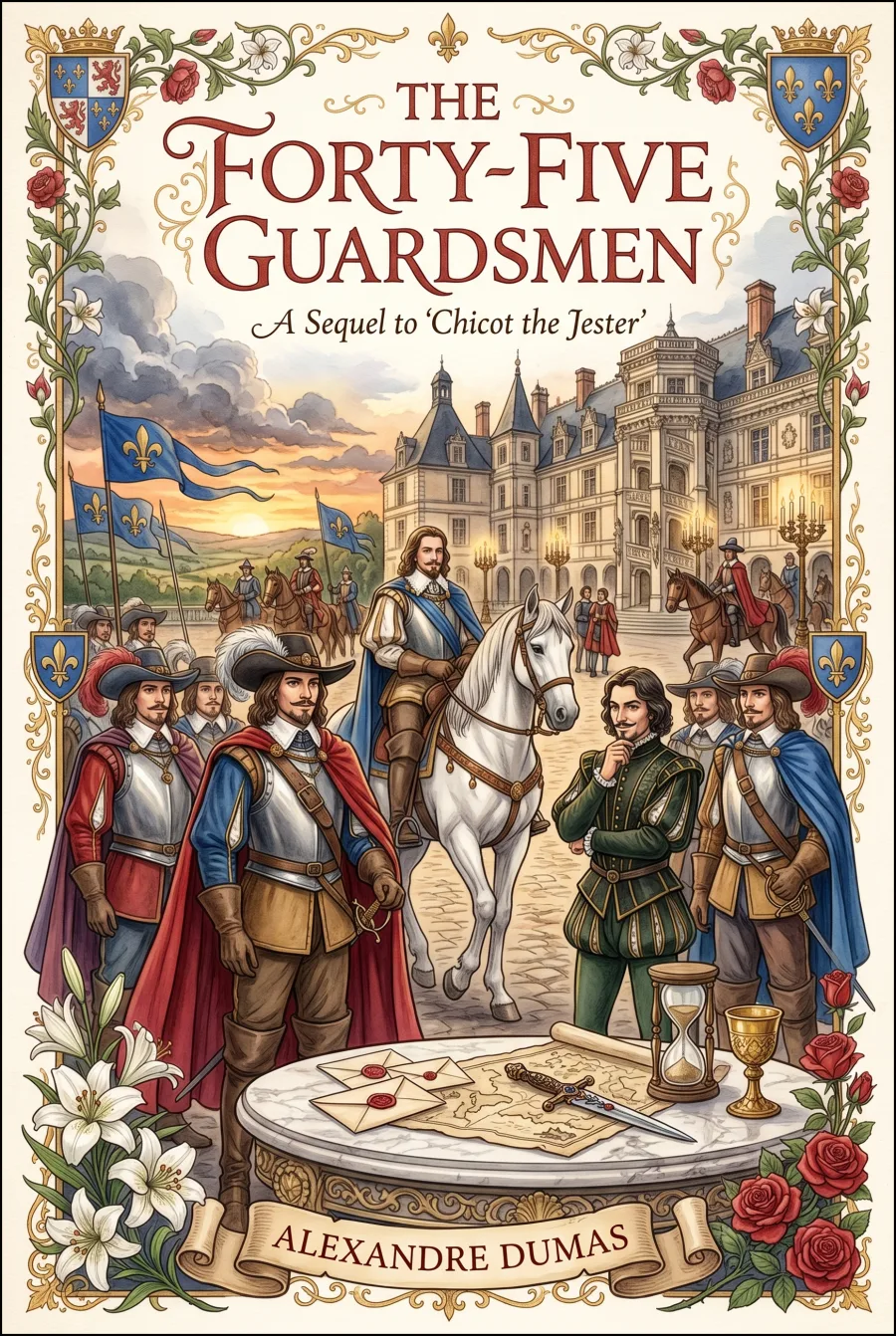
The Forty-Five Guardsmen: A Sequel to 'Chicot the Jester'
eBook
• INR 51.00
• English
• 9788169359733
No ratings yet
| Publisher | General Press |
|---|---|
| ISBN13 | 9788169359733 |
| Book Format | eBook |
| Language | English |
| List Price | INR 51.00 |
| Subject Code | FIC002000, FIC031020, FIC032000 |
| Publishing Date | 05/09/2026 |
| Book Code | BD00070396 |
Buy this Book
Amazon Stores
Ebook Stores
Other Stores
Discover The Forty-Five Guardsmen: A Sequel to 'Chicot the Jester' by Alexandre Dumas. This book is published by General Press in eBook format, ISBN 9788169359733, under Literature and Fiction, Action and Adventure Fiction, Historical Thrillers.
Book Description
When a kingdom is torn apart by rival ambitions, political conspiracies, and violent struggles for the throne, loyalty can become as dangerous as betrayal. "The Forty-Five Guardsmen: A Sequel to Chicot the Jester" by Alexandre Dumas is a classic historical adventure and political fiction novel that continues the dramatic events of "Chicot the Jester", returning readers to sixteenth-century France, where kings, nobles, soldiers, and secret plotters compete for power.
The story takes place during a turbulent period in the reign of King Henry III, when the French monarchy faces threats from powerful political and religious factions. After the events of the previous novel, the balance of power remains fragile, and the royal court is filled with suspicion. Henry III relies on an elite group of forty-five loyal guardsmen, whose courage and devotion make them an important force in protecting the king. Their presence gives the novel its title and provides a foundation for a story filled with military action, personal loyalty, and political intrigue.
At the center of the narrative are familiar figures from Dumas’s historical world, including King Henry III, the Duke of Guise, the Duke of Anjou, and the ever-resourceful Chicot. Each character is driven by a different combination of ambition, loyalty, revenge, or political calculation. As rival factions maneuver for control, friendships are tested and alliances become increasingly uncertain. Chicot, with his sharp intelligence and fearless humor, remains one of the story’s most entertaining figures, using wit and cleverness to survive in a court where a careless word can have serious consequences.
Dumas combines historical events with the fast pace of adventure fiction. Sword fights, secret missions, disguises, political plots, escapes, and confrontations keep the story moving, while the larger conflict reflects the religious and dynastic tensions of Renaissance France. The novel also explores the meaning of loyalty when individuals are forced to choose between personal friendship, political duty, and their own ambitions.
As a sequel, "The Forty-Five Guardsmen" expands the world established in "Chicot the Jester" while raising the stakes for its characters. Readers interested in Alexandre Dumas, the French Wars of Religion, Renaissance history, classic historical fiction, or the Musketeer-style adventure tradition will find a richly entertaining story of courage and conspiracy. With the throne surrounded by enemies and the forty-five guardsmen prepared to defend their king, the real suspense lies in discovering who can be trusted when the next move could change the fate of France.
The story takes place during a turbulent period in the reign of King Henry III, when the French monarchy faces threats from powerful political and religious factions. After the events of the previous novel, the balance of power remains fragile, and the royal court is filled with suspicion. Henry III relies on an elite group of forty-five loyal guardsmen, whose courage and devotion make them an important force in protecting the king. Their presence gives the novel its title and provides a foundation for a story filled with military action, personal loyalty, and political intrigue.
At the center of the narrative are familiar figures from Dumas’s historical world, including King Henry III, the Duke of Guise, the Duke of Anjou, and the ever-resourceful Chicot. Each character is driven by a different combination of ambition, loyalty, revenge, or political calculation. As rival factions maneuver for control, friendships are tested and alliances become increasingly uncertain. Chicot, with his sharp intelligence and fearless humor, remains one of the story’s most entertaining figures, using wit and cleverness to survive in a court where a careless word can have serious consequences.
Dumas combines historical events with the fast pace of adventure fiction. Sword fights, secret missions, disguises, political plots, escapes, and confrontations keep the story moving, while the larger conflict reflects the religious and dynastic tensions of Renaissance France. The novel also explores the meaning of loyalty when individuals are forced to choose between personal friendship, political duty, and their own ambitions.
As a sequel, "The Forty-Five Guardsmen" expands the world established in "Chicot the Jester" while raising the stakes for its characters. Readers interested in Alexandre Dumas, the French Wars of Religion, Renaissance history, classic historical fiction, or the Musketeer-style adventure tradition will find a richly entertaining story of courage and conspiracy. With the throne surrounded by enemies and the forty-five guardsmen prepared to defend their king, the real suspense lies in discovering who can be trusted when the next move could change the fate of France.
Author Biography
Alexandre Dumas (1802–1870), also known as ‘Alexandre Dumas père’, was one of the most popular French novelists and playwrights of the nineteenth century. Best known for ‘The Three Musketeers’ and ‘The Count of Monte Cristo’, Dumas created some of the most enduring adventure stories in world literature. His novels combine history, romance, revenge, friendship, courage, political intrigue, and fast-moving action, making his work accessible to generations of readers. Born on ‘July 24, 1802, in Villers-Cotterêts, France’, Dumas was the son of General Thomas-Alexandre Dumas, a celebrated military commander of mixed-race heritage, and Marie-Louise Labouret. His father died when Alexandre was only four, leaving his mother to raise him with limited financial resources. Dumas received little formal education and largely educated himself through reading.
As a young man, Dumas moved to Paris, where his excellent handwriting helped him obtain a position in the household of the ‘Duke of Orléans’. He soon became fascinated by literature and theater and began writing plays. His early dramatic successes established him as a promising figure in the French Romantic movement. Dumas eventually turned increasingly toward historical fiction, where his extraordinary storytelling abilities found their fullest expression.
The great turning point in ‘Alexandre Dumas's literary career’ came in the 1840s, when serialized fiction became enormously popular in French newspapers. His most famous novels appeared in this format, reaching readers chapter by chapter. ‘The Three Musketeers’, published in 1844, introduced readers to d'Artagnan, Athos, Porthos, and Aramis and became a landmark of historical adventure fiction. Dumas followed it with ‘The Count of Monte Cristo’, published between 1844 and 1846, a sweeping story of wrongful imprisonment, escape, revenge, justice, and transformation. He also wrote major historical novels such as ‘The Queen's Necklace’, ‘La Reine Margot’, and the later Musketeer novels. His collaboration with writer ‘Auguste Maquet’ played an important role in the development of several of his major works.
Dumas was extraordinarily energetic and lived a colorful, sometimes extravagant life. He traveled widely, wrote memoirs and travel books, founded a theater, established newspapers, and became involved in political events. His enthusiasm for expensive projects and lavish living, however, contributed to serious financial difficulties. He also traveled to Italy and became associated with ‘Giuseppe Garibaldi’ during the struggle for Italian unification.
Alexandre Dumas died on ‘December 5, 1870’, near Dieppe, France. His literary legacy has proved remarkably durable. His books have been translated into numerous languages and adapted repeatedly for film, television, theater, and other media. Dumas remains especially important to readers searching for ‘classic adventure novels, historical fiction, revenge stories, swashbuckling heroes, and timeless tales of friendship and courage’. His greatest achievement was turning history into vivid human drama, creating stories that remain exciting, emotional, and surprisingly modern more than a century after his death.
As a young man, Dumas moved to Paris, where his excellent handwriting helped him obtain a position in the household of the ‘Duke of Orléans’. He soon became fascinated by literature and theater and began writing plays. His early dramatic successes established him as a promising figure in the French Romantic movement. Dumas eventually turned increasingly toward historical fiction, where his extraordinary storytelling abilities found their fullest expression.
The great turning point in ‘Alexandre Dumas's literary career’ came in the 1840s, when serialized fiction became enormously popular in French newspapers. His most famous novels appeared in this format, reaching readers chapter by chapter. ‘The Three Musketeers’, published in 1844, introduced readers to d'Artagnan, Athos, Porthos, and Aramis and became a landmark of historical adventure fiction. Dumas followed it with ‘The Count of Monte Cristo’, published between 1844 and 1846, a sweeping story of wrongful imprisonment, escape, revenge, justice, and transformation. He also wrote major historical novels such as ‘The Queen's Necklace’, ‘La Reine Margot’, and the later Musketeer novels. His collaboration with writer ‘Auguste Maquet’ played an important role in the development of several of his major works.
Dumas was extraordinarily energetic and lived a colorful, sometimes extravagant life. He traveled widely, wrote memoirs and travel books, founded a theater, established newspapers, and became involved in political events. His enthusiasm for expensive projects and lavish living, however, contributed to serious financial difficulties. He also traveled to Italy and became associated with ‘Giuseppe Garibaldi’ during the struggle for Italian unification.
Alexandre Dumas died on ‘December 5, 1870’, near Dieppe, France. His literary legacy has proved remarkably durable. His books have been translated into numerous languages and adapted repeatedly for film, television, theater, and other media. Dumas remains especially important to readers searching for ‘classic adventure novels, historical fiction, revenge stories, swashbuckling heroes, and timeless tales of friendship and courage’. His greatest achievement was turning history into vivid human drama, creating stories that remain exciting, emotional, and surprisingly modern more than a century after his death.
Editorial Reviews
Editorial Reviews will be added soon…
Book Summary
'The Forty-Five Guardsmen: A Sequel to “Chicot the Jester”' by Alexandre Dumas is a sweeping historical adventure novel filled with political intrigue, royal conspiracies, romance, revenge, duels, disguises, and shifting loyalties. Set in France during the turbulent final years of the Valois dynasty, the novel continues the story begun in 'Chicot the Jester' and brings together several of Dumas’s most memorable characters, including King Henry III, the clever and irreverent Chicot, the ambitious Duke of Guise, the fanatical League, and the young nobleman Ernauton de Carmainges. Like many of Dumas’s historical romances, the novel combines real events and historical figures with fictional adventures, creating a dramatic picture of a France divided by religious conflict and threatened by political ambition. At its heart, 'The Forty-Five Guardsmen' is a story about a kingdom in crisis, where personal loyalty and political survival are constantly tested.
The novel takes place during the reign of Henry III, a king whose authority is increasingly weakened by political enemies, religious divisions, and the growing influence of the powerful Guise family. France is deeply divided between Catholics and Protestants, while competing factions struggle to control the throne. Henry III himself is presented as a complicated ruler. He possesses intelligence and refinement, but he is also vain, indecisive, theatrical, and often unable to command the respect that his position requires. Around him gathers a colorful court filled with favorites, schemers, soldiers, nobles, spies, and opportunists. Dumas uses this unstable royal environment to create an atmosphere in which almost every conversation may conceal a political purpose and every friendship may have a hidden cost.
One of the most important developments in the story is Henry III’s decision to create his personal guard of forty-five gentlemen. These men are selected to protect the king at a time when his enemies are becoming increasingly dangerous. The Forty-Five are not simply soldiers in the ordinary sense. They represent Henry's attempt to surround himself with men whose loyalty belongs directly to him rather than to rival aristocratic factions. Their arrival gives the novel its title and introduces one of its central ideas: the relationship between power and loyalty. Henry understands that a king without trustworthy protectors is vulnerable, but the novel repeatedly demonstrates that even loyalty can become complicated when political circumstances change.
Among these guardsmen is Ernauton de Carmainges, a young nobleman who becomes one of the novel's central figures. Ernauton is courageous, honorable, and idealistic, qualities that distinguish him from many of the more calculating characters around him. He enters the dangerous world of the royal court without fully understanding how treacherous it can be. His youth and sincerity make him an appealing protagonist because he approaches questions of honor and love with a seriousness that contrasts with the cynicism of experienced political players. Yet Ernauton must gradually learn that courage alone is not enough in a court where people manipulate appearances and where a man's survival may depend on understanding what others are planning before they reveal their intentions.
Ernauton's personal story becomes closely connected with his love for a mysterious young woman, whose identity and circumstances draw him deeper into the novel's web of intrigue. As with many Dumas romances, love is never isolated from political danger. The lovers are surrounded by people whose ambitions can interfere with their happiness, and questions of identity and loyalty repeatedly complicate their relationship. Ernauton's romantic feelings give him something more valuable than political advancement: a reason to act according to his conscience. His love also exposes his vulnerability because the people around him can use his emotions to manipulate his choices.
The novel's most fascinating character, however, remains Chicot. As the king's jester, Chicot appears to be a comic figure, but his apparent foolishness conceals extraordinary intelligence. He understands the weaknesses of the people around him and uses humor as a weapon. Because a jester is allowed to say things that would be dangerous for an ordinary courtier, Chicot can move through the political world with unusual freedom. He observes what others overlook, mocks those who take themselves too seriously, and frequently understands political situations more clearly than the men who officially control the kingdom. His humor gives the novel much of its energy, but beneath the comedy is a serious political intelligence.
Chicot's relationship with Henry III is especially important. Although he mocks the king relentlessly, there is genuine affection between them. Chicot's loyalty is not the blind obedience of a courtier. He often criticizes Henry precisely because he cares about him and wants him to survive. This creates one of the novel's most interesting forms of loyalty. Chicot can insult the king, deceive him, and make fun of him while remaining one of his most dependable supporters. Dumas uses their relationship to suggest that honest friendship may sometimes be more valuable to a ruler than flattering obedience.
Opposing Henry's position is the powerful Duke of Guise, one of the central political forces in the novel. Guise is ambitious, charismatic, intelligent, and dangerous. He belongs to a family whose influence has grown so powerful that the monarchy itself appears threatened by it. Guise does not merely seek personal wealth or prestige; he wants political control and understands how religious passion can be transformed into political power. His connection with the Catholic League gives him access to a movement capable of challenging the authority of the king. The conflict between Henry III and Guise therefore becomes much larger than a personal rivalry. It represents a struggle over who will control the future of France.
The Catholic League is one of the most important forces in the novel's historical background. Religious conflict in sixteenth-century France had already produced enormous violence, and the League seeks to defend Catholic interests while weakening the Protestant movement. But Dumas shows that religious language can also conceal political ambition. Some characters genuinely believe they are fighting for their faith, while others use religious divisions to advance their own power. This mixture of sincere conviction and political calculation makes the novel's conflicts more complicated. Nobody can be easily classified as purely motivated by religion, patriotism, ambition, or personal revenge.
The tension between Henry III and the Duke of Guise gradually becomes more dangerous. Henry realizes that Guise has become powerful enough to challenge royal authority, yet the king struggles to respond decisively. Guise, meanwhile, enjoys enormous popularity and political influence. The situation reaches a point where France seems to have two centers of power: the official monarchy represented by Henry and the powerful faction represented by Guise. Dumas turns this political rivalry into a suspenseful contest in which strategy, deception, and personal courage are just as important as armies.
The Forty-Five themselves become essential to Henry's efforts to maintain his authority. They are young, capable, and devoted to the king, but they are also drawn into a world of violence and intrigue that is far more complicated than ordinary military service. Their presence gives Henry a sense of security, but it also reminds readers that the king's authority has become so fragile that he must rely on a small personal force for protection. The guardsmen therefore symbolize both strength and weakness. They are a visible expression of royal power, yet their very existence reveals how threatened the monarchy has become.
Dumas also fills the novel with the kind of physical adventure that made his historical romances so enduring. There are sword fights, secret missions, escapes, ambushes, disguises, clandestine meetings, and dangerous journeys. Characters are repeatedly forced to improvise when carefully constructed plans collapse. Dumas has a particular talent for making danger feel immediate while keeping the tone lively. A serious political confrontation may suddenly become comic, while a humorous conversation may unexpectedly reveal information that changes the entire course of the plot.
The theme of disguise is especially important because so many characters cannot safely reveal their true intentions. Chicot's role as a jester is itself a kind of disguise. He hides his intelligence behind comedy, allowing him to move through dangerous situations without appearing threatening. Other characters conceal their identities, loyalties, or motivations. Dumas uses these disguises to emphasize the difference between appearance and reality. In the world of 'The Forty-Five Guardsmen', a person's clothes, title, social position, or public behavior cannot necessarily be trusted. The person who appears weakest may be the most dangerous, while the person who appears foolish may be the most intelligent.
Another major theme is honor. Ernauton represents a traditional ideal of honorable conduct in a world where political manipulation is becoming normal. He wants to believe that courage, loyalty, and honesty have clear meanings. Yet the events surrounding him force him to recognize that honorable choices can have painful consequences. Dumas does not simply celebrate honor as an abstract virtue; he examines the cost of maintaining it. A man may lose his safety, reputation, love, or even life by refusing to betray his principles. At the same time, the novel suggests that a life without honor can lead to power but not necessarily to happiness or respect.
Friendship and loyalty are equally important. Chicot's devotion to Henry, the commitment of the Forty-Five to their king, and Ernauton's loyalty to those he loves all provide a contrast to the opportunistic behavior of political schemers. Dumas repeatedly asks what people are willing to sacrifice for someone else. Loyalty is valuable precisely because betrayal is so common. In a world where alliances can change overnight, genuine friendship becomes a rare and precious form of stability.
The novel's historical setting also gives the story a tragic dimension. The characters are living at the end of an era. The Valois monarchy is approaching its collapse, and the political structures that once seemed permanent are beginning to break apart. Henry III's difficulties are not merely personal failures; they reflect the broader weakness of his dynasty. The Guise family's ambitions, religious warfare, and the struggles of the various factions are all signs of a society moving toward profound political transformation. Dumas captures this feeling of historical transition by placing his fictional characters inside real political events. Their personal adventures become part of a larger story about the decline of one royal house and the rise of another.
The relationship between Henry III and Chicot gives the novel much of its emotional depth. Their interactions are often comic, but the humor gradually acquires a darker meaning because the reader can sense the danger surrounding them. Chicot's jokes are not merely entertainment; they are his way of confronting a frightening political reality. He understands that the king is surrounded by enemies and that the old order cannot last forever. His loyalty therefore has an almost tragic quality. He may be able to outwit individual enemies, but he cannot permanently stop the historical forces moving against the Valois monarchy.
As the political struggle intensifies, the novel moves steadily toward violence and betrayal. The conflict with the Guise faction becomes increasingly personal, and Henry III recognizes that ordinary political maneuvering may no longer be sufficient. The dramatic climax reflects the ruthlessness of the period, when political assassination could become an instrument of statecraft. Dumas does not treat these events simply as historical facts. He gives them the emotional force of a great tragedy, showing how ambition and fear can push people toward decisions from which there is no return.
The ending of 'The Forty-Five Guardsmen' carries a strong sense of historical inevitability. Individual characters may win temporary victories, escape immediate dangers, or defeat particular enemies, but the larger political transformation cannot be stopped. The world represented by Henry III is disappearing. The struggles of the characters therefore have two levels of meaning: they matter intensely to the people involved, yet they are also small pieces of a much larger historical movement. This is one reason Dumas's historical novels remain compelling. He allows readers to experience history not as a list of dates and names but as something lived by frightened, ambitious, loving, courageous, and flawed human beings.
Ultimately, 'The Forty-Five Guardsmen' is a story about a kingdom caught between loyalty and ambition, faith and politics, friendship and betrayal, and an old order and a new one. Ernauton provides the perspective of a young man learning how complicated honor can become, while Chicot represents intelligence disguised as comedy and loyalty expressed through irreverence. Henry III embodies the weakness and uncertainty of a declining monarchy, while the Duke of Guise represents the dangerous power of ambition supported by popular and religious forces. Around them, the Forty-Five guardsmen become symbols of courage and devotion in a world where political violence threatens everyone.
For readers searching for a detailed summary of 'The Forty-Five Guardsmen' by Alexandre Dumas, the novel can ultimately be understood as both an adventure story and a portrait of a society approaching political collapse. Its sword fights, romantic complications, disguises, secret plots, and daring escapes provide the excitement expected from Dumas, but beneath the action lies a deeper examination of loyalty, power, honor, friendship, and historical change. The novel's greatest strength is the way it makes these large themes personal. Kings can be weak, great nobles can be ambitious, soldiers can be frightened, lovers can be separated by political circumstances, and jesters can sometimes understand the truth better than rulers. Through this mixture of action and humanity, Dumas creates a richly entertaining sequel to 'Chicot the Jester' and a vivid historical romance about the dangerous final years of the Valois monarchy.
The novel takes place during the reign of Henry III, a king whose authority is increasingly weakened by political enemies, religious divisions, and the growing influence of the powerful Guise family. France is deeply divided between Catholics and Protestants, while competing factions struggle to control the throne. Henry III himself is presented as a complicated ruler. He possesses intelligence and refinement, but he is also vain, indecisive, theatrical, and often unable to command the respect that his position requires. Around him gathers a colorful court filled with favorites, schemers, soldiers, nobles, spies, and opportunists. Dumas uses this unstable royal environment to create an atmosphere in which almost every conversation may conceal a political purpose and every friendship may have a hidden cost.
One of the most important developments in the story is Henry III’s decision to create his personal guard of forty-five gentlemen. These men are selected to protect the king at a time when his enemies are becoming increasingly dangerous. The Forty-Five are not simply soldiers in the ordinary sense. They represent Henry's attempt to surround himself with men whose loyalty belongs directly to him rather than to rival aristocratic factions. Their arrival gives the novel its title and introduces one of its central ideas: the relationship between power and loyalty. Henry understands that a king without trustworthy protectors is vulnerable, but the novel repeatedly demonstrates that even loyalty can become complicated when political circumstances change.
Among these guardsmen is Ernauton de Carmainges, a young nobleman who becomes one of the novel's central figures. Ernauton is courageous, honorable, and idealistic, qualities that distinguish him from many of the more calculating characters around him. He enters the dangerous world of the royal court without fully understanding how treacherous it can be. His youth and sincerity make him an appealing protagonist because he approaches questions of honor and love with a seriousness that contrasts with the cynicism of experienced political players. Yet Ernauton must gradually learn that courage alone is not enough in a court where people manipulate appearances and where a man's survival may depend on understanding what others are planning before they reveal their intentions.
Ernauton's personal story becomes closely connected with his love for a mysterious young woman, whose identity and circumstances draw him deeper into the novel's web of intrigue. As with many Dumas romances, love is never isolated from political danger. The lovers are surrounded by people whose ambitions can interfere with their happiness, and questions of identity and loyalty repeatedly complicate their relationship. Ernauton's romantic feelings give him something more valuable than political advancement: a reason to act according to his conscience. His love also exposes his vulnerability because the people around him can use his emotions to manipulate his choices.
The novel's most fascinating character, however, remains Chicot. As the king's jester, Chicot appears to be a comic figure, but his apparent foolishness conceals extraordinary intelligence. He understands the weaknesses of the people around him and uses humor as a weapon. Because a jester is allowed to say things that would be dangerous for an ordinary courtier, Chicot can move through the political world with unusual freedom. He observes what others overlook, mocks those who take themselves too seriously, and frequently understands political situations more clearly than the men who officially control the kingdom. His humor gives the novel much of its energy, but beneath the comedy is a serious political intelligence.
Chicot's relationship with Henry III is especially important. Although he mocks the king relentlessly, there is genuine affection between them. Chicot's loyalty is not the blind obedience of a courtier. He often criticizes Henry precisely because he cares about him and wants him to survive. This creates one of the novel's most interesting forms of loyalty. Chicot can insult the king, deceive him, and make fun of him while remaining one of his most dependable supporters. Dumas uses their relationship to suggest that honest friendship may sometimes be more valuable to a ruler than flattering obedience.
Opposing Henry's position is the powerful Duke of Guise, one of the central political forces in the novel. Guise is ambitious, charismatic, intelligent, and dangerous. He belongs to a family whose influence has grown so powerful that the monarchy itself appears threatened by it. Guise does not merely seek personal wealth or prestige; he wants political control and understands how religious passion can be transformed into political power. His connection with the Catholic League gives him access to a movement capable of challenging the authority of the king. The conflict between Henry III and Guise therefore becomes much larger than a personal rivalry. It represents a struggle over who will control the future of France.
The Catholic League is one of the most important forces in the novel's historical background. Religious conflict in sixteenth-century France had already produced enormous violence, and the League seeks to defend Catholic interests while weakening the Protestant movement. But Dumas shows that religious language can also conceal political ambition. Some characters genuinely believe they are fighting for their faith, while others use religious divisions to advance their own power. This mixture of sincere conviction and political calculation makes the novel's conflicts more complicated. Nobody can be easily classified as purely motivated by religion, patriotism, ambition, or personal revenge.
The tension between Henry III and the Duke of Guise gradually becomes more dangerous. Henry realizes that Guise has become powerful enough to challenge royal authority, yet the king struggles to respond decisively. Guise, meanwhile, enjoys enormous popularity and political influence. The situation reaches a point where France seems to have two centers of power: the official monarchy represented by Henry and the powerful faction represented by Guise. Dumas turns this political rivalry into a suspenseful contest in which strategy, deception, and personal courage are just as important as armies.
The Forty-Five themselves become essential to Henry's efforts to maintain his authority. They are young, capable, and devoted to the king, but they are also drawn into a world of violence and intrigue that is far more complicated than ordinary military service. Their presence gives Henry a sense of security, but it also reminds readers that the king's authority has become so fragile that he must rely on a small personal force for protection. The guardsmen therefore symbolize both strength and weakness. They are a visible expression of royal power, yet their very existence reveals how threatened the monarchy has become.
Dumas also fills the novel with the kind of physical adventure that made his historical romances so enduring. There are sword fights, secret missions, escapes, ambushes, disguises, clandestine meetings, and dangerous journeys. Characters are repeatedly forced to improvise when carefully constructed plans collapse. Dumas has a particular talent for making danger feel immediate while keeping the tone lively. A serious political confrontation may suddenly become comic, while a humorous conversation may unexpectedly reveal information that changes the entire course of the plot.
The theme of disguise is especially important because so many characters cannot safely reveal their true intentions. Chicot's role as a jester is itself a kind of disguise. He hides his intelligence behind comedy, allowing him to move through dangerous situations without appearing threatening. Other characters conceal their identities, loyalties, or motivations. Dumas uses these disguises to emphasize the difference between appearance and reality. In the world of 'The Forty-Five Guardsmen', a person's clothes, title, social position, or public behavior cannot necessarily be trusted. The person who appears weakest may be the most dangerous, while the person who appears foolish may be the most intelligent.
Another major theme is honor. Ernauton represents a traditional ideal of honorable conduct in a world where political manipulation is becoming normal. He wants to believe that courage, loyalty, and honesty have clear meanings. Yet the events surrounding him force him to recognize that honorable choices can have painful consequences. Dumas does not simply celebrate honor as an abstract virtue; he examines the cost of maintaining it. A man may lose his safety, reputation, love, or even life by refusing to betray his principles. At the same time, the novel suggests that a life without honor can lead to power but not necessarily to happiness or respect.
Friendship and loyalty are equally important. Chicot's devotion to Henry, the commitment of the Forty-Five to their king, and Ernauton's loyalty to those he loves all provide a contrast to the opportunistic behavior of political schemers. Dumas repeatedly asks what people are willing to sacrifice for someone else. Loyalty is valuable precisely because betrayal is so common. In a world where alliances can change overnight, genuine friendship becomes a rare and precious form of stability.
The novel's historical setting also gives the story a tragic dimension. The characters are living at the end of an era. The Valois monarchy is approaching its collapse, and the political structures that once seemed permanent are beginning to break apart. Henry III's difficulties are not merely personal failures; they reflect the broader weakness of his dynasty. The Guise family's ambitions, religious warfare, and the struggles of the various factions are all signs of a society moving toward profound political transformation. Dumas captures this feeling of historical transition by placing his fictional characters inside real political events. Their personal adventures become part of a larger story about the decline of one royal house and the rise of another.
The relationship between Henry III and Chicot gives the novel much of its emotional depth. Their interactions are often comic, but the humor gradually acquires a darker meaning because the reader can sense the danger surrounding them. Chicot's jokes are not merely entertainment; they are his way of confronting a frightening political reality. He understands that the king is surrounded by enemies and that the old order cannot last forever. His loyalty therefore has an almost tragic quality. He may be able to outwit individual enemies, but he cannot permanently stop the historical forces moving against the Valois monarchy.
As the political struggle intensifies, the novel moves steadily toward violence and betrayal. The conflict with the Guise faction becomes increasingly personal, and Henry III recognizes that ordinary political maneuvering may no longer be sufficient. The dramatic climax reflects the ruthlessness of the period, when political assassination could become an instrument of statecraft. Dumas does not treat these events simply as historical facts. He gives them the emotional force of a great tragedy, showing how ambition and fear can push people toward decisions from which there is no return.
The ending of 'The Forty-Five Guardsmen' carries a strong sense of historical inevitability. Individual characters may win temporary victories, escape immediate dangers, or defeat particular enemies, but the larger political transformation cannot be stopped. The world represented by Henry III is disappearing. The struggles of the characters therefore have two levels of meaning: they matter intensely to the people involved, yet they are also small pieces of a much larger historical movement. This is one reason Dumas's historical novels remain compelling. He allows readers to experience history not as a list of dates and names but as something lived by frightened, ambitious, loving, courageous, and flawed human beings.
Ultimately, 'The Forty-Five Guardsmen' is a story about a kingdom caught between loyalty and ambition, faith and politics, friendship and betrayal, and an old order and a new one. Ernauton provides the perspective of a young man learning how complicated honor can become, while Chicot represents intelligence disguised as comedy and loyalty expressed through irreverence. Henry III embodies the weakness and uncertainty of a declining monarchy, while the Duke of Guise represents the dangerous power of ambition supported by popular and religious forces. Around them, the Forty-Five guardsmen become symbols of courage and devotion in a world where political violence threatens everyone.
For readers searching for a detailed summary of 'The Forty-Five Guardsmen' by Alexandre Dumas, the novel can ultimately be understood as both an adventure story and a portrait of a society approaching political collapse. Its sword fights, romantic complications, disguises, secret plots, and daring escapes provide the excitement expected from Dumas, but beneath the action lies a deeper examination of loyalty, power, honor, friendship, and historical change. The novel's greatest strength is the way it makes these large themes personal. Kings can be weak, great nobles can be ambitious, soldiers can be frightened, lovers can be separated by political circumstances, and jesters can sometimes understand the truth better than rulers. Through this mixture of action and humanity, Dumas creates a richly entertaining sequel to 'Chicot the Jester' and a vivid historical romance about the dangerous final years of the Valois monarchy.
Sample Chapters
Sample Chapters will be added soon…
Reader Reviews
No reviews yet.
The Forty-Five Guardsmen: A Sequel to 'Chicot the Jester'
Download Cover Image
Do you want to download the full cover image for The Forty-Five Guardsmen: A Sequel to 'Chicot the Jester'?