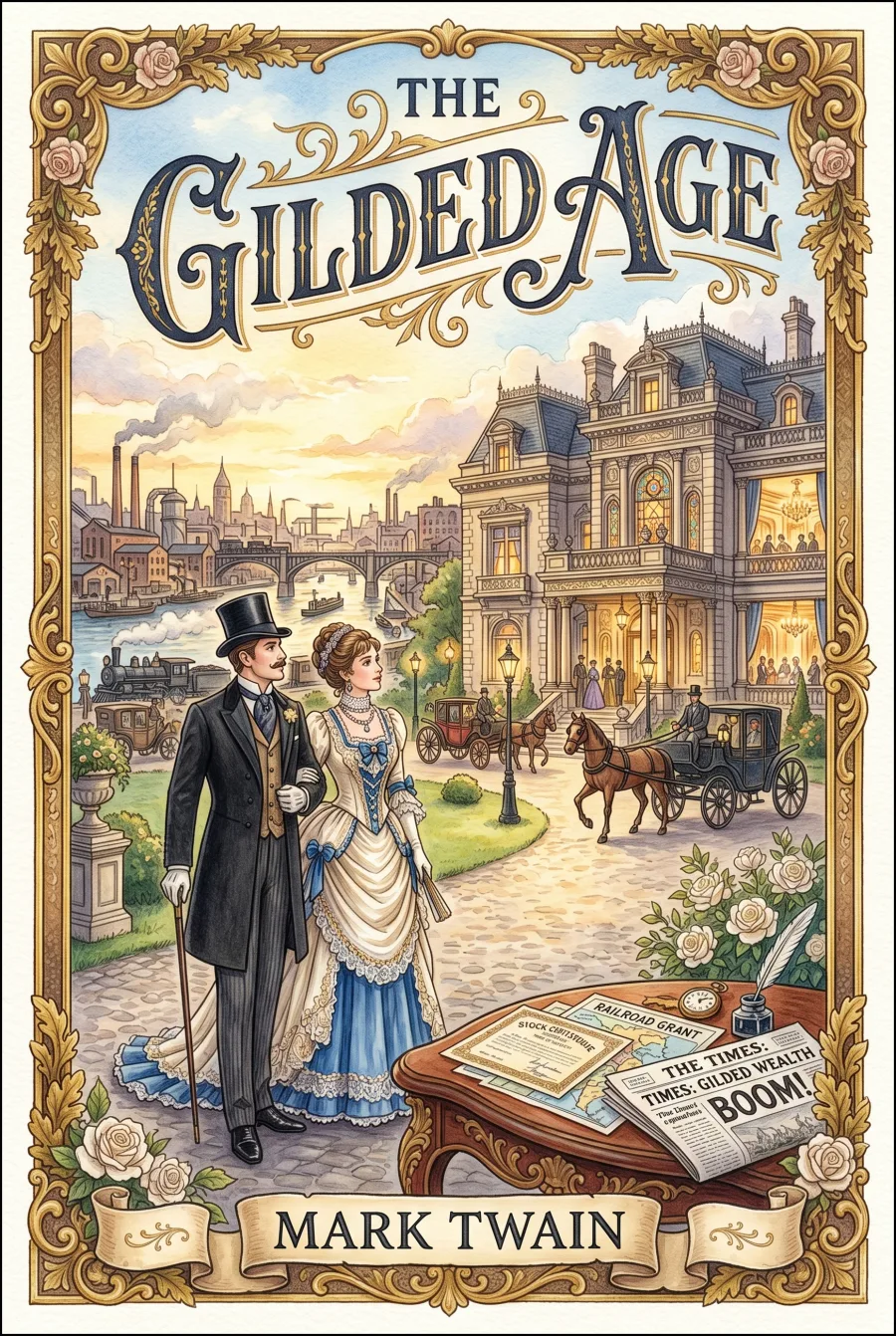
The Gilded Age
eBook
• INR 51.00
• English
• 9788169359740
No ratings yet
| Publisher | General Press |
|---|---|
| ISBN13 | 9788169359740 |
| Book Format | eBook |
| Language | English |
| List Price | INR 51.00 |
| Subject Code | FIC052000, FIC037000, FIC016000 |
| Publishing Date | 05/09/2026 |
| Book Code | BD00070397 |
Buy this Book
Amazon Stores
Ebook Stores
Other Stores
Discover The Gilded Age by Mark Twain. This book is published by General Press in eBook format, ISBN 9788169359740, under Literature and Fiction, Fiction Satire, Political Fiction.
Book Description
What happens when the promise of wealth and success becomes so powerful that almost everyone is willing to bend the rules to get ahead? "The Gilded Age" by Mark Twain, written with Charles Dudley Warner, is a classic American satirical novel that examines post–Civil War America through a lively mixture of comedy, ambition, political corruption, social climbing, and the pursuit of wealth.
The story brings together several characters whose lives become connected by dreams of prosperity and advancement. One of the central figures is Colonel Beriah Sellers, an endlessly confident schemer who is always certain that his next grand idea will make him rich. His optimism and elaborate plans provide much of the novel’s humor while also reflecting a society increasingly fascinated by speculation, business opportunities, and the promise of easy fortunes.
Alongside Sellers is the Hawkins family, who own a large but undeveloped tract of land in Tennessee and hope to turn it into a fortune. Their efforts to obtain a much higher value for their property lead them into a complicated world of investors, politicians, lawyers, and business interests. Meanwhile, Philip and Laura Hawkins pursue their own ambitions in Washington, D.C., where they encounter the pressures and temptations of political life. Laura, in particular, becomes determined to achieve independence and social success, taking a path that brings her into increasingly difficult circumstances.
Rather than following a single straightforward adventure, the novel moves between interconnected stories that reveal different sides of American society. Twain and Warner use irony and exaggeration to expose political lobbying, bribery, speculation, corruption, and the enormous gap between public ideals and private interests. Washington becomes a place where political influence can be bought and personal ambition can easily overpower principle, while the broader society is portrayed as hungry for wealth and status.
Published in 1873, "The Gilded Age" gave its name to the period of American history later associated with rapid economic growth, conspicuous wealth, political corruption, and stark inequality. Its humor can be broad and sometimes deliberately absurd, but its central observations remain sharp. For readers interested in Mark Twain, American history, political satire, classic American literature, or novels about wealth and ambition, the book offers both entertainment and social criticism.
Behind its comic characters and outrageous schemes lies a serious question: what happens to a society when the desire to become rich and powerful becomes more important than honesty? To discover how these ambitions collide, readers need only follow the tangled fortunes of the characters in "The Gilded Age".
The story brings together several characters whose lives become connected by dreams of prosperity and advancement. One of the central figures is Colonel Beriah Sellers, an endlessly confident schemer who is always certain that his next grand idea will make him rich. His optimism and elaborate plans provide much of the novel’s humor while also reflecting a society increasingly fascinated by speculation, business opportunities, and the promise of easy fortunes.
Alongside Sellers is the Hawkins family, who own a large but undeveloped tract of land in Tennessee and hope to turn it into a fortune. Their efforts to obtain a much higher value for their property lead them into a complicated world of investors, politicians, lawyers, and business interests. Meanwhile, Philip and Laura Hawkins pursue their own ambitions in Washington, D.C., where they encounter the pressures and temptations of political life. Laura, in particular, becomes determined to achieve independence and social success, taking a path that brings her into increasingly difficult circumstances.
Rather than following a single straightforward adventure, the novel moves between interconnected stories that reveal different sides of American society. Twain and Warner use irony and exaggeration to expose political lobbying, bribery, speculation, corruption, and the enormous gap between public ideals and private interests. Washington becomes a place where political influence can be bought and personal ambition can easily overpower principle, while the broader society is portrayed as hungry for wealth and status.
Published in 1873, "The Gilded Age" gave its name to the period of American history later associated with rapid economic growth, conspicuous wealth, political corruption, and stark inequality. Its humor can be broad and sometimes deliberately absurd, but its central observations remain sharp. For readers interested in Mark Twain, American history, political satire, classic American literature, or novels about wealth and ambition, the book offers both entertainment and social criticism.
Behind its comic characters and outrageous schemes lies a serious question: what happens to a society when the desire to become rich and powerful becomes more important than honesty? To discover how these ambitions collide, readers need only follow the tangled fortunes of the characters in "The Gilded Age".
Author Biography
Mark Twain (1835–1910), the pen name of “Samuel Langhorne Clemens”, was an American novelist, humorist, journalist, lecturer, and social critic who became one of the most important voices in American literature. Born on November 30, 1835, in Florida, Missouri, Twain moved with his family to Hannibal, Missouri, when he was four. Growing up beside the Mississippi River, he absorbed the stories, speech, humor, conflicts, and adventures of river life that would later shape his most famous books. His father died when Twain was eleven, and he left school early to work as a printer and typesetter. He later pursued his childhood ambition of becoming a Mississippi River steamboat pilot, an experience that deeply influenced his writing.
Twain's career changed direction after the Civil War disrupted river traffic. He traveled west, worked in Nevada, and began writing for the ‘Territorial Enterprise’ in Virginia City in 1862. It was during this period that Samuel Clemens adopted the name “Mark Twain”, a river expression referring to a water depth of two fathoms. His humorous writing quickly attracted attention, and his 1865 story “The Celebrated Jumping Frog of Calaveras County” brought him national recognition. He subsequently worked as a journalist and lecturer and traveled widely, turning his observations of people and places into memorable comic writing.
Twain's greatest literary achievements include ‘The Adventures of Tom Sawyer’ (1876), ‘The Prince and the Pauper’ (1881), ‘Life on the Mississippi’ (1883), and ‘Adventures of Huckleberry Finn’ (1884). ‘Tom Sawyer’ drew heavily on his childhood experiences in Hannibal, while ‘Huckleberry Finn’ used the Mississippi River journey to examine slavery, racism, conscience, friendship, and the contradictions of American society. The novel's distinctive voice and use of regional speech helped establish Twain as a major figure in American realism. The Library of Congress describes ‘Huckleberry Finn’ as his masterpiece and identifies ‘Tom Sawyer’ and ‘Huckleberry Finn’ as the works most closely associated with his Mississippi childhood.
Behind Twain's humor was a sharp and increasingly critical social conscience. He satirized political corruption, greed, religious hypocrisy, racism, imperialism, and the obsession with wealth and technological progress. His later writings, including ‘A Connecticut Yankee in King Arthur's Court’, ‘Following the Equator’, and ‘The War Prayer’, revealed a more openly skeptical and critical side. He eventually became a prominent opponent of American imperialism and joined the Anti-Imperialist League.
Twain's private life contained considerable hardship. He married Olivia Langdon in 1870, and they had four children, though only three daughters survived infancy. Financial difficulties caused by unsuccessful investments eventually forced him into bankruptcy, after which he undertook a worldwide lecture tour to repay his debts. He also endured the deaths of his wife and three daughters. Twain died on April 21, 1910, in Redding, Connecticut, at the age of seventy-four.
Today, Mark Twain remains essential for readers searching for “Mark Twain's biography, Samuel Clemens, ‘The Adventures of Huckleberry Finn’, ‘The Adventures of Tom Sawyer’, American literature, humor, satire, and nineteenth-century American history”. His greatest strength was his ability to make readers laugh while quietly forcing them to question society. Through unforgettable characters, natural dialogue, sharp satire, and a deep understanding of human weakness, Twain transformed distinctly American experiences into literature with universal appeal.
Twain's career changed direction after the Civil War disrupted river traffic. He traveled west, worked in Nevada, and began writing for the ‘Territorial Enterprise’ in Virginia City in 1862. It was during this period that Samuel Clemens adopted the name “Mark Twain”, a river expression referring to a water depth of two fathoms. His humorous writing quickly attracted attention, and his 1865 story “The Celebrated Jumping Frog of Calaveras County” brought him national recognition. He subsequently worked as a journalist and lecturer and traveled widely, turning his observations of people and places into memorable comic writing.
Twain's greatest literary achievements include ‘The Adventures of Tom Sawyer’ (1876), ‘The Prince and the Pauper’ (1881), ‘Life on the Mississippi’ (1883), and ‘Adventures of Huckleberry Finn’ (1884). ‘Tom Sawyer’ drew heavily on his childhood experiences in Hannibal, while ‘Huckleberry Finn’ used the Mississippi River journey to examine slavery, racism, conscience, friendship, and the contradictions of American society. The novel's distinctive voice and use of regional speech helped establish Twain as a major figure in American realism. The Library of Congress describes ‘Huckleberry Finn’ as his masterpiece and identifies ‘Tom Sawyer’ and ‘Huckleberry Finn’ as the works most closely associated with his Mississippi childhood.
Behind Twain's humor was a sharp and increasingly critical social conscience. He satirized political corruption, greed, religious hypocrisy, racism, imperialism, and the obsession with wealth and technological progress. His later writings, including ‘A Connecticut Yankee in King Arthur's Court’, ‘Following the Equator’, and ‘The War Prayer’, revealed a more openly skeptical and critical side. He eventually became a prominent opponent of American imperialism and joined the Anti-Imperialist League.
Twain's private life contained considerable hardship. He married Olivia Langdon in 1870, and they had four children, though only three daughters survived infancy. Financial difficulties caused by unsuccessful investments eventually forced him into bankruptcy, after which he undertook a worldwide lecture tour to repay his debts. He also endured the deaths of his wife and three daughters. Twain died on April 21, 1910, in Redding, Connecticut, at the age of seventy-four.
Today, Mark Twain remains essential for readers searching for “Mark Twain's biography, Samuel Clemens, ‘The Adventures of Huckleberry Finn’, ‘The Adventures of Tom Sawyer’, American literature, humor, satire, and nineteenth-century American history”. His greatest strength was his ability to make readers laugh while quietly forcing them to question society. Through unforgettable characters, natural dialogue, sharp satire, and a deep understanding of human weakness, Twain transformed distinctly American experiences into literature with universal appeal.
Editorial Reviews
Editorial Reviews will be added soon…
Book Summary
'The Gilded Age: A Tale of Today' by Mark Twain and Charles Dudley Warner is a sharp, humorous, and surprisingly modern novel about ambition, greed, political corruption, social climbing, and the American dream gone wrong. Published in 1873, the book takes its title from the phrase “Gilded Age,” describing a period in American history when rapid economic growth and dazzling displays of wealth existed alongside widespread poverty, corruption, and inequality. Rather than presenting a simple story with one central hero, the novel follows several characters whose lives become entangled through money, politics, land speculation, romance, and social ambition. Mark Twain supplies much of the novel’s satire and comic energy, while Charles Dudley Warner contributes to its broader social and political critique. The result is a sprawling story that examines what happens when people begin to believe that almost everything—including public office, friendship, morality, and even love—can be used as a means of getting rich.
The story begins with Colonel Beriah Sellers, one of the novel’s most memorable and comic characters. Sellers is an enthusiastic dreamer who is constantly imagining fantastic schemes for making money. He is convinced that his next invention, investment, or business opportunity will make him enormously wealthy, even though his plans rarely produce anything substantial. Sellers represents a particular kind of American optimism: he has complete faith in the possibility of sudden success and almost no ability to distinguish genuine opportunity from fantasy. His confidence is so great that failure never seems to discourage him. Instead, every unsuccessful scheme becomes merely a reason to begin another. Through Sellers, Twain mocks the culture of speculation that encouraged people to chase fortunes without considering whether their investments were practical, honest, or socially useful.
Alongside Sellers is Washington Hawkins, a young man whose financial circumstances are far less comfortable. Hawkins comes from Tennessee and is determined to improve his position through politics and land speculation. He believes that a huge tract of undeveloped land owned by his family can make him rich, but turning that land into a fortune requires political influence and access to government resources. Hawkins therefore becomes involved in the political world of Washington, D.C., where he discovers that idealism is often less useful than connections. His ambitions are not necessarily evil at first. He wants to secure his future and help his family, but his desire for wealth gradually draws him into a system where personal interests and public responsibilities become difficult to separate.
A major part of the novel follows Laura Hawkins, Washington Hawkins's sister, whose ambitions are different but equally powerful. Laura is intelligent, attractive, and determined to escape the limitations imposed upon women by nineteenth-century society. She wants a larger and more exciting life than the one available to her in Tennessee. Her journey to Washington introduces her to a world of political power, wealth, reputation, and social influence. She becomes fascinated by the possibilities that appear to surround her, and her ambitions gradually become connected with the larger culture of speculation and political manipulation. Through Laura, the novel explores the restricted choices available to women while also examining the dangers that can arise when a person enters a social environment where appearance and ambition are valued above honesty.
Laura's story becomes one of the novel's most important examples of the relationship between personal desire and social pressure. She is not simply portrayed as a villainous or immoral woman. Instead, she is someone who wants independence and a better life but is caught in a society where women's opportunities are limited and often dependent upon marriage, wealth, and social status. Her attempts to control her own destiny repeatedly lead her into difficult situations. Twain's treatment of Laura can sometimes feel harsh by modern standards, but the character remains significant because she illustrates the complicated relationship between female independence, social expectations, and economic power in the nineteenth century.
The novel's political world is equally important. Washington, D.C., is presented as a place where ambitious individuals attempt to turn government into an instrument for private gain. The Hawkins family's enormous landholding becomes central to this political struggle. Their property is valuable in theory, but its potential value depends upon government action and infrastructure. They therefore seek legislation that will increase the value of the land, particularly through the construction of a railroad. The situation creates an obvious conflict of interest: the people promoting a public project also stand to become extremely wealthy if the government approves it. Twain uses this plot to satirize the practice of lobbying and the influence of wealthy interests over politicians.
The railroad scheme becomes one of the clearest symbols in 'The Gilded Age'. Railroads represented progress, modernization, and national development, but they could also become vehicles for speculation and corruption. In the novel, the proposed railroad is not simply about transportation or public benefit. It becomes a mechanism through which characters hope to transform worthless or inaccessible land into a fortune. The difference between public good and private profit becomes increasingly blurred. Politicians are approached, influence is purchased, promises are made, and ambitious people begin treating government decisions as opportunities for personal enrichment. The satire remains powerful because Twain is not attacking progress itself; he is attacking the dishonest motives that can hide behind the language of progress.
One of the novel's most interesting features is its mixture of comedy and serious social criticism. Colonel Sellers, for example, is often hilarious because of his endless confidence and exaggerated schemes. Yet the humor surrounding him also exposes a real social problem. A society obsessed with speculation encourages people to believe that wealth can be created without patience, labor, or responsibility. Sellers's fantasies may be absurd, but they reflect a broader national fascination with getting rich quickly. Twain understands that excessive optimism can become dangerous when it is combined with greed. A person who believes that every scheme is an opportunity may eventually stop asking whether the scheme is ethical.
The novel also examines the American obsession with social advancement. Characters repeatedly measure themselves against wealthier and more influential people. Money becomes a form of power, and power becomes a way of gaining social respect. The result is a society in which people are encouraged to present themselves as more successful than they really are. Reputation becomes almost as valuable as money because it can open doors to political and financial opportunities. This is part of what makes the title 'The Gilded Age' so meaningful. Something gilded is covered with a thin layer of gold, but underneath the surface may be something much less valuable. Twain and Warner suggest that American society can look prosperous and impressive from the outside while hiding serious moral and social problems underneath.
Another important storyline concerns Philip Sterling and Henry Brierly, two young men whose experiences provide a contrast to the more cynical world of speculation and politics. Their story introduces a different kind of ambition, involving education, professional success, friendship, and personal relationships. The novel's many characters and interconnected plots allow the authors to present different versions of American aspiration. Some people seek wealth, some seek social recognition, some seek love, and some seek meaningful work. Yet nearly all of them encounter a society where economic success strongly influences how a person is valued.
The novel's treatment of education is also revealing. Knowledge and professional ability are valuable, but they do not necessarily guarantee success. Social connections, money, and political influence can sometimes matter more than talent. This creates a tension between the traditional ideal of advancement through hard work and the reality of a society increasingly shaped by capital and connections. The characters who understand this system can sometimes move ahead faster than those who simply trust in merit. Twain uses this contradiction to question whether the American promise of equal opportunity is actually being fulfilled.
As the various plots develop, characters repeatedly make decisions based on incomplete information, exaggerated expectations, and self-interest. Romantic relationships become entangled with questions of money and social position. Political decisions become connected with private investments. Personal friendships are tested by financial pressures. The novel therefore creates a world in which almost every human relationship is touched by the pursuit of wealth. Yet this is not presented as a simple story of greedy people behaving badly. Twain's deeper point is that the surrounding culture encourages such behavior. When society rewards speculation, political influence, and appearances, individuals who want to succeed may feel compelled to participate.
Laura's experiences become increasingly tragic as her hopes for independence collide with the realities of the society around her. She encounters men who view her through the lens of attraction, status, and possession rather than as an independent person. Her attempts to control her own life lead to mistakes and emotional suffering. Through her story, the novel exposes some of the limited and dangerous choices available to women who wished to escape conventional expectations. Laura wants freedom, but the society she enters offers freedom unevenly and often attaches a heavy price to it.
At the same time, Washington Hawkins's political ambitions reveal the corrupting effects of proximity to power. He begins with a desire to improve his family's circumstances, but political involvement gradually encourages him to think in terms of influence and financial opportunity. The line between serving the public and serving oneself becomes increasingly unclear. The novel's Washington is therefore not merely a geographical setting; it becomes a symbol of a political culture in which legislation can be influenced by private interests. The Hawkins family's attempts to obtain government support for their land demonstrate how easily public policy can become a commodity.
The novel's humor is often deliberately exaggerated, but beneath the comedy lies a serious concern about the future of American democracy. Twain and Warner were writing only a few years after the American Civil War, during a period of rapid industrialization and political transformation. They saw a country becoming richer and more powerful while also becoming increasingly unequal and vulnerable to corruption. Their novel asks whether economic growth is truly progress if the institutions responsible for protecting the public can be manipulated by those seeking private wealth.
One of the reasons 'The Gilded Age' remains important is that its central concerns are not limited to the nineteenth century. The novel explores speculation, lobbying, political influence, wealth inequality, social ambition, financial deception, and the temptation to become rich quickly. These themes continue to appear in modern discussions of business and government. The technology and political institutions have changed, but the human impulses Twain satirizes—greed, vanity, optimism, self-deception, and the desire for status—remain recognizable. The novel's comedy therefore has an enduring quality because it is ultimately comedy about human nature.
The structure of 'The Gilded Age' can sometimes feel sprawling because several storylines compete for attention, and the novel moves between characters and locations rather than following one straightforward adventure. However, this broad structure serves the book's purpose. Twain and Warner are attempting to portray an entire society rather than a single person's journey. The characters form a kind of social panorama, with politicians, speculators, professionals, wealthy figures, ambitious young people, and outsiders all participating in the same culture. The interconnected stories show that corruption is not an isolated problem belonging only to obviously dishonest individuals. It can become part of the normal functioning of society when enough people accept it.
Ultimately, 'The Gilded Age' is a novel about the gap between appearance and reality. America appears to be entering an age of prosperity and opportunity, but beneath the surface are political corruption, economic uncertainty, inequality, and personal desperation. Colonel Sellers's endless schemes, Washington Hawkins's political ambitions, Laura Hawkins's search for independence, and the various romantic and professional struggles all reveal different sides of this contradiction. The characters want better lives, and many of their desires are understandable. What makes their stories tragic or comic is the way those desires become distorted by a culture that teaches them to measure success primarily through money and influence.
A useful way to understand 'The Gilded Age' is to see it not simply as a historical novel but as a satire of the American dream when that dream becomes detached from moral responsibility. Twain does not reject ambition, prosperity, invention, or social advancement. Instead, he asks what happens when the pursuit of these things becomes more important than honesty, public service, human dignity, and genuine achievement. The novel suggests that a society cannot be judged by the brilliance of its surface alone. Wealth may glitter, cities may expand, railroads may promise progress, and politicians may speak about public good, but none of these things automatically create a just or healthy society.
In the end, 'The Gilded Age' stands as one of Mark Twain's most ambitious works of social and political satire. Its characters are sometimes comic, sometimes foolish, sometimes sympathetic, and sometimes deeply troubled, but together they create a vivid portrait of a nation struggling to define what success should mean. The book's central message is both humorous and unsettling: a society can appear prosperous while being morally impoverished underneath. By exposing the greed, political manipulation, speculation, and social pressures of his time, Twain created a story that still invites readers to question the relationship between money and power. The enduring value of 'The Gilded Age' lies precisely in this tension. It makes us laugh at the absurdity of its characters while quietly asking whether the world around them is really so different from our own.
The story begins with Colonel Beriah Sellers, one of the novel’s most memorable and comic characters. Sellers is an enthusiastic dreamer who is constantly imagining fantastic schemes for making money. He is convinced that his next invention, investment, or business opportunity will make him enormously wealthy, even though his plans rarely produce anything substantial. Sellers represents a particular kind of American optimism: he has complete faith in the possibility of sudden success and almost no ability to distinguish genuine opportunity from fantasy. His confidence is so great that failure never seems to discourage him. Instead, every unsuccessful scheme becomes merely a reason to begin another. Through Sellers, Twain mocks the culture of speculation that encouraged people to chase fortunes without considering whether their investments were practical, honest, or socially useful.
Alongside Sellers is Washington Hawkins, a young man whose financial circumstances are far less comfortable. Hawkins comes from Tennessee and is determined to improve his position through politics and land speculation. He believes that a huge tract of undeveloped land owned by his family can make him rich, but turning that land into a fortune requires political influence and access to government resources. Hawkins therefore becomes involved in the political world of Washington, D.C., where he discovers that idealism is often less useful than connections. His ambitions are not necessarily evil at first. He wants to secure his future and help his family, but his desire for wealth gradually draws him into a system where personal interests and public responsibilities become difficult to separate.
A major part of the novel follows Laura Hawkins, Washington Hawkins's sister, whose ambitions are different but equally powerful. Laura is intelligent, attractive, and determined to escape the limitations imposed upon women by nineteenth-century society. She wants a larger and more exciting life than the one available to her in Tennessee. Her journey to Washington introduces her to a world of political power, wealth, reputation, and social influence. She becomes fascinated by the possibilities that appear to surround her, and her ambitions gradually become connected with the larger culture of speculation and political manipulation. Through Laura, the novel explores the restricted choices available to women while also examining the dangers that can arise when a person enters a social environment where appearance and ambition are valued above honesty.
Laura's story becomes one of the novel's most important examples of the relationship between personal desire and social pressure. She is not simply portrayed as a villainous or immoral woman. Instead, she is someone who wants independence and a better life but is caught in a society where women's opportunities are limited and often dependent upon marriage, wealth, and social status. Her attempts to control her own destiny repeatedly lead her into difficult situations. Twain's treatment of Laura can sometimes feel harsh by modern standards, but the character remains significant because she illustrates the complicated relationship between female independence, social expectations, and economic power in the nineteenth century.
The novel's political world is equally important. Washington, D.C., is presented as a place where ambitious individuals attempt to turn government into an instrument for private gain. The Hawkins family's enormous landholding becomes central to this political struggle. Their property is valuable in theory, but its potential value depends upon government action and infrastructure. They therefore seek legislation that will increase the value of the land, particularly through the construction of a railroad. The situation creates an obvious conflict of interest: the people promoting a public project also stand to become extremely wealthy if the government approves it. Twain uses this plot to satirize the practice of lobbying and the influence of wealthy interests over politicians.
The railroad scheme becomes one of the clearest symbols in 'The Gilded Age'. Railroads represented progress, modernization, and national development, but they could also become vehicles for speculation and corruption. In the novel, the proposed railroad is not simply about transportation or public benefit. It becomes a mechanism through which characters hope to transform worthless or inaccessible land into a fortune. The difference between public good and private profit becomes increasingly blurred. Politicians are approached, influence is purchased, promises are made, and ambitious people begin treating government decisions as opportunities for personal enrichment. The satire remains powerful because Twain is not attacking progress itself; he is attacking the dishonest motives that can hide behind the language of progress.
One of the novel's most interesting features is its mixture of comedy and serious social criticism. Colonel Sellers, for example, is often hilarious because of his endless confidence and exaggerated schemes. Yet the humor surrounding him also exposes a real social problem. A society obsessed with speculation encourages people to believe that wealth can be created without patience, labor, or responsibility. Sellers's fantasies may be absurd, but they reflect a broader national fascination with getting rich quickly. Twain understands that excessive optimism can become dangerous when it is combined with greed. A person who believes that every scheme is an opportunity may eventually stop asking whether the scheme is ethical.
The novel also examines the American obsession with social advancement. Characters repeatedly measure themselves against wealthier and more influential people. Money becomes a form of power, and power becomes a way of gaining social respect. The result is a society in which people are encouraged to present themselves as more successful than they really are. Reputation becomes almost as valuable as money because it can open doors to political and financial opportunities. This is part of what makes the title 'The Gilded Age' so meaningful. Something gilded is covered with a thin layer of gold, but underneath the surface may be something much less valuable. Twain and Warner suggest that American society can look prosperous and impressive from the outside while hiding serious moral and social problems underneath.
Another important storyline concerns Philip Sterling and Henry Brierly, two young men whose experiences provide a contrast to the more cynical world of speculation and politics. Their story introduces a different kind of ambition, involving education, professional success, friendship, and personal relationships. The novel's many characters and interconnected plots allow the authors to present different versions of American aspiration. Some people seek wealth, some seek social recognition, some seek love, and some seek meaningful work. Yet nearly all of them encounter a society where economic success strongly influences how a person is valued.
The novel's treatment of education is also revealing. Knowledge and professional ability are valuable, but they do not necessarily guarantee success. Social connections, money, and political influence can sometimes matter more than talent. This creates a tension between the traditional ideal of advancement through hard work and the reality of a society increasingly shaped by capital and connections. The characters who understand this system can sometimes move ahead faster than those who simply trust in merit. Twain uses this contradiction to question whether the American promise of equal opportunity is actually being fulfilled.
As the various plots develop, characters repeatedly make decisions based on incomplete information, exaggerated expectations, and self-interest. Romantic relationships become entangled with questions of money and social position. Political decisions become connected with private investments. Personal friendships are tested by financial pressures. The novel therefore creates a world in which almost every human relationship is touched by the pursuit of wealth. Yet this is not presented as a simple story of greedy people behaving badly. Twain's deeper point is that the surrounding culture encourages such behavior. When society rewards speculation, political influence, and appearances, individuals who want to succeed may feel compelled to participate.
Laura's experiences become increasingly tragic as her hopes for independence collide with the realities of the society around her. She encounters men who view her through the lens of attraction, status, and possession rather than as an independent person. Her attempts to control her own life lead to mistakes and emotional suffering. Through her story, the novel exposes some of the limited and dangerous choices available to women who wished to escape conventional expectations. Laura wants freedom, but the society she enters offers freedom unevenly and often attaches a heavy price to it.
At the same time, Washington Hawkins's political ambitions reveal the corrupting effects of proximity to power. He begins with a desire to improve his family's circumstances, but political involvement gradually encourages him to think in terms of influence and financial opportunity. The line between serving the public and serving oneself becomes increasingly unclear. The novel's Washington is therefore not merely a geographical setting; it becomes a symbol of a political culture in which legislation can be influenced by private interests. The Hawkins family's attempts to obtain government support for their land demonstrate how easily public policy can become a commodity.
The novel's humor is often deliberately exaggerated, but beneath the comedy lies a serious concern about the future of American democracy. Twain and Warner were writing only a few years after the American Civil War, during a period of rapid industrialization and political transformation. They saw a country becoming richer and more powerful while also becoming increasingly unequal and vulnerable to corruption. Their novel asks whether economic growth is truly progress if the institutions responsible for protecting the public can be manipulated by those seeking private wealth.
One of the reasons 'The Gilded Age' remains important is that its central concerns are not limited to the nineteenth century. The novel explores speculation, lobbying, political influence, wealth inequality, social ambition, financial deception, and the temptation to become rich quickly. These themes continue to appear in modern discussions of business and government. The technology and political institutions have changed, but the human impulses Twain satirizes—greed, vanity, optimism, self-deception, and the desire for status—remain recognizable. The novel's comedy therefore has an enduring quality because it is ultimately comedy about human nature.
The structure of 'The Gilded Age' can sometimes feel sprawling because several storylines compete for attention, and the novel moves between characters and locations rather than following one straightforward adventure. However, this broad structure serves the book's purpose. Twain and Warner are attempting to portray an entire society rather than a single person's journey. The characters form a kind of social panorama, with politicians, speculators, professionals, wealthy figures, ambitious young people, and outsiders all participating in the same culture. The interconnected stories show that corruption is not an isolated problem belonging only to obviously dishonest individuals. It can become part of the normal functioning of society when enough people accept it.
Ultimately, 'The Gilded Age' is a novel about the gap between appearance and reality. America appears to be entering an age of prosperity and opportunity, but beneath the surface are political corruption, economic uncertainty, inequality, and personal desperation. Colonel Sellers's endless schemes, Washington Hawkins's political ambitions, Laura Hawkins's search for independence, and the various romantic and professional struggles all reveal different sides of this contradiction. The characters want better lives, and many of their desires are understandable. What makes their stories tragic or comic is the way those desires become distorted by a culture that teaches them to measure success primarily through money and influence.
A useful way to understand 'The Gilded Age' is to see it not simply as a historical novel but as a satire of the American dream when that dream becomes detached from moral responsibility. Twain does not reject ambition, prosperity, invention, or social advancement. Instead, he asks what happens when the pursuit of these things becomes more important than honesty, public service, human dignity, and genuine achievement. The novel suggests that a society cannot be judged by the brilliance of its surface alone. Wealth may glitter, cities may expand, railroads may promise progress, and politicians may speak about public good, but none of these things automatically create a just or healthy society.
In the end, 'The Gilded Age' stands as one of Mark Twain's most ambitious works of social and political satire. Its characters are sometimes comic, sometimes foolish, sometimes sympathetic, and sometimes deeply troubled, but together they create a vivid portrait of a nation struggling to define what success should mean. The book's central message is both humorous and unsettling: a society can appear prosperous while being morally impoverished underneath. By exposing the greed, political manipulation, speculation, and social pressures of his time, Twain created a story that still invites readers to question the relationship between money and power. The enduring value of 'The Gilded Age' lies precisely in this tension. It makes us laugh at the absurdity of its characters while quietly asking whether the world around them is really so different from our own.
Sample Chapters
Sample Chapters will be added soon…
Reader Reviews
No reviews yet.
The Gilded Age