
The Grand Inquisitor
eBook
• INR 51.00
• English
• 9788169359757
No ratings yet
| Publisher | General Press |
|---|---|
| ISBN13 | 9788169359757 |
| Book Format | eBook |
| Language | English |
| List Price | INR 51.00 |
| Subject Code | FIC039000, FIC004000, FIC019000 |
| Publishing Date | 05/09/2026 |
| Book Code | BD00070398 |
Buy this Book
Amazon Stores
Ebook Stores
Other Stores
Discover The Grand Inquisitor by Fyodor Dostoyevsky. This book is published by General Press in eBook format, ISBN 9788169359757, under Literature and Fiction, Metaphysical and Visionary Fiction, Classic Literature and Fiction.
Book Description
What if humanity were offered complete freedom but chose comfort, certainty, and obedience instead? "The Grand Inquisitor" by Fyodor Dostoyevsky is a classic philosophical and religious literary work, presented as a powerful story within "The Brothers Karamazov", that explores free will, faith, human weakness, authority, suffering, and the difficult responsibilities that come with spiritual freedom.
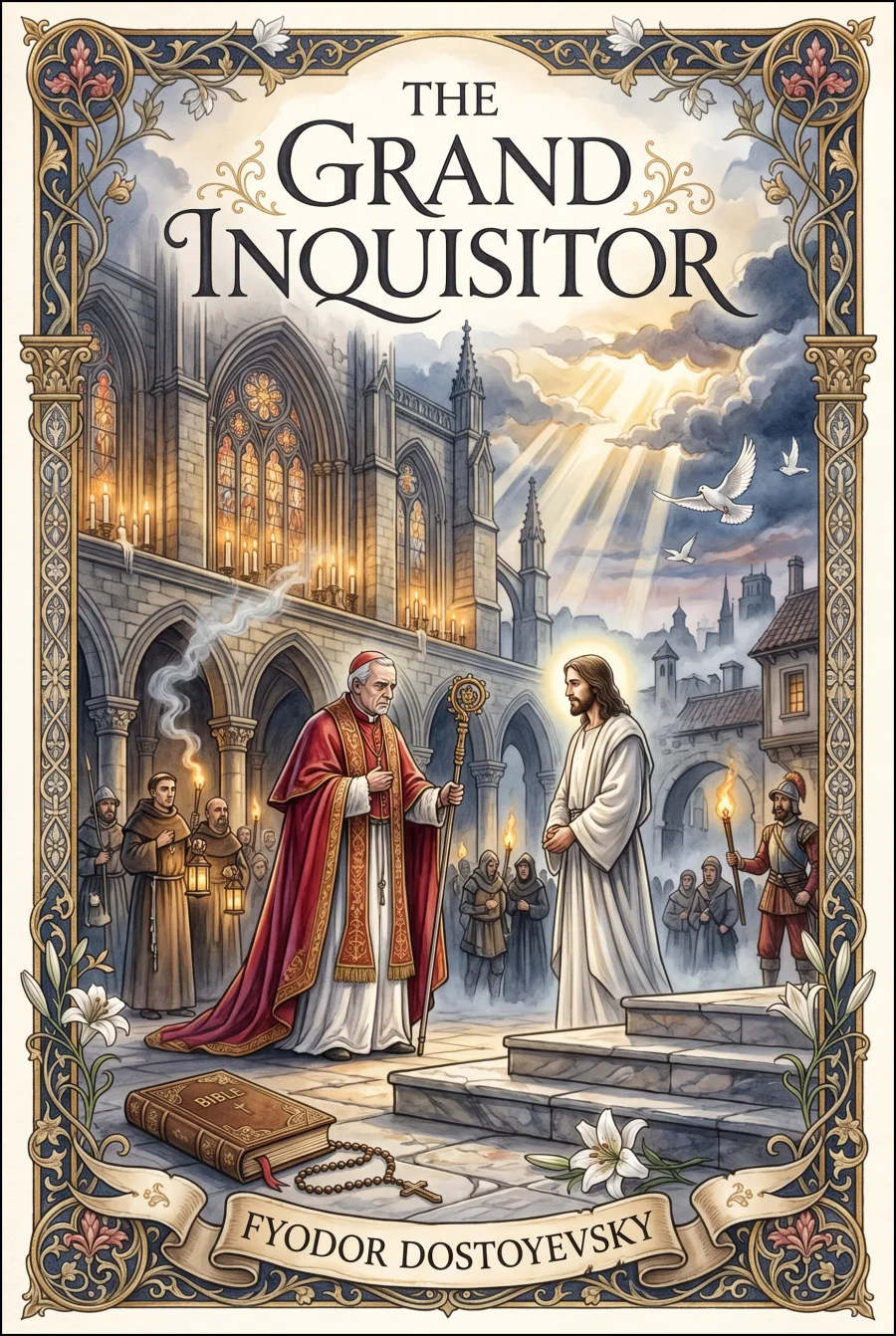
The story is presented through Ivan Karamazov, who shares with his brother Alyosha a fictional tale set in sixteenth-century Seville during the Spanish Inquisition. In Ivan’s imagined story, Christ returns to earth and appears among ordinary people once again. His presence immediately creates a sense of wonder, and people recognize him through his acts of compassion and healing. Yet this peaceful moment does not last. The returning Christ is soon confronted by the elderly Grand Inquisitor, the powerful leader of the Inquisition.
Rather than welcoming Christ, the Grand Inquisitor orders his arrest. He then visits him in prison and delivers a long, passionate argument explaining why Christ’s return is, in his view, a threat to the system humanity needs. The Inquisitor believes that most people are unable to bear the burden of genuine freedom. They want bread, security, miracles, and someone powerful enough to make difficult choices for them. In his reasoning, giving people absolute freedom leaves them anxious, uncertain, and vulnerable to suffering.
The heart of the story lies in the contrast between two visions of human life. The Grand Inquisitor believes that people can be made happy by removing difficult choices and controlling their lives, while Christ represents a radically different idea of freedom based on faith, love, conscience, and voluntary choice. Their confrontation raises uncomfortable questions about whether people truly want freedom when freedom brings responsibility and uncertainty.
Dostoyevsky uses this dramatic encounter to explore some of the deepest questions in religious and philosophical literature. What does it mean to have free will? Can happiness exist without freedom? Should an authority figure protect people from difficult choices, or allow them to struggle and choose for themselves? The story does not offer easy answers, which is part of its enduring power.
For readers interested in Dostoyevsky, Christian philosophy, existential thought, religious literature, or classic works about freedom and human nature, "The Grand Inquisitor" remains remarkably compelling. Its short narrative opens into a much larger debate about faith, authority, and the human heart—and the final silence of Christ leaves readers with a question that is difficult to forget.
The story is presented through Ivan Karamazov, who shares with his brother Alyosha a fictional tale set in sixteenth-century Seville during the Spanish Inquisition. In Ivan’s imagined story, Christ returns to earth and appears among ordinary people once again. His presence immediately creates a sense of wonder, and people recognize him through his acts of compassion and healing. Yet this peaceful moment does not last. The returning Christ is soon confronted by the elderly Grand Inquisitor, the powerful leader of the Inquisition.
Rather than welcoming Christ, the Grand Inquisitor orders his arrest. He then visits him in prison and delivers a long, passionate argument explaining why Christ’s return is, in his view, a threat to the system humanity needs. The Inquisitor believes that most people are unable to bear the burden of genuine freedom. They want bread, security, miracles, and someone powerful enough to make difficult choices for them. In his reasoning, giving people absolute freedom leaves them anxious, uncertain, and vulnerable to suffering.
The heart of the story lies in the contrast between two visions of human life. The Grand Inquisitor believes that people can be made happy by removing difficult choices and controlling their lives, while Christ represents a radically different idea of freedom based on faith, love, conscience, and voluntary choice. Their confrontation raises uncomfortable questions about whether people truly want freedom when freedom brings responsibility and uncertainty.
Dostoyevsky uses this dramatic encounter to explore some of the deepest questions in religious and philosophical literature. What does it mean to have free will? Can happiness exist without freedom? Should an authority figure protect people from difficult choices, or allow them to struggle and choose for themselves? The story does not offer easy answers, which is part of its enduring power.
For readers interested in Dostoyevsky, Christian philosophy, existential thought, religious literature, or classic works about freedom and human nature, "The Grand Inquisitor" remains remarkably compelling. Its short narrative opens into a much larger debate about faith, authority, and the human heart—and the final silence of Christ leaves readers with a question that is difficult to forget.
Author Biography
Fyodor Dostoyevsky stands as one of the towering figures of world literature, celebrated for his unparalleled ability to plunge into the darkest, most complex depths of human psychology. Born in Moscow in 1821, he grew up on the grounds of a charity hospital where his father worked as a doctor. This early exposure to suffering, poverty, and illness profoundly shaped his worldview and literary voice. Unlike the aristocratic writers of his era, Dostoyevsky deeply understood the gritty, desperate reality of the Russian underclass, a theme that would later become the beating heart of his greatest novels.
The trajectory of Dostoyevsky’s life changed forever in 1849. As a young, radical intellectual, he was arrested for discussing banned socialist literature. In a deeply traumatizing event, he was sentenced to death by firing squad, only to receive a dramatic, last-minute reprieve from the Tsar moments before the execution. Instead of death, he endured four agonizing years of hard labor in a freezing Siberian prison camp. This harrowing ordeal shattered his former political idealism but birthed a profound spiritual awakening. His time in Siberia stripped away his illusions, leaving him with an intense, enduring focus on human suffering, free will, and spiritual redemption.
Upon returning to society, Dostoyevsky channeled his intense life experiences into a series of masterpieces that reshaped modern storytelling. In ‘Notes from Underground’, he laid the foundational groundwork for existentialist philosophy, exploring the irrationality of human nature. He soon followed this with ‘Crime and Punishment’, a gripping psychological thriller exploring the crushing weight of guilt and morality, and ‘The Idiot’, a tragic look at absolute goodness in a deeply corrupt world. His crowning achievement, ‘The Brothers Karamazov’, remains a breathtaking philosophical drama questioning faith, reason, and the heavy burden of freedom.
Despite battling crippling epilepsy, devastating gambling debts, and profound personal tragedies, Dostoyevsky wrote with a furious, urgent passion. He passed away in 1881, leaving behind a cultural legacy that transcends traditional fiction. Modern readers, psychologists, and philosophers continue to turn to his books not just for their gripping narratives, but for their raw, empathetic confrontation with what it truly means to be human in a flawed world.
The trajectory of Dostoyevsky’s life changed forever in 1849. As a young, radical intellectual, he was arrested for discussing banned socialist literature. In a deeply traumatizing event, he was sentenced to death by firing squad, only to receive a dramatic, last-minute reprieve from the Tsar moments before the execution. Instead of death, he endured four agonizing years of hard labor in a freezing Siberian prison camp. This harrowing ordeal shattered his former political idealism but birthed a profound spiritual awakening. His time in Siberia stripped away his illusions, leaving him with an intense, enduring focus on human suffering, free will, and spiritual redemption.
Upon returning to society, Dostoyevsky channeled his intense life experiences into a series of masterpieces that reshaped modern storytelling. In ‘Notes from Underground’, he laid the foundational groundwork for existentialist philosophy, exploring the irrationality of human nature. He soon followed this with ‘Crime and Punishment’, a gripping psychological thriller exploring the crushing weight of guilt and morality, and ‘The Idiot’, a tragic look at absolute goodness in a deeply corrupt world. His crowning achievement, ‘The Brothers Karamazov’, remains a breathtaking philosophical drama questioning faith, reason, and the heavy burden of freedom.
Despite battling crippling epilepsy, devastating gambling debts, and profound personal tragedies, Dostoyevsky wrote with a furious, urgent passion. He passed away in 1881, leaving behind a cultural legacy that transcends traditional fiction. Modern readers, psychologists, and philosophers continue to turn to his books not just for their gripping narratives, but for their raw, empathetic confrontation with what it truly means to be human in a flawed world.
Editorial Reviews
Editorial Reviews will be added soon…
Book Summary
'The Grand Inquisitor' by Fyodor Dostoyevsky is one of the most famous and philosophically powerful passages in world literature. It is not a separate novel in the conventional sense, but a chapter within Dostoyevsky’s great novel 'The Brothers Karamazov', where Ivan Karamazov tells his younger brother Alyosha a story about Christ returning to Earth during the Spanish Inquisition. Despite its relatively short length, the story raises enormous questions about religion, freedom, human nature, suffering, morality, authority, and the meaning of faith. At its heart is a simple but unsettling question: if human beings are given complete freedom, will they truly be happy, or will they willingly surrender their freedom to anyone who promises them security, certainty, and bread? Dostoyevsky does not offer an easy answer. Instead, through Ivan’s imagined encounter between Christ and the Grand Inquisitor, he creates a dramatic debate between spiritual freedom and authoritarian control.
The story is presented by Ivan to Alyosha, two brothers whose personalities and beliefs are very different. Ivan is intellectually restless and deeply troubled by the problem of suffering, especially the suffering of innocent people. Alyosha, by contrast, is gentle, compassionate, and spiritually devoted. Ivan knows that his ideas are difficult and perhaps disturbing, but he wants Alyosha to understand the kind of religious and moral problem that torments him. He therefore tells him a fictional story about Christ appearing in Seville during the sixteenth century, at the height of the Spanish Inquisition. Christ has not come to deliver a speech or announce a new doctrine. He simply appears among ordinary people, and they recognize Him. His presence immediately produces a powerful emotional response.
The people gather around Christ because they remember Him, or perhaps because something in His presence awakens their deepest spiritual longing. He quietly performs acts of compassion and healing. He restores sight to a blind man and raises a dead child. The people respond with wonder and love. His actions resemble the acts described in the Gospels, and the atmosphere becomes almost miraculous. Yet Christ's return creates a problem for the religious authorities. The Church, represented by the Grand Inquisitor, does not welcome Him. Instead, the elderly Inquisitor orders Christ to be arrested.
The Grand Inquisitor is one of the most striking figures in Dostoyevsky's fiction because he is not presented as a simple villain. He is an intelligent, experienced, and deeply convinced man who believes that he understands human beings better than Christ does. He has devoted his life to serving what he believes is the practical good of humanity. His central accusation is that Christ made human beings free, but freedom is too difficult for most people to bear. According to the Inquisitor, Christ demanded too much from humanity by asking people to choose faith freely, resist temptation, accept uncertainty, and live according to conscience. The Inquisitor believes that ordinary people do not want such a burden. They want someone to tell them what to believe, what to do, and how to live.
The heart of the Grand Inquisitor's argument is based on Christ's three temptations in the wilderness, as described in the Gospels. Dostoyevsky transforms these biblical temptations into a profound philosophical argument about human nature. The first temptation concerns bread. Satan challenges Christ to turn stones into bread, but Christ refuses. The Inquisitor argues that this was a mistake from the perspective of human happiness. People, he says, care deeply about food and material security. If Christ had given humanity bread, He could have won the people's obedience immediately. Instead, Christ chose to offer spiritual freedom. The Inquisitor sees this as an unnecessary burden because hungry people cannot easily think about spiritual freedom. They want to know where their next meal will come from.
This argument becomes much more complicated because the Inquisitor is not simply defending greed. He believes that providing bread is an act of compassion. He thinks humanity should be relieved of the anxiety of making difficult choices. If an institution can guarantee food and security, people will be grateful and obedient. In this sense, the Inquisitor's argument anticipates a recurring political problem: people may accept restrictions on freedom if those restrictions provide safety, prosperity, and stability. The question is whether material happiness is worth the loss of moral independence. Dostoyevsky leaves the reader to wrestle with that question.
The second temptation concerns miracles. Christ refuses to throw Himself from the temple to prove His divine identity because doing so would force people to believe through spectacle rather than freely chosen faith. The Grand Inquisitor again sees this as a mistake. He believes human beings naturally crave certainty. They want visible proof that someone powerful is watching over them. They are frightened by uncertainty and by the possibility that they might have to make moral decisions without guaranteed answers. Miracles, according to the Inquisitor, would remove this uncertainty. People would no longer have to struggle with doubt.
The Inquisitor's criticism therefore becomes a criticism of freedom itself. Genuine freedom means that people can choose wrongly. They can reject God, make terrible decisions, doubt, suffer, or live without certainty. The Inquisitor thinks this is cruel. He believes that a truly compassionate religious authority should protect people from this responsibility. Instead of demanding faith, it should give them certainty. Instead of asking them to choose, it should choose for them. Instead of asking them to live with mystery, it should provide clear answers.
The third temptation concerns earthly power. Christ refuses to rule through political authority, but the Inquisitor believes that humanity desperately wants someone to rule over it. People, he argues, want to belong to a community with clear rules and a powerful leader. They want someone to whom they can surrender their individual responsibility. Political and religious authority can therefore provide something that freedom cannot: a sense of belonging and certainty. The Inquisitor believes that the Church has corrected Christ's supposed mistake by taking upon itself the responsibility of controlling humanity.
This is the central irony of the story. The Grand Inquisitor claims to love humanity more than Christ does. He believes that he understands human weakness and therefore has the right to protect people from freedom. His vision of compassion is paternalistic: he wants to make people happy by making their choices for them. He imagines a world in which ordinary people can live peacefully because powerful religious leaders take responsibility for morality, belief, and social order. The people will be given bread, certainty, and community, while a small group of rulers carries the burden of knowledge and authority.
The Inquisitor's vision is disturbing precisely because it contains an element of truth. Dostoyevsky does not pretend that freedom is easy. Human beings really do become frightened when they face uncertainty. Hunger, insecurity, loneliness, and responsibility can make freedom painful. People often prefer clear rules to difficult moral choices. They may willingly surrender independence in exchange for safety. The Grand Inquisitor understands these weaknesses with extraordinary psychological insight. His argument becomes frightening because the reader can recognize aspects of real human behavior within it.
Yet Christ does not answer the Inquisitor with an argument. Throughout the entire speech, Christ remains silent. This silence is crucial. The Grand Inquisitor expects a response, perhaps a theological explanation or a defense of freedom. Instead, Christ offers no verbal rebuttal. He simply listens. His silence forces the reader to confront the Inquisitor's arguments without an easy answer. It also creates a sharp contrast between the Inquisitor's complicated intellectual justification and Christ's quiet expression of love.
At the end of the encounter, Christ responds not with a debate but with a kiss. He kisses the old man gently on the lips. The Inquisitor is shaken by this simple act. He releases Christ but tells Him never to return. The kiss does not logically disprove the Inquisitor's arguments. Instead, it represents a different kind of answer. The Inquisitor has spent his entire speech explaining humanity through fear, weakness, security, and control. Christ responds through love without coercion. The kiss suggests that genuine spiritual freedom cannot be defended only through intellectual reasoning; it must be experienced through an act of unconditional love.
This ending is one of the main reasons 'The Grand Inquisitor' has remained so influential. The story does not conclude by proving that the Inquisitor is completely wrong. In fact, some of his observations about human weakness remain painfully persuasive. What Dostoyevsky challenges is the Inquisitor's conclusion that because people are weak, they should therefore be controlled. The Inquisitor believes that happiness can be manufactured by removing freedom. Christ's silent response suggests that a human life without freedom may be comfortable, but it would not possess the dignity or spiritual meaning that comes from freely choosing love and goodness.
The relationship between Ivan and Alyosha adds another layer to the story. Ivan is the one telling the tale, and his Grand Inquisitor reflects his own intellectual struggle with Christianity. Ivan cannot easily accept a world in which innocent suffering is permitted, and he is suspicious of religious answers that seem to explain away human pain. The story allows him to explore a radical alternative: perhaps humanity would be happier under compassionate authoritarian control than under the difficult freedom offered by Christ. Alyosha listens without dismissing his brother. His compassion is important because Dostoyevsky does not present the conversation as a contest in which one brother simply defeats the other.
The Grand Inquisitor can therefore be read as a profound exploration of the conflict between freedom and security. It asks whether people genuinely want freedom when freedom includes uncertainty, responsibility, and the possibility of failure. It also asks whether a government, church, leader, or institution can ever legitimately take freedom away in the name of protecting people. The Inquisitor believes that authority can create happiness by reducing human choice. Christ represents the opposite possibility: that authentic human dignity depends on the ability to choose freely, even when that freedom produces suffering and mistakes.
The story also explores the difference between genuine compassion and control disguised as compassion. The Grand Inquisitor sincerely believes that he is helping humanity. He does not imagine himself as a cruel tyrant. He sees himself as someone willing to sacrifice his own spiritual freedom to make life easier for millions of ordinary people. This makes him much more frightening than a conventional villain. Dostoyevsky shows how authoritarianism can emerge not only from hatred or greed but also from the belief that ordinary people cannot be trusted with responsibility. When someone says, "I know what is best for you," the statement can sound caring while quietly eliminating the other person's freedom.
Another major theme is the relationship between happiness and truth. The Inquisitor suggests that people may prefer comforting illusions to difficult truths. If an institution can give people simple answers and emotional security, they may not want to know how uncertain their lives really are. Christ's way is more demanding because it asks people to seek truth and accept responsibility. Dostoyevsky does not make this choice appear easy. Instead, he shows why the temptation to exchange truth for comfort can be so powerful.
Ultimately, 'The Grand Inquisitor' is a story about what it means to be human. It asks whether human beings should be treated primarily as fragile creatures who need protection or as morally free individuals capable of choosing goodness. The Grand Inquisitor chooses protection, bread, certainty, and authority. Christ represents freedom, love, faith, and the dignity of voluntary choice. The final kiss suggests that love cannot be created through force and that spiritual truth loses something essential when it becomes merely an instrument of control.
For anyone looking for a 'The Grand Inquisitor' summary or an explanation of its meaning, the simplest way to understand the story is to see it as a confrontation between two visions of human happiness. The Grand Inquisitor believes people will be happiest when their burdens are removed and their choices are made for them. Christ, through His silence and final kiss, represents the belief that human beings must be trusted with freedom, even when freedom is difficult. Dostoyevsky's genius lies in refusing to make this conflict simplistic. The Inquisitor understands real human suffering, while Christ offers an ideal that demands enormous courage. The story remains powerful because its question has never disappeared: when freedom becomes frightening and painful, would we rather remain free or surrender our freedom in exchange for security and happiness? Dostoyevsky leaves that question alive in the reader, making 'The Grand Inquisitor' not merely a religious passage but one of the most enduring philosophical explorations of freedom, authority, faith, and human nature in literature.
The story is presented by Ivan to Alyosha, two brothers whose personalities and beliefs are very different. Ivan is intellectually restless and deeply troubled by the problem of suffering, especially the suffering of innocent people. Alyosha, by contrast, is gentle, compassionate, and spiritually devoted. Ivan knows that his ideas are difficult and perhaps disturbing, but he wants Alyosha to understand the kind of religious and moral problem that torments him. He therefore tells him a fictional story about Christ appearing in Seville during the sixteenth century, at the height of the Spanish Inquisition. Christ has not come to deliver a speech or announce a new doctrine. He simply appears among ordinary people, and they recognize Him. His presence immediately produces a powerful emotional response.
The people gather around Christ because they remember Him, or perhaps because something in His presence awakens their deepest spiritual longing. He quietly performs acts of compassion and healing. He restores sight to a blind man and raises a dead child. The people respond with wonder and love. His actions resemble the acts described in the Gospels, and the atmosphere becomes almost miraculous. Yet Christ's return creates a problem for the religious authorities. The Church, represented by the Grand Inquisitor, does not welcome Him. Instead, the elderly Inquisitor orders Christ to be arrested.
The Grand Inquisitor is one of the most striking figures in Dostoyevsky's fiction because he is not presented as a simple villain. He is an intelligent, experienced, and deeply convinced man who believes that he understands human beings better than Christ does. He has devoted his life to serving what he believes is the practical good of humanity. His central accusation is that Christ made human beings free, but freedom is too difficult for most people to bear. According to the Inquisitor, Christ demanded too much from humanity by asking people to choose faith freely, resist temptation, accept uncertainty, and live according to conscience. The Inquisitor believes that ordinary people do not want such a burden. They want someone to tell them what to believe, what to do, and how to live.
The heart of the Grand Inquisitor's argument is based on Christ's three temptations in the wilderness, as described in the Gospels. Dostoyevsky transforms these biblical temptations into a profound philosophical argument about human nature. The first temptation concerns bread. Satan challenges Christ to turn stones into bread, but Christ refuses. The Inquisitor argues that this was a mistake from the perspective of human happiness. People, he says, care deeply about food and material security. If Christ had given humanity bread, He could have won the people's obedience immediately. Instead, Christ chose to offer spiritual freedom. The Inquisitor sees this as an unnecessary burden because hungry people cannot easily think about spiritual freedom. They want to know where their next meal will come from.
This argument becomes much more complicated because the Inquisitor is not simply defending greed. He believes that providing bread is an act of compassion. He thinks humanity should be relieved of the anxiety of making difficult choices. If an institution can guarantee food and security, people will be grateful and obedient. In this sense, the Inquisitor's argument anticipates a recurring political problem: people may accept restrictions on freedom if those restrictions provide safety, prosperity, and stability. The question is whether material happiness is worth the loss of moral independence. Dostoyevsky leaves the reader to wrestle with that question.
The second temptation concerns miracles. Christ refuses to throw Himself from the temple to prove His divine identity because doing so would force people to believe through spectacle rather than freely chosen faith. The Grand Inquisitor again sees this as a mistake. He believes human beings naturally crave certainty. They want visible proof that someone powerful is watching over them. They are frightened by uncertainty and by the possibility that they might have to make moral decisions without guaranteed answers. Miracles, according to the Inquisitor, would remove this uncertainty. People would no longer have to struggle with doubt.
The Inquisitor's criticism therefore becomes a criticism of freedom itself. Genuine freedom means that people can choose wrongly. They can reject God, make terrible decisions, doubt, suffer, or live without certainty. The Inquisitor thinks this is cruel. He believes that a truly compassionate religious authority should protect people from this responsibility. Instead of demanding faith, it should give them certainty. Instead of asking them to choose, it should choose for them. Instead of asking them to live with mystery, it should provide clear answers.
The third temptation concerns earthly power. Christ refuses to rule through political authority, but the Inquisitor believes that humanity desperately wants someone to rule over it. People, he argues, want to belong to a community with clear rules and a powerful leader. They want someone to whom they can surrender their individual responsibility. Political and religious authority can therefore provide something that freedom cannot: a sense of belonging and certainty. The Inquisitor believes that the Church has corrected Christ's supposed mistake by taking upon itself the responsibility of controlling humanity.
This is the central irony of the story. The Grand Inquisitor claims to love humanity more than Christ does. He believes that he understands human weakness and therefore has the right to protect people from freedom. His vision of compassion is paternalistic: he wants to make people happy by making their choices for them. He imagines a world in which ordinary people can live peacefully because powerful religious leaders take responsibility for morality, belief, and social order. The people will be given bread, certainty, and community, while a small group of rulers carries the burden of knowledge and authority.
The Inquisitor's vision is disturbing precisely because it contains an element of truth. Dostoyevsky does not pretend that freedom is easy. Human beings really do become frightened when they face uncertainty. Hunger, insecurity, loneliness, and responsibility can make freedom painful. People often prefer clear rules to difficult moral choices. They may willingly surrender independence in exchange for safety. The Grand Inquisitor understands these weaknesses with extraordinary psychological insight. His argument becomes frightening because the reader can recognize aspects of real human behavior within it.
Yet Christ does not answer the Inquisitor with an argument. Throughout the entire speech, Christ remains silent. This silence is crucial. The Grand Inquisitor expects a response, perhaps a theological explanation or a defense of freedom. Instead, Christ offers no verbal rebuttal. He simply listens. His silence forces the reader to confront the Inquisitor's arguments without an easy answer. It also creates a sharp contrast between the Inquisitor's complicated intellectual justification and Christ's quiet expression of love.
At the end of the encounter, Christ responds not with a debate but with a kiss. He kisses the old man gently on the lips. The Inquisitor is shaken by this simple act. He releases Christ but tells Him never to return. The kiss does not logically disprove the Inquisitor's arguments. Instead, it represents a different kind of answer. The Inquisitor has spent his entire speech explaining humanity through fear, weakness, security, and control. Christ responds through love without coercion. The kiss suggests that genuine spiritual freedom cannot be defended only through intellectual reasoning; it must be experienced through an act of unconditional love.
This ending is one of the main reasons 'The Grand Inquisitor' has remained so influential. The story does not conclude by proving that the Inquisitor is completely wrong. In fact, some of his observations about human weakness remain painfully persuasive. What Dostoyevsky challenges is the Inquisitor's conclusion that because people are weak, they should therefore be controlled. The Inquisitor believes that happiness can be manufactured by removing freedom. Christ's silent response suggests that a human life without freedom may be comfortable, but it would not possess the dignity or spiritual meaning that comes from freely choosing love and goodness.
The relationship between Ivan and Alyosha adds another layer to the story. Ivan is the one telling the tale, and his Grand Inquisitor reflects his own intellectual struggle with Christianity. Ivan cannot easily accept a world in which innocent suffering is permitted, and he is suspicious of religious answers that seem to explain away human pain. The story allows him to explore a radical alternative: perhaps humanity would be happier under compassionate authoritarian control than under the difficult freedom offered by Christ. Alyosha listens without dismissing his brother. His compassion is important because Dostoyevsky does not present the conversation as a contest in which one brother simply defeats the other.
The Grand Inquisitor can therefore be read as a profound exploration of the conflict between freedom and security. It asks whether people genuinely want freedom when freedom includes uncertainty, responsibility, and the possibility of failure. It also asks whether a government, church, leader, or institution can ever legitimately take freedom away in the name of protecting people. The Inquisitor believes that authority can create happiness by reducing human choice. Christ represents the opposite possibility: that authentic human dignity depends on the ability to choose freely, even when that freedom produces suffering and mistakes.
The story also explores the difference between genuine compassion and control disguised as compassion. The Grand Inquisitor sincerely believes that he is helping humanity. He does not imagine himself as a cruel tyrant. He sees himself as someone willing to sacrifice his own spiritual freedom to make life easier for millions of ordinary people. This makes him much more frightening than a conventional villain. Dostoyevsky shows how authoritarianism can emerge not only from hatred or greed but also from the belief that ordinary people cannot be trusted with responsibility. When someone says, "I know what is best for you," the statement can sound caring while quietly eliminating the other person's freedom.
Another major theme is the relationship between happiness and truth. The Inquisitor suggests that people may prefer comforting illusions to difficult truths. If an institution can give people simple answers and emotional security, they may not want to know how uncertain their lives really are. Christ's way is more demanding because it asks people to seek truth and accept responsibility. Dostoyevsky does not make this choice appear easy. Instead, he shows why the temptation to exchange truth for comfort can be so powerful.
Ultimately, 'The Grand Inquisitor' is a story about what it means to be human. It asks whether human beings should be treated primarily as fragile creatures who need protection or as morally free individuals capable of choosing goodness. The Grand Inquisitor chooses protection, bread, certainty, and authority. Christ represents freedom, love, faith, and the dignity of voluntary choice. The final kiss suggests that love cannot be created through force and that spiritual truth loses something essential when it becomes merely an instrument of control.
For anyone looking for a 'The Grand Inquisitor' summary or an explanation of its meaning, the simplest way to understand the story is to see it as a confrontation between two visions of human happiness. The Grand Inquisitor believes people will be happiest when their burdens are removed and their choices are made for them. Christ, through His silence and final kiss, represents the belief that human beings must be trusted with freedom, even when freedom is difficult. Dostoyevsky's genius lies in refusing to make this conflict simplistic. The Inquisitor understands real human suffering, while Christ offers an ideal that demands enormous courage. The story remains powerful because its question has never disappeared: when freedom becomes frightening and painful, would we rather remain free or surrender our freedom in exchange for security and happiness? Dostoyevsky leaves that question alive in the reader, making 'The Grand Inquisitor' not merely a religious passage but one of the most enduring philosophical explorations of freedom, authority, faith, and human nature in literature.
Sample Chapters
Sample Chapters will be added soon…
Reader Reviews
No reviews yet.
The Grand Inquisitor
Download Cover Image
Do you want to download the full cover image for The Grand Inquisitor?