
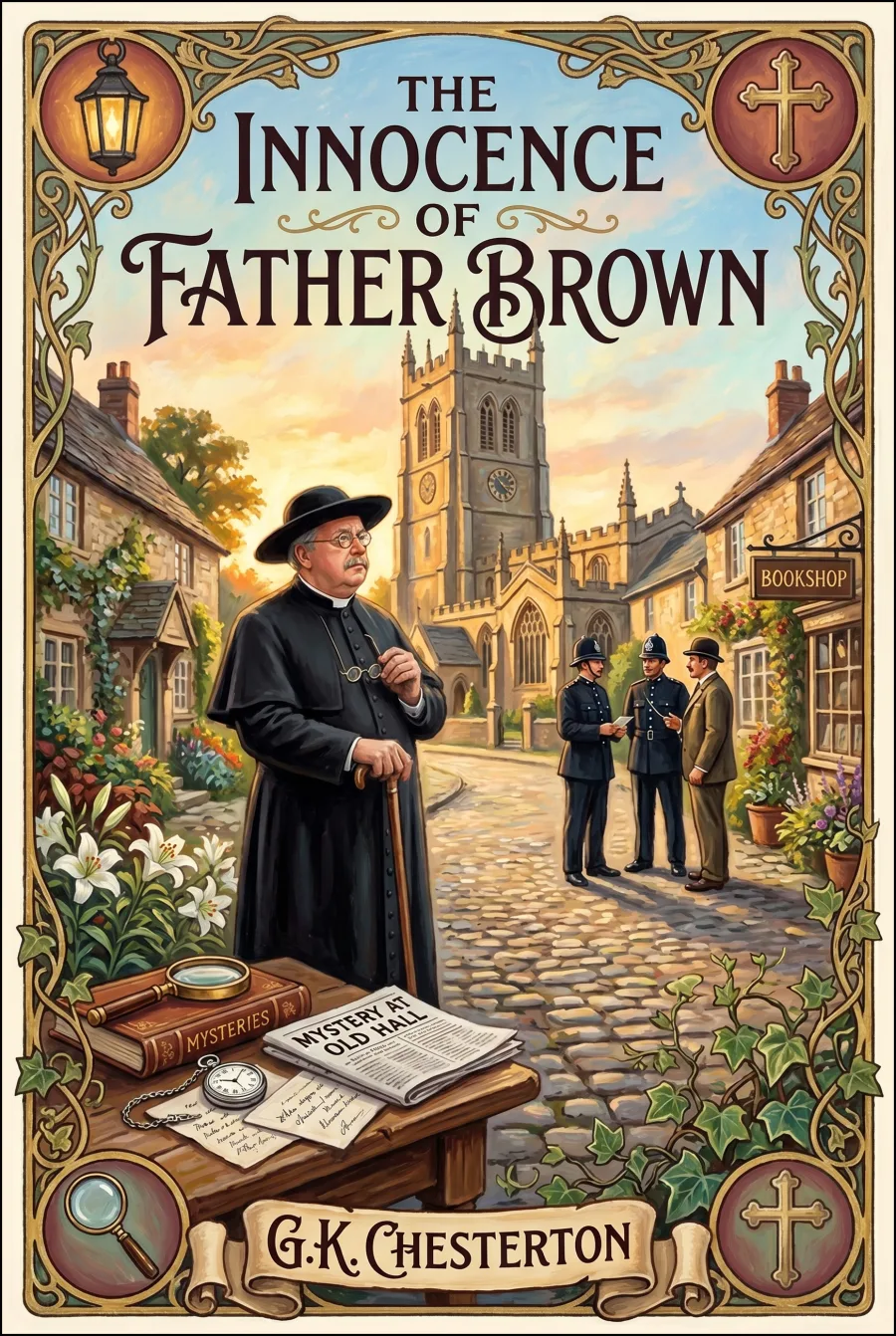
The Innocence of Father Brown
eBook
• INR 51.00
• English
• 9788169359788
No ratings yet
| Publisher | General Press |
|---|---|
| ISBN13 | 9788169359788 |
| Book Format | eBook |
| Language | English |
| List Price | INR 51.00 |
| Subject Code | FIC022030, FIC022100, FIC022050 |
| Publishing Date | 05/09/2026 |
| Book Code | BD00070399 |
Buy this Book
Amazon Stores
Ebook Stores
Other Stores
Discover The Innocence of Father Brown by G.K. Chesterton. This book is published by General Press in eBook format, ISBN 9788169359788, under Literature and Fiction, Traditional Detective Mysteries, Amateur Sleuths Mystery.
Book Description
A quiet Catholic priest may seem like the least likely person to solve a murder, yet Father Brown has an unusual talent for seeing what others miss. "The Innocence of Father Brown" by G. K. Chesterton is a classic collection of detective fiction and mystery stories that introduces one of literature’s most memorable amateur detectives, whose modest appearance and gentle manner conceal an extraordinarily sharp understanding of human nature.
The collection contains twelve stories featuring Father Brown as he encounters murders, thefts, disappearances, strange crimes, and seemingly impossible mysteries. He often finds himself among people who are convinced that a crime can be explained only through elaborate schemes, supernatural forces, or brilliant criminal genius. Father Brown approaches these mysteries differently. Instead of relying solely on physical clues or complicated deductions, he tries to understand the minds of the people involved and considers the weaknesses, desires, fears, and temptations that may have driven them to commit a crime.
Father Brown’s methods make him a fascinating contrast to the traditional image of the detective. He is not a glamorous investigator, a wealthy gentleman, or a scientific expert. He is a small, unassuming priest who listens carefully, observes quietly, and possesses an intimate knowledge of human sin and moral weakness. His religious background is not simply a feature of his character; it becomes an important part of how he interprets crime. He understands that people can deceive others, but they can also deceive themselves.
Across the stories, Chesterton creates mysteries that frequently appear impossible at first. Strange evidence, locked-room situations, disguises, unusual motives, and unexpected reversals challenge both the characters and the reader. The solutions often arrive through an insight into human behavior rather than through a sensational revelation. This gives the collection a distinctive combination of intellectual puzzle and moral reflection.
First published in 1911, "The Innocence of Father Brown" helped establish Father Brown as a major figure in classic detective literature. Chesterton’s stories are entertaining and suspenseful, but they also ask deeper questions about guilt, forgiveness, morality, justice, and the complicated nature of evil. For readers searching for classic mystery stories, Father Brown mysteries, religious detective fiction, or intelligent crime literature, this collection offers a wonderfully unusual reading experience. Each mystery begins with something that seems impossible—and Father Brown’s quiet insight may reveal that the real mystery lies not in what happened, but in why a human being chose to do it.
The collection contains twelve stories featuring Father Brown as he encounters murders, thefts, disappearances, strange crimes, and seemingly impossible mysteries. He often finds himself among people who are convinced that a crime can be explained only through elaborate schemes, supernatural forces, or brilliant criminal genius. Father Brown approaches these mysteries differently. Instead of relying solely on physical clues or complicated deductions, he tries to understand the minds of the people involved and considers the weaknesses, desires, fears, and temptations that may have driven them to commit a crime.
Father Brown’s methods make him a fascinating contrast to the traditional image of the detective. He is not a glamorous investigator, a wealthy gentleman, or a scientific expert. He is a small, unassuming priest who listens carefully, observes quietly, and possesses an intimate knowledge of human sin and moral weakness. His religious background is not simply a feature of his character; it becomes an important part of how he interprets crime. He understands that people can deceive others, but they can also deceive themselves.
Across the stories, Chesterton creates mysteries that frequently appear impossible at first. Strange evidence, locked-room situations, disguises, unusual motives, and unexpected reversals challenge both the characters and the reader. The solutions often arrive through an insight into human behavior rather than through a sensational revelation. This gives the collection a distinctive combination of intellectual puzzle and moral reflection.
First published in 1911, "The Innocence of Father Brown" helped establish Father Brown as a major figure in classic detective literature. Chesterton’s stories are entertaining and suspenseful, but they also ask deeper questions about guilt, forgiveness, morality, justice, and the complicated nature of evil. For readers searching for classic mystery stories, Father Brown mysteries, religious detective fiction, or intelligent crime literature, this collection offers a wonderfully unusual reading experience. Each mystery begins with something that seems impossible—and Father Brown’s quiet insight may reveal that the real mystery lies not in what happened, but in why a human being chose to do it.
Author Biography
Gilbert Keith Chesterton (1874–1936) was a man who literally and figuratively took up an enormous amount of space in the world. Standing six feet four inches tall and weighing nearly 300 pounds, he was an instantly recognizable figure in early 20th-century London, known for his trademark cape, crumpled hat, and ever-present cigar. Far more massive than his physical frame, however, was his intellectual output and his boundless capacity for wonder. Originally trained in illustration at art school, Chesterton soon found his true calling in journalism and literature, embarking on a career that would make him one of the most prolific, joyful defenders of Christianity, the family, and everyday common sense.
Often celebrated for his unique literary style, Chesterton possessed an uncanny ability to turn an argument on its head using paradox to reveal deeper, often neglected truths. Across his lifetime, he authored over a hundred books, roughly two hundred short stories, and more than 4,000 newspaper essays. His philosophical masterpieces, notably ‘Orthodoxy’ and ‘The Everlasting Man’, profoundly shaped modern Christian apologetics; the latter famously played a crucial role in the conversion of a young atheist named C.S. Lewis. Yet, despite the sheer depth of his intellect, Chesterton wrote with an intoxicating lightness and humor that made complex theology accessible and highly engaging.
In the realm of fiction, Chesterton is most widely celebrated for creating the beloved priest-detective, Father Brown. Unlike Sherlock Holmes, who relied on cold, clinical deduction, Father Brown solved grisly crimes through deep empathy and a profound psychological understanding of human brokenness—a perspective he honed in the confessional box. This focus on spiritual redemption over mere justice highlighted Chesterton’s own deepening faith, which ultimately culminated in his formal conversion to Roman Catholicism in 1922.
Though he passed away in 1936, G.K. Chesterton's legacy remains vibrantly alive today. He was a ferocious public debater who frequently sparred with intellectual heavyweights like George Bernard Shaw and H.G. Wells, yet he loved his opponents dearly and never let philosophical disagreements destroy a personal friendship. Modern readers from all walks of life continue to turn to Chesterton for his infectious optimism, his profoundly charitable spirit, and his timeless reminder that the ordinary world is a place of profound magic and meaning.
Often celebrated for his unique literary style, Chesterton possessed an uncanny ability to turn an argument on its head using paradox to reveal deeper, often neglected truths. Across his lifetime, he authored over a hundred books, roughly two hundred short stories, and more than 4,000 newspaper essays. His philosophical masterpieces, notably ‘Orthodoxy’ and ‘The Everlasting Man’, profoundly shaped modern Christian apologetics; the latter famously played a crucial role in the conversion of a young atheist named C.S. Lewis. Yet, despite the sheer depth of his intellect, Chesterton wrote with an intoxicating lightness and humor that made complex theology accessible and highly engaging.
In the realm of fiction, Chesterton is most widely celebrated for creating the beloved priest-detective, Father Brown. Unlike Sherlock Holmes, who relied on cold, clinical deduction, Father Brown solved grisly crimes through deep empathy and a profound psychological understanding of human brokenness—a perspective he honed in the confessional box. This focus on spiritual redemption over mere justice highlighted Chesterton’s own deepening faith, which ultimately culminated in his formal conversion to Roman Catholicism in 1922.
Though he passed away in 1936, G.K. Chesterton's legacy remains vibrantly alive today. He was a ferocious public debater who frequently sparred with intellectual heavyweights like George Bernard Shaw and H.G. Wells, yet he loved his opponents dearly and never let philosophical disagreements destroy a personal friendship. Modern readers from all walks of life continue to turn to Chesterton for his infectious optimism, his profoundly charitable spirit, and his timeless reminder that the ordinary world is a place of profound magic and meaning.
Editorial Reviews
Editorial Reviews will be added soon…
Book Summary
'The Innocence of Father Brown' by G. K. Chesterton is a classic collection of detective stories featuring Father Brown, a small, quiet, apparently ordinary Catholic priest whose greatest strength is his remarkable understanding of human nature. First published in 1911, the book introduces one of the most distinctive detectives in English literature. Unlike the brilliant but theatrical detectives who rely primarily on scientific clues, elaborate deductions, or superior intellect, Father Brown solves crimes by understanding sin, guilt, temptation, fear, pride, jealousy, and desperation. His priestly experience has given him an unusual knowledge of what people are capable of doing when their emotions overcome their principles. The title's reference to “innocence” is therefore deeply important: Father Brown's innocence does not mean that he is naïve about evil. Instead, he understands evil so well that he is not easily deceived by appearances. The collection contains five stories—“The Blue Cross,” “The Secret Garden,” “The Queer Feet,” “The Flying Stars,” and “The Invisible Man”—and together they establish the central ideas, methods, and personality that would make Father Brown one of the most beloved fictional detectives of the twentieth century.
The first story, “The Blue Cross,” introduces Father Brown through a confrontation with the famous French criminal Flambeau. Flambeau is a master of disguise and a highly intelligent criminal who has stolen a valuable religious object, the Blue Cross. Father Brown, however, has been entrusted with the cross and is secretly transporting it to safety. Flambeau disguises himself as a priest in an attempt to trick Father Brown, but the seemingly harmless clergyman notices that something is wrong. The story becomes a fascinating battle between two forms of intelligence. Flambeau believes that clever disguises and elaborate schemes will give him control, while Father Brown observes human behavior and recognizes the criminal's intentions. Father Brown eventually outwits him and ensures that the Blue Cross is recovered. The story establishes an important principle for the entire collection: appearances can be misleading, and the person who looks least threatening may be the one who understands the situation most clearly.
Father Brown's method is especially striking because he does not usually begin by examining physical evidence. Instead, he asks himself what kind of person would commit the crime and why. He enters the imagination of the criminal. Rather than thinking, “What would I do?” he asks, in effect, “What would a person consumed by this particular temptation do?” This approach allows him to recognize motives that other investigators overlook. Chesterton uses this method to create a detective who is intellectually sharp but also deeply compassionate. Father Brown does not treat criminals as fascinating monsters or simply as puzzles to be solved. He sees them as human beings who have allowed some weakness or desire to dominate them. His understanding of sin gives him an unusually realistic view of human behavior.
“The Secret Garden” presents a much darker mystery involving a murder in a secluded garden. A wealthy and influential man, Brayne, is found dead after a gathering of distinguished people. The garden appears almost impossible to enter or leave without being noticed, creating the impression of an impossible crime. Several people at the gathering have motives, secrets, or suspicious circumstances, and the investigation initially seems to move toward a supernatural or highly complicated explanation. Father Brown, however, refuses to be distracted by the dramatic appearance of the crime. He carefully considers the psychology of the people involved. The story explores one of Chesterton's recurring ideas: people often become fascinated by mystery because they assume that an extraordinary crime must have an extraordinary explanation. Father Brown is able to see through this fascination and search for the simplest human explanation hidden beneath the theatrical surface.
“The Queer Feet” takes place in a hotel and revolves around a mysterious figure whose strange footsteps are heard moving through the building. The story initially seems almost comic, but Chesterton gradually turns the mystery into a moral story about theft, repentance, and social class. Father Brown encounters a man who has stolen valuable objects from the hotel, yet instead of treating the criminal as permanently evil, he recognizes the possibility of conscience and change. The strange footsteps become an important symbol because the sound seems to belong to a person who moves between different worlds. The criminal is not simply a villain; he is a man capable of both wrongdoing and remorse. Father Brown's response shows that justice, in his understanding, is not merely about identifying the guilty person. It is also about recognizing the human possibility of repentance.
This story also demonstrates Chesterton's interest in the contrast between outward respectability and hidden wrongdoing. People may dress elegantly, speak politely, and occupy respectable social positions while concealing selfishness or dishonesty. At the same time, someone who looks suspicious or socially inferior may possess genuine moral qualities. Father Brown therefore does not judge people according to social appearance. His Christianity gives him a particular understanding of human equality: everyone is capable of good and evil. This makes him a surprisingly modern detective character because he resists the assumption that appearance, class, education, or reputation determines morality.
In “The Flying Stars,” Father Brown becomes involved in another crime involving valuable jewels and a group of people connected by complicated relationships. The central object is a set of precious stones known as the Flying Stars. The story combines theft, deception, romance, and moral conflict. Once again, the apparent mystery is less important to Father Brown than the emotional forces behind it. People act because they desire wealth, freedom, revenge, admiration, or escape from their circumstances. Chesterton shows how easily human beings can convince themselves that wrongdoing is justified when they want something strongly enough. Father Brown's gift is to recognize the self-deception behind such actions. He understands that criminals often create elaborate stories to themselves before they ever create lies for other people.
The final story, “The Invisible Man,” is one of the most memorable stories in the collection because it plays directly with the idea of an impossible crime. A man is apparently murdered in a building that seems completely secure. There are people nearby, the entrances are watched, and nobody appears to have entered or left the building. Yet the murderer seems to have been invisible. The mystery therefore appears to require some extraordinary explanation. Father Brown once again demonstrates that the most mysterious-looking crimes can have surprisingly ordinary causes. He refuses to accept the assumption that “nobody saw the murderer” means that no person was present. The story explores the difference between physical invisibility and psychological invisibility. People can be overlooked not because they are supernatural but because society has trained itself not to notice certain kinds of people.
Across these five stories, Father Brown's investigative method becomes increasingly clear. He combines observation with moral imagination. He does not possess supernatural powers, and he is not presented as a flawless genius who can calculate every detail instantly. Instead, he understands ordinary human weaknesses. He knows what jealousy looks like, what pride sounds like, how greed can disguise itself as necessity, and how guilt can cause people to behave irrationally. His knowledge comes partly from his religious vocation. As a priest, he has listened to confessions and encountered people at moments when they reveal their deepest secrets. This gives him an understanding of human nature that conventional detectives often lack.
The word “innocence” in the title is therefore one of the book's most important ideas. Father Brown is innocent in the sense that he has not surrendered himself to cynicism. He knows that evil exists, but he does not become fascinated by it for its own sake. He does not romanticize criminals. At the same time, he does not assume that evil people are fundamentally different from everyone else. His innocence allows him to see human beings without the distortions created by pride, fashionable theories, or excessive suspicion. In this sense, Father Brown's innocence is actually a form of wisdom. He understands darkness without allowing darkness to determine his view of humanity.
Chesterton also uses the stories to challenge the idea that science and technology can explain everything about human behavior. The early twentieth century was a period of enormous enthusiasm for scientific progress, and detective fiction often reflected that enthusiasm through fingerprints, forensic evidence, chemical analysis, and mechanical reasoning. Chesterton does not reject reason, but he argues that reason alone can become misleading when investigators forget the irrational side of human nature. People do not always behave according to neat calculations. They become jealous, frightened, vain, desperate, resentful, and emotionally overwhelmed. Understanding those forces can sometimes solve a crime more effectively than examining physical evidence.
Another major theme is the danger of judging by appearances. Almost every story in 'The Innocence of Father Brown' contains a gap between what something appears to be and what it actually is. A priest may be a criminal in disguise. An impossible murder may have a simple explanation. A respectable person may hide dishonesty. A suspicious stranger may not be guilty. A seemingly invisible murderer may have been visible all along. Chesterton repeatedly encourages readers to question their first assumptions. The mystery is often created because characters—and sometimes the reader—look at the world in the wrong way.
Father Brown's relationship with Flambeau adds another layer to the collection. Flambeau is physically imposing, flamboyant, clever, and capable of disguising himself almost perfectly. Father Brown, by comparison, is physically unimpressive and often overlooked. Yet their encounters demonstrate that intellectual power does not always belong to the person who appears strongest. Flambeau gradually comes to respect Father Brown because he recognizes the priest's unusual insight. Their relationship also suggests that intelligence can be used either for destruction or for understanding. The same sharp mind that creates elaborate crimes can potentially be redirected toward something better.
What makes 'The Innocence of Father Brown' especially enduring is the humanity at the center of its mysteries. Chesterton is not simply interested in asking, “Who committed the crime?” He is interested in asking why a person committed it, what weakness led to the decision, and whether a human being can return from wrongdoing. Father Brown's investigations therefore become moral journeys. He identifies criminals, but he does not celebrate their downfall. His attitude is often surprisingly merciful because he believes that recognizing a person's guilt does not require denying their humanity.
The collection also remains enjoyable because Chesterton writes with wit, paradox, vivid imagery, and a strong sense of intellectual play. His mysteries are designed to make readers question assumptions and reconsider apparently obvious explanations. Just when a situation seems to point toward one solution, Father Brown reveals that the real answer lies somewhere else. This creates the distinctive pleasure of the stories: the reader is not simply watching a detective gather clues but is being challenged to think differently.
Ultimately, 'The Innocence of Father Brown' is both a classic detective collection and a thoughtful exploration of human nature. Father Brown solves mysteries not because he is detached from humanity but because he understands it intimately. He knows that people can lie, steal, betray, and kill, but he also knows that fear, regret, love, pride, loneliness, and the desire for redemption are equally human. His greatest strength is the ability to look beyond appearances and see the moral reality underneath them. The book's lasting message is that evil is often less mysterious than it appears, while goodness can be more intelligent and resilient than we expect. Father Brown's innocence is not ignorance; it is the clear-eyed refusal to become cynical. That combination of faith, reason, compassion, and psychological insight makes 'The Innocence of Father Brown' an enduring work of detective fiction and a compelling portrait of a detective whose deepest weapon is his understanding of the human heart.
The first story, “The Blue Cross,” introduces Father Brown through a confrontation with the famous French criminal Flambeau. Flambeau is a master of disguise and a highly intelligent criminal who has stolen a valuable religious object, the Blue Cross. Father Brown, however, has been entrusted with the cross and is secretly transporting it to safety. Flambeau disguises himself as a priest in an attempt to trick Father Brown, but the seemingly harmless clergyman notices that something is wrong. The story becomes a fascinating battle between two forms of intelligence. Flambeau believes that clever disguises and elaborate schemes will give him control, while Father Brown observes human behavior and recognizes the criminal's intentions. Father Brown eventually outwits him and ensures that the Blue Cross is recovered. The story establishes an important principle for the entire collection: appearances can be misleading, and the person who looks least threatening may be the one who understands the situation most clearly.
Father Brown's method is especially striking because he does not usually begin by examining physical evidence. Instead, he asks himself what kind of person would commit the crime and why. He enters the imagination of the criminal. Rather than thinking, “What would I do?” he asks, in effect, “What would a person consumed by this particular temptation do?” This approach allows him to recognize motives that other investigators overlook. Chesterton uses this method to create a detective who is intellectually sharp but also deeply compassionate. Father Brown does not treat criminals as fascinating monsters or simply as puzzles to be solved. He sees them as human beings who have allowed some weakness or desire to dominate them. His understanding of sin gives him an unusually realistic view of human behavior.
“The Secret Garden” presents a much darker mystery involving a murder in a secluded garden. A wealthy and influential man, Brayne, is found dead after a gathering of distinguished people. The garden appears almost impossible to enter or leave without being noticed, creating the impression of an impossible crime. Several people at the gathering have motives, secrets, or suspicious circumstances, and the investigation initially seems to move toward a supernatural or highly complicated explanation. Father Brown, however, refuses to be distracted by the dramatic appearance of the crime. He carefully considers the psychology of the people involved. The story explores one of Chesterton's recurring ideas: people often become fascinated by mystery because they assume that an extraordinary crime must have an extraordinary explanation. Father Brown is able to see through this fascination and search for the simplest human explanation hidden beneath the theatrical surface.
“The Queer Feet” takes place in a hotel and revolves around a mysterious figure whose strange footsteps are heard moving through the building. The story initially seems almost comic, but Chesterton gradually turns the mystery into a moral story about theft, repentance, and social class. Father Brown encounters a man who has stolen valuable objects from the hotel, yet instead of treating the criminal as permanently evil, he recognizes the possibility of conscience and change. The strange footsteps become an important symbol because the sound seems to belong to a person who moves between different worlds. The criminal is not simply a villain; he is a man capable of both wrongdoing and remorse. Father Brown's response shows that justice, in his understanding, is not merely about identifying the guilty person. It is also about recognizing the human possibility of repentance.
This story also demonstrates Chesterton's interest in the contrast between outward respectability and hidden wrongdoing. People may dress elegantly, speak politely, and occupy respectable social positions while concealing selfishness or dishonesty. At the same time, someone who looks suspicious or socially inferior may possess genuine moral qualities. Father Brown therefore does not judge people according to social appearance. His Christianity gives him a particular understanding of human equality: everyone is capable of good and evil. This makes him a surprisingly modern detective character because he resists the assumption that appearance, class, education, or reputation determines morality.
In “The Flying Stars,” Father Brown becomes involved in another crime involving valuable jewels and a group of people connected by complicated relationships. The central object is a set of precious stones known as the Flying Stars. The story combines theft, deception, romance, and moral conflict. Once again, the apparent mystery is less important to Father Brown than the emotional forces behind it. People act because they desire wealth, freedom, revenge, admiration, or escape from their circumstances. Chesterton shows how easily human beings can convince themselves that wrongdoing is justified when they want something strongly enough. Father Brown's gift is to recognize the self-deception behind such actions. He understands that criminals often create elaborate stories to themselves before they ever create lies for other people.
The final story, “The Invisible Man,” is one of the most memorable stories in the collection because it plays directly with the idea of an impossible crime. A man is apparently murdered in a building that seems completely secure. There are people nearby, the entrances are watched, and nobody appears to have entered or left the building. Yet the murderer seems to have been invisible. The mystery therefore appears to require some extraordinary explanation. Father Brown once again demonstrates that the most mysterious-looking crimes can have surprisingly ordinary causes. He refuses to accept the assumption that “nobody saw the murderer” means that no person was present. The story explores the difference between physical invisibility and psychological invisibility. People can be overlooked not because they are supernatural but because society has trained itself not to notice certain kinds of people.
Across these five stories, Father Brown's investigative method becomes increasingly clear. He combines observation with moral imagination. He does not possess supernatural powers, and he is not presented as a flawless genius who can calculate every detail instantly. Instead, he understands ordinary human weaknesses. He knows what jealousy looks like, what pride sounds like, how greed can disguise itself as necessity, and how guilt can cause people to behave irrationally. His knowledge comes partly from his religious vocation. As a priest, he has listened to confessions and encountered people at moments when they reveal their deepest secrets. This gives him an understanding of human nature that conventional detectives often lack.
The word “innocence” in the title is therefore one of the book's most important ideas. Father Brown is innocent in the sense that he has not surrendered himself to cynicism. He knows that evil exists, but he does not become fascinated by it for its own sake. He does not romanticize criminals. At the same time, he does not assume that evil people are fundamentally different from everyone else. His innocence allows him to see human beings without the distortions created by pride, fashionable theories, or excessive suspicion. In this sense, Father Brown's innocence is actually a form of wisdom. He understands darkness without allowing darkness to determine his view of humanity.
Chesterton also uses the stories to challenge the idea that science and technology can explain everything about human behavior. The early twentieth century was a period of enormous enthusiasm for scientific progress, and detective fiction often reflected that enthusiasm through fingerprints, forensic evidence, chemical analysis, and mechanical reasoning. Chesterton does not reject reason, but he argues that reason alone can become misleading when investigators forget the irrational side of human nature. People do not always behave according to neat calculations. They become jealous, frightened, vain, desperate, resentful, and emotionally overwhelmed. Understanding those forces can sometimes solve a crime more effectively than examining physical evidence.
Another major theme is the danger of judging by appearances. Almost every story in 'The Innocence of Father Brown' contains a gap between what something appears to be and what it actually is. A priest may be a criminal in disguise. An impossible murder may have a simple explanation. A respectable person may hide dishonesty. A suspicious stranger may not be guilty. A seemingly invisible murderer may have been visible all along. Chesterton repeatedly encourages readers to question their first assumptions. The mystery is often created because characters—and sometimes the reader—look at the world in the wrong way.
Father Brown's relationship with Flambeau adds another layer to the collection. Flambeau is physically imposing, flamboyant, clever, and capable of disguising himself almost perfectly. Father Brown, by comparison, is physically unimpressive and often overlooked. Yet their encounters demonstrate that intellectual power does not always belong to the person who appears strongest. Flambeau gradually comes to respect Father Brown because he recognizes the priest's unusual insight. Their relationship also suggests that intelligence can be used either for destruction or for understanding. The same sharp mind that creates elaborate crimes can potentially be redirected toward something better.
What makes 'The Innocence of Father Brown' especially enduring is the humanity at the center of its mysteries. Chesterton is not simply interested in asking, “Who committed the crime?” He is interested in asking why a person committed it, what weakness led to the decision, and whether a human being can return from wrongdoing. Father Brown's investigations therefore become moral journeys. He identifies criminals, but he does not celebrate their downfall. His attitude is often surprisingly merciful because he believes that recognizing a person's guilt does not require denying their humanity.
The collection also remains enjoyable because Chesterton writes with wit, paradox, vivid imagery, and a strong sense of intellectual play. His mysteries are designed to make readers question assumptions and reconsider apparently obvious explanations. Just when a situation seems to point toward one solution, Father Brown reveals that the real answer lies somewhere else. This creates the distinctive pleasure of the stories: the reader is not simply watching a detective gather clues but is being challenged to think differently.
Ultimately, 'The Innocence of Father Brown' is both a classic detective collection and a thoughtful exploration of human nature. Father Brown solves mysteries not because he is detached from humanity but because he understands it intimately. He knows that people can lie, steal, betray, and kill, but he also knows that fear, regret, love, pride, loneliness, and the desire for redemption are equally human. His greatest strength is the ability to look beyond appearances and see the moral reality underneath them. The book's lasting message is that evil is often less mysterious than it appears, while goodness can be more intelligent and resilient than we expect. Father Brown's innocence is not ignorance; it is the clear-eyed refusal to become cynical. That combination of faith, reason, compassion, and psychological insight makes 'The Innocence of Father Brown' an enduring work of detective fiction and a compelling portrait of a detective whose deepest weapon is his understanding of the human heart.
Sample Chapters
Sample Chapters will be added soon…
Reader Reviews
No reviews yet.
The Innocence of Father Brown
Download Cover Image
Do you want to download the full cover image for The Innocence of Father Brown?