
The Napoleon of Notting Hill
eBook
• INR 51.00
• English
• 9788169359801
No ratings yet
| Publisher | General Press |
|---|---|
| ISBN13 | 9788169359801 |
| Book Format | eBook |
| Language | English |
| List Price | INR 51.00 |
| Subject Code | FIC052000, FIC037000, FIC039000 |
| Publishing Date | 05/09/2026 |
| Book Code | BD00070400 |
Buy this Book
Amazon Stores
Ebook Stores
Other Stores
Discover The Napoleon of Notting Hill by G.K. Chesterton. This book is published by General Press in eBook format, ISBN 9788169359801, under Literature and Fiction, Fiction Satire, Political Fiction.
Book Description
What if a completely ordinary man were chosen to become king simply because a government believed randomness was safer than politics? "The Napoleon of Notting Hill" by G. K. Chesterton is a classic political fantasy and satirical novel that turns this strange idea into a lively story about individuality, imagination, patriotism, power, and the importance of caring about the places and traditions that make life meaningful.
Set in a fictional future London, the novel imagines a society that has become highly organized, practical, and politically indifferent. Elections and political ambition have largely disappeared, and the government believes that ordinary life can run smoothly without strong personalities or passionate public debate. To preserve this system, a ruler is selected through a random process rather than through traditional political competition. The result is the unexpected appointment of Auberon Quin, a man who initially seems to have little interest in leadership.
Instead of treating his position seriously, Quin uses his authority to introduce elaborate medieval costumes, pageantry, and historical traditions into London’s modern administrative system. What begins as a joke gradually has surprising consequences. One of the people affected is Adam Wayne, a passionate young man from Notting Hill who takes the new traditions completely seriously. For Wayne, his neighborhood is not simply a collection of streets and buildings; it is a place with its own identity, history, and dignity.
As the citizens of London are drawn into an increasingly strange political conflict, Wayne becomes the unlikely champion of Notting Hill. His fierce devotion to his community brings him into opposition with people who see the city only in terms of efficiency, commerce, and practical administration. The resulting struggle transforms what initially looks like a ridiculous game into a serious confrontation over freedom, imagination, and the value of local identity.
Chesterton mixes absurd humor with surprisingly serious political ideas. Beneath the novel’s eccentric costumes, mock battles, and exaggerated characters is a critique of a society that has become so rational and comfortable that it has forgotten how to care deeply about anything. The novel asks whether a peaceful society without passion is truly healthy and whether imagination can be a form of resistance.
First published in 1904, "The Napoleon of Notting Hill" remains an entertaining and thought-provoking work of classic literature. For readers interested in G. K. Chesterton, political satire, dystopian fiction, fantasy, or imaginative stories about London, it offers a wonderfully unconventional adventure. What begins as a joke about government soon becomes something much more serious—and the fate of Notting Hill depends on just how far one man is willing to take his ideals.
Set in a fictional future London, the novel imagines a society that has become highly organized, practical, and politically indifferent. Elections and political ambition have largely disappeared, and the government believes that ordinary life can run smoothly without strong personalities or passionate public debate. To preserve this system, a ruler is selected through a random process rather than through traditional political competition. The result is the unexpected appointment of Auberon Quin, a man who initially seems to have little interest in leadership.
Instead of treating his position seriously, Quin uses his authority to introduce elaborate medieval costumes, pageantry, and historical traditions into London’s modern administrative system. What begins as a joke gradually has surprising consequences. One of the people affected is Adam Wayne, a passionate young man from Notting Hill who takes the new traditions completely seriously. For Wayne, his neighborhood is not simply a collection of streets and buildings; it is a place with its own identity, history, and dignity.
As the citizens of London are drawn into an increasingly strange political conflict, Wayne becomes the unlikely champion of Notting Hill. His fierce devotion to his community brings him into opposition with people who see the city only in terms of efficiency, commerce, and practical administration. The resulting struggle transforms what initially looks like a ridiculous game into a serious confrontation over freedom, imagination, and the value of local identity.
Chesterton mixes absurd humor with surprisingly serious political ideas. Beneath the novel’s eccentric costumes, mock battles, and exaggerated characters is a critique of a society that has become so rational and comfortable that it has forgotten how to care deeply about anything. The novel asks whether a peaceful society without passion is truly healthy and whether imagination can be a form of resistance.
First published in 1904, "The Napoleon of Notting Hill" remains an entertaining and thought-provoking work of classic literature. For readers interested in G. K. Chesterton, political satire, dystopian fiction, fantasy, or imaginative stories about London, it offers a wonderfully unconventional adventure. What begins as a joke about government soon becomes something much more serious—and the fate of Notting Hill depends on just how far one man is willing to take his ideals.
Author Biography
Gilbert Keith Chesterton (1874–1936) was a man who literally and figuratively took up an enormous amount of space in the world. Standing six feet four inches tall and weighing nearly 300 pounds, he was an instantly recognizable figure in early 20th-century London, known for his trademark cape, crumpled hat, and ever-present cigar. Far more massive than his physical frame, however, was his intellectual output and his boundless capacity for wonder. Originally trained in illustration at art school, Chesterton soon found his true calling in journalism and literature, embarking on a career that would make him one of the most prolific, joyful defenders of Christianity, the family, and everyday common sense.
Often celebrated for his unique literary style, Chesterton possessed an uncanny ability to turn an argument on its head using paradox to reveal deeper, often neglected truths. Across his lifetime, he authored over a hundred books, roughly two hundred short stories, and more than 4,000 newspaper essays. His philosophical masterpieces, notably ‘Orthodoxy’ and ‘The Everlasting Man’, profoundly shaped modern Christian apologetics; the latter famously played a crucial role in the conversion of a young atheist named C.S. Lewis. Yet, despite the sheer depth of his intellect, Chesterton wrote with an intoxicating lightness and humor that made complex theology accessible and highly engaging.
In the realm of fiction, Chesterton is most widely celebrated for creating the beloved priest-detective, Father Brown. Unlike Sherlock Holmes, who relied on cold, clinical deduction, Father Brown solved grisly crimes through deep empathy and a profound psychological understanding of human brokenness—a perspective he honed in the confessional box. This focus on spiritual redemption over mere justice highlighted Chesterton’s own deepening faith, which ultimately culminated in his formal conversion to Roman Catholicism in 1922.
Though he passed away in 1936, G.K. Chesterton's legacy remains vibrantly alive today. He was a ferocious public debater who frequently sparred with intellectual heavyweights like George Bernard Shaw and H.G. Wells, yet he loved his opponents dearly and never let philosophical disagreements destroy a personal friendship. Modern readers from all walks of life continue to turn to Chesterton for his infectious optimism, his profoundly charitable spirit, and his timeless reminder that the ordinary world is a place of profound magic and meaning.
Often celebrated for his unique literary style, Chesterton possessed an uncanny ability to turn an argument on its head using paradox to reveal deeper, often neglected truths. Across his lifetime, he authored over a hundred books, roughly two hundred short stories, and more than 4,000 newspaper essays. His philosophical masterpieces, notably ‘Orthodoxy’ and ‘The Everlasting Man’, profoundly shaped modern Christian apologetics; the latter famously played a crucial role in the conversion of a young atheist named C.S. Lewis. Yet, despite the sheer depth of his intellect, Chesterton wrote with an intoxicating lightness and humor that made complex theology accessible and highly engaging.
In the realm of fiction, Chesterton is most widely celebrated for creating the beloved priest-detective, Father Brown. Unlike Sherlock Holmes, who relied on cold, clinical deduction, Father Brown solved grisly crimes through deep empathy and a profound psychological understanding of human brokenness—a perspective he honed in the confessional box. This focus on spiritual redemption over mere justice highlighted Chesterton’s own deepening faith, which ultimately culminated in his formal conversion to Roman Catholicism in 1922.
Though he passed away in 1936, G.K. Chesterton's legacy remains vibrantly alive today. He was a ferocious public debater who frequently sparred with intellectual heavyweights like George Bernard Shaw and H.G. Wells, yet he loved his opponents dearly and never let philosophical disagreements destroy a personal friendship. Modern readers from all walks of life continue to turn to Chesterton for his infectious optimism, his profoundly charitable spirit, and his timeless reminder that the ordinary world is a place of profound magic and meaning.
Editorial Reviews
Editorial Reviews will be added soon…
Book Summary
'The Napoleon of Notting Hill' by G. K. Chesterton is a witty, imaginative, and surprisingly philosophical novel about individuality, imagination, patriotism, politics, and the danger of a world in which people stop caring about the places and traditions that make life meaningful. First published in 1904, the novel is set in a strange version of London in the future, but Chesterton is less interested in predicting technology or political developments than in using the future as a playful mirror of his own time. Beneath its comedy and absurdity, the story asks a serious question: what happens when a society becomes so practical and rational that it forgets the value of beauty, enthusiasm, local identity, and personal conviction? The answer comes through the unlikely rise of Adam Wayne, an eccentric young man who becomes the defender of Notting Hill and turns an ordinary London neighborhood into the center of an extraordinary political conflict.
The novel opens in a future London where politics has become almost completely mechanical. The city is governed by a system in which elections and public administration have lost much of their excitement and idealism. People are expected to accept whatever happens with a kind of tired practicality. The government is not necessarily portrayed as brutally oppressive; its greater problem is that it has become unimaginative. Politicians think in terms of efficiency, convenience, and routine. They do not have strong beliefs, and they do not seem particularly interested in inspiring anyone. Chesterton deliberately creates this strange political atmosphere because he wants to show the emptiness that can result when public life becomes entirely detached from passion and imagination.
Against this dull political background stands Adam Wayne, one of the novel's most memorable characters. Wayne is young, intense, romantic, and almost comically serious about the neighborhood in which he lives. To other people, Notting Hill is simply one district among many in London. To Wayne, it is a kingdom with its own character, history, streets, buildings, and traditions. He sees beauty and meaning in things that other people barely notice. His attachment to Notting Hill initially seems ridiculous because the surrounding society has lost the habit of treating local places as worthy of devotion. Yet Wayne's eccentricity gradually becomes a form of moral courage. He is willing to defend something simply because he believes it is beautiful and worth loving.
The central conflict begins when the government plans to reorganize London according to practical considerations. The city is to be treated as a collection of areas that can be efficiently managed, rearranged, and improved. From the government's point of view, there is nothing particularly sacred about Notting Hill. It can be altered, merged, renamed, or developed if doing so makes administrative sense. Wayne, however, sees this as an attack on the soul of the neighborhood. He refuses to accept the idea that a place matters only because of its economic or administrative usefulness. His rebellion is therefore much larger than a dispute over streets. He is defending the principle that ordinary people should be allowed to love their own surroundings and create meaning from them.
Wayne's opponents initially have difficulty understanding him because they approach his behavior through ordinary political logic. They assume that anyone fighting so passionately must want money, power, or some practical advantage. Wayne wants none of these things. His motivation is imaginative rather than material. This makes him particularly difficult for the authorities to deal with. He is not negotiating for a better contract or demanding a political appointment. He is acting because he genuinely believes that Notting Hill is worth defending. Chesterton uses this contrast for comic effect, but the underlying idea is serious: a person driven by ideals can appear irrational to a society that has forgotten how ideals work.
The political system eventually produces an unusual result when Wayne becomes provost of Notting Hill. Instead of behaving like a conventional politician, he embraces his role with extravagant enthusiasm. He treats Notting Hill as an independent kingdom and begins giving its streets and institutions a heroic significance. He invents ceremonies, symbols, and traditions, transforming the ordinary neighborhood into something almost medieval in spirit. The comedy comes from the enormous difference between the grand language Wayne uses and the humble reality of the streets around him. Yet Chesterton wants readers to recognize that Wayne's absurdity contains a kind of truth. Human beings have always turned ordinary places into meaningful ones through stories, rituals, symbols, and shared memories.
As Wayne's imagination takes hold, the people of Notting Hill begin to respond. What starts as one man's eccentricity becomes a collective movement. Residents who previously thought little about their neighborhood begin to see it differently. The streets become their streets. Their local identity becomes something worth defending. Chesterton suggests that communities are not created merely by administrative boundaries. They are created when people develop affection for a place and feel that it belongs to them in a deeper emotional sense. Wayne's great achievement is therefore not simply political rebellion; it is the restoration of imagination to ordinary civic life.
The novel's famous conflict between Notting Hill and the rest of London becomes increasingly theatrical. Wayne's opponents eventually decide that his rebellion must be crushed. Armies and political forces become involved, turning the streets of London into a battlefield. The absurdity of the situation is central to Chesterton's style. He takes something apparently trivial—a local neighborhood—and treats it with the seriousness normally reserved for a great nation at war. At first, this seems like pure satire. But as the conflict develops, the reader begins to understand why Chesterton chose this strange scale. By making a neighborhood into a kingdom, he asks us to reconsider what actually makes a nation or community worthy of loyalty.
One of the most important characters in the story besides Adam Wayne is Auberon Quin. Quin is almost Wayne's opposite. He is a practical joker and a cynic who originally has no interest in taking politics seriously. He becomes involved in the strange political transformation of London almost as a joke. Yet his playful actions unintentionally create consequences that become increasingly serious. Through Quin, Chesterton explores another form of irresponsibility: the person who treats everything as a joke because he assumes nothing truly matters. Quin's cynicism is different from the government's dull practicality, but both initially suffer from a lack of genuine commitment.
The contrast between Wayne and Quin gives the novel much of its philosophical energy. Wayne believes too intensely in something that others regard as insignificant, while Quin initially believes in almost nothing. One represents excessive idealism; the other represents detached irony. Their relationship suggests that both imagination and seriousness have to be handled carefully. Wayne's idealism can become dangerous because he is willing to sacrifice himself and others for his vision, while Quin's detachment can become dangerous because a person who treats everything as a joke may fail to recognize the consequences of his actions. Chesterton does not simply declare one character right and the other wrong. Instead, he uses their differences to explore the complicated relationship between freedom, responsibility, and belief.
The war itself becomes increasingly personal and symbolic. Ordinary streets are transformed into places of battle, and the people defending Notting Hill begin to experience their neighborhood as something almost sacred. The novel's humor comes from the contrast between the grand scale of the language and the small physical scale of the territory. Yet Chesterton's point is that human beings routinely attach enormous emotional meaning to limited pieces of land. A home, a village, a city, or a country may look insignificant on a map, but to the people who live there it can represent memory, identity, family, and belonging. The absurd war of Notting Hill is therefore a comic exaggeration of a very real human instinct.
As the violence grows, the novel becomes darker. What began as a joke or political eccentricity begins to produce genuine suffering. Chesterton does not allow his romantic vision of local patriotism to remain completely harmless. Wayne's courage is admirable, but his absolute commitment to his cause also has consequences. The story therefore raises a difficult question about idealism: can a noble belief become destructive when it refuses compromise? Wayne is heroic because he takes something seriously in a world where people take almost nothing seriously. But his heroism also reveals the dangers of turning one's personal vision into an absolute political principle.
The title 'The Napoleon of Notting Hill' captures this mixture of comedy and seriousness. Napoleon was a figure associated with enormous ambition, military genius, and political transformation. Adam Wayne, by comparison, controls almost nothing more than a London neighborhood. Calling him the "Napoleon" of Notting Hill is deliberately ridiculous. Yet Wayne shares something with great historical leaders: he possesses the ability to make people believe that something ordinary is extraordinary. He gives his followers a story in which their streets are not merely streets but the setting of a cause worth defending. Chesterton is interested in the power of this kind of imagination, whether it appears in a heroic leader, a patriot, an artist, or an ordinary citizen.
Another major theme in the novel is the importance of beauty. Chesterton strongly challenges the idea that society should be organized only around utility. The authorities want to improve London through efficiency, but Wayne sees beauty in its irregularity and local character. His rebellion suggests that a city should not be judged solely by how efficiently it functions. Streets can have character, buildings can inspire affection, and traditions can give people a sense of continuity. Even when Chesterton exaggerates these ideas for comic effect, his larger argument is that a purely practical civilization can become spiritually empty.
The novel also celebrates the dignity of ordinary things. Chesterton's imagination is not focused on grand palaces or distant empires. Instead, he finds significance in familiar streets and everyday surroundings. Notting Hill becomes important precisely because it is ordinary. This is one reason the story remains surprisingly relevant. People often search for meaning in extraordinary experiences while overlooking the places where they actually live. Chesterton reverses this tendency. He suggests that a street corner, a local shop, a familiar building, or a neighborhood tradition can become meaningful when people learn to see it with affection.
Adam Wayne's journey can therefore be understood as a story about rediscovering wonder. He refuses to see the world as merely functional. Where others see streets, he sees a kingdom. Where others see bureaucracy, he sees an opportunity for adventure. Where others see ordinary citizens, he sees a community capable of courage and loyalty. His greatest power is not military strength but his ability to make other people see differently. This is why the novel is ultimately as much about imagination as it is about politics.
At the same time, Chesterton's treatment of Wayne is not simple hero worship. Wayne is sincere, brave, and inspiring, but he is also extreme. His refusal to compromise can become troubling, and his romantic vision can lead him into conflict that affects innocent people. The novel's wisdom lies partly in this ambiguity. Chesterton understands that civilization needs people who care passionately about something, but he also understands that passion without restraint can become destructive. The challenge is not to eliminate idealism but to combine it with humility, responsibility, and awareness of other people's lives.
By the conclusion, the story has transformed the reader's understanding of what initially seemed like a ridiculous political joke. The struggle for Notting Hill has become a meditation on human dignity and the need for meaning. The characters have learned that people cannot live entirely by efficiency, just as they cannot live entirely by fantasy. A healthy society needs practical institutions, but it also needs imagination, affection, tradition, courage, and a willingness to see value in things that cannot be measured. Chesterton's comic future therefore becomes a warning about the present: a society that makes everything efficient may accidentally make everything meaningless.
For readers searching for an 'The Napoleon of Notting Hill' book summary, the heart of the story is Adam Wayne's extraordinary attempt to defend an ordinary London neighborhood from a political system that sees no reason to value local identity. His rebellion begins as an eccentric act but grows into a movement that forces London to confront the power of imagination and the meaning of belonging. Through Wayne, Auberon Quin, and the citizens of Notting Hill, G. K. Chesterton explores individuality, patriotism, political authority, community, tradition, and the human need to believe that everyday life contains something worth loving. The novel is funny because its events are wildly disproportionate to their setting, but it is memorable because its central idea is deeply human: people need more than efficiency to make a life worth living. They need places they love, stories they believe in, communities they care about, and the freedom to see beauty where others see only ordinary things. 'The Napoleon of Notting Hill' ultimately argues that imagination is not an escape from reality but one of the forces that gives reality its meaning.
The novel opens in a future London where politics has become almost completely mechanical. The city is governed by a system in which elections and public administration have lost much of their excitement and idealism. People are expected to accept whatever happens with a kind of tired practicality. The government is not necessarily portrayed as brutally oppressive; its greater problem is that it has become unimaginative. Politicians think in terms of efficiency, convenience, and routine. They do not have strong beliefs, and they do not seem particularly interested in inspiring anyone. Chesterton deliberately creates this strange political atmosphere because he wants to show the emptiness that can result when public life becomes entirely detached from passion and imagination.
Against this dull political background stands Adam Wayne, one of the novel's most memorable characters. Wayne is young, intense, romantic, and almost comically serious about the neighborhood in which he lives. To other people, Notting Hill is simply one district among many in London. To Wayne, it is a kingdom with its own character, history, streets, buildings, and traditions. He sees beauty and meaning in things that other people barely notice. His attachment to Notting Hill initially seems ridiculous because the surrounding society has lost the habit of treating local places as worthy of devotion. Yet Wayne's eccentricity gradually becomes a form of moral courage. He is willing to defend something simply because he believes it is beautiful and worth loving.
The central conflict begins when the government plans to reorganize London according to practical considerations. The city is to be treated as a collection of areas that can be efficiently managed, rearranged, and improved. From the government's point of view, there is nothing particularly sacred about Notting Hill. It can be altered, merged, renamed, or developed if doing so makes administrative sense. Wayne, however, sees this as an attack on the soul of the neighborhood. He refuses to accept the idea that a place matters only because of its economic or administrative usefulness. His rebellion is therefore much larger than a dispute over streets. He is defending the principle that ordinary people should be allowed to love their own surroundings and create meaning from them.
Wayne's opponents initially have difficulty understanding him because they approach his behavior through ordinary political logic. They assume that anyone fighting so passionately must want money, power, or some practical advantage. Wayne wants none of these things. His motivation is imaginative rather than material. This makes him particularly difficult for the authorities to deal with. He is not negotiating for a better contract or demanding a political appointment. He is acting because he genuinely believes that Notting Hill is worth defending. Chesterton uses this contrast for comic effect, but the underlying idea is serious: a person driven by ideals can appear irrational to a society that has forgotten how ideals work.
The political system eventually produces an unusual result when Wayne becomes provost of Notting Hill. Instead of behaving like a conventional politician, he embraces his role with extravagant enthusiasm. He treats Notting Hill as an independent kingdom and begins giving its streets and institutions a heroic significance. He invents ceremonies, symbols, and traditions, transforming the ordinary neighborhood into something almost medieval in spirit. The comedy comes from the enormous difference between the grand language Wayne uses and the humble reality of the streets around him. Yet Chesterton wants readers to recognize that Wayne's absurdity contains a kind of truth. Human beings have always turned ordinary places into meaningful ones through stories, rituals, symbols, and shared memories.
As Wayne's imagination takes hold, the people of Notting Hill begin to respond. What starts as one man's eccentricity becomes a collective movement. Residents who previously thought little about their neighborhood begin to see it differently. The streets become their streets. Their local identity becomes something worth defending. Chesterton suggests that communities are not created merely by administrative boundaries. They are created when people develop affection for a place and feel that it belongs to them in a deeper emotional sense. Wayne's great achievement is therefore not simply political rebellion; it is the restoration of imagination to ordinary civic life.
The novel's famous conflict between Notting Hill and the rest of London becomes increasingly theatrical. Wayne's opponents eventually decide that his rebellion must be crushed. Armies and political forces become involved, turning the streets of London into a battlefield. The absurdity of the situation is central to Chesterton's style. He takes something apparently trivial—a local neighborhood—and treats it with the seriousness normally reserved for a great nation at war. At first, this seems like pure satire. But as the conflict develops, the reader begins to understand why Chesterton chose this strange scale. By making a neighborhood into a kingdom, he asks us to reconsider what actually makes a nation or community worthy of loyalty.
One of the most important characters in the story besides Adam Wayne is Auberon Quin. Quin is almost Wayne's opposite. He is a practical joker and a cynic who originally has no interest in taking politics seriously. He becomes involved in the strange political transformation of London almost as a joke. Yet his playful actions unintentionally create consequences that become increasingly serious. Through Quin, Chesterton explores another form of irresponsibility: the person who treats everything as a joke because he assumes nothing truly matters. Quin's cynicism is different from the government's dull practicality, but both initially suffer from a lack of genuine commitment.
The contrast between Wayne and Quin gives the novel much of its philosophical energy. Wayne believes too intensely in something that others regard as insignificant, while Quin initially believes in almost nothing. One represents excessive idealism; the other represents detached irony. Their relationship suggests that both imagination and seriousness have to be handled carefully. Wayne's idealism can become dangerous because he is willing to sacrifice himself and others for his vision, while Quin's detachment can become dangerous because a person who treats everything as a joke may fail to recognize the consequences of his actions. Chesterton does not simply declare one character right and the other wrong. Instead, he uses their differences to explore the complicated relationship between freedom, responsibility, and belief.
The war itself becomes increasingly personal and symbolic. Ordinary streets are transformed into places of battle, and the people defending Notting Hill begin to experience their neighborhood as something almost sacred. The novel's humor comes from the contrast between the grand scale of the language and the small physical scale of the territory. Yet Chesterton's point is that human beings routinely attach enormous emotional meaning to limited pieces of land. A home, a village, a city, or a country may look insignificant on a map, but to the people who live there it can represent memory, identity, family, and belonging. The absurd war of Notting Hill is therefore a comic exaggeration of a very real human instinct.
As the violence grows, the novel becomes darker. What began as a joke or political eccentricity begins to produce genuine suffering. Chesterton does not allow his romantic vision of local patriotism to remain completely harmless. Wayne's courage is admirable, but his absolute commitment to his cause also has consequences. The story therefore raises a difficult question about idealism: can a noble belief become destructive when it refuses compromise? Wayne is heroic because he takes something seriously in a world where people take almost nothing seriously. But his heroism also reveals the dangers of turning one's personal vision into an absolute political principle.
The title 'The Napoleon of Notting Hill' captures this mixture of comedy and seriousness. Napoleon was a figure associated with enormous ambition, military genius, and political transformation. Adam Wayne, by comparison, controls almost nothing more than a London neighborhood. Calling him the "Napoleon" of Notting Hill is deliberately ridiculous. Yet Wayne shares something with great historical leaders: he possesses the ability to make people believe that something ordinary is extraordinary. He gives his followers a story in which their streets are not merely streets but the setting of a cause worth defending. Chesterton is interested in the power of this kind of imagination, whether it appears in a heroic leader, a patriot, an artist, or an ordinary citizen.
Another major theme in the novel is the importance of beauty. Chesterton strongly challenges the idea that society should be organized only around utility. The authorities want to improve London through efficiency, but Wayne sees beauty in its irregularity and local character. His rebellion suggests that a city should not be judged solely by how efficiently it functions. Streets can have character, buildings can inspire affection, and traditions can give people a sense of continuity. Even when Chesterton exaggerates these ideas for comic effect, his larger argument is that a purely practical civilization can become spiritually empty.
The novel also celebrates the dignity of ordinary things. Chesterton's imagination is not focused on grand palaces or distant empires. Instead, he finds significance in familiar streets and everyday surroundings. Notting Hill becomes important precisely because it is ordinary. This is one reason the story remains surprisingly relevant. People often search for meaning in extraordinary experiences while overlooking the places where they actually live. Chesterton reverses this tendency. He suggests that a street corner, a local shop, a familiar building, or a neighborhood tradition can become meaningful when people learn to see it with affection.
Adam Wayne's journey can therefore be understood as a story about rediscovering wonder. He refuses to see the world as merely functional. Where others see streets, he sees a kingdom. Where others see bureaucracy, he sees an opportunity for adventure. Where others see ordinary citizens, he sees a community capable of courage and loyalty. His greatest power is not military strength but his ability to make other people see differently. This is why the novel is ultimately as much about imagination as it is about politics.
At the same time, Chesterton's treatment of Wayne is not simple hero worship. Wayne is sincere, brave, and inspiring, but he is also extreme. His refusal to compromise can become troubling, and his romantic vision can lead him into conflict that affects innocent people. The novel's wisdom lies partly in this ambiguity. Chesterton understands that civilization needs people who care passionately about something, but he also understands that passion without restraint can become destructive. The challenge is not to eliminate idealism but to combine it with humility, responsibility, and awareness of other people's lives.
By the conclusion, the story has transformed the reader's understanding of what initially seemed like a ridiculous political joke. The struggle for Notting Hill has become a meditation on human dignity and the need for meaning. The characters have learned that people cannot live entirely by efficiency, just as they cannot live entirely by fantasy. A healthy society needs practical institutions, but it also needs imagination, affection, tradition, courage, and a willingness to see value in things that cannot be measured. Chesterton's comic future therefore becomes a warning about the present: a society that makes everything efficient may accidentally make everything meaningless.
For readers searching for an 'The Napoleon of Notting Hill' book summary, the heart of the story is Adam Wayne's extraordinary attempt to defend an ordinary London neighborhood from a political system that sees no reason to value local identity. His rebellion begins as an eccentric act but grows into a movement that forces London to confront the power of imagination and the meaning of belonging. Through Wayne, Auberon Quin, and the citizens of Notting Hill, G. K. Chesterton explores individuality, patriotism, political authority, community, tradition, and the human need to believe that everyday life contains something worth loving. The novel is funny because its events are wildly disproportionate to their setting, but it is memorable because its central idea is deeply human: people need more than efficiency to make a life worth living. They need places they love, stories they believe in, communities they care about, and the freedom to see beauty where others see only ordinary things. 'The Napoleon of Notting Hill' ultimately argues that imagination is not an escape from reality but one of the forces that gives reality its meaning.
Sample Chapters
Sample Chapters will be added soon…
Reader Reviews
No reviews yet.
The Napoleon of Notting Hill
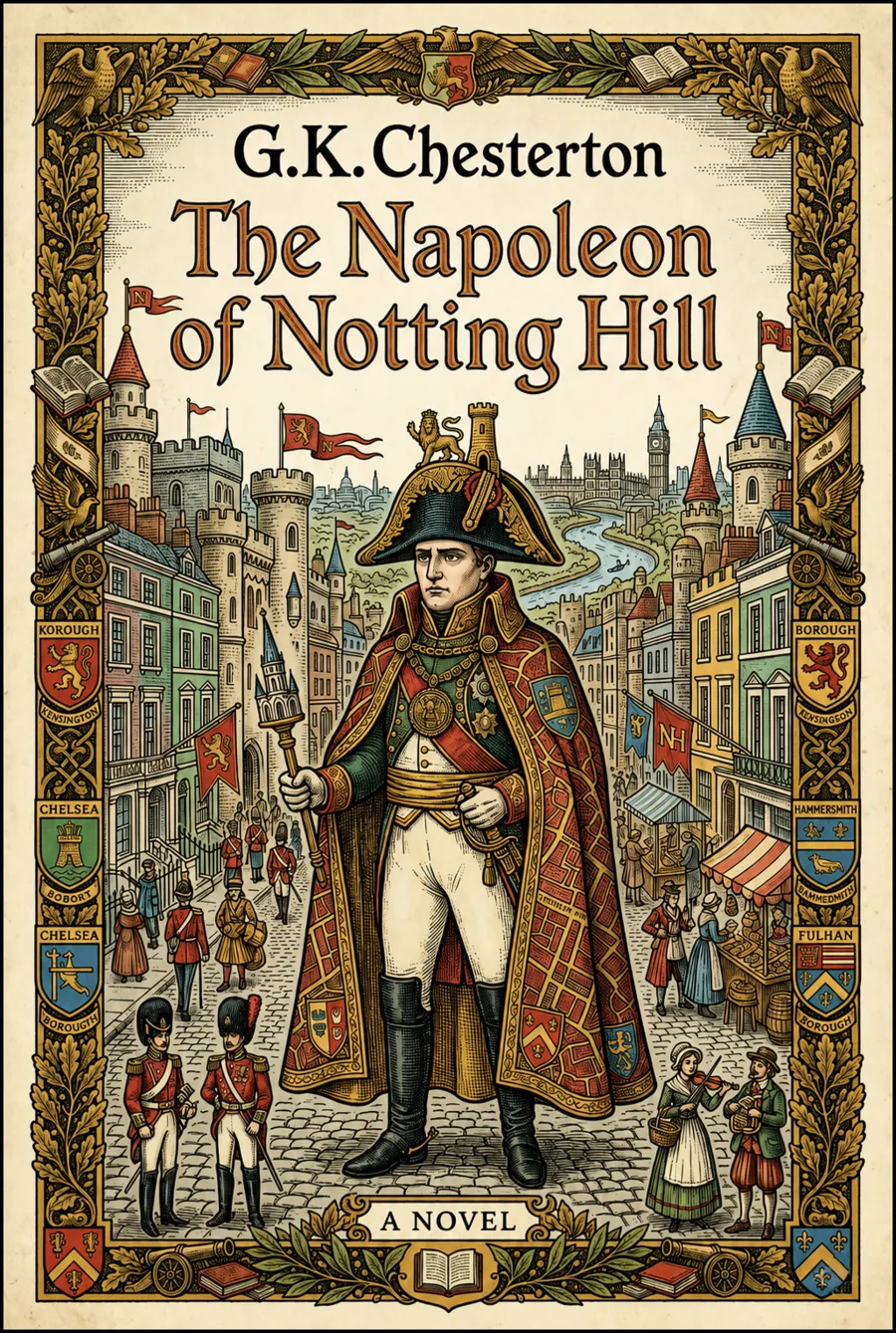
Download Cover Image
Do you want to download the full cover image for The Napoleon of Notting Hill?