
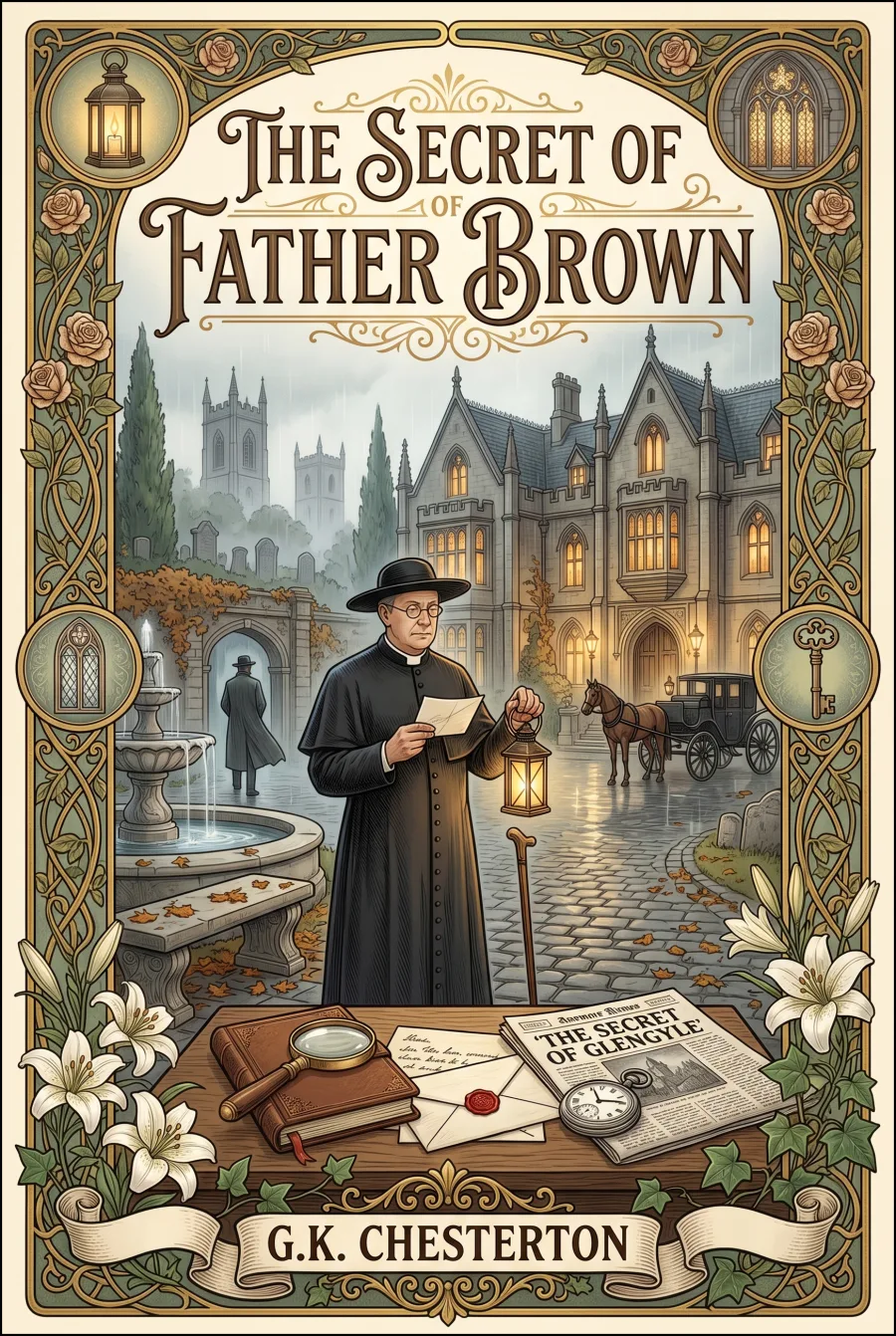
The Secret of Father Brown
eBook
• INR 51.00
• English
• 9788169359825
No ratings yet
| Publisher | General Press |
|---|---|
| ISBN13 | 9788169359825 |
| Book Format | eBook |
| Language | English |
| List Price | INR 51.00 |
| Subject Code | FIC022030, FIC022100, FIC022050 |
| Publishing Date | 05/09/2026 |
| Book Code | BD00070402 |
Buy this Book
Amazon Stores
Ebook Stores
Other Stores
Discover The Secret of Father Brown by G.K. Chesterton. This book is published by General Press in eBook format, ISBN 9788169359825, under Literature and Fiction, Traditional Detective Mysteries, Amateur Sleuths Mystery.
Book Description
A crime may look impossible from the outside, but to Father Brown, the most important clue is often hidden inside the mind of the person who committed it. "The Secret of Father Brown" by G. K. Chesterton is a classic collection of detective fiction and mystery stories that follows the quiet Catholic priest as he confronts ingenious crimes, deceptive appearances, and criminals whose motives are far more revealing than the evidence they leave behind.
The collection brings together a series of mysteries in which Father Brown once again proves that extraordinary detective work does not always require scientific equipment, dramatic interrogations, or elaborate theories. His greatest advantage is his understanding of human nature. He knows that people are capable of lying, rationalizing their behavior, giving in to temptation, and hiding their darkest impulses behind respectable appearances. By imagining how a criminal might think, Father Brown often finds his way toward the truth.
Across the stories, Father Brown encounters murders, thefts, disappearances, mysterious deaths, and crimes that initially seem to have supernatural or impossible explanations. Chesterton deliberately creates situations that challenge conventional detective reasoning. Strange clues and unexpected circumstances encourage both the characters and the reader to follow one explanation, only for Father Brown to reveal a different and often surprisingly simple truth.
The collection also develops the unusual relationship between Father Brown and Flambeau, a former criminal who becomes an important figure in the stories. Their contrasting perspectives add another layer to the mysteries. Flambeau understands the techniques and ambitions of criminals from experience, while Father Brown approaches wrongdoing from a moral and psychological perspective. Together, their interactions highlight Chesterton’s interest in the boundary between crime and conscience.
First published in 1927, "The Secret of Father Brown" combines entertaining puzzles with deeper reflections on morality, guilt, justice, forgiveness, and the complicated motives that influence human behavior. Father Brown’s religious beliefs are central to his method, but the stories remain accessible even to readers approaching them simply as classic detective mysteries.
For anyone searching for Father Brown stories, G. K. Chesterton mysteries, classic detective fiction, or intelligent crime stories with philosophical depth, this collection offers a distinctive reading experience. Each case begins with uncertainty and deception, but Father Brown sees beyond the surface—and the secret he uncovers may be hiding in a place no ordinary detective thought to look.
The collection brings together a series of mysteries in which Father Brown once again proves that extraordinary detective work does not always require scientific equipment, dramatic interrogations, or elaborate theories. His greatest advantage is his understanding of human nature. He knows that people are capable of lying, rationalizing their behavior, giving in to temptation, and hiding their darkest impulses behind respectable appearances. By imagining how a criminal might think, Father Brown often finds his way toward the truth.
Across the stories, Father Brown encounters murders, thefts, disappearances, mysterious deaths, and crimes that initially seem to have supernatural or impossible explanations. Chesterton deliberately creates situations that challenge conventional detective reasoning. Strange clues and unexpected circumstances encourage both the characters and the reader to follow one explanation, only for Father Brown to reveal a different and often surprisingly simple truth.
The collection also develops the unusual relationship between Father Brown and Flambeau, a former criminal who becomes an important figure in the stories. Their contrasting perspectives add another layer to the mysteries. Flambeau understands the techniques and ambitions of criminals from experience, while Father Brown approaches wrongdoing from a moral and psychological perspective. Together, their interactions highlight Chesterton’s interest in the boundary between crime and conscience.
First published in 1927, "The Secret of Father Brown" combines entertaining puzzles with deeper reflections on morality, guilt, justice, forgiveness, and the complicated motives that influence human behavior. Father Brown’s religious beliefs are central to his method, but the stories remain accessible even to readers approaching them simply as classic detective mysteries.
For anyone searching for Father Brown stories, G. K. Chesterton mysteries, classic detective fiction, or intelligent crime stories with philosophical depth, this collection offers a distinctive reading experience. Each case begins with uncertainty and deception, but Father Brown sees beyond the surface—and the secret he uncovers may be hiding in a place no ordinary detective thought to look.
Author Biography
Gilbert Keith Chesterton (1874–1936) was a man who literally and figuratively took up an enormous amount of space in the world. Standing six feet four inches tall and weighing nearly 300 pounds, he was an instantly recognizable figure in early 20th-century London, known for his trademark cape, crumpled hat, and ever-present cigar. Far more massive than his physical frame, however, was his intellectual output and his boundless capacity for wonder. Originally trained in illustration at art school, Chesterton soon found his true calling in journalism and literature, embarking on a career that would make him one of the most prolific, joyful defenders of Christianity, the family, and everyday common sense.
Often celebrated for his unique literary style, Chesterton possessed an uncanny ability to turn an argument on its head using paradox to reveal deeper, often neglected truths. Across his lifetime, he authored over a hundred books, roughly two hundred short stories, and more than 4,000 newspaper essays. His philosophical masterpieces, notably ‘Orthodoxy’ and ‘The Everlasting Man’, profoundly shaped modern Christian apologetics; the latter famously played a crucial role in the conversion of a young atheist named C.S. Lewis. Yet, despite the sheer depth of his intellect, Chesterton wrote with an intoxicating lightness and humor that made complex theology accessible and highly engaging.
In the realm of fiction, Chesterton is most widely celebrated for creating the beloved priest-detective, Father Brown. Unlike Sherlock Holmes, who relied on cold, clinical deduction, Father Brown solved grisly crimes through deep empathy and a profound psychological understanding of human brokenness—a perspective he honed in the confessional box. This focus on spiritual redemption over mere justice highlighted Chesterton’s own deepening faith, which ultimately culminated in his formal conversion to Roman Catholicism in 1922.
Though he passed away in 1936, G.K. Chesterton's legacy remains vibrantly alive today. He was a ferocious public debater who frequently sparred with intellectual heavyweights like George Bernard Shaw and H.G. Wells, yet he loved his opponents dearly and never let philosophical disagreements destroy a personal friendship. Modern readers from all walks of life continue to turn to Chesterton for his infectious optimism, his profoundly charitable spirit, and his timeless reminder that the ordinary world is a place of profound magic and meaning.
Often celebrated for his unique literary style, Chesterton possessed an uncanny ability to turn an argument on its head using paradox to reveal deeper, often neglected truths. Across his lifetime, he authored over a hundred books, roughly two hundred short stories, and more than 4,000 newspaper essays. His philosophical masterpieces, notably ‘Orthodoxy’ and ‘The Everlasting Man’, profoundly shaped modern Christian apologetics; the latter famously played a crucial role in the conversion of a young atheist named C.S. Lewis. Yet, despite the sheer depth of his intellect, Chesterton wrote with an intoxicating lightness and humor that made complex theology accessible and highly engaging.
In the realm of fiction, Chesterton is most widely celebrated for creating the beloved priest-detective, Father Brown. Unlike Sherlock Holmes, who relied on cold, clinical deduction, Father Brown solved grisly crimes through deep empathy and a profound psychological understanding of human brokenness—a perspective he honed in the confessional box. This focus on spiritual redemption over mere justice highlighted Chesterton’s own deepening faith, which ultimately culminated in his formal conversion to Roman Catholicism in 1922.
Though he passed away in 1936, G.K. Chesterton's legacy remains vibrantly alive today. He was a ferocious public debater who frequently sparred with intellectual heavyweights like George Bernard Shaw and H.G. Wells, yet he loved his opponents dearly and never let philosophical disagreements destroy a personal friendship. Modern readers from all walks of life continue to turn to Chesterton for his infectious optimism, his profoundly charitable spirit, and his timeless reminder that the ordinary world is a place of profound magic and meaning.
Editorial Reviews
Editorial Reviews will be added soon…
Book Summary
'The Secret of Father Brown' by G. K. Chesterton is a collection of ten detective stories featuring Father Brown, the quiet, short, seemingly ordinary Catholic priest who solves crimes not through scientific equipment, dramatic deduction, or the authority of the police, but through an unusually deep understanding of human nature. First published in 1927, the collection is one of the most memorable works in Chesterton’s Father Brown series. At the heart of these stories is a simple but powerful idea: to understand a crime, one must understand the mind of the criminal. Father Brown succeeds because he is able to imagine temptation, fear, pride, anger, greed, jealousy, and guilt from the inside. His secret is not a mysterious supernatural power. It is his intimate knowledge of the weaknesses of the human heart, developed through his experience as a priest who has listened to people's confessions and confronted the darker possibilities of human behavior.
Unlike many traditional fictional detectives, Father Brown does not look impressive when he first appears. He is small, modestly dressed, absent-minded in his manner, and often seems almost invisible in a room filled with more confident personalities. He does not behave like a brilliant detective eager to demonstrate his intelligence. Instead, he observes quietly and speaks with simplicity. Yet behind his ordinary appearance is a remarkably disciplined mind. He understands that people often commit crimes for reasons that are hidden beneath respectable appearances. A gentleman can be a murderer, an apparently helpless person can be dangerous, and a situation that looks impossible may become understandable once the emotional motives of the people involved are examined.
The title of the collection, 'The Secret of Father Brown', refers to the central method that connects all ten stories. Father Brown explains that he solves crimes partly because he has learned to imagine himself as the criminal. This does not mean that he approves of crime or possesses some dark personality. Quite the opposite is true. His moral and religious awareness allows him to recognize the temptations that can lead an ordinary person toward terrible actions. He knows that human beings are capable of both goodness and evil, and he refuses to assume that wickedness belongs only to obvious villains. For Father Brown, the real mystery is often not how a crime was physically committed but how an apparently normal human being became capable of committing it.
In the opening story, “The Secret of Father Brown,” Chesterton directly presents the philosophy behind his detective's method. Father Brown is asked how he repeatedly discovers the truth when other investigators fail. His answer challenges the conventional image of detective work. Instead of depending entirely upon footprints, fingerprints, weapons, or complicated chains of physical evidence, he imagines the criminal's state of mind. He considers what he himself might do if he were driven by the same motive, surrounded by the same circumstances, and tempted by the same opportunity. This method gives Father Brown an unusual advantage. While other detectives may examine the outside of a crime, he examines the human interior that produced it.
“The Mirror of the Magistrate” continues the collection's exploration of deception and appearances. The story demonstrates how easily people can be misled when they trust what seems obvious. Father Brown is constantly aware that appearances can be deliberately arranged to create a false conclusion. The criminal may construct a scene that encourages investigators to believe one particular story, while the actual truth lies elsewhere. Father Brown's strength is his unwillingness to accept the first explanation simply because it looks convincing. He knows that clever criminals often depend more upon psychology than upon physical skill.
In “The Man with Two Beards,” Chesterton explores the relationship between appearance and identity. The story plays with the idea that people can create entirely different impressions of themselves through small changes in appearance and behavior. Father Brown understands that identity is not always as stable or transparent as people imagine. A person's clothing, face, reputation, and social position can become tools of deception. The story therefore reflects one of the collection's larger concerns: the danger of judging people according to superficial evidence. Someone may look innocent because he has learned how innocence is supposed to look.
“The Song of the Flying Fish” brings together mystery, unusual circumstances, and the recurring Chestertonian contrast between the ordinary and the extraordinary. Father Brown does not become fascinated by the strange merely because it is strange. He searches for the rational explanation behind it. Chesterton frequently creates situations that appear almost supernatural, only to reveal that human ingenuity, manipulation, or mistaken assumptions have produced the mystery. This is one of the pleasures of Father Brown's stories. The reader is encouraged to believe that something impossible has occurred, but Father Brown calmly asks whether the impossible explanation is really necessary.
“The Actor and the Alibi” examines the ways in which performance can become a weapon. Acting is naturally associated with pretending to be someone else, and Chesterton uses this idea to explore the relationship between theatrical performance and criminal deception. An alibi may appear convincing because it has been carefully staged, but Father Brown understands that a convincing performance is not the same thing as truth. The story highlights his ability to distinguish between what people want others to see and what they are actually doing. His detective work becomes a study of human performance, where criminals act out identities just as actors play characters on a stage.
In “The Vanishing of Vaudrey,” the mystery once again depends upon the difference between reality and perception. Chesterton is particularly interested in the ways people can disappear socially or psychologically even when they have not physically vanished. Names, reputations, identities, and assumptions can be manipulated until the truth becomes difficult to recognize. Father Brown's method is to look beneath these layers of confusion. He does not allow the mystery's unusual surface to distract him from the fundamental question of what people are trying to achieve.
“The Worst Crime in the World” is particularly important because it expands the collection beyond the question of who committed a particular crime. Chesterton is interested in the moral dimension of wrongdoing and in the possibility that some crimes are more deeply destructive than their outward appearance suggests. Father Brown's religious understanding makes him especially sensitive to the difference between legal guilt and moral responsibility. A person may escape punishment while still being morally corrupt, while another person may appear suspicious despite having a conscience that ultimately prevents him from doing wrong. Through Father Brown, Chesterton repeatedly reminds the reader that morality cannot be reduced to a courtroom verdict.
“The Red Moon” is another example of Chesterton's ability to construct a mysterious atmosphere around apparently inexplicable events. The story encourages the reader to consider supernatural or extraordinary explanations, but Father Brown remains grounded. He recognizes that fear itself can become a tool of manipulation. People who believe they are witnessing something impossible may become incapable of noticing the ordinary facts surrounding them. Father Brown's calmness becomes a form of intellectual courage. He refuses to surrender reason simply because a situation is frightening.
“The Arrow of Heaven” explores crime, reputation, and the danger of assuming that public perception corresponds to reality. The story demonstrates how an individual can be judged by circumstances that have been carefully arranged by another person. Father Brown's investigations repeatedly show that criminals do not merely hide evidence; they also manufacture stories. They understand that human beings want simple explanations. If investigators are given a believable story, they may stop searching for the truth. Father Brown is difficult to deceive because he remains skeptical of stories that seem too neatly constructed.
The final story, “The Oracle of the Dog,” brings together many of the collection's characteristic elements: an apparently supernatural mystery, conflicting interpretations, strange circumstances, and Father Brown's patient search for a rational explanation. The presence of a dog and the suggestion that the animal possesses some mysterious knowledge contribute to the story's atmosphere of uncertainty. Yet Father Brown refuses to attribute human intelligence or supernatural powers to an animal merely because people are frightened or confused. His reasoning demonstrates Chesterton's broader belief that mystery should not automatically lead to superstition. The world can be strange without requiring irrational explanations.
Across the collection, Father Brown repeatedly encounters people who make the same basic mistake: they believe that evil must have a recognizable face. Chesterton challenges this assumption. The murderer may be cultured, religious, wealthy, charming, respected, or apparently helpless. Conversely, someone who looks suspicious may be innocent. Father Brown therefore pays close attention to motives rather than appearances. He understands that a person's social identity tells us very little about what that person might do under pressure. This psychological realism gives the stories their enduring strength.
Religion is also central to Father Brown's character, but the stories are not simply religious sermons disguised as mysteries. Father Brown's faith shapes the way he understands human beings. He believes that people are capable of terrible wrongdoing, but he also believes that they can repent and change. This prevents him from becoming a cold or purely analytical detective. He is interested in justice, but he is also interested in the soul of the person who committed the crime. His understanding of evil is therefore complicated by compassion. He can condemn an action without reducing the person who committed it to a monster.
Another important theme is the conflict between reason and superstition. Chesterton frequently creates crimes that seem to involve ghosts, curses, mysterious creatures, impossible disappearances, or supernatural forces. The reader is encouraged to entertain extraordinary possibilities, but Father Brown generally discovers that the truth is rooted in human behavior. His rationalism is not based on a belief that life is simple. Instead, he recognizes that people themselves are extraordinarily complicated. A human being with intelligence, imagination, fear, and selfishness can create a mystery that looks supernatural.
The stories also reveal Chesterton's criticism of excessive confidence in modern investigative methods. Science and forensic evidence have their place, but Chesterton suggests that no amount of technical knowledge can replace an understanding of character. Evidence must be interpreted by human beings, and human beings can be deceived. Father Brown's advantage is that he understands how criminals think. He knows that a murderer may deliberately leave misleading evidence, exploit assumptions, manipulate witnesses, or create an artificial sense of impossibility. The best detective, therefore, is not simply the person who notices the most facts but the person who understands what those facts mean.
Father Brown's modest personality makes these ideas even more effective. He does not seek fame. He rarely celebrates his victories. When he reveals the truth, he often does so almost casually, as though solving the mystery were simply another responsibility. His humility contrasts sharply with detectives who treat crime-solving as a competition of intelligence. Father Brown's goal is not to prove that he is cleverer than everyone else. He wants to prevent injustice and, where possible, understand the person who has gone wrong.
Ultimately, 'The Secret of Father Brown' is much more than a collection of classic detective stories. It is a study of human nature presented through mystery, suspense, irony, and carefully constructed puzzles. Each story asks the reader to look beyond appearances and to consider the motives that exist beneath ordinary behavior. Father Brown's greatest gift is his ability to recognize that evil does not always announce itself and that innocence is not always visually convincing. His method is deeply humane because it begins with the recognition that every criminal is still a human being who has made terrible choices.
For readers looking for a detailed summary of 'The Secret of Father Brown', the central message is that understanding crime requires understanding people. Father Brown solves mysteries by combining observation, logic, moral insight, and an intimate knowledge of temptation. He sees through disguises because he understands why people create them; he rejects supernatural explanations because he knows how inventive human beings can be; and he recognizes criminals because he understands the weaknesses that exist in every human heart. G. K. Chesterton uses these mysteries to create something richer than simple detective entertainment. He asks readers to question appearances, distrust easy conclusions, and recognize the complexity of human motives. Father Brown remains memorable not because he is the most spectacular detective, but because he is perhaps the most compassionate and psychologically perceptive one. His quiet presence turns each crime into an examination of conscience, reminding us that the deepest mysteries are often not hidden objects, secret rooms, or impossible murders, but the strange and sometimes frightening capacity of ordinary people to choose between good and evil.
Unlike many traditional fictional detectives, Father Brown does not look impressive when he first appears. He is small, modestly dressed, absent-minded in his manner, and often seems almost invisible in a room filled with more confident personalities. He does not behave like a brilliant detective eager to demonstrate his intelligence. Instead, he observes quietly and speaks with simplicity. Yet behind his ordinary appearance is a remarkably disciplined mind. He understands that people often commit crimes for reasons that are hidden beneath respectable appearances. A gentleman can be a murderer, an apparently helpless person can be dangerous, and a situation that looks impossible may become understandable once the emotional motives of the people involved are examined.
The title of the collection, 'The Secret of Father Brown', refers to the central method that connects all ten stories. Father Brown explains that he solves crimes partly because he has learned to imagine himself as the criminal. This does not mean that he approves of crime or possesses some dark personality. Quite the opposite is true. His moral and religious awareness allows him to recognize the temptations that can lead an ordinary person toward terrible actions. He knows that human beings are capable of both goodness and evil, and he refuses to assume that wickedness belongs only to obvious villains. For Father Brown, the real mystery is often not how a crime was physically committed but how an apparently normal human being became capable of committing it.
In the opening story, “The Secret of Father Brown,” Chesterton directly presents the philosophy behind his detective's method. Father Brown is asked how he repeatedly discovers the truth when other investigators fail. His answer challenges the conventional image of detective work. Instead of depending entirely upon footprints, fingerprints, weapons, or complicated chains of physical evidence, he imagines the criminal's state of mind. He considers what he himself might do if he were driven by the same motive, surrounded by the same circumstances, and tempted by the same opportunity. This method gives Father Brown an unusual advantage. While other detectives may examine the outside of a crime, he examines the human interior that produced it.
“The Mirror of the Magistrate” continues the collection's exploration of deception and appearances. The story demonstrates how easily people can be misled when they trust what seems obvious. Father Brown is constantly aware that appearances can be deliberately arranged to create a false conclusion. The criminal may construct a scene that encourages investigators to believe one particular story, while the actual truth lies elsewhere. Father Brown's strength is his unwillingness to accept the first explanation simply because it looks convincing. He knows that clever criminals often depend more upon psychology than upon physical skill.
In “The Man with Two Beards,” Chesterton explores the relationship between appearance and identity. The story plays with the idea that people can create entirely different impressions of themselves through small changes in appearance and behavior. Father Brown understands that identity is not always as stable or transparent as people imagine. A person's clothing, face, reputation, and social position can become tools of deception. The story therefore reflects one of the collection's larger concerns: the danger of judging people according to superficial evidence. Someone may look innocent because he has learned how innocence is supposed to look.
“The Song of the Flying Fish” brings together mystery, unusual circumstances, and the recurring Chestertonian contrast between the ordinary and the extraordinary. Father Brown does not become fascinated by the strange merely because it is strange. He searches for the rational explanation behind it. Chesterton frequently creates situations that appear almost supernatural, only to reveal that human ingenuity, manipulation, or mistaken assumptions have produced the mystery. This is one of the pleasures of Father Brown's stories. The reader is encouraged to believe that something impossible has occurred, but Father Brown calmly asks whether the impossible explanation is really necessary.
“The Actor and the Alibi” examines the ways in which performance can become a weapon. Acting is naturally associated with pretending to be someone else, and Chesterton uses this idea to explore the relationship between theatrical performance and criminal deception. An alibi may appear convincing because it has been carefully staged, but Father Brown understands that a convincing performance is not the same thing as truth. The story highlights his ability to distinguish between what people want others to see and what they are actually doing. His detective work becomes a study of human performance, where criminals act out identities just as actors play characters on a stage.
In “The Vanishing of Vaudrey,” the mystery once again depends upon the difference between reality and perception. Chesterton is particularly interested in the ways people can disappear socially or psychologically even when they have not physically vanished. Names, reputations, identities, and assumptions can be manipulated until the truth becomes difficult to recognize. Father Brown's method is to look beneath these layers of confusion. He does not allow the mystery's unusual surface to distract him from the fundamental question of what people are trying to achieve.
“The Worst Crime in the World” is particularly important because it expands the collection beyond the question of who committed a particular crime. Chesterton is interested in the moral dimension of wrongdoing and in the possibility that some crimes are more deeply destructive than their outward appearance suggests. Father Brown's religious understanding makes him especially sensitive to the difference between legal guilt and moral responsibility. A person may escape punishment while still being morally corrupt, while another person may appear suspicious despite having a conscience that ultimately prevents him from doing wrong. Through Father Brown, Chesterton repeatedly reminds the reader that morality cannot be reduced to a courtroom verdict.
“The Red Moon” is another example of Chesterton's ability to construct a mysterious atmosphere around apparently inexplicable events. The story encourages the reader to consider supernatural or extraordinary explanations, but Father Brown remains grounded. He recognizes that fear itself can become a tool of manipulation. People who believe they are witnessing something impossible may become incapable of noticing the ordinary facts surrounding them. Father Brown's calmness becomes a form of intellectual courage. He refuses to surrender reason simply because a situation is frightening.
“The Arrow of Heaven” explores crime, reputation, and the danger of assuming that public perception corresponds to reality. The story demonstrates how an individual can be judged by circumstances that have been carefully arranged by another person. Father Brown's investigations repeatedly show that criminals do not merely hide evidence; they also manufacture stories. They understand that human beings want simple explanations. If investigators are given a believable story, they may stop searching for the truth. Father Brown is difficult to deceive because he remains skeptical of stories that seem too neatly constructed.
The final story, “The Oracle of the Dog,” brings together many of the collection's characteristic elements: an apparently supernatural mystery, conflicting interpretations, strange circumstances, and Father Brown's patient search for a rational explanation. The presence of a dog and the suggestion that the animal possesses some mysterious knowledge contribute to the story's atmosphere of uncertainty. Yet Father Brown refuses to attribute human intelligence or supernatural powers to an animal merely because people are frightened or confused. His reasoning demonstrates Chesterton's broader belief that mystery should not automatically lead to superstition. The world can be strange without requiring irrational explanations.
Across the collection, Father Brown repeatedly encounters people who make the same basic mistake: they believe that evil must have a recognizable face. Chesterton challenges this assumption. The murderer may be cultured, religious, wealthy, charming, respected, or apparently helpless. Conversely, someone who looks suspicious may be innocent. Father Brown therefore pays close attention to motives rather than appearances. He understands that a person's social identity tells us very little about what that person might do under pressure. This psychological realism gives the stories their enduring strength.
Religion is also central to Father Brown's character, but the stories are not simply religious sermons disguised as mysteries. Father Brown's faith shapes the way he understands human beings. He believes that people are capable of terrible wrongdoing, but he also believes that they can repent and change. This prevents him from becoming a cold or purely analytical detective. He is interested in justice, but he is also interested in the soul of the person who committed the crime. His understanding of evil is therefore complicated by compassion. He can condemn an action without reducing the person who committed it to a monster.
Another important theme is the conflict between reason and superstition. Chesterton frequently creates crimes that seem to involve ghosts, curses, mysterious creatures, impossible disappearances, or supernatural forces. The reader is encouraged to entertain extraordinary possibilities, but Father Brown generally discovers that the truth is rooted in human behavior. His rationalism is not based on a belief that life is simple. Instead, he recognizes that people themselves are extraordinarily complicated. A human being with intelligence, imagination, fear, and selfishness can create a mystery that looks supernatural.
The stories also reveal Chesterton's criticism of excessive confidence in modern investigative methods. Science and forensic evidence have their place, but Chesterton suggests that no amount of technical knowledge can replace an understanding of character. Evidence must be interpreted by human beings, and human beings can be deceived. Father Brown's advantage is that he understands how criminals think. He knows that a murderer may deliberately leave misleading evidence, exploit assumptions, manipulate witnesses, or create an artificial sense of impossibility. The best detective, therefore, is not simply the person who notices the most facts but the person who understands what those facts mean.
Father Brown's modest personality makes these ideas even more effective. He does not seek fame. He rarely celebrates his victories. When he reveals the truth, he often does so almost casually, as though solving the mystery were simply another responsibility. His humility contrasts sharply with detectives who treat crime-solving as a competition of intelligence. Father Brown's goal is not to prove that he is cleverer than everyone else. He wants to prevent injustice and, where possible, understand the person who has gone wrong.
Ultimately, 'The Secret of Father Brown' is much more than a collection of classic detective stories. It is a study of human nature presented through mystery, suspense, irony, and carefully constructed puzzles. Each story asks the reader to look beyond appearances and to consider the motives that exist beneath ordinary behavior. Father Brown's greatest gift is his ability to recognize that evil does not always announce itself and that innocence is not always visually convincing. His method is deeply humane because it begins with the recognition that every criminal is still a human being who has made terrible choices.
For readers looking for a detailed summary of 'The Secret of Father Brown', the central message is that understanding crime requires understanding people. Father Brown solves mysteries by combining observation, logic, moral insight, and an intimate knowledge of temptation. He sees through disguises because he understands why people create them; he rejects supernatural explanations because he knows how inventive human beings can be; and he recognizes criminals because he understands the weaknesses that exist in every human heart. G. K. Chesterton uses these mysteries to create something richer than simple detective entertainment. He asks readers to question appearances, distrust easy conclusions, and recognize the complexity of human motives. Father Brown remains memorable not because he is the most spectacular detective, but because he is perhaps the most compassionate and psychologically perceptive one. His quiet presence turns each crime into an examination of conscience, reminding us that the deepest mysteries are often not hidden objects, secret rooms, or impossible murders, but the strange and sometimes frightening capacity of ordinary people to choose between good and evil.
Sample Chapters
Sample Chapters will be added soon…
Reader Reviews
No reviews yet.
The Secret of Father Brown
Download Cover Image
Do you want to download the full cover image for The Secret of Father Brown?