
The Wisdom of Father Brown
eBook
• INR 51.00
• English
• 9788169359849
No ratings yet
| Publisher | General Press |
|---|---|
| ISBN13 | 9788169359849 |
| Book Format | eBook |
| Language | English |
| List Price | INR 51.00 |
| Subject Code | FIC022030, FIC022100, FIC022050 |
| Publishing Date | 05/09/2026 |
| Book Code | BD00070404 |
Buy this Book
Amazon Stores
Ebook Stores
Other Stores
Discover The Wisdom of Father Brown by G.K. Chesterton. This book is published by General Press in eBook format, ISBN 9788169359849, under Literature and Fiction, Traditional Detective Mysteries, Amateur Sleuths Mystery.
Book Description
A murder can be hidden behind an ordinary face, a respectable reputation, or even an apparently impossible set of circumstances, but Father Brown has learned that human nature often reveals what evidence conceals. "The Wisdom of Father Brown" by G. K. Chesterton is a classic collection of detective fiction and mystery stories that follows the unassuming priest as he investigates strange crimes while using his remarkable understanding of guilt, temptation, fear, and human weakness.
The collection features a series of cases in which Father Brown encounters murder, theft, deception, disappearance, and other puzzling crimes. Each mystery presents a challenge that appears difficult to solve, often because the obvious explanation points in the wrong direction. Rather than becoming distracted by dramatic clues or elaborate theories, Father Brown quietly examines the people involved. He understands that a crime is not simply an event to reconstruct; it is an act committed by a human being with particular desires, fears, and weaknesses.
One of the most distinctive features of these stories is Father Brown himself. He does not resemble the traditional brilliant detective. He is modest, ordinary-looking, and usually more interested in listening than displaying his intelligence. Yet his religious vocation gives him a deep familiarity with the darker sides of human behavior. He understands both the possibility of wrongdoing and the possibility of repentance, allowing him to approach criminals with a perspective that is different from that of the police or conventional investigators.
Chesterton also delights in creating mysteries that initially seem to have supernatural or impossible explanations. Strange events, unexpected deaths, suspicious coincidences, secret motives, and apparently unexplainable circumstances keep readers guessing. The solutions, however, usually emerge from careful attention to psychology and ordinary human behavior rather than from anything truly supernatural. This balance between mystery and moral insight gives the collection its distinctive character.
First published in 1914, "The Wisdom of Father Brown" is one of the best-known collections featuring Chesterton’s celebrated detective. The stories are entertaining on the surface but also explore deeper questions about morality, justice, pride, forgiveness, and the ways people deceive themselves. For readers interested in Father Brown mysteries, classic detective fiction, G. K. Chesterton, or crime stories with philosophical depth, this collection remains highly rewarding.
Every case begins with uncertainty, but Father Brown knows that the most revealing clue may not be found at the scene of the crime at all. It may be hidden within the person who committed it—and discovering that secret is where the real mystery begins.
The collection features a series of cases in which Father Brown encounters murder, theft, deception, disappearance, and other puzzling crimes. Each mystery presents a challenge that appears difficult to solve, often because the obvious explanation points in the wrong direction. Rather than becoming distracted by dramatic clues or elaborate theories, Father Brown quietly examines the people involved. He understands that a crime is not simply an event to reconstruct; it is an act committed by a human being with particular desires, fears, and weaknesses.
One of the most distinctive features of these stories is Father Brown himself. He does not resemble the traditional brilliant detective. He is modest, ordinary-looking, and usually more interested in listening than displaying his intelligence. Yet his religious vocation gives him a deep familiarity with the darker sides of human behavior. He understands both the possibility of wrongdoing and the possibility of repentance, allowing him to approach criminals with a perspective that is different from that of the police or conventional investigators.
Chesterton also delights in creating mysteries that initially seem to have supernatural or impossible explanations. Strange events, unexpected deaths, suspicious coincidences, secret motives, and apparently unexplainable circumstances keep readers guessing. The solutions, however, usually emerge from careful attention to psychology and ordinary human behavior rather than from anything truly supernatural. This balance between mystery and moral insight gives the collection its distinctive character.
First published in 1914, "The Wisdom of Father Brown" is one of the best-known collections featuring Chesterton’s celebrated detective. The stories are entertaining on the surface but also explore deeper questions about morality, justice, pride, forgiveness, and the ways people deceive themselves. For readers interested in Father Brown mysteries, classic detective fiction, G. K. Chesterton, or crime stories with philosophical depth, this collection remains highly rewarding.
Every case begins with uncertainty, but Father Brown knows that the most revealing clue may not be found at the scene of the crime at all. It may be hidden within the person who committed it—and discovering that secret is where the real mystery begins.
Author Biography
Gilbert Keith Chesterton (1874–1936) was a man who literally and figuratively took up an enormous amount of space in the world. Standing six feet four inches tall and weighing nearly 300 pounds, he was an instantly recognizable figure in early 20th-century London, known for his trademark cape, crumpled hat, and ever-present cigar. Far more massive than his physical frame, however, was his intellectual output and his boundless capacity for wonder. Originally trained in illustration at art school, Chesterton soon found his true calling in journalism and literature, embarking on a career that would make him one of the most prolific, joyful defenders of Christianity, the family, and everyday common sense.
Often celebrated for his unique literary style, Chesterton possessed an uncanny ability to turn an argument on its head using paradox to reveal deeper, often neglected truths. Across his lifetime, he authored over a hundred books, roughly two hundred short stories, and more than 4,000 newspaper essays. His philosophical masterpieces, notably ‘Orthodoxy’ and ‘The Everlasting Man’, profoundly shaped modern Christian apologetics; the latter famously played a crucial role in the conversion of a young atheist named C.S. Lewis. Yet, despite the sheer depth of his intellect, Chesterton wrote with an intoxicating lightness and humor that made complex theology accessible and highly engaging.
In the realm of fiction, Chesterton is most widely celebrated for creating the beloved priest-detective, Father Brown. Unlike Sherlock Holmes, who relied on cold, clinical deduction, Father Brown solved grisly crimes through deep empathy and a profound psychological understanding of human brokenness—a perspective he honed in the confessional box. This focus on spiritual redemption over mere justice highlighted Chesterton’s own deepening faith, which ultimately culminated in his formal conversion to Roman Catholicism in 1922.
Though he passed away in 1936, G.K. Chesterton's legacy remains vibrantly alive today. He was a ferocious public debater who frequently sparred with intellectual heavyweights like George Bernard Shaw and H.G. Wells, yet he loved his opponents dearly and never let philosophical disagreements destroy a personal friendship. Modern readers from all walks of life continue to turn to Chesterton for his infectious optimism, his profoundly charitable spirit, and his timeless reminder that the ordinary world is a place of profound magic and meaning.
Often celebrated for his unique literary style, Chesterton possessed an uncanny ability to turn an argument on its head using paradox to reveal deeper, often neglected truths. Across his lifetime, he authored over a hundred books, roughly two hundred short stories, and more than 4,000 newspaper essays. His philosophical masterpieces, notably ‘Orthodoxy’ and ‘The Everlasting Man’, profoundly shaped modern Christian apologetics; the latter famously played a crucial role in the conversion of a young atheist named C.S. Lewis. Yet, despite the sheer depth of his intellect, Chesterton wrote with an intoxicating lightness and humor that made complex theology accessible and highly engaging.
In the realm of fiction, Chesterton is most widely celebrated for creating the beloved priest-detective, Father Brown. Unlike Sherlock Holmes, who relied on cold, clinical deduction, Father Brown solved grisly crimes through deep empathy and a profound psychological understanding of human brokenness—a perspective he honed in the confessional box. This focus on spiritual redemption over mere justice highlighted Chesterton’s own deepening faith, which ultimately culminated in his formal conversion to Roman Catholicism in 1922.
Though he passed away in 1936, G.K. Chesterton's legacy remains vibrantly alive today. He was a ferocious public debater who frequently sparred with intellectual heavyweights like George Bernard Shaw and H.G. Wells, yet he loved his opponents dearly and never let philosophical disagreements destroy a personal friendship. Modern readers from all walks of life continue to turn to Chesterton for his infectious optimism, his profoundly charitable spirit, and his timeless reminder that the ordinary world is a place of profound magic and meaning.
Editorial Reviews
Editorial Reviews will be added soon…
Book Summary
'The Wisdom of Father Brown' by G. K. Chesterton is the second collection of stories featuring Father Brown, the quiet, unassuming Catholic priest who solves crimes not through dramatic displays of intelligence, forensic technology, or conventional detective methods, but through his deep understanding of human nature. First published in 1914, the book contains a series of mysteries in which apparently impossible crimes, strange disappearances, murders, thefts, and acts of deception are gradually explained through Father Brown’s ability to understand what people are capable of doing when driven by fear, pride, greed, guilt, jealousy, or desperation. The title is important because Father Brown’s greatest advantage is not simply cleverness. His “wisdom” comes from his knowledge of the human heart. He understands both goodness and evil, and because he does not assume that criminals are fundamentally different from ordinary people, he can often see the truth long before more worldly investigators do.
The stories in this collection continue the distinctive character of Father Brown established in 'The Innocence of Father Brown'. He is physically unimpressive, speaks simply, and often appears distracted or even foolish when first introduced. He does not resemble the glamorous detectives of popular fiction. He carries no aura of superiority and rarely tries to impress anyone. Yet behind his modest appearance is an exceptionally disciplined mind. Father Brown listens carefully, observes small details, and reconstructs the emotional and moral circumstances surrounding a crime. His method is based on imagination as much as deduction. Instead of asking only, “What happened?”, he asks, “What kind of person would do this, and why?” That question repeatedly leads him to solutions that seem surprising but become convincing once he explains them.
One of the most memorable stories in the collection is “The Absence of Mr. Glass.” The story begins with a mysterious situation involving a man who appears to have been murdered and another man who seems to have disappeared. The circumstances encourage the reader to imagine a conventional crime, complete with a missing victim and a possible murderer. Father Brown, however, recognizes that appearances are deliberately misleading. His investigation shows how easily people can construct a false story from incomplete evidence. Chesterton uses the mystery to demonstrate one of the central principles of Father Brown’s method: the obvious explanation is not always the most rational one. A detective who becomes too attached to the first interpretation of the evidence can be manipulated by someone who understands that human beings naturally create stories to fill gaps in what they know.
“The Paradise of Thieves” takes Father Brown into another complicated situation in which criminal motives are connected with political and social circumstances. The story illustrates Chesterton’s interest in the relationship between crime and ideology. People often imagine that political or revolutionary criminals are motivated by grand principles, but Father Brown looks beyond the language of ideals and examines the individual human beings involved. He understands that lofty political words can conceal ordinary motives such as ambition, revenge, fear, and greed. This ability to look behind appearances is one of the collection’s most important recurring ideas. Father Brown is suspicious not only of obvious criminals but also of overly convenient explanations.
In “The Man with Two Beards,” Chesterton explores the problem of identity and the difficulty of knowing what another person is truly like. The story involves a striking contrast between appearances and reality, and Father Brown's understanding of personality becomes more important than physical clues. Chesterton repeatedly challenges the assumption that a person's appearance tells us much about his moral character. A respectable person may conceal terrible intentions, while someone who looks suspicious may be entirely innocent. Father Brown does not judge people simply by their clothes, social position, manners, or reputation. Instead, he tries to understand the psychological possibilities hidden behind the public image.
“The Song of the Flying Fish” is another story in which the mystery seems to involve unusual circumstances and potentially impossible actions. As with many of Chesterton's detective stories, the unusual object or event becomes a distraction from the deeper human problem. Father Brown's strength lies in recognizing which details matter and which have been placed there to encourage the wrong conclusion. This is a recurring feature of 'The Wisdom of Father Brown': the reader is encouraged to look in one direction while the truth is quietly waiting somewhere else.
In “The Actor and the Alibi,” Chesterton turns his attention to performance and deception. The very idea of an actor provides a natural metaphor for crime because an actor deliberately creates an identity for an audience. Criminals can behave similarly. They perform innocence, construct false personalities, and manipulate the expectations of others. Father Brown understands that deception works because people want to believe appearances. If someone behaves as society expects an innocent person to behave, observers may stop looking for the truth. Father Brown therefore pays attention to the gap between performance and reality. He knows that a convincing appearance can be one of the strongest forms of concealment.
“The Vanishing of Vaudrey” continues this fascination with disappearance and mistaken assumptions. Chesterton often uses disappearance not merely as a physical mystery but as a psychological one. What does it mean for someone to “vanish”? Can a person disappear simply by changing his identity, circumstances, or social role? Father Brown's investigations repeatedly suggest that the human desire to categorize people makes us vulnerable to deception. Once we decide that someone is a certain kind of person, we may fail to recognize evidence that contradicts our assumptions.
“The Worst Crime in the World” is particularly significant because it pushes the reader beyond the ordinary question of who committed a crime. Chesterton is interested in the moral seriousness of wrongdoing and in the possibility that society sometimes misunderstands what constitutes the worst kind of evil. Father Brown's religious perspective becomes especially important here. He does not treat crime merely as a puzzle. Murder, deception, betrayal, and corruption have moral consequences. His understanding of evil is grounded in the belief that human beings are capable of terrible actions but are also capable of repentance. This gives his detective work a dimension that is different from purely secular crime fiction.
One of the most interesting aspects of Father Brown is that he understands criminals without excusing them. This distinction is central to his character. Because he is a priest, he has spent his life listening to confessions and confronting people with their weaknesses. He therefore knows how easily ordinary human emotions can become destructive. He does not imagine that criminals belong to some separate species of humanity. He knows that pride, resentment, greed, lust, envy, and fear exist within ordinary people. This knowledge makes him unusually effective as a detective. He can imagine committing a crime himself, not because he wants to commit one, but because he recognizes the weaknesses shared by all human beings.
This is also why Father Brown differs so strongly from Sherlock Holmes and other rational detectives of the period. Holmes typically approaches a mystery as an intellectual problem that can be solved through observation, evidence, and logical deduction. Father Brown certainly values logic, but his method adds moral and psychological insight. He tries to reconstruct the criminal's mind from the inside. His reasoning is not simply about physical possibilities; it is about what human beings are capable of believing and doing. Chesterton's great insight is that understanding evil can sometimes require a profound understanding of ordinary human weakness.
Another major theme in 'The Wisdom of Father Brown' is the danger of pride. Many crimes in Chesterton's fiction are made possible because someone believes he is cleverer than everyone else. Criminals often construct elaborate schemes because they are confident that other people will behave predictably. Father Brown defeats them partly because he refuses to underestimate human complexity. He recognizes that people can be irrational, emotional, impulsive, or surprisingly self-destructive. The criminal's plan may look brilliant on paper but fail because the criminal misunderstands the person he is trying to manipulate.
Chesterton also repeatedly examines the difference between innocence and wisdom. The title of the collection suggests that Father Brown possesses wisdom precisely because he does not possess worldly arrogance. He may appear naïve, but his apparent simplicity hides a realistic understanding of humanity. He knows that evil is real, yet he also knows that people are more complicated than the labels society gives them. His humility makes him observant. He does not need to dominate a room or demonstrate his superiority. He can remain quiet while others reveal themselves.
The religious dimension of the stories is equally important. Father Brown's Catholic faith is not merely an ornamental feature of his character. It shapes his entire approach to crime. He believes in sin, confession, conscience, forgiveness, and moral responsibility. Because he believes that people have free will, he does not regard criminals as helpless products of their circumstances. At the same time, because he believes in human weakness, he does not imagine that evil is something only monsters can commit. This combination of moral seriousness and compassion gives his judgments unusual depth.
Chesterton's writing style adds another layer to the collection. His stories are not simply straightforward detective puzzles. They often contain paradoxes, philosophical observations, unexpected reversals, and descriptions designed to challenge the reader's assumptions. He enjoys taking a familiar idea and turning it upside down. A respectable man may prove dangerous; a frightening situation may have an innocent explanation; an apparently supernatural event may have a completely rational cause. The stories invite readers to question what they think they know.
At the same time, Father Brown's solutions are usually satisfying because they emerge from character rather than arbitrary tricks. Chesterton does not merely reveal a hidden object or introduce an unknown fact at the last moment. The explanations often depend on understanding why a person behaved in a particular way. This gives the stories an emotional dimension. The mystery matters because the people involved matter. Behind every crime is a human decision, and behind every decision is a mixture of motives.
The collection can therefore be read as both detective fiction and a study of human nature. Readers searching for a summary of 'The Wisdom of Father Brown' will find that its individual mysteries differ greatly, but they are connected by Father Brown's consistent philosophy. He approaches every crime with humility, careful observation, psychological insight, and a profound awareness of morality. He does not assume that the most suspicious person is guilty, nor does he assume that respectable people are innocent. Instead, he looks for the explanation that best accounts for both the evidence and the human motives behind it.
Ultimately, 'The Wisdom of Father Brown' is about the limits of appearances and the importance of understanding people deeply. Father Brown's wisdom comes from accepting uncomfortable truths about human nature while refusing to give up on humanity itself. He knows that people can lie, betray, kill, manipulate, and deceive, but he also understands that people can regret their actions and change. His detective work is therefore never merely an intellectual game. Every mystery becomes an opportunity to explore the difference between appearance and reality, innocence and guilt, intelligence and wisdom, and punishment and forgiveness.
The enduring appeal of 'The Wisdom of Father Brown' lies in this unusual combination of mystery and humanity. The stories provide clever puzzles and surprising solutions, but their deepest interest is psychological and moral. Father Brown succeeds because he understands that crime begins not with mysterious footprints or strange objects but with a human mind making a choice. His greatest tool is his ability to imagine that mind without losing sight of the moral consequences of its actions. For readers who enjoy classic detective fiction, philosophical mysteries, psychological crime stories, and character-driven investigations, 'The Wisdom of Father Brown' remains a remarkably rewarding collection. It reminds us that the hardest mysteries are often not about discovering what happened, but about understanding why a human being was capable of making it happen.
The stories in this collection continue the distinctive character of Father Brown established in 'The Innocence of Father Brown'. He is physically unimpressive, speaks simply, and often appears distracted or even foolish when first introduced. He does not resemble the glamorous detectives of popular fiction. He carries no aura of superiority and rarely tries to impress anyone. Yet behind his modest appearance is an exceptionally disciplined mind. Father Brown listens carefully, observes small details, and reconstructs the emotional and moral circumstances surrounding a crime. His method is based on imagination as much as deduction. Instead of asking only, “What happened?”, he asks, “What kind of person would do this, and why?” That question repeatedly leads him to solutions that seem surprising but become convincing once he explains them.
One of the most memorable stories in the collection is “The Absence of Mr. Glass.” The story begins with a mysterious situation involving a man who appears to have been murdered and another man who seems to have disappeared. The circumstances encourage the reader to imagine a conventional crime, complete with a missing victim and a possible murderer. Father Brown, however, recognizes that appearances are deliberately misleading. His investigation shows how easily people can construct a false story from incomplete evidence. Chesterton uses the mystery to demonstrate one of the central principles of Father Brown’s method: the obvious explanation is not always the most rational one. A detective who becomes too attached to the first interpretation of the evidence can be manipulated by someone who understands that human beings naturally create stories to fill gaps in what they know.
“The Paradise of Thieves” takes Father Brown into another complicated situation in which criminal motives are connected with political and social circumstances. The story illustrates Chesterton’s interest in the relationship between crime and ideology. People often imagine that political or revolutionary criminals are motivated by grand principles, but Father Brown looks beyond the language of ideals and examines the individual human beings involved. He understands that lofty political words can conceal ordinary motives such as ambition, revenge, fear, and greed. This ability to look behind appearances is one of the collection’s most important recurring ideas. Father Brown is suspicious not only of obvious criminals but also of overly convenient explanations.
In “The Man with Two Beards,” Chesterton explores the problem of identity and the difficulty of knowing what another person is truly like. The story involves a striking contrast between appearances and reality, and Father Brown's understanding of personality becomes more important than physical clues. Chesterton repeatedly challenges the assumption that a person's appearance tells us much about his moral character. A respectable person may conceal terrible intentions, while someone who looks suspicious may be entirely innocent. Father Brown does not judge people simply by their clothes, social position, manners, or reputation. Instead, he tries to understand the psychological possibilities hidden behind the public image.
“The Song of the Flying Fish” is another story in which the mystery seems to involve unusual circumstances and potentially impossible actions. As with many of Chesterton's detective stories, the unusual object or event becomes a distraction from the deeper human problem. Father Brown's strength lies in recognizing which details matter and which have been placed there to encourage the wrong conclusion. This is a recurring feature of 'The Wisdom of Father Brown': the reader is encouraged to look in one direction while the truth is quietly waiting somewhere else.
In “The Actor and the Alibi,” Chesterton turns his attention to performance and deception. The very idea of an actor provides a natural metaphor for crime because an actor deliberately creates an identity for an audience. Criminals can behave similarly. They perform innocence, construct false personalities, and manipulate the expectations of others. Father Brown understands that deception works because people want to believe appearances. If someone behaves as society expects an innocent person to behave, observers may stop looking for the truth. Father Brown therefore pays attention to the gap between performance and reality. He knows that a convincing appearance can be one of the strongest forms of concealment.
“The Vanishing of Vaudrey” continues this fascination with disappearance and mistaken assumptions. Chesterton often uses disappearance not merely as a physical mystery but as a psychological one. What does it mean for someone to “vanish”? Can a person disappear simply by changing his identity, circumstances, or social role? Father Brown's investigations repeatedly suggest that the human desire to categorize people makes us vulnerable to deception. Once we decide that someone is a certain kind of person, we may fail to recognize evidence that contradicts our assumptions.
“The Worst Crime in the World” is particularly significant because it pushes the reader beyond the ordinary question of who committed a crime. Chesterton is interested in the moral seriousness of wrongdoing and in the possibility that society sometimes misunderstands what constitutes the worst kind of evil. Father Brown's religious perspective becomes especially important here. He does not treat crime merely as a puzzle. Murder, deception, betrayal, and corruption have moral consequences. His understanding of evil is grounded in the belief that human beings are capable of terrible actions but are also capable of repentance. This gives his detective work a dimension that is different from purely secular crime fiction.
One of the most interesting aspects of Father Brown is that he understands criminals without excusing them. This distinction is central to his character. Because he is a priest, he has spent his life listening to confessions and confronting people with their weaknesses. He therefore knows how easily ordinary human emotions can become destructive. He does not imagine that criminals belong to some separate species of humanity. He knows that pride, resentment, greed, lust, envy, and fear exist within ordinary people. This knowledge makes him unusually effective as a detective. He can imagine committing a crime himself, not because he wants to commit one, but because he recognizes the weaknesses shared by all human beings.
This is also why Father Brown differs so strongly from Sherlock Holmes and other rational detectives of the period. Holmes typically approaches a mystery as an intellectual problem that can be solved through observation, evidence, and logical deduction. Father Brown certainly values logic, but his method adds moral and psychological insight. He tries to reconstruct the criminal's mind from the inside. His reasoning is not simply about physical possibilities; it is about what human beings are capable of believing and doing. Chesterton's great insight is that understanding evil can sometimes require a profound understanding of ordinary human weakness.
Another major theme in 'The Wisdom of Father Brown' is the danger of pride. Many crimes in Chesterton's fiction are made possible because someone believes he is cleverer than everyone else. Criminals often construct elaborate schemes because they are confident that other people will behave predictably. Father Brown defeats them partly because he refuses to underestimate human complexity. He recognizes that people can be irrational, emotional, impulsive, or surprisingly self-destructive. The criminal's plan may look brilliant on paper but fail because the criminal misunderstands the person he is trying to manipulate.
Chesterton also repeatedly examines the difference between innocence and wisdom. The title of the collection suggests that Father Brown possesses wisdom precisely because he does not possess worldly arrogance. He may appear naïve, but his apparent simplicity hides a realistic understanding of humanity. He knows that evil is real, yet he also knows that people are more complicated than the labels society gives them. His humility makes him observant. He does not need to dominate a room or demonstrate his superiority. He can remain quiet while others reveal themselves.
The religious dimension of the stories is equally important. Father Brown's Catholic faith is not merely an ornamental feature of his character. It shapes his entire approach to crime. He believes in sin, confession, conscience, forgiveness, and moral responsibility. Because he believes that people have free will, he does not regard criminals as helpless products of their circumstances. At the same time, because he believes in human weakness, he does not imagine that evil is something only monsters can commit. This combination of moral seriousness and compassion gives his judgments unusual depth.
Chesterton's writing style adds another layer to the collection. His stories are not simply straightforward detective puzzles. They often contain paradoxes, philosophical observations, unexpected reversals, and descriptions designed to challenge the reader's assumptions. He enjoys taking a familiar idea and turning it upside down. A respectable man may prove dangerous; a frightening situation may have an innocent explanation; an apparently supernatural event may have a completely rational cause. The stories invite readers to question what they think they know.
At the same time, Father Brown's solutions are usually satisfying because they emerge from character rather than arbitrary tricks. Chesterton does not merely reveal a hidden object or introduce an unknown fact at the last moment. The explanations often depend on understanding why a person behaved in a particular way. This gives the stories an emotional dimension. The mystery matters because the people involved matter. Behind every crime is a human decision, and behind every decision is a mixture of motives.
The collection can therefore be read as both detective fiction and a study of human nature. Readers searching for a summary of 'The Wisdom of Father Brown' will find that its individual mysteries differ greatly, but they are connected by Father Brown's consistent philosophy. He approaches every crime with humility, careful observation, psychological insight, and a profound awareness of morality. He does not assume that the most suspicious person is guilty, nor does he assume that respectable people are innocent. Instead, he looks for the explanation that best accounts for both the evidence and the human motives behind it.
Ultimately, 'The Wisdom of Father Brown' is about the limits of appearances and the importance of understanding people deeply. Father Brown's wisdom comes from accepting uncomfortable truths about human nature while refusing to give up on humanity itself. He knows that people can lie, betray, kill, manipulate, and deceive, but he also understands that people can regret their actions and change. His detective work is therefore never merely an intellectual game. Every mystery becomes an opportunity to explore the difference between appearance and reality, innocence and guilt, intelligence and wisdom, and punishment and forgiveness.
The enduring appeal of 'The Wisdom of Father Brown' lies in this unusual combination of mystery and humanity. The stories provide clever puzzles and surprising solutions, but their deepest interest is psychological and moral. Father Brown succeeds because he understands that crime begins not with mysterious footprints or strange objects but with a human mind making a choice. His greatest tool is his ability to imagine that mind without losing sight of the moral consequences of its actions. For readers who enjoy classic detective fiction, philosophical mysteries, psychological crime stories, and character-driven investigations, 'The Wisdom of Father Brown' remains a remarkably rewarding collection. It reminds us that the hardest mysteries are often not about discovering what happened, but about understanding why a human being was capable of making it happen.
Sample Chapters
Sample Chapters will be added soon…
Reader Reviews
No reviews yet.
The Wisdom of Father Brown
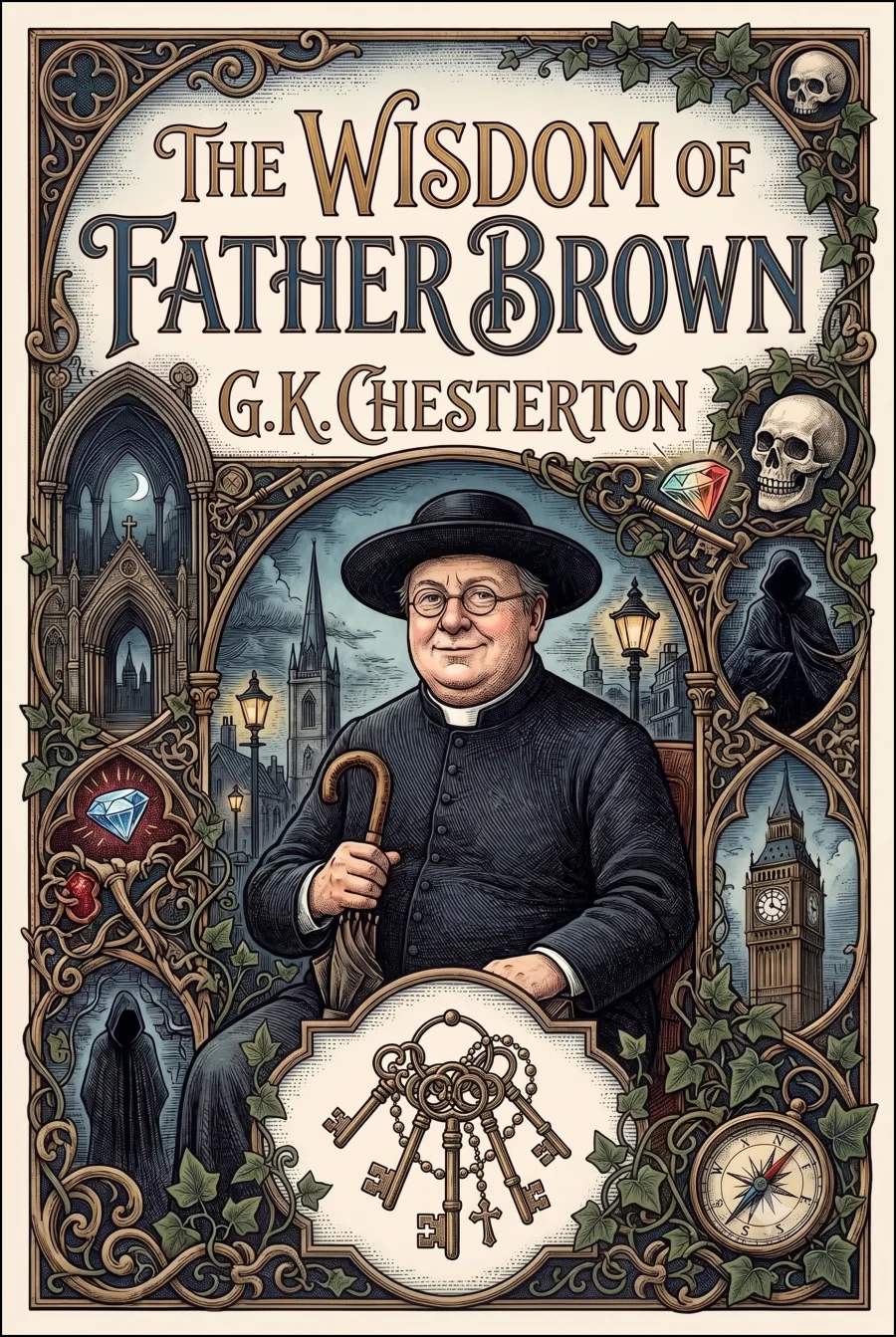
Download Cover Image
Do you want to download the full cover image for The Wisdom of Father Brown?