
Tom Sawyer, Detective
eBook
• INR 51.00
• English
• 9788169359856
No ratings yet
| Publisher | General Press |
|---|---|
| ISBN13 | 9788169359856 |
| Book Format | eBook |
| Language | English |
| List Price | INR 51.00 |
| Subject Code | FIC022060, JUV028000, JUV001000 |
| Publishing Date | 05/09/2026 |
| Book Code | BD00070405 |
Buy this Book
Amazon Stores
Ebook Stores
Other Stores
Discover Tom Sawyer, Detective by Mark Twain. This book is published by General Press in eBook format, ISBN 9788169359856, under Literature and Fiction, Historical Mystery, Children's Mystery, Detective, and Spy.
Book Description
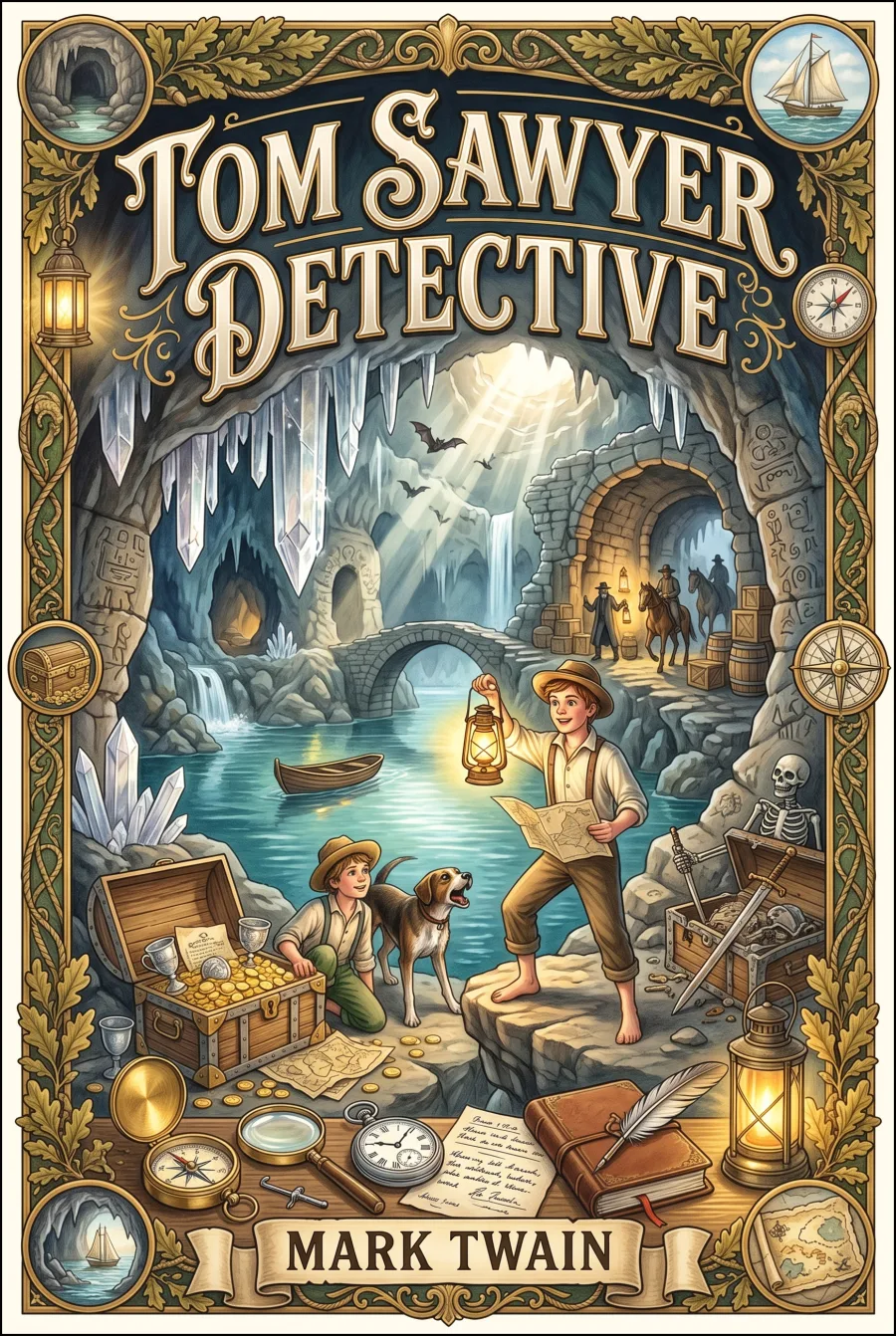
When Tom Sawyer decides to become a detective, ordinary life in a quiet Arkansas community quickly turns into a thrilling mystery filled with mistaken identities, secret clues, and unexpected danger. "Tom Sawyer, Detective" by Mark Twain is a classic mystery and adventure novella that brings back Tom Sawyer and Huck Finn for another entertaining escapade, blending youthful imagination with a surprisingly complicated criminal investigation.
The story begins when Tom and Huck find themselves involved in a strange case surrounding the mysterious disappearance of a valuable diamond and a disputed inheritance. Their curiosity is immediately awakened, and Tom sees the situation as an opportunity to put his detective skills to work. Inspired by the detective stories he admires, he approaches the mystery with confidence, developing theories, collecting clues, and attempting to reconstruct what happened. Huck, as usual, provides a more practical and cautious perspective, creating a humorous contrast with Tom’s enthusiasm for dramatic detective work.
The investigation becomes more complicated when identical twins enter the story. Their resemblance creates confusion about who is who, making it difficult for the people involved—and for Tom himself—to determine the truth. As evidence accumulates, questions of identity, deception, money, and guilt become increasingly important. Tom’s imagination helps him notice possibilities that others overlook, but his tendency to dramatize events also leads him into situations that are more serious than he initially expects.
Twain uses the mystery plot not only to create suspense but also to revisit the personalities and friendship that made Tom and Huck memorable. Tom remains energetic, inventive, and eager for adventure, while Huck’s straightforward nature provides a grounded counterbalance. Their partnership gives the story plenty of humor even as the investigation moves toward more dangerous territory.
Published in 1896, "Tom Sawyer, Detective" is a lighter and more mystery-focused return to the world of Twain’s famous characters. The story combines comedy, adventure, crime, mistaken identity, and youthful ingenuity in a way that makes it accessible to both longtime fans and new readers. For anyone searching for Mark Twain’s Tom Sawyer stories, Huck Finn adventures, classic mystery fiction, or humorous detective tales, this novella offers a fast-moving and entertaining read.
Tom may believe he has mastered the art of detection, but solving a real mystery is very different from playing detective. As the clues begin to fit together, readers are left wondering whether Tom’s clever theories will uncover the truth—or lead him straight into even more trouble.
The story begins when Tom and Huck find themselves involved in a strange case surrounding the mysterious disappearance of a valuable diamond and a disputed inheritance. Their curiosity is immediately awakened, and Tom sees the situation as an opportunity to put his detective skills to work. Inspired by the detective stories he admires, he approaches the mystery with confidence, developing theories, collecting clues, and attempting to reconstruct what happened. Huck, as usual, provides a more practical and cautious perspective, creating a humorous contrast with Tom’s enthusiasm for dramatic detective work.
The investigation becomes more complicated when identical twins enter the story. Their resemblance creates confusion about who is who, making it difficult for the people involved—and for Tom himself—to determine the truth. As evidence accumulates, questions of identity, deception, money, and guilt become increasingly important. Tom’s imagination helps him notice possibilities that others overlook, but his tendency to dramatize events also leads him into situations that are more serious than he initially expects.
Twain uses the mystery plot not only to create suspense but also to revisit the personalities and friendship that made Tom and Huck memorable. Tom remains energetic, inventive, and eager for adventure, while Huck’s straightforward nature provides a grounded counterbalance. Their partnership gives the story plenty of humor even as the investigation moves toward more dangerous territory.
Published in 1896, "Tom Sawyer, Detective" is a lighter and more mystery-focused return to the world of Twain’s famous characters. The story combines comedy, adventure, crime, mistaken identity, and youthful ingenuity in a way that makes it accessible to both longtime fans and new readers. For anyone searching for Mark Twain’s Tom Sawyer stories, Huck Finn adventures, classic mystery fiction, or humorous detective tales, this novella offers a fast-moving and entertaining read.
Tom may believe he has mastered the art of detection, but solving a real mystery is very different from playing detective. As the clues begin to fit together, readers are left wondering whether Tom’s clever theories will uncover the truth—or lead him straight into even more trouble.
Author Biography
Mark Twain (1835–1910), the pen name of “Samuel Langhorne Clemens”, was an American novelist, humorist, journalist, lecturer, and social critic who became one of the most important voices in American literature. Born on November 30, 1835, in Florida, Missouri, Twain moved with his family to Hannibal, Missouri, when he was four. Growing up beside the Mississippi River, he absorbed the stories, speech, humor, conflicts, and adventures of river life that would later shape his most famous books. His father died when Twain was eleven, and he left school early to work as a printer and typesetter. He later pursued his childhood ambition of becoming a Mississippi River steamboat pilot, an experience that deeply influenced his writing.
Twain's career changed direction after the Civil War disrupted river traffic. He traveled west, worked in Nevada, and began writing for the ‘Territorial Enterprise’ in Virginia City in 1862. It was during this period that Samuel Clemens adopted the name “Mark Twain”, a river expression referring to a water depth of two fathoms. His humorous writing quickly attracted attention, and his 1865 story “The Celebrated Jumping Frog of Calaveras County” brought him national recognition. He subsequently worked as a journalist and lecturer and traveled widely, turning his observations of people and places into memorable comic writing.
Twain's greatest literary achievements include ‘The Adventures of Tom Sawyer’ (1876), ‘The Prince and the Pauper’ (1881), ‘Life on the Mississippi’ (1883), and ‘Adventures of Huckleberry Finn’ (1884). ‘Tom Sawyer’ drew heavily on his childhood experiences in Hannibal, while ‘Huckleberry Finn’ used the Mississippi River journey to examine slavery, racism, conscience, friendship, and the contradictions of American society. The novel's distinctive voice and use of regional speech helped establish Twain as a major figure in American realism. The Library of Congress describes ‘Huckleberry Finn’ as his masterpiece and identifies ‘Tom Sawyer’ and ‘Huckleberry Finn’ as the works most closely associated with his Mississippi childhood.
Behind Twain's humor was a sharp and increasingly critical social conscience. He satirized political corruption, greed, religious hypocrisy, racism, imperialism, and the obsession with wealth and technological progress. His later writings, including ‘A Connecticut Yankee in King Arthur's Court’, ‘Following the Equator’, and ‘The War Prayer’, revealed a more openly skeptical and critical side. He eventually became a prominent opponent of American imperialism and joined the Anti-Imperialist League.
Twain's private life contained considerable hardship. He married Olivia Langdon in 1870, and they had four children, though only three daughters survived infancy. Financial difficulties caused by unsuccessful investments eventually forced him into bankruptcy, after which he undertook a worldwide lecture tour to repay his debts. He also endured the deaths of his wife and three daughters. Twain died on April 21, 1910, in Redding, Connecticut, at the age of seventy-four.
Today, Mark Twain remains essential for readers searching for “Mark Twain's biography, Samuel Clemens, ‘The Adventures of Huckleberry Finn’, ‘The Adventures of Tom Sawyer’, American literature, humor, satire, and nineteenth-century American history”. His greatest strength was his ability to make readers laugh while quietly forcing them to question society. Through unforgettable characters, natural dialogue, sharp satire, and a deep understanding of human weakness, Twain transformed distinctly American experiences into literature with universal appeal.
Twain's career changed direction after the Civil War disrupted river traffic. He traveled west, worked in Nevada, and began writing for the ‘Territorial Enterprise’ in Virginia City in 1862. It was during this period that Samuel Clemens adopted the name “Mark Twain”, a river expression referring to a water depth of two fathoms. His humorous writing quickly attracted attention, and his 1865 story “The Celebrated Jumping Frog of Calaveras County” brought him national recognition. He subsequently worked as a journalist and lecturer and traveled widely, turning his observations of people and places into memorable comic writing.
Twain's greatest literary achievements include ‘The Adventures of Tom Sawyer’ (1876), ‘The Prince and the Pauper’ (1881), ‘Life on the Mississippi’ (1883), and ‘Adventures of Huckleberry Finn’ (1884). ‘Tom Sawyer’ drew heavily on his childhood experiences in Hannibal, while ‘Huckleberry Finn’ used the Mississippi River journey to examine slavery, racism, conscience, friendship, and the contradictions of American society. The novel's distinctive voice and use of regional speech helped establish Twain as a major figure in American realism. The Library of Congress describes ‘Huckleberry Finn’ as his masterpiece and identifies ‘Tom Sawyer’ and ‘Huckleberry Finn’ as the works most closely associated with his Mississippi childhood.
Behind Twain's humor was a sharp and increasingly critical social conscience. He satirized political corruption, greed, religious hypocrisy, racism, imperialism, and the obsession with wealth and technological progress. His later writings, including ‘A Connecticut Yankee in King Arthur's Court’, ‘Following the Equator’, and ‘The War Prayer’, revealed a more openly skeptical and critical side. He eventually became a prominent opponent of American imperialism and joined the Anti-Imperialist League.
Twain's private life contained considerable hardship. He married Olivia Langdon in 1870, and they had four children, though only three daughters survived infancy. Financial difficulties caused by unsuccessful investments eventually forced him into bankruptcy, after which he undertook a worldwide lecture tour to repay his debts. He also endured the deaths of his wife and three daughters. Twain died on April 21, 1910, in Redding, Connecticut, at the age of seventy-four.
Today, Mark Twain remains essential for readers searching for “Mark Twain's biography, Samuel Clemens, ‘The Adventures of Huckleberry Finn’, ‘The Adventures of Tom Sawyer’, American literature, humor, satire, and nineteenth-century American history”. His greatest strength was his ability to make readers laugh while quietly forcing them to question society. Through unforgettable characters, natural dialogue, sharp satire, and a deep understanding of human weakness, Twain transformed distinctly American experiences into literature with universal appeal.
Editorial Reviews
Editorial Reviews will be added soon…
Book Summary
'Tom Sawyer, Detective' by Mark Twain is a short mystery and adventure story that brings back two of Twain’s most famous young characters, Tom Sawyer and Huckleberry Finn. Published in 1896, the book follows Tom and Huck as they become involved in a murder mystery while visiting the Arkansas community of Pikesville. Although the story is much lighter and more playful than some of Twain’s darker works, it combines suspense, humor, mistaken identity, courtroom drama, and the imaginative energy that makes Tom Sawyer such an enduring character. The novel is particularly interesting because Tom approaches the mystery not as a trained investigator but as a boy who has read detective stories and is determined to imitate the clever detectives he admires. The result is an entertaining tale in which imagination, deduction, luck, and youthful confidence all become part of the investigation.
The story begins with Tom Sawyer and Huck Finn traveling down the Mississippi River and eventually reaching Pikesville, Arkansas. Their arrival introduces them to a family whose members are caught in a difficult and mysterious situation. The central figures are the three brothers Brace Dunlap, Jubiter Dunlap, and Jake Dunlap. Brace and Jubiter are wealthy but have a bitter history involving money, family relationships, and suspicion. Jake, meanwhile, is a deaf and mute brother whose position within the family makes him particularly vulnerable. The brothers have a complicated past, and Twain gradually reveals the tensions among them rather than presenting the mystery all at once. This setting allows Tom and Huck to enter a world where appearances can be misleading and where an apparently straightforward crime turns out to involve questions of identity and hidden motives.
Tom quickly becomes fascinated by the mystery. Unlike Huck, who tends to react to events in a practical and sometimes fearful way, Tom sees the situation as an opportunity to live out the adventures he has imagined from books. He has a strong belief in the methods of fictional detectives, and he approaches the case with enormous enthusiasm. His confidence is sometimes amusing because he does not have the formal knowledge or experience of a real investigator. Yet Tom possesses something important: an energetic mind that enjoys connecting clues, questioning assumptions, and constructing theories. His detective work becomes a mixture of genuine observation and theatrical performance.
The mystery becomes serious when a man is murdered and suspicion falls upon the wrong person. The victim is Jubiter Dunlap, and his death creates confusion within the community. The evidence seems to point toward Jake Dunlap, the deaf-mute brother. Jake's inability to speak makes the situation especially tragic because he cannot easily explain what happened or defend himself. The authorities and townspeople begin to interpret the available evidence in ways that place Jake in danger. Tom, however, becomes convinced that the obvious explanation cannot be correct. He believes that something more complicated has happened and decides that he must uncover the truth.
One of the most important elements of the story is Tom's determination to investigate despite the skepticism of adults. He has always been a boy who resists ordinary expectations, and his imagination allows him to see possibilities that other people overlook. His detective methods are often influenced by the mystery stories he has read. He imagines himself as a brilliant investigator who can notice tiny details and eventually reveal the criminal in a dramatic moment. Twain gently makes fun of this habit, but he also shows that imagination can sometimes encourage a person to ask useful questions. Tom's confidence may be exaggerated, but his willingness to investigate prevents the adults from settling too quickly on a false conclusion.
Huck's role provides an important contrast. Huck is not as interested in detective theatrics as Tom. He is more practical and tends to describe events in his plain, straightforward manner. His narrative voice gives the story much of its humor because he often reports Tom's elaborate schemes without sharing Tom's excitement about them. Huck has also learned from his previous adventures that dangerous situations can become serious very quickly. As a result, he often provides a grounded perspective when Tom becomes overly enthusiastic. Their friendship remains central to the story, with Tom supplying imagination and boldness while Huck contributes caution and common sense.
As Tom investigates the murder, questions of identity become increasingly important. The story involves people who resemble one another and circumstances in which one person can be mistaken for another. Twain uses this confusion to create both suspense and comedy. Tom's investigation depends on recognizing that the surface appearance of the evidence does not necessarily tell the whole story. The case becomes a puzzle involving family relationships, hidden identities, and the motives of people who have much to gain or lose from the truth.
The plot also contains a strong element of theatricality. Tom loves dramatic situations, and the investigation gives him the opportunity to stage one. He does not simply want to discover the truth privately; he wants the truth to be revealed in a memorable fashion. This is very characteristic of Tom Sawyer. He has always treated ordinary life as though it were an adventure story. Whether he is pretending to be a pirate, organizing a gang, or turning punishment into an opportunity for entertainment, Tom transforms reality through imagination. In 'Tom Sawyer, Detective', he does the same thing with a murder investigation.
At the same time, Twain uses Tom's behavior to gently satirize popular detective fiction. During the nineteenth century, detective stories were becoming increasingly popular, and readers enjoyed tales in which brilliant investigators solved apparently impossible crimes through clues and logic. Tom has absorbed this literary tradition enthusiastically. He believes that detectives should make mysterious deductions, search for hidden evidence, and reveal the criminal at precisely the right dramatic moment. Twain allows Tom to imitate these conventions while also making the process humorous. Tom's detective work is therefore both a genuine mystery plot and a playful parody of detective storytelling.
As the investigation develops, Tom becomes convinced that the crime has been misunderstood. He studies the available evidence and attempts to reconstruct what happened. He pays attention to details that other people have ignored, and his confidence grows as he begins to see a pattern. The important point is that Tom does not solve the case through a single miraculous discovery. Instead, the mystery gradually becomes clearer as different pieces of information are connected. This gives the story its sense of movement: the reader follows Tom and Huck as they move from uncertainty toward a clearer understanding of the crime.
The courtroom portion of the story becomes especially important because the mystery is no longer simply an entertaining puzzle. A real person's life is at stake. The accusation against Jake demonstrates how dangerous it can be when people judge a person without hearing his side of the story. Because Jake cannot communicate easily, others are tempted to speak for him or interpret his behavior without knowing what he actually means. Tom's determination to investigate therefore becomes an act of justice as well as an adventure. He wants to prove that the evidence has been misunderstood and that the wrong person is being blamed.
This gives the story a surprisingly humane dimension beneath its humor. Twain repeatedly shows how quickly a community can form a judgment. Once people believe that someone is guilty, every new fact can be interpreted as further evidence of guilt. The possibility of innocence becomes harder to recognize. Tom's role is to challenge that assumption. His youthful imagination, which can sometimes lead him into foolishness, becomes useful because he is willing to consider explanations that adults have dismissed. The story suggests that curiosity and skepticism can be valuable qualities when people are too eager to accept the obvious answer.
Another important theme is the difference between appearance and reality. This theme appears throughout Twain's writing, and 'Tom Sawyer, Detective' uses the mystery genre to explore it directly. People are not always what they seem, physical resemblance can create false assumptions, and evidence can be interpreted incorrectly. The mystery works because the characters initially believe that they understand what they are seeing. Tom's investigation gradually reveals that the truth is more complicated. The reader is encouraged to question first impressions alongside the characters.
Tom's personality remains the heart of the book. He is clever, adventurous, self-confident, and imaginative, but he is also vain and sometimes ridiculous. He enjoys being admired and likes the idea of being recognized as a great detective. Yet his flaws make him more believable and entertaining. He is not a perfect hero who possesses supernatural intelligence. He is a boy who has read too many adventure stories and is delighted to discover that real life can sometimes resemble them. His enthusiasm may lead him to exaggerate his abilities, but it also gives him the courage to act when others hesitate.
Huck's presence also reminds readers of the larger world of Twain's fiction. His plainspoken personality and skepticism contrast with Tom's romantic imagination. Huck does not need to turn every event into a grand adventure. He observes what happens and tries to survive it. Their different personalities have always made them an effective pair, and 'Tom Sawyer, Detective' uses the same contrast to create humor. Tom wants to make a mystery into a story; Huck often seems to wish that the mystery would simply end without getting either of them into trouble.
The resolution brings Tom's detective efforts to a satisfying conclusion. His deductions help expose the real circumstances surrounding the murder and clear the innocent person who has been placed under suspicion. The mystery ultimately demonstrates that the truth can emerge when evidence is examined carefully rather than accepted at face value. Tom's success also gives him the dramatic ending he has been hoping for. He is able to play the role of detective and prove that his confidence was not entirely misplaced. Yet Twain keeps the tone playful rather than turning Tom into a serious professional investigator.
What makes 'Tom Sawyer, Detective' particularly enjoyable as a book summary and as a reading experience is its combination of mystery and comedy. Readers looking for a Tom Sawyer adventure will find the familiar qualities of Tom's imagination, Huck's practicality, and their tendency to become involved in situations much larger than themselves. Readers interested in Mark Twain's detective fiction will find a deliberately playful mystery built around mistaken identity, murder, clues, investigation, and courtroom suspense. The book is also useful for understanding how Twain could take a popular literary form and reshape it through humor and satire.
The story is not as psychologically deep as 'The Adventures of Huckleberry Finn', nor does it have the broad social scope of some of Twain's major works. Instead, its appeal lies in its compactness and energy. It is a late return to characters who had already become cultural icons, and Twain uses them to entertain readers while gently making fun of the conventions of detective stories. The narrative is fast-moving, accessible, and filled with the kind of youthful confidence that has always defined Tom Sawyer.
Ultimately, 'Tom Sawyer, Detective' is a story about curiosity, friendship, imagination, and the search for truth. Tom's investigation begins partly because he wants to play detective, but it becomes meaningful because an innocent person is in danger. His imagination helps him look beyond the obvious explanation, while Huck's practical nature keeps the adventure connected to reality. The mystery surrounding the Dunlap family provides the suspense, but the deeper pleasure of the novel comes from watching Tom transform an ordinary investigation into one of his grand adventures. Twain reminds us that children may sometimes see possibilities adults overlook, even when their methods are unconventional. The book's enduring charm comes from this mixture of innocence and intelligence: Tom is not a professional detective, but he is curious enough to question appearances, brave enough to pursue the truth, and imaginative enough to turn the search into an unforgettable adventure. For anyone searching for an in-depth summary of 'Tom Sawyer, Detective', the novel can ultimately be understood as Mark Twain's humorous return to Tom and Huck, combining a murder mystery with youthful adventure while exploring how easily appearances can mislead and how persistence, friendship, and careful observation can help uncover the truth.
The story begins with Tom Sawyer and Huck Finn traveling down the Mississippi River and eventually reaching Pikesville, Arkansas. Their arrival introduces them to a family whose members are caught in a difficult and mysterious situation. The central figures are the three brothers Brace Dunlap, Jubiter Dunlap, and Jake Dunlap. Brace and Jubiter are wealthy but have a bitter history involving money, family relationships, and suspicion. Jake, meanwhile, is a deaf and mute brother whose position within the family makes him particularly vulnerable. The brothers have a complicated past, and Twain gradually reveals the tensions among them rather than presenting the mystery all at once. This setting allows Tom and Huck to enter a world where appearances can be misleading and where an apparently straightforward crime turns out to involve questions of identity and hidden motives.
Tom quickly becomes fascinated by the mystery. Unlike Huck, who tends to react to events in a practical and sometimes fearful way, Tom sees the situation as an opportunity to live out the adventures he has imagined from books. He has a strong belief in the methods of fictional detectives, and he approaches the case with enormous enthusiasm. His confidence is sometimes amusing because he does not have the formal knowledge or experience of a real investigator. Yet Tom possesses something important: an energetic mind that enjoys connecting clues, questioning assumptions, and constructing theories. His detective work becomes a mixture of genuine observation and theatrical performance.
The mystery becomes serious when a man is murdered and suspicion falls upon the wrong person. The victim is Jubiter Dunlap, and his death creates confusion within the community. The evidence seems to point toward Jake Dunlap, the deaf-mute brother. Jake's inability to speak makes the situation especially tragic because he cannot easily explain what happened or defend himself. The authorities and townspeople begin to interpret the available evidence in ways that place Jake in danger. Tom, however, becomes convinced that the obvious explanation cannot be correct. He believes that something more complicated has happened and decides that he must uncover the truth.
One of the most important elements of the story is Tom's determination to investigate despite the skepticism of adults. He has always been a boy who resists ordinary expectations, and his imagination allows him to see possibilities that other people overlook. His detective methods are often influenced by the mystery stories he has read. He imagines himself as a brilliant investigator who can notice tiny details and eventually reveal the criminal in a dramatic moment. Twain gently makes fun of this habit, but he also shows that imagination can sometimes encourage a person to ask useful questions. Tom's confidence may be exaggerated, but his willingness to investigate prevents the adults from settling too quickly on a false conclusion.
Huck's role provides an important contrast. Huck is not as interested in detective theatrics as Tom. He is more practical and tends to describe events in his plain, straightforward manner. His narrative voice gives the story much of its humor because he often reports Tom's elaborate schemes without sharing Tom's excitement about them. Huck has also learned from his previous adventures that dangerous situations can become serious very quickly. As a result, he often provides a grounded perspective when Tom becomes overly enthusiastic. Their friendship remains central to the story, with Tom supplying imagination and boldness while Huck contributes caution and common sense.
As Tom investigates the murder, questions of identity become increasingly important. The story involves people who resemble one another and circumstances in which one person can be mistaken for another. Twain uses this confusion to create both suspense and comedy. Tom's investigation depends on recognizing that the surface appearance of the evidence does not necessarily tell the whole story. The case becomes a puzzle involving family relationships, hidden identities, and the motives of people who have much to gain or lose from the truth.
The plot also contains a strong element of theatricality. Tom loves dramatic situations, and the investigation gives him the opportunity to stage one. He does not simply want to discover the truth privately; he wants the truth to be revealed in a memorable fashion. This is very characteristic of Tom Sawyer. He has always treated ordinary life as though it were an adventure story. Whether he is pretending to be a pirate, organizing a gang, or turning punishment into an opportunity for entertainment, Tom transforms reality through imagination. In 'Tom Sawyer, Detective', he does the same thing with a murder investigation.
At the same time, Twain uses Tom's behavior to gently satirize popular detective fiction. During the nineteenth century, detective stories were becoming increasingly popular, and readers enjoyed tales in which brilliant investigators solved apparently impossible crimes through clues and logic. Tom has absorbed this literary tradition enthusiastically. He believes that detectives should make mysterious deductions, search for hidden evidence, and reveal the criminal at precisely the right dramatic moment. Twain allows Tom to imitate these conventions while also making the process humorous. Tom's detective work is therefore both a genuine mystery plot and a playful parody of detective storytelling.
As the investigation develops, Tom becomes convinced that the crime has been misunderstood. He studies the available evidence and attempts to reconstruct what happened. He pays attention to details that other people have ignored, and his confidence grows as he begins to see a pattern. The important point is that Tom does not solve the case through a single miraculous discovery. Instead, the mystery gradually becomes clearer as different pieces of information are connected. This gives the story its sense of movement: the reader follows Tom and Huck as they move from uncertainty toward a clearer understanding of the crime.
The courtroom portion of the story becomes especially important because the mystery is no longer simply an entertaining puzzle. A real person's life is at stake. The accusation against Jake demonstrates how dangerous it can be when people judge a person without hearing his side of the story. Because Jake cannot communicate easily, others are tempted to speak for him or interpret his behavior without knowing what he actually means. Tom's determination to investigate therefore becomes an act of justice as well as an adventure. He wants to prove that the evidence has been misunderstood and that the wrong person is being blamed.
This gives the story a surprisingly humane dimension beneath its humor. Twain repeatedly shows how quickly a community can form a judgment. Once people believe that someone is guilty, every new fact can be interpreted as further evidence of guilt. The possibility of innocence becomes harder to recognize. Tom's role is to challenge that assumption. His youthful imagination, which can sometimes lead him into foolishness, becomes useful because he is willing to consider explanations that adults have dismissed. The story suggests that curiosity and skepticism can be valuable qualities when people are too eager to accept the obvious answer.
Another important theme is the difference between appearance and reality. This theme appears throughout Twain's writing, and 'Tom Sawyer, Detective' uses the mystery genre to explore it directly. People are not always what they seem, physical resemblance can create false assumptions, and evidence can be interpreted incorrectly. The mystery works because the characters initially believe that they understand what they are seeing. Tom's investigation gradually reveals that the truth is more complicated. The reader is encouraged to question first impressions alongside the characters.
Tom's personality remains the heart of the book. He is clever, adventurous, self-confident, and imaginative, but he is also vain and sometimes ridiculous. He enjoys being admired and likes the idea of being recognized as a great detective. Yet his flaws make him more believable and entertaining. He is not a perfect hero who possesses supernatural intelligence. He is a boy who has read too many adventure stories and is delighted to discover that real life can sometimes resemble them. His enthusiasm may lead him to exaggerate his abilities, but it also gives him the courage to act when others hesitate.
Huck's presence also reminds readers of the larger world of Twain's fiction. His plainspoken personality and skepticism contrast with Tom's romantic imagination. Huck does not need to turn every event into a grand adventure. He observes what happens and tries to survive it. Their different personalities have always made them an effective pair, and 'Tom Sawyer, Detective' uses the same contrast to create humor. Tom wants to make a mystery into a story; Huck often seems to wish that the mystery would simply end without getting either of them into trouble.
The resolution brings Tom's detective efforts to a satisfying conclusion. His deductions help expose the real circumstances surrounding the murder and clear the innocent person who has been placed under suspicion. The mystery ultimately demonstrates that the truth can emerge when evidence is examined carefully rather than accepted at face value. Tom's success also gives him the dramatic ending he has been hoping for. He is able to play the role of detective and prove that his confidence was not entirely misplaced. Yet Twain keeps the tone playful rather than turning Tom into a serious professional investigator.
What makes 'Tom Sawyer, Detective' particularly enjoyable as a book summary and as a reading experience is its combination of mystery and comedy. Readers looking for a Tom Sawyer adventure will find the familiar qualities of Tom's imagination, Huck's practicality, and their tendency to become involved in situations much larger than themselves. Readers interested in Mark Twain's detective fiction will find a deliberately playful mystery built around mistaken identity, murder, clues, investigation, and courtroom suspense. The book is also useful for understanding how Twain could take a popular literary form and reshape it through humor and satire.
The story is not as psychologically deep as 'The Adventures of Huckleberry Finn', nor does it have the broad social scope of some of Twain's major works. Instead, its appeal lies in its compactness and energy. It is a late return to characters who had already become cultural icons, and Twain uses them to entertain readers while gently making fun of the conventions of detective stories. The narrative is fast-moving, accessible, and filled with the kind of youthful confidence that has always defined Tom Sawyer.
Ultimately, 'Tom Sawyer, Detective' is a story about curiosity, friendship, imagination, and the search for truth. Tom's investigation begins partly because he wants to play detective, but it becomes meaningful because an innocent person is in danger. His imagination helps him look beyond the obvious explanation, while Huck's practical nature keeps the adventure connected to reality. The mystery surrounding the Dunlap family provides the suspense, but the deeper pleasure of the novel comes from watching Tom transform an ordinary investigation into one of his grand adventures. Twain reminds us that children may sometimes see possibilities adults overlook, even when their methods are unconventional. The book's enduring charm comes from this mixture of innocence and intelligence: Tom is not a professional detective, but he is curious enough to question appearances, brave enough to pursue the truth, and imaginative enough to turn the search into an unforgettable adventure. For anyone searching for an in-depth summary of 'Tom Sawyer, Detective', the novel can ultimately be understood as Mark Twain's humorous return to Tom and Huck, combining a murder mystery with youthful adventure while exploring how easily appearances can mislead and how persistence, friendship, and careful observation can help uncover the truth.
Sample Chapters
Sample Chapters will be added soon…
Reader Reviews
No reviews yet.
Tom Sawyer, Detective
Download Cover Image
Do you want to download the full cover image for Tom Sawyer, Detective?