
My Experiments with Truth: An Autobiography of Gandhi
Hardcover
• 476 Pages
• INR 895.00
• English
• 9789387669277
No ratings yet
| Publisher | General Press |
|---|---|
| ISBN13 | 9789387669277 |
| ASIN/SKU | 9387669270 |
| Book Format | Hardcover |
| Language | English |
| Pages | 476 |
| List Price | INR 895.00 |
| Subject Code | BIO010000, BIO032000, BIO026000 |
| Publishing Date | 03/02/2018 |
| Dimensions | 8.25 x 5.25 x 1.0 inches |
| Book Code | BD00068022 |
Buy this Book
Amazon Stores
Ebook Stores
Other Stores
Discover My Experiments with Truth: An Autobiography of Gandhi by Mahatma Gandhi. This book is published by General Press in Hardcover format, ISBN 9789387669277, ASIN 9387669270, under Biographies and Memoirs, Political Leader Biographies, Social Activist Biographies.
Book Description
Mahatma Gandhi’s 'The Story of My Experiments with Truth' is not just a historical memoir; it is a profoundly intimate confession of a flawed human being striving for moral perfection. Written with striking humility and lucid honesty, the autobiography strips away the myth of the "Mahatma" (Great Soul) to reveal a vulnerable man constantly wrestling with his own weaknesses, desires, and doubts.
The narrative traces his journey from a timid boy in Gujarat to an insecure law student in London, and ultimately to the fearless leader of India’s nonviolent independence movement. Yet, rather than focusing on grand political victories, Gandhi anchors his story in quiet, everyday struggles—his early battles with lust, jealousy, and anger, and his obsessive experiments with diet, fasting, and celibacy. He views his entire life as a spiritual laboratory where every mistake is an opportunity to learn.
At the heart of this deeply humane book is the dual philosophy of Ahimsa (nonviolence) and Satyagraha (truth-force). Gandhi demonstrates that true political liberation must first begin with personal purification and radical self-honesty. He does not present himself as a flawless saint, but as an ordinary seeker who made countless errors along the way.
This remarkable autobiography is a timeless invitation to introspection. It reminds us that greatness is not born from inherent perfection, but from the relentless, compassionate courage to confront our own flaws and align our daily actions with the absolute truth.
The narrative traces his journey from a timid boy in Gujarat to an insecure law student in London, and ultimately to the fearless leader of India’s nonviolent independence movement. Yet, rather than focusing on grand political victories, Gandhi anchors his story in quiet, everyday struggles—his early battles with lust, jealousy, and anger, and his obsessive experiments with diet, fasting, and celibacy. He views his entire life as a spiritual laboratory where every mistake is an opportunity to learn.
At the heart of this deeply humane book is the dual philosophy of Ahimsa (nonviolence) and Satyagraha (truth-force). Gandhi demonstrates that true political liberation must first begin with personal purification and radical self-honesty. He does not present himself as a flawless saint, but as an ordinary seeker who made countless errors along the way.
This remarkable autobiography is a timeless invitation to introspection. It reminds us that greatness is not born from inherent perfection, but from the relentless, compassionate courage to confront our own flaws and align our daily actions with the absolute truth.
Author Biography
Born in 1869 in the coastal town of Porbandar, India, Mohandas Karamchand Gandhi was raised in a devout Hindu family heavily influenced by Jain pacifist teachings. After completing his early education in India, he traveled to London in 1888 to study law and jurisprudence. Upon passing the bar, he briefly attempted to establish a legal practice in Bombay before accepting a fateful year-long contract to work in South Africa in 1893.
Instead of a brief stint, Gandhi spent over two decades in South Africa, where he faced severe, systemic racial discrimination. These experiences fundamentally transformed him from a shy lawyer into a resilient civil rights activist. It was here that he first developed and implemented Satyagraha, his defining philosophy of nonviolent civil disobedience, successfully mobilizing the Indian expatriate community to protest oppressive colonial laws.
Returning to India in 1915, Gandhi brought his formidable organizing skills and moral authority to the Indian independence movement. Assuming leadership of the Indian National Congress, the "Mahatma" (Great Soul) orchestrated massive nationwide campaigns against British colonial rule, including the famous Salt March of 1930 and the "Quit India" movement of 1942. His methods relied entirely on peaceful non-cooperation, boycotts, and fasting, which continually captured the world's attention.
Throughout his life of activism, Gandhi was also a remarkably prolific writer and journalist. He founded and edited several influential newspapers, using them to advocate for social reforms, religious harmony, and the eradication of untouchability. His most enduring literary contribution is his deeply introspective autobiography, The Story of My Experiments with Truth, which detailed his lifelong pursuit of spiritual purity, dietary discipline, and the profound moral convictions that guided his political vision.
Though India finally achieved independence in 1947, the violent partition of the subcontinent into India and Pakistan left Gandhi deeply sorrowful. While tirelessly working to quell Hindu-Muslim communal violence, he was assassinated by a Hindu nationalist in January 1948 at the age of seventy-eight. He left behind an unparalleled legacy as the father of modern India and a global icon of peaceful resistance.
Instead of a brief stint, Gandhi spent over two decades in South Africa, where he faced severe, systemic racial discrimination. These experiences fundamentally transformed him from a shy lawyer into a resilient civil rights activist. It was here that he first developed and implemented Satyagraha, his defining philosophy of nonviolent civil disobedience, successfully mobilizing the Indian expatriate community to protest oppressive colonial laws.
Returning to India in 1915, Gandhi brought his formidable organizing skills and moral authority to the Indian independence movement. Assuming leadership of the Indian National Congress, the "Mahatma" (Great Soul) orchestrated massive nationwide campaigns against British colonial rule, including the famous Salt March of 1930 and the "Quit India" movement of 1942. His methods relied entirely on peaceful non-cooperation, boycotts, and fasting, which continually captured the world's attention.
Throughout his life of activism, Gandhi was also a remarkably prolific writer and journalist. He founded and edited several influential newspapers, using them to advocate for social reforms, religious harmony, and the eradication of untouchability. His most enduring literary contribution is his deeply introspective autobiography, The Story of My Experiments with Truth, which detailed his lifelong pursuit of spiritual purity, dietary discipline, and the profound moral convictions that guided his political vision.
Though India finally achieved independence in 1947, the violent partition of the subcontinent into India and Pakistan left Gandhi deeply sorrowful. While tirelessly working to quell Hindu-Muslim communal violence, he was assassinated by a Hindu nationalist in January 1948 at the age of seventy-eight. He left behind an unparalleled legacy as the father of modern India and a global icon of peaceful resistance.
Editorial Reviews
Editorial Reviews will be added soon…
Book Summary
Mahatma Gandhi’s "The Story of My Experiments with Truth" is a stark departure from the traditional political memoir. Serialized in his journal Navjivan between 1925 and 1929, the autobiography does not seek to chronicle a comprehensive history of the Indian independence movement or position its author as an infallible savior. Instead, it is an unflinchingly transparent, deeply introspective exploration of one man’s relentless pursuit of absolute morality. For Gandhi, truth was not merely a philosophical concept; it was synonymous with God. The book is appropriately titled, as he viewed his entire existence—from his dietary habits to his political campaigns—as a rigorous series of scientific, moral experiments designed to bring him closer to this divine truth.
The narrative begins with his ordinary, unremarkable childhood in Porbandar, India. Born into a devout Hindu family, the young Mohandas Karamchand Gandhi describes himself as a mediocre student, crippled by intense shyness and fearful of ghosts and thieves. He was married to Kasturba at the tender age of thirteen, a custom he later fiercely condemned. During his adolescence, he grappled with intense internal conflicts, most notably experimenting with meat-eating in a misguided attempt to grow as physically strong as the British imperialists. This secret rebellion filled him with profound guilt, culminating in a tearful written confession to his ailing father. The unconditional forgiveness he received in response left an indelible mark on his soul, offering him his first profound lesson in the transformative power of non-violence and love.
Seeking to establish a career, Gandhi traveled to London to study law, but not before taking a solemn vow to his mother to abstain from wine, women, and meat. The transition to Victorian England was a period of severe cultural shock and youthful insecurity. For a brief, somewhat comical period, he attempted to mold himself into a polished "English gentleman," purchasing tailored suits, taking dancing lessons, and trying to learn the violin. However, he quickly realized the hollowness of this pursuit. He abandoned his superficial aspirations, embraced a life of strict frugality, and found his intellectual community among the London Vegetarian Society. It was here, ironically thousands of miles from India, that he first read the Bhagavad Gita in translation, a text that would become his ultimate spiritual dictionary and moral compass.
Upon returning to India as a qualified barrister, Gandhi faced a crushing series of professional failures. His crippling shyness remained unresolved, to the point where he physically could not speak during his first cross-examination in a Bombay court, forcing him to abruptly refund his client's fee. Feeling completely inept and suffocating under the complex, corrupt web of Indian legal bureaucracy, he suffered a humiliating encounter with a haughty British officer who physically threw him out of his office. Defeated and desperate for an escape, Gandhi eagerly accepted a modest, year-long legal contract in South Africa, completely unaware that this distant continent would be the forge that would temper him into a global icon of resistance.
South Africa proved to be the pivotal turning point of Gandhi’s life, abruptly awakening his dormant political consciousness. Shortly after his arrival, he was thrown off a first-class train carriage at Pietermaritzburg station in the dead of winter, simply because he was a "colored" man holding a first-class ticket. Sitting shivering in the dark waiting room, he faced the most crucial crossroads of his existence: flee back to the safety of India, or stay and fight the deeply entrenched, institutionalized racial prejudice. He chose to stay. This single night of humiliation ignited a fierce, unyielding resolve within him to combat injustice, marking the true birth of his public life and his lifelong crusade against human indignity.
It was in the crucible of South African racial politics that Gandhi developed his revolutionary philosophy of Satyagraha, or "truth-force." Moving beyond the ineffective, traditional methods of political petitioning, he realized that true resistance required an active, unyielding, yet strictly non-violent confrontation with unjust laws. Parallel to this was his deepening commitment to Ahimsa (non-violence), which he began to understand not merely as a political tactic, but as a comprehensive way of life demanding total love and the absolute absence of malice toward one's oppressors. To ground these philosophies in daily practice, he established communal settlements like Tolstoy Farm and the Phoenix Settlement, where individuals of different races and religions lived together, sharing manual labor and stripping away the artificial divisions of society.
As his political responsibilities expanded, Gandhi became convinced that public service required absolute personal purification. He concluded that he could not effectively lead a spiritual or political revolution without first conquering his own physical desires. This led to his monumental vow of Brahmacharya (celibacy) at the age of 37, taken with Kasturba's consent. For Gandhi, controlling the sexual drive was inextricably linked to controlling the palate. He launched into extreme dietetic experiments, exploring raw foods, fruitarianism, and prolonged fasting. These practices were not just about physical health; they were vital tools for spiritual mastery, teaching him emotional detachment and allowing him to achieve a profound, physical empathy with the starving, impoverished masses he sought to liberate.
Returning to India in 1915, at the age of 45, Gandhi was an entirely transformed man. On the advice of his political mentor, Gopal Krishna Gokhale, he spent a year traveling the length and breadth of the Indian subcontinent to truly understand the pulse of the masses. His early, localized campaigns in Champaran and Kheda successfully tested the principles of Satyagraha on Indian soil. However, the autobiography reveals that Gandhi viewed political independence from the British as only a fraction of the necessary struggle. He realized that India's true enemies were internal: the brutal practice of untouchability, extreme poverty, and a widespread lack of sanitation. He championed the spinning wheel (charkha) not just as a tool for economic self-reliance against British textile monopolies, but as a daily meditation on the dignity of physical labor.
"The Story of My Experiments with Truth" concludes rather abruptly in the 1920s, with Gandhi explaining that his life from that point forward had become entirely public, merging seamlessly with the broader history of the Indian independence movement. He felt no need to document his later, globally recognized campaigns, as they were already an open book to the world. The enduring power of his autobiography lies in its radical vulnerability. Gandhi never attempts to paint himself as a born saint or a flawless prophet; instead, he presents himself as a deeply flawed, ordinary man who achieved the extraordinary through sheer willpower and a terrifyingly strict adherence to his moral convictions. It is a timeless testament to the idea that true political and social liberation must always begin with the relentless, uncompromising conquest of the self.
The narrative begins with his ordinary, unremarkable childhood in Porbandar, India. Born into a devout Hindu family, the young Mohandas Karamchand Gandhi describes himself as a mediocre student, crippled by intense shyness and fearful of ghosts and thieves. He was married to Kasturba at the tender age of thirteen, a custom he later fiercely condemned. During his adolescence, he grappled with intense internal conflicts, most notably experimenting with meat-eating in a misguided attempt to grow as physically strong as the British imperialists. This secret rebellion filled him with profound guilt, culminating in a tearful written confession to his ailing father. The unconditional forgiveness he received in response left an indelible mark on his soul, offering him his first profound lesson in the transformative power of non-violence and love.
Seeking to establish a career, Gandhi traveled to London to study law, but not before taking a solemn vow to his mother to abstain from wine, women, and meat. The transition to Victorian England was a period of severe cultural shock and youthful insecurity. For a brief, somewhat comical period, he attempted to mold himself into a polished "English gentleman," purchasing tailored suits, taking dancing lessons, and trying to learn the violin. However, he quickly realized the hollowness of this pursuit. He abandoned his superficial aspirations, embraced a life of strict frugality, and found his intellectual community among the London Vegetarian Society. It was here, ironically thousands of miles from India, that he first read the Bhagavad Gita in translation, a text that would become his ultimate spiritual dictionary and moral compass.
Upon returning to India as a qualified barrister, Gandhi faced a crushing series of professional failures. His crippling shyness remained unresolved, to the point where he physically could not speak during his first cross-examination in a Bombay court, forcing him to abruptly refund his client's fee. Feeling completely inept and suffocating under the complex, corrupt web of Indian legal bureaucracy, he suffered a humiliating encounter with a haughty British officer who physically threw him out of his office. Defeated and desperate for an escape, Gandhi eagerly accepted a modest, year-long legal contract in South Africa, completely unaware that this distant continent would be the forge that would temper him into a global icon of resistance.
South Africa proved to be the pivotal turning point of Gandhi’s life, abruptly awakening his dormant political consciousness. Shortly after his arrival, he was thrown off a first-class train carriage at Pietermaritzburg station in the dead of winter, simply because he was a "colored" man holding a first-class ticket. Sitting shivering in the dark waiting room, he faced the most crucial crossroads of his existence: flee back to the safety of India, or stay and fight the deeply entrenched, institutionalized racial prejudice. He chose to stay. This single night of humiliation ignited a fierce, unyielding resolve within him to combat injustice, marking the true birth of his public life and his lifelong crusade against human indignity.
It was in the crucible of South African racial politics that Gandhi developed his revolutionary philosophy of Satyagraha, or "truth-force." Moving beyond the ineffective, traditional methods of political petitioning, he realized that true resistance required an active, unyielding, yet strictly non-violent confrontation with unjust laws. Parallel to this was his deepening commitment to Ahimsa (non-violence), which he began to understand not merely as a political tactic, but as a comprehensive way of life demanding total love and the absolute absence of malice toward one's oppressors. To ground these philosophies in daily practice, he established communal settlements like Tolstoy Farm and the Phoenix Settlement, where individuals of different races and religions lived together, sharing manual labor and stripping away the artificial divisions of society.
As his political responsibilities expanded, Gandhi became convinced that public service required absolute personal purification. He concluded that he could not effectively lead a spiritual or political revolution without first conquering his own physical desires. This led to his monumental vow of Brahmacharya (celibacy) at the age of 37, taken with Kasturba's consent. For Gandhi, controlling the sexual drive was inextricably linked to controlling the palate. He launched into extreme dietetic experiments, exploring raw foods, fruitarianism, and prolonged fasting. These practices were not just about physical health; they were vital tools for spiritual mastery, teaching him emotional detachment and allowing him to achieve a profound, physical empathy with the starving, impoverished masses he sought to liberate.
Returning to India in 1915, at the age of 45, Gandhi was an entirely transformed man. On the advice of his political mentor, Gopal Krishna Gokhale, he spent a year traveling the length and breadth of the Indian subcontinent to truly understand the pulse of the masses. His early, localized campaigns in Champaran and Kheda successfully tested the principles of Satyagraha on Indian soil. However, the autobiography reveals that Gandhi viewed political independence from the British as only a fraction of the necessary struggle. He realized that India's true enemies were internal: the brutal practice of untouchability, extreme poverty, and a widespread lack of sanitation. He championed the spinning wheel (charkha) not just as a tool for economic self-reliance against British textile monopolies, but as a daily meditation on the dignity of physical labor.
"The Story of My Experiments with Truth" concludes rather abruptly in the 1920s, with Gandhi explaining that his life from that point forward had become entirely public, merging seamlessly with the broader history of the Indian independence movement. He felt no need to document his later, globally recognized campaigns, as they were already an open book to the world. The enduring power of his autobiography lies in its radical vulnerability. Gandhi never attempts to paint himself as a born saint or a flawless prophet; instead, he presents himself as a deeply flawed, ordinary man who achieved the extraordinary through sheer willpower and a terrifyingly strict adherence to his moral convictions. It is a timeless testament to the idea that true political and social liberation must always begin with the relentless, uncompromising conquest of the self.
Sample Chapters
Chapter 1 : Birth and Parentage
The Gandhis belong to the Bania caste and seem to have been originally grocers. But for three generations, from my grandfather, they have been Prime Ministers in several Kathiawad States. Uttamchand Gandhi, alias Ota Gandhi, my grandfather, must have been a man of principle. State intrigues compelled him to leave Porbandar, where he was Diwan, and to seek refuge in Junagadh. There he saluted the Nawab with the left hand. Someone, noticing the apparent discourtesy, asked for an explanation, which was given thus: “The right hand is already pledged to Porbandar.”
Ota Gandhi married a second time, having lost his first wife. He had four sons by his first wife and two by his second wife. I do not think that in my childhood I ever felt or knew that these sons of Ota Gandhi were not all of the same mother. The fifth of these six brothers was Karamchand Gandhi, alias Kaba Gandhi, and the sixth was Tulsidas Gandhi. Both these brothers were Prime Ministers in Porbandar, one after the other. Kaba Gandhi was my father. He was a member of the Rajasthanik Court. It is now extinct, but in those days it was a very influential body for settling disputes between the chiefs and their fellow clansmen. He was for some time Prime Minister in Rajkot and then in Vankaner. He was a pensioner of the Rajkot State when he died.
Kaba Gandhi married four times in succession, having lost his wife each time by death. He had two daughters by his first and second marriages. His last wife, Putlibai, bore him a daughter and three sons, I being the youngest.
My father was a lover of his clan, truthful, brave and generous, but short-tempered. To a certain extent he might have been given to carnal pleasures. For he married for the fourth time when he was over forty. But he was incorruptible and had earned a name for strict impartiality in his family as well as outside. His loyalty to the state was well known. An Assistant Political Agent spoke insultingly of the Rajkot Thakore Saheb, his chief, and he stood up to the insult. The Agent was angry and asked Kaba Gandhi to apologize. This he refused to do and was therefore kept under detention for a few hours. But when the Agent saw that Kaba Gandhi was adamant, he ordered him to be released.
My father never had any ambition to accumulate riches and left us very little property.
He had no education, save that of experience. At best, he might be said to have read up to the fifth Gujarati standard. Of history and geography he was innocent. But his rich experience of practical affairs stood him in good stead in the solution of the most intricate questions and in managing hundreds of men. Of religious training he had very little, but he had that kind of religious culture which frequent visits to temples and listening to religious discourses make available to many Hindus. In his last days he began reading the Gita at the instance of a learned Brahman friend of the family, and he used to repeat aloud some verses every day at the time of worship.
The outstanding impression my mother has left on my memory is that of saintliness. She was deeply religious. She would not think of taking her meals without her daily prayers. Going to Haveli—the Vaishnava temple—was one of her daily duties. As far as my memory can go back, I do not remember her having ever missed the Chaturmas. She would take the hardest vows and keep them without flinching. Illness was no excuse for relaxing them. I can recall her once falling ill when she was observing the Chandrayana vow, but the illness was not allowed to interrupt the observance. To keep two or three consecutive fasts was nothing to her. Living on one meal a day during Chaturmas was a habit with her. Not content with that, she fasted every alternate day during one Chaturmas. During another Chaturmas she vowed not to have food without seeing the sun. We children on those days would stand, staring at the sky, waiting to announce the appearance of the sun to our mother. Everyone knows that at the height of the rainy season the sun often does not condescend to show his face. And I remember days when, at his sudden appearance, we would rush and announce it to her. She would run out to see with her own eyes, but by that time the fugitive sun would be gone, thus depriving her of her meal. “That does not matter,” she would say cheerfully, “God did not want me to eat today.” And then she would return to her round of duties.
My mother had strong common sense. She was well informed about all matters of state, and ladies of the court thought highly of her intelligence. Often I would accompany her, exercising the privilege of childhood, and I still remember many lively discussions she had with the widowed mother of the Thakore Saheb.
Of these parents I was born at Porbandar, otherwise known as Sudamapuri, on the 2nd October, 1869, I passed my childhood in Porbandar. I recollect having been put to school. It was with some difficulty that I got through the multiplication tables. The fact that I recollect nothing more of those days than having learnt, in company with other boys, to call our teacher all kinds of names, would strongly suggest that my intellect must have been sluggish, and my memory raw.
Chapter 2 : Childhood
I must have been about seven when my father left Porbandar for Rajkot to become a member of the Rajasthanik Court. There I was put into a primary school, and I can well recollect those days, including the names and other particulars of the teachers who taught me. As at Porbandar, so here, there is hardly anything to note about my studies. I could only have been a mediocre student. From this school I went to the suburban school and thence to the high school, having already reached my twelfth year. I do not remember having ever told a lie, during this short period, either to my teachers or to my school-mates. I used to be very shy and avoided all company. My books and my lessons were my sole companions. To be at school at the stroke of the hour and to run back home as soon as the school closed—that was my daily habit. I literally ran back, because I could not bear to talk to anybody. I was even afraid lest anyone should poke fun at me.
There is an incident which occurred at the examination during my first year at the high school and which is worth recording. Mr. Giles, the Educational Inspector, had come on a visit of inspection. He had set us five words to write as a spelling exercise. One of the words was ‘kettle’. I had mis-spelt it. The teacher tried to prompt me with the point of his boot, but I would not be prompted. It was beyond me to see that he wanted me to copy the spelling from my neighbour’s slate, for I had thought that the teacher was there to supervise us against copying. The result was that all the boys, except myself, were found to have spelt every word correctly. Only I had been stupid. The teacher tried later to bring this stupidity home to me, but without effect. I never could learn the art of ‘copying’.
Yet the incident did not in the least diminish my respect for my teacher. I was by nature blind to the faults of elders. Later I came to know of many other failings of this teacher, but my regard for him remained the same. For I had learnt to carry out the orders of elders, not to scan their actions.
Two other incidents belonging to the same period have always clung to my memory. As a rule I had a distaste for any reading beyond my school books. The daily lessons had to be done, because I disliked being taken to task by my teacher as much as I disliked deceiving him. Therefore I would do the lessons, but often without my mind in them. Thus when even the lessons could not be done properly, there was of course no question of any extra reading. But somehow my eyes fell on a book purchased by my father. It was Shravana Pitribhakti Nataka (a play about Shravana’s devotion to his parents). I read it with intense interest. There came to our place about the same time itinerant showmen. One of the pictures I was shown was of Shravana carrying, by means of slings fitted for his shoulders, his blind parents on a pilgrimage. The book and the picture left an indelible impression on my mind. “Here is an example for you to copy,” I said to myself. The agonised lament of the parents over Shravana’s death is still fresh in my memory. The melting tune moved me deeply, and I played it on a concertina which my father had purchased for me.
There was a similar incident connected with another play. Just about this time, I had secured my father’s permission to see a play performed by a certain dramatic company. This play—Harishchandra—captured my heart. I could never be tired of seeing it. But how often should I be permitted to go? It haunted me and I must have acted Harishchandra to myself times without number. “Why should not all be truthful like Harishchandra?” was the question I asked myself day and night. To follow truth and to go through all the ordeals Harishchandra went through was the one ideal it inspired in me. I literally believed in the story of Harishchandra. The thought of it all often made me weep. My commonsense tells me today that Harishchandra could not have been a historical character. Still both Harishchandra and Shravana are living realities for me, and I am sure I should be moved as before if I were to read those plays again today.
Chapter 3 : Child Marriage
Much as I wish that I had not to write this chapter, I know that I shall have to swallow many such bitter draughts in the course of this narrative. And I cannot do otherwise, if I claim to be a worshipper of Truth. It is my painful duty to have to record here my marriage at the age of thirteen. As I see the youngsters of the same age about me who are under my care, and think of my own marriage, I am inclined to pity myself and to congratulate them on having escaped my lot. I can see no moral argument in support of such a preposterously early marriage.
Let the reader make no mistake. I was married, not betrothed. For in Kathiawad there are two distinct rites—betrothal and marriage. Betrothal is a preliminary promise on the part of the parents of the boy and the girl to join them in marriage, and it is not inviolable. The death of the boy entails no widowhood on the girl. It is an agreement purely between the parents, and the children have no concern with it. Often they are not even informed of it. It appears that I was betrothed thrice, though without my knowledge. I was told that two girls chosen for me had died in turn, and therefore I infer that I was betrothed three times. I have a faint recollection, however, that the third betrothal took place in my seventh year. But I do not recollect having been informed about it. In the present chapter I am talking about my marriage, of which I have the clearest recollection.
It will be remembered that we were three brothers. The first was already married. The elders decided to marry my second brother, who was two or three years my senior, a cousin, possibly a year older, and me, all at the same time. In doing so there was no thought of our welfare, much less our wishes. It was purely a question of their own convenience and economy.
Marriage among Hindus is no simple matter. The parents of the bride and the bridegroom often bring themselves to ruin over it. They waste their substance, they waste their time. Months are taken up over the preparations—in making clothes and ornaments and in preparing budgets for dinners. Each tries to outdo the other in the number and variety of courses to be prepared. Women, whether they have a voice or no, sing themselves hoarse, even get ill, and disturb the peace of their neighbours. These in their turn quietly put up with all the turmoil and bustle all the dirt and filth, representing the remains of the feasts, because they know that a time will come when they also will be behaving in the same manner.
It would be better, thought my elders, to have all this bother over at one and the same time. Less expense and greater éclat. For money could be freely spent if it had only to be spent once instead of thrice. My father and my uncle were both old, and we were the last children they had to marry. It is likely that they wanted to have the last best time of their lives. In view of all these considerations, a triple wedding was decided upon, and as I have said before, months were taken up in preparation for it.
It was only through these preparations that we got warning of the coming event. I do not think it meant to me anything more than the prospect of good clothes to wear, drum beating, marriage processions, rich dinners and a strange girl to play with. The carnal desire came later. I propose to draw the curtain over my shame, except for a few details worth recording. To these I shall come later. But even they have little to do with the central idea I have kept before me in writing this story.
So my brother and I were both taken to Porbandar from Rajkot. There are some amusing details of the preliminaries to the final drama, e.g. smearing our bodies all over with turmeric paste, but I must omit them.
My father was a Diwan, but nevertheless a servant, and all the more so because he was in favour with the Thakore Saheb. The latter would not let him go until the last moment. And when he did so, he ordered for my father special stage coaches, reducing the journey by two days. But the fates had willed otherwise. Porbandar is 120 miles from Rajkot—a cart journey of five days. My father did the distance in three, but the coach toppled over in the third stage, and he sustained severe injuries. He arrived bandaged all over. Both his and our interest in the coming event was half destroyed, but the ceremony had to be gone through. For how could the marriage dates be changed? However, I forgot my grief over my father’s injuries in the childish amusement of the wedding.
I was devoted to my parents. But no less was I devoted to the passions that flesh is heir to. I had yet to learn that all happiness and pleasure should be sacrificed in devoted service to my parents. And yet, as though by way of punishment for my desire for pleasures, an incident happened, which has ever since rankled in my mind and which I will relate later. Nishkulanand sings: “Renunciation of objects, without the renunciation of desires, is short-lived, however hard you may try.” Whenever I sing this song or hear it sung, this bitter untoward incident, rushes to my memory and fills me with shame.
My father put on a brave face in spite of his injuries, and took full part in the wedding. As I think of it, I can even today call before my mind’s eye the places where he sat as he went through the different details of the ceremony. Little did I dream then that one day I should severely criticise my father for having married me as a child. Everything on that day seemed to me right and proper and pleasing. There was also my own eagerness to get married. And as everything that my father did then struck me as beyond reproach, the recollection of those things is fresh in my memory. I can picture to myself, even today, how we sat on our wedding dais, how we performed the Saptapadi, how we, the newly wedded husband and wife, put the sweet kansar into each other’s mouth, and how we began to live together. And oh! That first night. Two innocent children all unwittingly hurled themselves into the ocean of life. My brother’s wife had thoroughly coached me about my behaviour on the first night. I do not know who had coached my wife. I have never asked her about it, nor am I inclined to do so now. The reader may be sure that we were too nervous to face each other. We were certainly too shy. How was I to talk to her, and what was I to say? The coaching could not carry me far. But no coaching is really necessary in such matters. The impressions of the former birth are potent enough to make all coaching superfluous. We gradually began to know each other, and to speak freely together. We were the same age. But I took no time in assuming the authority of a husband.
The Gandhis belong to the Bania caste and seem to have been originally grocers. But for three generations, from my grandfather, they have been Prime Ministers in several Kathiawad States. Uttamchand Gandhi, alias Ota Gandhi, my grandfather, must have been a man of principle. State intrigues compelled him to leave Porbandar, where he was Diwan, and to seek refuge in Junagadh. There he saluted the Nawab with the left hand. Someone, noticing the apparent discourtesy, asked for an explanation, which was given thus: “The right hand is already pledged to Porbandar.”
Ota Gandhi married a second time, having lost his first wife. He had four sons by his first wife and two by his second wife. I do not think that in my childhood I ever felt or knew that these sons of Ota Gandhi were not all of the same mother. The fifth of these six brothers was Karamchand Gandhi, alias Kaba Gandhi, and the sixth was Tulsidas Gandhi. Both these brothers were Prime Ministers in Porbandar, one after the other. Kaba Gandhi was my father. He was a member of the Rajasthanik Court. It is now extinct, but in those days it was a very influential body for settling disputes between the chiefs and their fellow clansmen. He was for some time Prime Minister in Rajkot and then in Vankaner. He was a pensioner of the Rajkot State when he died.
Kaba Gandhi married four times in succession, having lost his wife each time by death. He had two daughters by his first and second marriages. His last wife, Putlibai, bore him a daughter and three sons, I being the youngest.
My father was a lover of his clan, truthful, brave and generous, but short-tempered. To a certain extent he might have been given to carnal pleasures. For he married for the fourth time when he was over forty. But he was incorruptible and had earned a name for strict impartiality in his family as well as outside. His loyalty to the state was well known. An Assistant Political Agent spoke insultingly of the Rajkot Thakore Saheb, his chief, and he stood up to the insult. The Agent was angry and asked Kaba Gandhi to apologize. This he refused to do and was therefore kept under detention for a few hours. But when the Agent saw that Kaba Gandhi was adamant, he ordered him to be released.
My father never had any ambition to accumulate riches and left us very little property.
He had no education, save that of experience. At best, he might be said to have read up to the fifth Gujarati standard. Of history and geography he was innocent. But his rich experience of practical affairs stood him in good stead in the solution of the most intricate questions and in managing hundreds of men. Of religious training he had very little, but he had that kind of religious culture which frequent visits to temples and listening to religious discourses make available to many Hindus. In his last days he began reading the Gita at the instance of a learned Brahman friend of the family, and he used to repeat aloud some verses every day at the time of worship.
The outstanding impression my mother has left on my memory is that of saintliness. She was deeply religious. She would not think of taking her meals without her daily prayers. Going to Haveli—the Vaishnava temple—was one of her daily duties. As far as my memory can go back, I do not remember her having ever missed the Chaturmas. She would take the hardest vows and keep them without flinching. Illness was no excuse for relaxing them. I can recall her once falling ill when she was observing the Chandrayana vow, but the illness was not allowed to interrupt the observance. To keep two or three consecutive fasts was nothing to her. Living on one meal a day during Chaturmas was a habit with her. Not content with that, she fasted every alternate day during one Chaturmas. During another Chaturmas she vowed not to have food without seeing the sun. We children on those days would stand, staring at the sky, waiting to announce the appearance of the sun to our mother. Everyone knows that at the height of the rainy season the sun often does not condescend to show his face. And I remember days when, at his sudden appearance, we would rush and announce it to her. She would run out to see with her own eyes, but by that time the fugitive sun would be gone, thus depriving her of her meal. “That does not matter,” she would say cheerfully, “God did not want me to eat today.” And then she would return to her round of duties.
My mother had strong common sense. She was well informed about all matters of state, and ladies of the court thought highly of her intelligence. Often I would accompany her, exercising the privilege of childhood, and I still remember many lively discussions she had with the widowed mother of the Thakore Saheb.
Of these parents I was born at Porbandar, otherwise known as Sudamapuri, on the 2nd October, 1869, I passed my childhood in Porbandar. I recollect having been put to school. It was with some difficulty that I got through the multiplication tables. The fact that I recollect nothing more of those days than having learnt, in company with other boys, to call our teacher all kinds of names, would strongly suggest that my intellect must have been sluggish, and my memory raw.
Chapter 2 : Childhood
I must have been about seven when my father left Porbandar for Rajkot to become a member of the Rajasthanik Court. There I was put into a primary school, and I can well recollect those days, including the names and other particulars of the teachers who taught me. As at Porbandar, so here, there is hardly anything to note about my studies. I could only have been a mediocre student. From this school I went to the suburban school and thence to the high school, having already reached my twelfth year. I do not remember having ever told a lie, during this short period, either to my teachers or to my school-mates. I used to be very shy and avoided all company. My books and my lessons were my sole companions. To be at school at the stroke of the hour and to run back home as soon as the school closed—that was my daily habit. I literally ran back, because I could not bear to talk to anybody. I was even afraid lest anyone should poke fun at me.
There is an incident which occurred at the examination during my first year at the high school and which is worth recording. Mr. Giles, the Educational Inspector, had come on a visit of inspection. He had set us five words to write as a spelling exercise. One of the words was ‘kettle’. I had mis-spelt it. The teacher tried to prompt me with the point of his boot, but I would not be prompted. It was beyond me to see that he wanted me to copy the spelling from my neighbour’s slate, for I had thought that the teacher was there to supervise us against copying. The result was that all the boys, except myself, were found to have spelt every word correctly. Only I had been stupid. The teacher tried later to bring this stupidity home to me, but without effect. I never could learn the art of ‘copying’.
Yet the incident did not in the least diminish my respect for my teacher. I was by nature blind to the faults of elders. Later I came to know of many other failings of this teacher, but my regard for him remained the same. For I had learnt to carry out the orders of elders, not to scan their actions.
Two other incidents belonging to the same period have always clung to my memory. As a rule I had a distaste for any reading beyond my school books. The daily lessons had to be done, because I disliked being taken to task by my teacher as much as I disliked deceiving him. Therefore I would do the lessons, but often without my mind in them. Thus when even the lessons could not be done properly, there was of course no question of any extra reading. But somehow my eyes fell on a book purchased by my father. It was Shravana Pitribhakti Nataka (a play about Shravana’s devotion to his parents). I read it with intense interest. There came to our place about the same time itinerant showmen. One of the pictures I was shown was of Shravana carrying, by means of slings fitted for his shoulders, his blind parents on a pilgrimage. The book and the picture left an indelible impression on my mind. “Here is an example for you to copy,” I said to myself. The agonised lament of the parents over Shravana’s death is still fresh in my memory. The melting tune moved me deeply, and I played it on a concertina which my father had purchased for me.
There was a similar incident connected with another play. Just about this time, I had secured my father’s permission to see a play performed by a certain dramatic company. This play—Harishchandra—captured my heart. I could never be tired of seeing it. But how often should I be permitted to go? It haunted me and I must have acted Harishchandra to myself times without number. “Why should not all be truthful like Harishchandra?” was the question I asked myself day and night. To follow truth and to go through all the ordeals Harishchandra went through was the one ideal it inspired in me. I literally believed in the story of Harishchandra. The thought of it all often made me weep. My commonsense tells me today that Harishchandra could not have been a historical character. Still both Harishchandra and Shravana are living realities for me, and I am sure I should be moved as before if I were to read those plays again today.
Chapter 3 : Child Marriage
Much as I wish that I had not to write this chapter, I know that I shall have to swallow many such bitter draughts in the course of this narrative. And I cannot do otherwise, if I claim to be a worshipper of Truth. It is my painful duty to have to record here my marriage at the age of thirteen. As I see the youngsters of the same age about me who are under my care, and think of my own marriage, I am inclined to pity myself and to congratulate them on having escaped my lot. I can see no moral argument in support of such a preposterously early marriage.
Let the reader make no mistake. I was married, not betrothed. For in Kathiawad there are two distinct rites—betrothal and marriage. Betrothal is a preliminary promise on the part of the parents of the boy and the girl to join them in marriage, and it is not inviolable. The death of the boy entails no widowhood on the girl. It is an agreement purely between the parents, and the children have no concern with it. Often they are not even informed of it. It appears that I was betrothed thrice, though without my knowledge. I was told that two girls chosen for me had died in turn, and therefore I infer that I was betrothed three times. I have a faint recollection, however, that the third betrothal took place in my seventh year. But I do not recollect having been informed about it. In the present chapter I am talking about my marriage, of which I have the clearest recollection.
It will be remembered that we were three brothers. The first was already married. The elders decided to marry my second brother, who was two or three years my senior, a cousin, possibly a year older, and me, all at the same time. In doing so there was no thought of our welfare, much less our wishes. It was purely a question of their own convenience and economy.
Marriage among Hindus is no simple matter. The parents of the bride and the bridegroom often bring themselves to ruin over it. They waste their substance, they waste their time. Months are taken up over the preparations—in making clothes and ornaments and in preparing budgets for dinners. Each tries to outdo the other in the number and variety of courses to be prepared. Women, whether they have a voice or no, sing themselves hoarse, even get ill, and disturb the peace of their neighbours. These in their turn quietly put up with all the turmoil and bustle all the dirt and filth, representing the remains of the feasts, because they know that a time will come when they also will be behaving in the same manner.
It would be better, thought my elders, to have all this bother over at one and the same time. Less expense and greater éclat. For money could be freely spent if it had only to be spent once instead of thrice. My father and my uncle were both old, and we were the last children they had to marry. It is likely that they wanted to have the last best time of their lives. In view of all these considerations, a triple wedding was decided upon, and as I have said before, months were taken up in preparation for it.
It was only through these preparations that we got warning of the coming event. I do not think it meant to me anything more than the prospect of good clothes to wear, drum beating, marriage processions, rich dinners and a strange girl to play with. The carnal desire came later. I propose to draw the curtain over my shame, except for a few details worth recording. To these I shall come later. But even they have little to do with the central idea I have kept before me in writing this story.
So my brother and I were both taken to Porbandar from Rajkot. There are some amusing details of the preliminaries to the final drama, e.g. smearing our bodies all over with turmeric paste, but I must omit them.
My father was a Diwan, but nevertheless a servant, and all the more so because he was in favour with the Thakore Saheb. The latter would not let him go until the last moment. And when he did so, he ordered for my father special stage coaches, reducing the journey by two days. But the fates had willed otherwise. Porbandar is 120 miles from Rajkot—a cart journey of five days. My father did the distance in three, but the coach toppled over in the third stage, and he sustained severe injuries. He arrived bandaged all over. Both his and our interest in the coming event was half destroyed, but the ceremony had to be gone through. For how could the marriage dates be changed? However, I forgot my grief over my father’s injuries in the childish amusement of the wedding.
I was devoted to my parents. But no less was I devoted to the passions that flesh is heir to. I had yet to learn that all happiness and pleasure should be sacrificed in devoted service to my parents. And yet, as though by way of punishment for my desire for pleasures, an incident happened, which has ever since rankled in my mind and which I will relate later. Nishkulanand sings: “Renunciation of objects, without the renunciation of desires, is short-lived, however hard you may try.” Whenever I sing this song or hear it sung, this bitter untoward incident, rushes to my memory and fills me with shame.
My father put on a brave face in spite of his injuries, and took full part in the wedding. As I think of it, I can even today call before my mind’s eye the places where he sat as he went through the different details of the ceremony. Little did I dream then that one day I should severely criticise my father for having married me as a child. Everything on that day seemed to me right and proper and pleasing. There was also my own eagerness to get married. And as everything that my father did then struck me as beyond reproach, the recollection of those things is fresh in my memory. I can picture to myself, even today, how we sat on our wedding dais, how we performed the Saptapadi, how we, the newly wedded husband and wife, put the sweet kansar into each other’s mouth, and how we began to live together. And oh! That first night. Two innocent children all unwittingly hurled themselves into the ocean of life. My brother’s wife had thoroughly coached me about my behaviour on the first night. I do not know who had coached my wife. I have never asked her about it, nor am I inclined to do so now. The reader may be sure that we were too nervous to face each other. We were certainly too shy. How was I to talk to her, and what was I to say? The coaching could not carry me far. But no coaching is really necessary in such matters. The impressions of the former birth are potent enough to make all coaching superfluous. We gradually began to know each other, and to speak freely together. We were the same age. But I took no time in assuming the authority of a husband.
Reader Reviews
No reviews yet.
My Experiments with Truth: An Autobiography of Gandhi
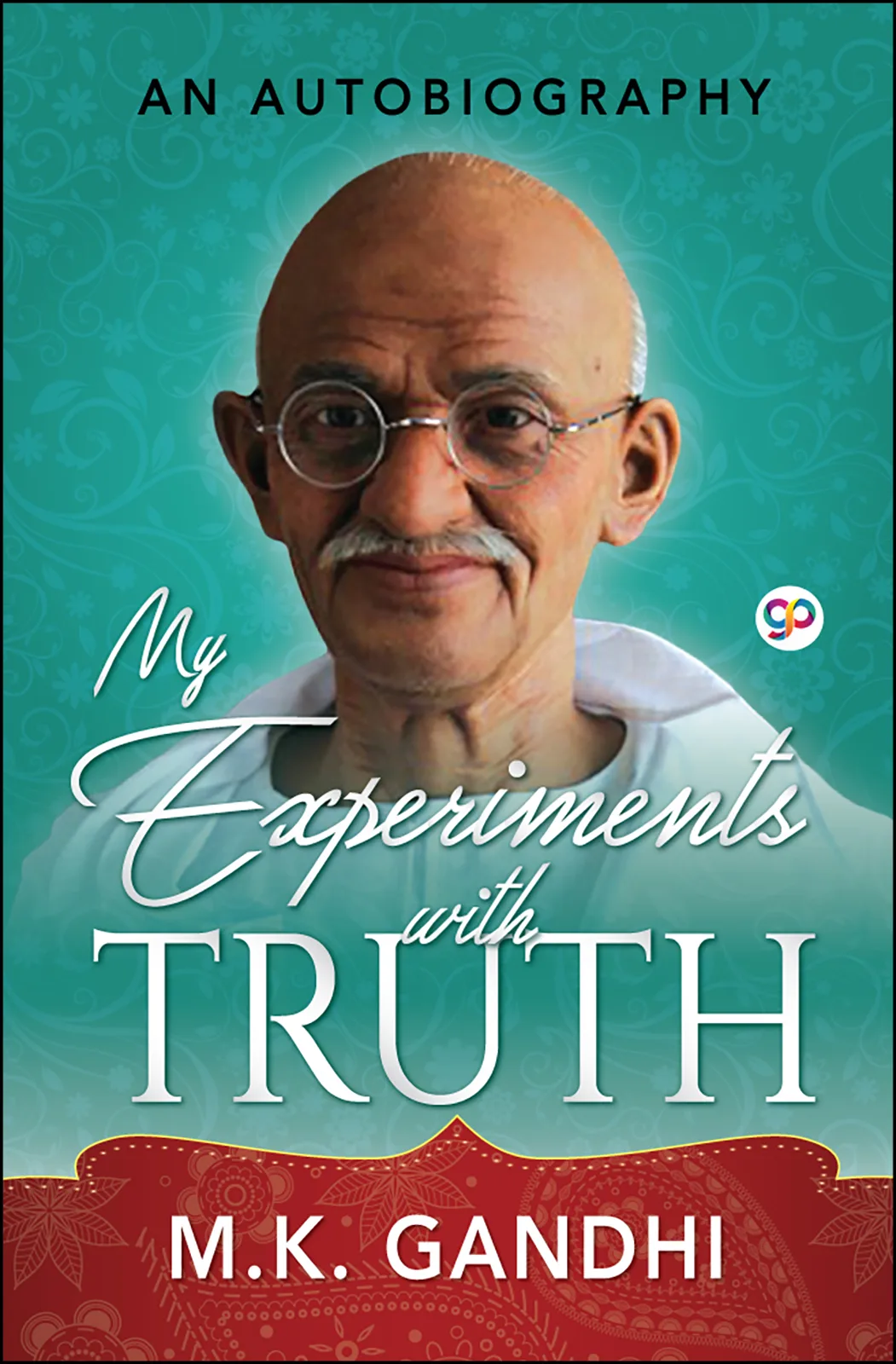
Download Cover Image
Do you want to download the full cover image for My Experiments with Truth: An Autobiography of Gandhi?