
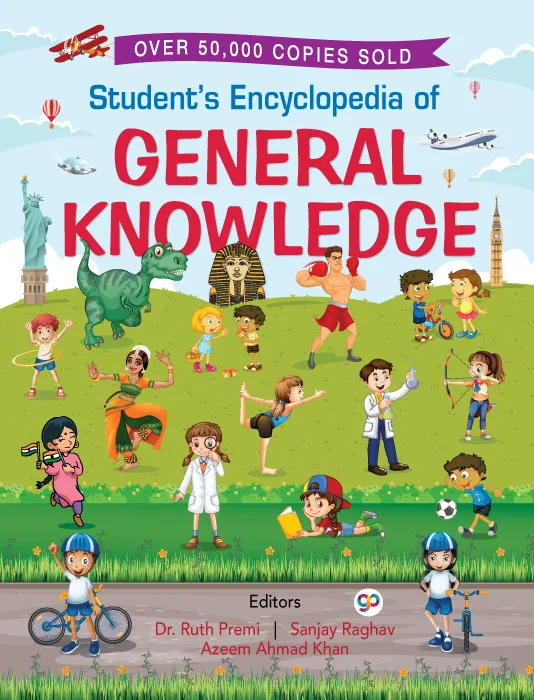
Student's Encyclopedia of General Knowledge
eBook
• INR 99.00
• English
No ratings yet
| Publisher | General Press |
|---|---|
| ASIN/SKU | B00SLTWZD2 |
| Book Format | eBook |
| Language | English |
| List Price | INR 99.00 |
| Subject Code | JNF048040, REF010000 |
| Book Code | BD00068227 |
Buy this Book
Amazon Stores
Ebook Stores
Other Stores
Discover Student's Encyclopedia of General Knowledge by Azeem Ahmad Khan. This book is published by General Press in eBook format, ASIN B00SLTWZD2, under Children's Books, Children's Reference Books, Children's Encyclopedias.
Book Description
Student's Encyclopedia of General Knowledge by Azeem Ahmad Khan is a comprehensive reference book designed to help learners build a strong foundation across a wide range of subjects. Created especially for students, the encyclopedia presents essential facts and concepts in a simple, organized, and engaging manner, making it an excellent resource for academic learning, competitive examinations, quizzes, and general awareness. Rather than focusing on a single discipline, it brings together knowledge from history, geography, science, technology, literature, politics, culture, sports, and many other fields.
The book is structured to encourage curiosity and independent learning. Each topic is explained in concise, easy-to-understand language, allowing readers to quickly grasp important ideas while expanding their understanding of the world. Along with factual information, it introduces notable personalities, landmark events, scientific discoveries, national and international organizations, inventions, and significant cultural achievements. This broad coverage helps students connect classroom learning with real-world knowledge and develop a well-rounded perspective.
Written in a clear and accessible style, the encyclopedia serves as both a practical study aid and an enjoyable companion for lifelong learning. Its systematic presentation enables readers to revise key information efficiently while inspiring them to explore subjects in greater depth. More than a collection of facts, Student's Encyclopedia of General Knowledge encourages critical thinking, intellectual curiosity, and confidence in learning. It equips students with the knowledge and awareness needed to excel academically while fostering a lasting interest in understanding the people, places, ideas, and events that shape our world.
The book is structured to encourage curiosity and independent learning. Each topic is explained in concise, easy-to-understand language, allowing readers to quickly grasp important ideas while expanding their understanding of the world. Along with factual information, it introduces notable personalities, landmark events, scientific discoveries, national and international organizations, inventions, and significant cultural achievements. This broad coverage helps students connect classroom learning with real-world knowledge and develop a well-rounded perspective.
Written in a clear and accessible style, the encyclopedia serves as both a practical study aid and an enjoyable companion for lifelong learning. Its systematic presentation enables readers to revise key information efficiently while inspiring them to explore subjects in greater depth. More than a collection of facts, Student's Encyclopedia of General Knowledge encourages critical thinking, intellectual curiosity, and confidence in learning. It equips students with the knowledge and awareness needed to excel academically while fostering a lasting interest in understanding the people, places, ideas, and events that shape our world.
Author Biography
Author Biography will be added soon…
Editorial Reviews
Editorial Reviews will be added soon…
Book Summary
"Student's Encyclopedia of General Knowledge" by Azeem Ahmad Khan is a comprehensive reference book designed to introduce young learners to the fascinating world of knowledge. Created primarily for students from Classes III to VIII, the encyclopedia brings together facts from a wide range of subjects in a single, easy-to-use volume. Instead of focusing on one discipline, it presents information covering geography, history, science, sports, literature, current affairs, culture, famous personalities, and many other topics. The book serves as both a learning companion and a quick reference guide, making it useful not only for students but also for teachers and parents who wish to strengthen a child's understanding of the world. The information has been compiled from reliable sources and organized in a simple, accessible format that encourages curiosity and independent learning.
One of the book's greatest strengths is its systematic organization. Rather than presenting lengthy explanations, it offers carefully arranged facts, lists, tables, and concise descriptions that are easy to read and remember. The chapters cover subjects in a logical sequence, beginning with common abbreviations and famous books before moving into detailed information about India, the countries of the world, geography, sports, science, and history. This structure allows readers to quickly locate specific information while also encouraging them to browse through related topics. The alphabetical arrangement of entries within many sections further improves accessibility, making the encyclopedia an excellent desk companion for homework, projects, and everyday learning.
A significant portion of the encyclopedia is devoted to helping students understand India. It introduces readers to the country's presidents, prime ministers, states, capitals, languages, dances, important monuments, museums, national parks, awards, and notable achievements. The book highlights India's rich cultural and historical diversity while also presenting important facts about national symbols, famous personalities, and major events. By bringing together these topics in one place, the encyclopedia helps young readers develop a stronger appreciation of their country's heritage and encourages them to explore its geography, traditions, and contributions to the world.
The encyclopedia also expands students' horizons by introducing them to countries across the globe. It presents information about capitals, currencies, languages, religions, nationalities, continents, geographical epithets, riverside cities, and places known for particular industries. These sections help children understand how nations differ from one another while also recognizing the connections that unite the world. Instead of overwhelming readers with detailed political or historical analysis, the book focuses on memorable facts that build a solid foundation of global awareness. This makes it particularly useful for school quizzes, competitive examinations, and general classroom discussions.
Sports receive equally detailed attention throughout the encyclopedia. Readers are introduced to Olympic Games, World Cup tournaments, famous sportspersons, national games, sports stadiums, trophies, measurements, playing fields, and the number of players required for different games. These sections provide a broad overview of both Indian and international sports, making them valuable for students preparing for school competitions or general knowledge contests. The information is presented in an engaging manner that helps children connect sporting achievements with the people and nations associated with them.
Science and technology form another important pillar of the encyclopedia. The book introduces readers to major inventions, scientific discoveries, branches of science, scientific instruments, the planets, vitamins, diseases, and fascinating facts about the human body. Rather than offering technical explanations, it presents essential information in a concise and student-friendly style. These chapters encourage scientific curiosity while giving learners a basic understanding of how the natural world works. The inclusion of simple scientific facts helps students connect classroom learning with everyday knowledge, making science more interesting and approachable.
The encyclopedia further broadens its scope by covering literature, awards, famous books, fictional characters, newspapers, important historical events, religions, festivals, world records, and remarkable achievements from around the globe. Readers encounter information about the Nobel Prize, Bharat Ratna, the United Nations, Seven Wonders of the Ancient World, famous sites, important days, and influential personalities whose contributions have shaped history. By presenting such a diverse collection of topics, the book encourages students to develop an interest in multiple fields rather than limiting themselves to one area of study.
To make learning enjoyable, the encyclopedia includes attractive illustrations, informative charts, "Believe It or Not" fact boxes, and an extensive quiz section containing hundreds of questions. These interactive elements transform the book from a simple reference guide into an engaging educational experience. The surprising facts spark curiosity, while the quizzes encourage revision and self-assessment. Students can test what they have learned, identify areas that need improvement, and build confidence in recalling information quickly during examinations and competitions. An extensive index also allows readers to locate topics with ease.
Overall, "Student's Encyclopedia of General Knowledge" is much more than a collection of facts. It is a thoughtfully designed educational resource that inspires young learners to become curious, informed, and confident. Its clear language, broad subject coverage, reliable information, and engaging presentation make it an excellent companion for school education as well as competitive examinations. Whether a student wants to learn about science, geography, sports, history, culture, or world affairs, the encyclopedia provides a solid starting point that encourages further exploration. By nurturing the habit of reading and expanding general awareness, the book helps children build a lifelong foundation of knowledge that extends far beyond the classroom.
One of the book's greatest strengths is its systematic organization. Rather than presenting lengthy explanations, it offers carefully arranged facts, lists, tables, and concise descriptions that are easy to read and remember. The chapters cover subjects in a logical sequence, beginning with common abbreviations and famous books before moving into detailed information about India, the countries of the world, geography, sports, science, and history. This structure allows readers to quickly locate specific information while also encouraging them to browse through related topics. The alphabetical arrangement of entries within many sections further improves accessibility, making the encyclopedia an excellent desk companion for homework, projects, and everyday learning.
A significant portion of the encyclopedia is devoted to helping students understand India. It introduces readers to the country's presidents, prime ministers, states, capitals, languages, dances, important monuments, museums, national parks, awards, and notable achievements. The book highlights India's rich cultural and historical diversity while also presenting important facts about national symbols, famous personalities, and major events. By bringing together these topics in one place, the encyclopedia helps young readers develop a stronger appreciation of their country's heritage and encourages them to explore its geography, traditions, and contributions to the world.
The encyclopedia also expands students' horizons by introducing them to countries across the globe. It presents information about capitals, currencies, languages, religions, nationalities, continents, geographical epithets, riverside cities, and places known for particular industries. These sections help children understand how nations differ from one another while also recognizing the connections that unite the world. Instead of overwhelming readers with detailed political or historical analysis, the book focuses on memorable facts that build a solid foundation of global awareness. This makes it particularly useful for school quizzes, competitive examinations, and general classroom discussions.
Sports receive equally detailed attention throughout the encyclopedia. Readers are introduced to Olympic Games, World Cup tournaments, famous sportspersons, national games, sports stadiums, trophies, measurements, playing fields, and the number of players required for different games. These sections provide a broad overview of both Indian and international sports, making them valuable for students preparing for school competitions or general knowledge contests. The information is presented in an engaging manner that helps children connect sporting achievements with the people and nations associated with them.
Science and technology form another important pillar of the encyclopedia. The book introduces readers to major inventions, scientific discoveries, branches of science, scientific instruments, the planets, vitamins, diseases, and fascinating facts about the human body. Rather than offering technical explanations, it presents essential information in a concise and student-friendly style. These chapters encourage scientific curiosity while giving learners a basic understanding of how the natural world works. The inclusion of simple scientific facts helps students connect classroom learning with everyday knowledge, making science more interesting and approachable.
The encyclopedia further broadens its scope by covering literature, awards, famous books, fictional characters, newspapers, important historical events, religions, festivals, world records, and remarkable achievements from around the globe. Readers encounter information about the Nobel Prize, Bharat Ratna, the United Nations, Seven Wonders of the Ancient World, famous sites, important days, and influential personalities whose contributions have shaped history. By presenting such a diverse collection of topics, the book encourages students to develop an interest in multiple fields rather than limiting themselves to one area of study.
To make learning enjoyable, the encyclopedia includes attractive illustrations, informative charts, "Believe It or Not" fact boxes, and an extensive quiz section containing hundreds of questions. These interactive elements transform the book from a simple reference guide into an engaging educational experience. The surprising facts spark curiosity, while the quizzes encourage revision and self-assessment. Students can test what they have learned, identify areas that need improvement, and build confidence in recalling information quickly during examinations and competitions. An extensive index also allows readers to locate topics with ease.
Overall, "Student's Encyclopedia of General Knowledge" is much more than a collection of facts. It is a thoughtfully designed educational resource that inspires young learners to become curious, informed, and confident. Its clear language, broad subject coverage, reliable information, and engaging presentation make it an excellent companion for school education as well as competitive examinations. Whether a student wants to learn about science, geography, sports, history, culture, or world affairs, the encyclopedia provides a solid starting point that encourages further exploration. By nurturing the habit of reading and expanding general awareness, the book helps children build a lifelong foundation of knowledge that extends far beyond the classroom.
Sample Chapters
1. Common Abbreviations
An abbreviation is a short form of a word or a group of words. They are commonly used because they save time and space. Here are some common abbreviations:
AD — Anno Domini (in the year of Our Lord)
AIDS — Acquired Immune Deficiency Syndrome
AIIMS — All India Institute of Medical Sciences
AIR — All India Radio
a.m. — ante meridiem (before noon)
AMU — Aligarh Muslim University
AP — Associated Press
ATM — Automated Teller Machine
B&W — Black and White
BA — Bachelor of Arts
BBC — British Broadcasting Corporation
BC — Before Christ
BEd. — Bachelor of Education
BP — Blood Pressure
BSc. — Bachelor of Science
BSF — Border Security Force
BSNL — Bharat Sanchar Nigam Limited
CA — Chartered Accountant
CBI — Central Bureau of Investigation
CBSE — Central Board of Secondary Education
CBT — Children’s Book Trust
CFL — Compact Fluorescent Lamp
CIA — Central Intelligence Agency (USA)
CID — Criminal Investigation Department
CNN — Cable News Network
CTBT — Comprehensive Test Ban Treaty
DIG — Deputy Inspector General
DNA — Deoxyribonucleic Acid
DOS — Disk Operating System
DTP — Desk-top Publishing
DVD — Digital Versatile Disc
E&OE — Errors and Omissions Exempted
ECG — Electrocardiogram
e.g. — exempli gratia (for example)
EMI — Equated Monthly Installments
etc. — et cetera (and other things)
FBI — Federal Bureau of Investigation
FIFA — Federation International de Football Association
(Federation of the International Football Association)
FIR — First Information Report
FM — Frequency Modulation
FYI — For Your Information
GMT — Greenwich Mean Time
Govt. — Government
GPO — General Post Office
HIV — Human Immunodeficiency Virus
HQ — Headquarters
IA — Indian Airlines
IAF — Indian Air Force
IAS — Indian Administrative Service
IBM — International Business Machines
ICU — Intensive Care Unit
i.e. — id est (that is)
IGNOU — Indira Gandhi National Open University
IIT — Indian Institute of Technology
INA — Indian National Army
INTERPOL — International Criminal Police Commission
IPS — Indian Police Service
IQ — Intelligence Quotient
ISBN — International Standard Book Number
ISD — International Subscriber Dialling
ISI — Indian Standards Institution/Inter-Services Intelligence (Pakistan)
IST — Indian Standard Time
ISRO — Indian Space Research Organization
ITI — Industrial Training Institute
ITO — Income Tax Officer/International Trade Organization
lbw — leg before wicket
LCD — Liquid-crystal Display
LIC — Life Insurance Corporation
LLB — Bachelor of Laws
LPG — Liquefied Petroleum Gas
Ltd. — Limited
LTTE — Liberation Tigers of Tamil Eelam
MA — Master of Arts
MBA — Master of Business Administration
MBBS — Bachelor of Medicine and Bachelor of Surgery
MLA — Member of Legislative Assembly
MNC — Multinational Corporation
MO — Money Order
MP — Member of Parliament
Mr. — Mister
Mrs. — Missus/Missis
MSc. — Master of Science
MTNL — Mahanagar Telephone Nigam Limited
NASA — National Aeronautics and Space Administration (USA)
NATO — North Atlantic Treaty Organization
NB — nota bene (note well)
NBT — National Book Trust
NCC — National Cadet Corps
NCERT — National Council of Educational Research and Training
NDA — National Defence Academy
NFDC — National Film Development Corporation
NIIT — National Institute of Information Technology
NRI — Non-resident Indian
OK — Okay (all correct)
OPD — Outdoor Patients Department
OTP — One Time Password
PC — Personal Computer
PFA — Plesae Find Attached
Ph.D — Doctor of Philosophy
PIB — Press Information Bureau
PIN — Postal Index Number/Personal Identification Number
p.m. — post meridiem (after noon)
PM — Prime Minister
PNB — Punjab National Bank
PO — Post Office
PTI — Press Trust of India
PTO — Please Turn Over
Pvt. — Private
R&D — Research and Development
RBI — Reserve Bank of India
RSVP — repondez sil vous plait (please reply)
SAARC — South Asian Association for Regional Co-operation
SAIL — Steel Authority of India Limited
SBI — State Bank of India
SC — Supreme Court/Schedule Caste
Sign. — Signature
SIM — Subscriber Identification Module (Card)
SLV — Satellite Launch Vehicle
SMS — Short Message Service
SOS — Save Our Souls
STD — Subscriber Trunk Dialling
TTE — Train Ticket Examiner
UFO — Unidentified Flying Object
UNESCO — United Nations Educational, Scientific and Cultural Organization
UNI — United News of India
UNICEF — United Nations Children’s Fund
UNO — United Nations Organization
UPSC — Union Public Service Commission
via — by way of
VIP — Very Important Person
viz. — videlicet (namely)
VPP — Value Payable Post
vs. — versus (against)
WHO — World Health Organization
WWF — Worldwide Fund for Nature
www — worldwide web
Xmas — Christmas
YMCA — Young Men’s Christian Association
YWCA — Young Women’s Christian Association
2. Famous Books (India)
Name of the Book Author
A Suitable Boy Vikram Seth
Ain-i-Akbari Abul Fazal
Anand Math Bankim Chandra Chatterji
Arthashastra Kautilya
Babarnama Babar
Bhagavadgita Ved Vyas
Broken Wing Sarojini Naidu
Devdas Sharat Chandra Chatterji
Dewan-e-Ghalib Mirza Ghalib
Discovery of India Jawaharlal Nehru
Gitanjali Rabindranath Tagore
Glimpses of World History Jawaharlal Nehru
Godan Premchand
Golden Gate Vikram Seth
Gora Rabindranath Tagore
Guide R.K. Narayan
Guru Granth Sahib Guru Arjun Dev
India Divided Dr. Rajendra Prasad
India Wins Freedom Maulana Abul Kalam Azad
Mahabharata Ved Vyas
Man-eaters of Kumaon Jim Corbett
Meghdoot Kalidas
Midnight’s Children Salman Rushdie
My Experiments with Truth Mahatma Gandhi
My Truth Indira Gandhi
Panchatantra Vishnu Sharma
Ram Charit Manas Tulsidas
Ramayana Valmiki
Rangbhoomi Premchand
Satanic Verses Salman Rushdie
Shakuntala Kalidas
Song of India Sarojini Naidu
Sunny Days Sunil Gavaskar
The God of Small Things Arundhati Roy
3. Famous Books (World)
Name of the book Author
A Passage to India E.M. Forster
A Tale of Two Cities Charles Dickens
Adventures of Sherlock Holmes Sir Arthur Conan Doyle
Alice in Wonderland Lewis Carroll
Animal Farm George Orwell
Arabian Nights Sir Richard Burton
Arms and the Man George Bernard Shaw
Around the World in Eighty Days Jules Verne
As You Like It William Shakespeare
Das Kapital Karl Marx
David Copperfield Charles Dickens
Dr. Zhivago Boris Pasternak
Great Expectations Charles Dickens
Gulliver’s Travels Jonathan Swift
Hamlet William Shakespeare
Harry Potter Series J.K. Rowling
Iliad Homer
Julius Caesar William Shakespeare
Jungle Book Rudyard Kipling
Jurassic Park Michael Crichton
Man and Superman George Bernard Shaw
Odyssey Homer
Oliver Twist Charles Dickens
Origin of Species Charles Darwin
Paradise Lost John Milton
Principia Sir Isaac Newton
Republic Plato
Robinson Crusoe Daniel Defoe
Romeo and Juliet William Shakespeare
Three Musketeers Alexander Dumas
Through the Looking-Glass Lewis Carroll
Treasure Island R.L. Stevenson
Uncle Tom’s Cabin H.B. Stowe
War and Peace Count Leo Tolstoy
An abbreviation is a short form of a word or a group of words. They are commonly used because they save time and space. Here are some common abbreviations:
AD — Anno Domini (in the year of Our Lord)
AIDS — Acquired Immune Deficiency Syndrome
AIIMS — All India Institute of Medical Sciences
AIR — All India Radio
a.m. — ante meridiem (before noon)
AMU — Aligarh Muslim University
AP — Associated Press
ATM — Automated Teller Machine
B&W — Black and White
BA — Bachelor of Arts
BBC — British Broadcasting Corporation
BC — Before Christ
BEd. — Bachelor of Education
BP — Blood Pressure
BSc. — Bachelor of Science
BSF — Border Security Force
BSNL — Bharat Sanchar Nigam Limited
CA — Chartered Accountant
CBI — Central Bureau of Investigation
CBSE — Central Board of Secondary Education
CBT — Children’s Book Trust
CFL — Compact Fluorescent Lamp
CIA — Central Intelligence Agency (USA)
CID — Criminal Investigation Department
CNN — Cable News Network
CTBT — Comprehensive Test Ban Treaty
DIG — Deputy Inspector General
DNA — Deoxyribonucleic Acid
DOS — Disk Operating System
DTP — Desk-top Publishing
DVD — Digital Versatile Disc
E&OE — Errors and Omissions Exempted
ECG — Electrocardiogram
e.g. — exempli gratia (for example)
EMI — Equated Monthly Installments
etc. — et cetera (and other things)
FBI — Federal Bureau of Investigation
FIFA — Federation International de Football Association
(Federation of the International Football Association)
FIR — First Information Report
FM — Frequency Modulation
FYI — For Your Information
GMT — Greenwich Mean Time
Govt. — Government
GPO — General Post Office
HIV — Human Immunodeficiency Virus
HQ — Headquarters
IA — Indian Airlines
IAF — Indian Air Force
IAS — Indian Administrative Service
IBM — International Business Machines
ICU — Intensive Care Unit
i.e. — id est (that is)
IGNOU — Indira Gandhi National Open University
IIT — Indian Institute of Technology
INA — Indian National Army
INTERPOL — International Criminal Police Commission
IPS — Indian Police Service
IQ — Intelligence Quotient
ISBN — International Standard Book Number
ISD — International Subscriber Dialling
ISI — Indian Standards Institution/Inter-Services Intelligence (Pakistan)
IST — Indian Standard Time
ISRO — Indian Space Research Organization
ITI — Industrial Training Institute
ITO — Income Tax Officer/International Trade Organization
lbw — leg before wicket
LCD — Liquid-crystal Display
LIC — Life Insurance Corporation
LLB — Bachelor of Laws
LPG — Liquefied Petroleum Gas
Ltd. — Limited
LTTE — Liberation Tigers of Tamil Eelam
MA — Master of Arts
MBA — Master of Business Administration
MBBS — Bachelor of Medicine and Bachelor of Surgery
MLA — Member of Legislative Assembly
MNC — Multinational Corporation
MO — Money Order
MP — Member of Parliament
Mr. — Mister
Mrs. — Missus/Missis
MSc. — Master of Science
MTNL — Mahanagar Telephone Nigam Limited
NASA — National Aeronautics and Space Administration (USA)
NATO — North Atlantic Treaty Organization
NB — nota bene (note well)
NBT — National Book Trust
NCC — National Cadet Corps
NCERT — National Council of Educational Research and Training
NDA — National Defence Academy
NFDC — National Film Development Corporation
NIIT — National Institute of Information Technology
NRI — Non-resident Indian
OK — Okay (all correct)
OPD — Outdoor Patients Department
OTP — One Time Password
PC — Personal Computer
PFA — Plesae Find Attached
Ph.D — Doctor of Philosophy
PIB — Press Information Bureau
PIN — Postal Index Number/Personal Identification Number
p.m. — post meridiem (after noon)
PM — Prime Minister
PNB — Punjab National Bank
PO — Post Office
PTI — Press Trust of India
PTO — Please Turn Over
Pvt. — Private
R&D — Research and Development
RBI — Reserve Bank of India
RSVP — repondez sil vous plait (please reply)
SAARC — South Asian Association for Regional Co-operation
SAIL — Steel Authority of India Limited
SBI — State Bank of India
SC — Supreme Court/Schedule Caste
Sign. — Signature
SIM — Subscriber Identification Module (Card)
SLV — Satellite Launch Vehicle
SMS — Short Message Service
SOS — Save Our Souls
STD — Subscriber Trunk Dialling
TTE — Train Ticket Examiner
UFO — Unidentified Flying Object
UNESCO — United Nations Educational, Scientific and Cultural Organization
UNI — United News of India
UNICEF — United Nations Children’s Fund
UNO — United Nations Organization
UPSC — Union Public Service Commission
via — by way of
VIP — Very Important Person
viz. — videlicet (namely)
VPP — Value Payable Post
vs. — versus (against)
WHO — World Health Organization
WWF — Worldwide Fund for Nature
www — worldwide web
Xmas — Christmas
YMCA — Young Men’s Christian Association
YWCA — Young Women’s Christian Association
2. Famous Books (India)
Name of the Book Author
A Suitable Boy Vikram Seth
Ain-i-Akbari Abul Fazal
Anand Math Bankim Chandra Chatterji
Arthashastra Kautilya
Babarnama Babar
Bhagavadgita Ved Vyas
Broken Wing Sarojini Naidu
Devdas Sharat Chandra Chatterji
Dewan-e-Ghalib Mirza Ghalib
Discovery of India Jawaharlal Nehru
Gitanjali Rabindranath Tagore
Glimpses of World History Jawaharlal Nehru
Godan Premchand
Golden Gate Vikram Seth
Gora Rabindranath Tagore
Guide R.K. Narayan
Guru Granth Sahib Guru Arjun Dev
India Divided Dr. Rajendra Prasad
India Wins Freedom Maulana Abul Kalam Azad
Mahabharata Ved Vyas
Man-eaters of Kumaon Jim Corbett
Meghdoot Kalidas
Midnight’s Children Salman Rushdie
My Experiments with Truth Mahatma Gandhi
My Truth Indira Gandhi
Panchatantra Vishnu Sharma
Ram Charit Manas Tulsidas
Ramayana Valmiki
Rangbhoomi Premchand
Satanic Verses Salman Rushdie
Shakuntala Kalidas
Song of India Sarojini Naidu
Sunny Days Sunil Gavaskar
The God of Small Things Arundhati Roy
3. Famous Books (World)
Name of the book Author
A Passage to India E.M. Forster
A Tale of Two Cities Charles Dickens
Adventures of Sherlock Holmes Sir Arthur Conan Doyle
Alice in Wonderland Lewis Carroll
Animal Farm George Orwell
Arabian Nights Sir Richard Burton
Arms and the Man George Bernard Shaw
Around the World in Eighty Days Jules Verne
As You Like It William Shakespeare
Das Kapital Karl Marx
David Copperfield Charles Dickens
Dr. Zhivago Boris Pasternak
Great Expectations Charles Dickens
Gulliver’s Travels Jonathan Swift
Hamlet William Shakespeare
Harry Potter Series J.K. Rowling
Iliad Homer
Julius Caesar William Shakespeare
Jungle Book Rudyard Kipling
Jurassic Park Michael Crichton
Man and Superman George Bernard Shaw
Odyssey Homer
Oliver Twist Charles Dickens
Origin of Species Charles Darwin
Paradise Lost John Milton
Principia Sir Isaac Newton
Republic Plato
Robinson Crusoe Daniel Defoe
Romeo and Juliet William Shakespeare
Three Musketeers Alexander Dumas
Through the Looking-Glass Lewis Carroll
Treasure Island R.L. Stevenson
Uncle Tom’s Cabin H.B. Stowe
War and Peace Count Leo Tolstoy
Reader Reviews
No reviews yet.
Student's Encyclopedia of General Knowledge
Download Cover Image
Do you want to download the full cover image for Student's Encyclopedia of General Knowledge?